Monocular Vehicle Pose and Shape Reconstruction via Dynamic Context Adaptation and Progressive Geometry Refinement
For distant vehicles in autonomous driving, MonoVPR's HDCA fuses object-centric geometry with scene-centric semantics. BIMR then uses tanh-bounded iterative mesh refinement to improve both 3D pose and shape recovery.
Quickly assess the paper's scope, problem setting, core method, experimental findings, and whether to read it in depth.
Paper Reading Notes (Coarse): Monocular Vehicle Pose and Shape Reconstruction via Dynamic Context Adaptation and Progressive Geometry Refinement
1. Basic information
Title: Monocular Vehicle Pose and Shape Reconstruction via Dynamic Context Adaptation and Progressive Geometry Refinement
Method: MonoVPR
Authors / affiliations: Wei Li, Long Ji, Ying Wang, Xiao Wu, Zhaoquan Yuan, Penglin Dai; Southwest Jiaotong University and associated intelligent-transportation research institutions
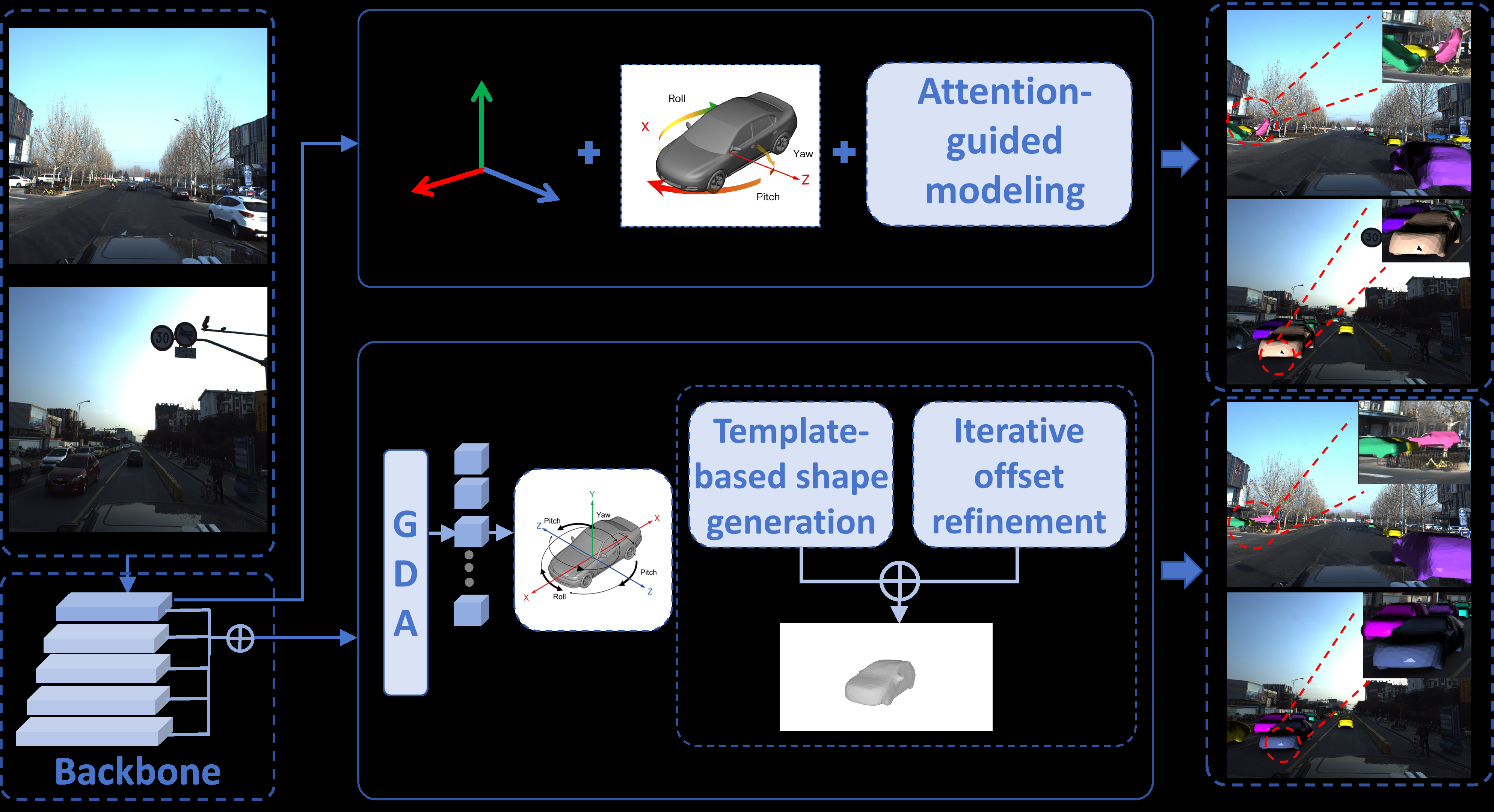
MonoVPR jointly recovers vehicle 3D pose and shape from monocular RGB. HDCA combines multiscale object geometry with scene semantics, while BIMR uses bounded iterative mesh refinement to reduce distant-object depth ambiguity and hollow shapes.
3. Problem setting
Task: monocular vehicle 3D pose + shape reconstruction.
Input: one driving-scene RGB image and 2D vehicle detections / keypoints.
Output: 3D translation, rotation, and mesh shape per vehicle instance.
Applications: distant-vehicle perception, autonomous-driving planning, and scene understanding.
4. Core motivation
Distant monocular vehicles lack clear depth cues; insufficient multiscale target features cause translation errors.
Single-step mesh-vertex offset regression can produce hollow or geometrically implausible shapes.
Scene-centric semantics support depth / translation, object-centric geometry supports shape / rotation, and stable iterations refine meshes.
5. Method overview
Mask R-CNN, Res2Net, and BiFPN form the 2D perception backbone.
HDCA: construct a multiscale feature pyramid, then use Local Detail and Global Gated paths in Gated Dual-path Attention to fuse inter-object relations and scene-object context.
BIMR: template-based shape generation and iterative-offset branches produce meshes, fused with learnable weights.
Loss: multitask detection, translation, rotation, shape, and 3D spatial objectives.
Training: two stages, first establishing 2D perception with a pretrained BAAM model, then end-to-end fine-tuning.
6. Experimental overview
Dataset: ApolloCar3D, 4077 training images and 200 validation images.
Support reproduction, comparison, related-work writing, and identifying opportunities for further research.
Paper Reading Notes (Deep): Monocular Vehicle Pose and Shape Reconstruction via Dynamic Context Adaptation and Progressive Geometry Refinement
1. Basic information
Title: Monocular Vehicle Pose and Shape Reconstruction via Dynamic Context Adaptation and Progressive Geometry Refinement
Method: MonoVPR
Authors / affiliations: Wei Li, Long Ji, Ying Wang, Xiao Wu, Zhaoquan Yuan, Penglin Dai; Southwest Jiaotong University and associated intelligent-transportation research institutions
Original Figure 1: comparison of existing methods and MonoVPR for distant monocular vehicle pose / shape reconstruction. Source: official AAAI PDF. Image copyright belongs to the paper's authors and publisher; reproduced here for academic analysis.
3. Problem setting and task boundaries
Input is one monocular RGB image, from which a 2D detector obtains vehicle instances, keypoints, and visibility scores.
Outputs include 3D translation, rotation, and vehicle mesh shape: closer to monocular 3D reconstruction + pose than general BOP object pose.
ApolloCar3D supplies industry-grade real-scale CAD models and dense semantic keypoints for shape supervision and pose evaluation.
No depth / LiDAR inference input, but camera models and training-time 3D annotations remain required.
Single-image translation has depth-scale ambiguity; shape estimation also faces template deformation and nonrigid appearance variation.
The vehicle-focused setting uses inter-object relationships and global scene context as priors.
4. Research context
Earlier DeepMANTA and 3D-RCNN methods use CAD libraries or PCA shape subspaces.
RoI-10D, GSNet, and BAAM bring RGB, 2D keypoints, scene context, and shape priors into vehicle 3D reconstruction.
MonoVPR continues BAAM’s multitask pose / shape approach, addressing insufficient context and single-step mesh deformation through HDCA and BIMR, respectively.
Unlike pure 3D detection, it outputs mesh-level shapes evaluated by overlap / vertex geometry rather than only boxes.
5. Research motivation
Authors’ central arguments
Distant vehicles need local details plus global scene semantics, beyond coarse feature maps.
Predicting all vertex offsets at once is sensitive to shape errors; use multiple small updates.
Template priors and instance-specific offsets need learned rather than fixed fusion weights.
My analysis
The paper treats shape recovery as a geometric constraint on pose rather than an independent reconstruction head. Shape and pose can cross-check each other, but the model depends strongly on vehicle priors and dense CAD annotations.
6. Method details
6.1 Overall pipeline
Res2Net + BiFPN builds an RGB feature pyramid.
A 2D detector extracts vehicle instances, 2D keypoints, and visibility.
Encode detections into object-centric features Xo.
HDCA forms multiscale scene representations; GDA’s Local Detail Path (LDP) and Global Gated Path (GGP) combine local details with global statistics.
Inter-object relation attention and scene-object cross-attention produce context-aware features X~t.
Object features directly regress rotation; enhanced context predicts translation.
BIMR generates Mbase from templates and O(T) through iterative offsets.
Learnable weights fuse meshes for final pose and shape.
6.2 Key modules
Module
Input
Output
Role
Connection to next module
Object-centric features
Detector, keypoints, visibility
Xo
Encodes instance appearance and 2D geometry together
HDCA and shape branch
GDA / HDCA
Multiscale feature pyramid
Context-aware features
LDP + GGP fuse local details and global semantics
Translation / context fusion
Inter-object relation attention
Object features
Relation-aware features
Spatial relations among vehicles
Residual fusion with scene-object attention
Template shape generation
Shape concept, basis
Mbase
Structured initial mesh
Fused with offset branch
Iterative offset refinement
Xo∗, previous offset
O(T)
Multistep instance-geometry correction
Tanh updates bound deformation
Learnable shape fusion
Mbase, O(T)
Mfinal
Balances template prior and instance detail
Evaluated with pose output
6.3 BIMR’s key update
The paper’s bounded update is:
O(t)=O(t−1)+0.5tanh(ΔO(t)).
Each vertex-correction step is thus bounded for stability. The final mesh is approximately:
Mfinal=w1Mbase+w2O(T).
Ablations favor T=3; increasing to 4 iterations degrades performance, so more refinement is not always better.
6.4 Training and supervision
Two-stage training: first use pretrained BAAM, then fine-tune end-to-end with the full multitask objective.
Total loss:
Ltotal=λdLd+λtLt+λrLr+λshapeLshape+λ3DL3D.
Translation uses XY L1 and uncertainty-aware depth L1; rotation uses cyclical L1 for angular periodicity; shape uses mesh-vertex L2; L3D constrains vertex error in rotation-only, translation-only, and final world spaces.
AdamW, global batch 4, initial LR 10−4 decaying to 10−5 over the last 10 epochs; two RTX A6000 GPUs.
7. Experimental analysis
7.1 Dataset and metrics
ApolloCar3D: 4077 training and 200 validation images; each vehicle has CAD and dense semantic keypoints.
A3DP jointly considers translation, rotation, and shape. A3DP-Abs uses absolute translation error; A3DP-Rel uses relative translation error. Shape is assessed through rendered-mask mIoU from 100 views.
Additional rotation error (RE), translation error (TE), and detailed-shape scores.
7.2 Main results
Method
A3DP-Abs mean
A3DP-Rel mean
BAAM (reimplemented)
24.20
21.93
MonoVPR
25.60
23.26
MonoVPR generally exceeds BAAM under loose / strict criteria and across distances. For small targets (d>50m), RE drops from 9.64° to 8.15°, TE from 1.61 m to 1.58 m, and mIoU rises from 85.99 to 87.62.
7.3 Ablation studies
Ablation
Key result
My assessment
Baseline → +HDCA
A3DP-Abs 24.20 → 24.72, A3DP-Rel 21.93 → 22.88
Effective context fusion, with limited gains alone
Baseline → +BIMR
A3DP-Abs 25.06, A3DP-Rel 23.18
Mesh refinement improves pose-shape coupling
HDCA+BIMR
25.60 / 23.26
Complementary modules
BIMR iterations
T=3 best, T=4 degrades
Bounded iterations need early stopping or learned stopping criteria
GDA
HDCA+GDA 25.60, above LDP / GGP alone
Local detail and global statistics are not interchangeable
Shape weights
Learned weights beat fixed w1=w2=1
Adapt weights for template priors and instance offsets
No systematic results on detector false positives, severe occlusion, night / rain / fog, or cross-city domain shift.
Front-end errors from Mask R-CNN and other 2D detectors contaminate both pose and shape; assess more than backend-head performance.
8. Critical analysis
Strengths
A unified explanation of joint distant-object pose and shape degradation.
BIMR’s bounded corrections have clear engineering value against large single-step deformations.
Ablations cover modules, iterations, distance, compute, and fusion weights.
Weaknesses and implicit assumptions
Narrow domain: vehicles, CAD templates, and ApolloCar3D; conclusions do not directly extend to generic pose.
Shape priors remain central, changing from fixed single-step deformation to dynamic templates + offsets.
The external 2D detector leaves fully end-to-end scene-level pose unresolved.
Real-world feasibility
A potential monocular vehicle-geometry module for autonomous driving, requiring robust detection, camera calibration, long-tail vehicle shapes, and weather adaptation in deployment.
9. Future work and improvements
Joint end-to-end detection, pose, shape, and uncertainty.
Depth foundation models or temporal video cues for distant vehicles.
Domain adaptation for illumination and city-distribution changes.
CAD-free or generative-template vehicle shape priors.
Replace BIMR’s fixed 3-step stopping with confidence-driven refinement.
10. Implications for my research
Transfer HDCA object-scene dual context to general pose, replacing vehicle-specific shape bases with category-independent geometry.
Feed pose uncertainty back into shape refinement for mutual correction.