M-VTOP: Modular Visuo-Tactile Object Pose Estimation for High-Precision Robotic Manipulation
M‑VTOP converts vision and GelSight observations into masks, rendering CAD masks for each SE(3) particle and updating belief by IoU. Object–environment signed distance adds a soft-contact likelihood. Across five real insertion categories, fused vision / touch achieves mean success of 93% / 100% with SAM2 / Mask R-CNN, above individual modalities. The full system runs at only 0.4 Hz and assumes CAD, calibration, rigid objects, and stable grasps.
one or more external RGB camerasone or more vision-based tactile sensorsbinary external-contact cueknown CAD and environment geometry
Requirements
object CAD modelcalibrated camera intrinsics and extrinsicsrobot and receptacle geometrysegmentation backend such as SAM2 or Mask R-CNNlarge pose-particle set and per-particle rendering
Full paper metadataAuthors, affiliations, research area, datasets, metrics, method tags, and reading statusExpandCollapse
Authors
Miquel Oller, Qiyang Qian, Radu Corcodel, Siddarth Jain
Affiliations
Mitsubishi Electric Research Laboratories / University of Michigan / University of California, Berkeley
object CAD modelcalibrated camera intrinsics and extrinsicsrobot and receptacle geometrysegmentation backend such as SAM2 or Mask R-CNNlarge pose-particle set and per-particle rendering
Reading Notes
Overview / Deep Dive
Available src/paper-notes/mvtop-icra2026/coarse.md
Paper overview notes
Quickly assess the paper's scope, problem setting, core method, experimental findings, and whether to read it in depth.
Authors / affiliations: Miquel Oller, Qiyang Qian, Radu Corcodel, Siddarth Jain; MERL, University of Michigan, UC Berkeley.
Task: a robot holds a small known-CAD object with unknown in-hand pose, continuously estimating 6D pose using external RGB, GelSight touch, and environmental contact for closed-loop precision insertion.
2. Positioning in one sentence
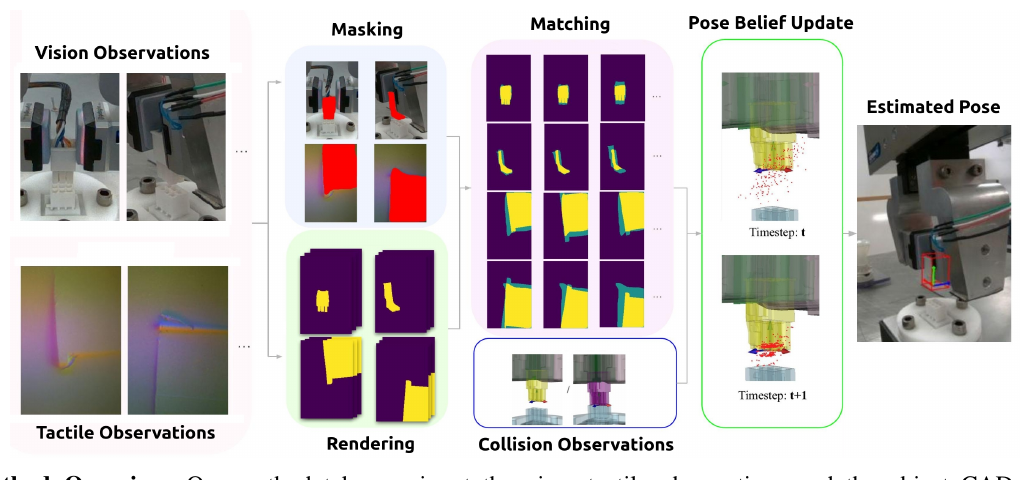
M‑VTOP converts vision and touch into object masks rather than directly concatenating features. It renders CAD masks for each SE(3) particle and updates pose beliefs through cross-sensor IoU and contact distances.
3. Method overview
SAM2 / Mobile-SAM or supervised Mask R-CNN generates masks for visual and tactile observations.
Compare zero-shot candidate masks against CAD renders over coarse poses and choose the most cross-modally consistent set; GelSight depth removes undeformed areas.
A particle filter maintains N pose hypotheses; each renders expected masks in all cameras / tactile sensors.
Observation likelihood is a weighted sum of visual and tactile mask IoU.
External contact triggers a smooth likelihood from object–environment signed distance. End-effector transforms propagate particles under robot motion, with increased motion noise during contact.
The same backend supports vision-only M‑VOP or tactile-only M‑TOP.
Original Figure 2: vision and touch first become masks, with particles individually rendered and matched. Binary contact observations contribute another belief-update likelihood. Source: M‑VTOP paper. Image copyright belongs to the authors; reproduced here for academic analysis.
4. Experiments at a glance
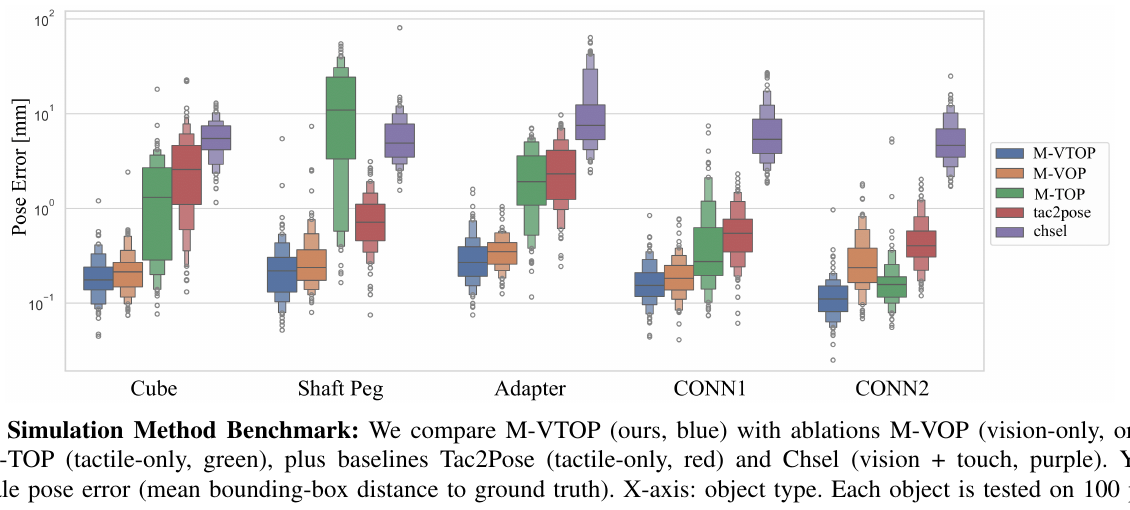
Simulation: 5 geometries, 100 poses each; full M‑VTOP mean bounding-box pose error is clearly below M‑VOP, M‑TOP, Tac2Pose, and Chsel.
Real hardware: MELFA Assista + Schunk WSG-50, two RealSense cameras, and two GelSight Minis; 5 object types include cube, shaft peg, plug adapter, and two connectors.
Only 3 grasp poses are tested per object / modality / masking backend.
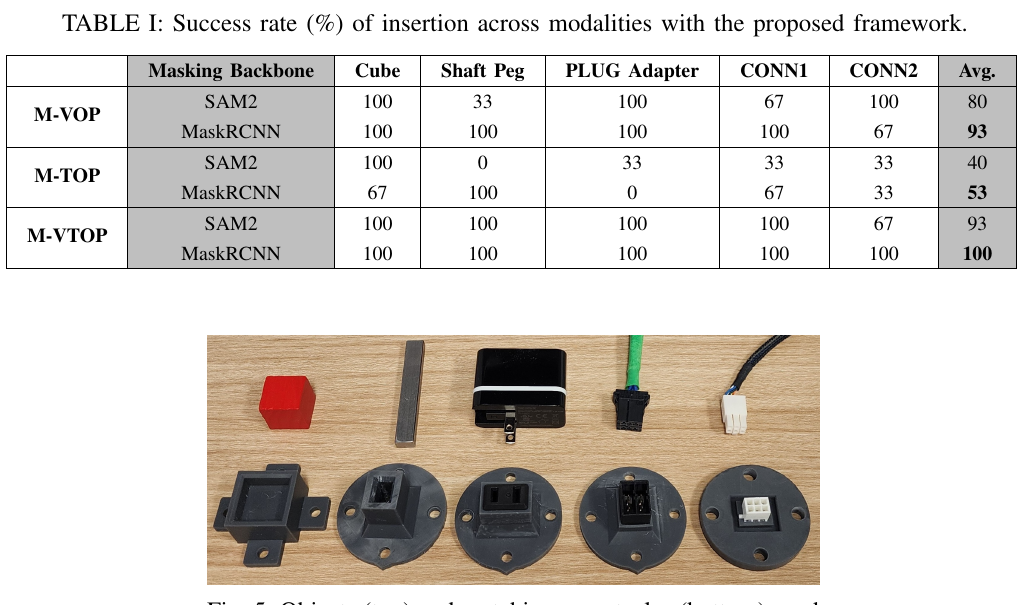
Mean insertion success rates:
M‑VOP: SAM2 80%, Mask R-CNN 93%;
M‑TOP: 40%, 53%;
M‑VTOP: 93%, 100%.
The full system runs at only 0.4 Hz; reported final pose errors reach sub-mm / sub-degree levels.
Original Table I and Figure 5: visual-tactile fusion exceeds touch alone with both masking backends. The 100% rate comes from 5 objects × 3 grasp poses each, a limited experiment rather than large-sample production statistics. Source: M‑VTOP paper. Image copyright belongs to the authors; reproduced here for academic analysis.
5. Quick assessment
Value: geometric masks offer a simple common language across vision / touch; particle beliefs tolerate some erroneous masks and naturally support missing modalities.
Zero-shot boundary: no retraining a pose model per new object, but accurate CAD, camera intrinsics / extrinsics, and robot / receptacle geometry remain required.
Main limits: slow 0.4 Hz; binary contact contributes little after particles converge; strong rigid-object, stable-grasp, and known-environment assumptions.
Available src/paper-notes/mvtop-icra2026/deep.md
In-depth paper notes
Support reproduction, comparison, related-work writing, and identifying opportunities for further research.
Problem: submillimeter industrial insertion needs global observability and local precision. Grippers occlude external cameras, while touch sees local surfaces with geometric aliasing, limiting either sensor alone.
Answer: convert visual / tactile observations into geometric masks, use CAD rendering as a shared forward model, and probabilistically fuse IoU and contact signed distances in a pose particle filter.
My assessment: modular interfaces and real insertion feedback are more mature contributions than any new deep network. Fusion helps in simulation and real success rates, but end-to-end speed is only 0.4 Hz, with only 3 grasp poses per real-experiment cell; interpret 100% carefully.
2. Problem setting
The target is held-object pose x∈SE(3) in the calibrated world / sensor frame. Inputs may contain any number NV of visual images, NT of visuotactile images, and binary external-contact cue c∈{0,1}.
Known quantities:
Object CAD.
Camera and tactile-sensor intrinsics / extrinsics.
Robot and environment / receptacle geometry.
End-effector motion uk.
Rigid objects, with external collisions only between held objects and the environment.
Zero-shot means no pose-estimator retraining per new CAD, not model-free inference. CAD tolerances, calibration, gripper models, and receptacle installation errors still limit accuracy.
3. Why masks as a common observation?
RGB cameras and GelSight RGB have very different appearance domains; direct feature fusion needs substantial cross-modal training. M‑VTOP compresses both to binary object masks:
Remove texture / lighting differences while retaining silhouette geometry.
Render the same prediction type from arbitrary poses and known CAD.
Sensor-count / placement changes only add backend observation terms.
Color, local texture, normals, and fine depth do not directly enter likelihoods; similar geometries still alias.
Original Figure 2: each pose particle renders object / occluder masks in each camera, compares them with observed masks, and updates the posterior; the next robot action propagates beliefs. Source: M‑VTOP paper. Image copyright belongs to the authors; reproduced here for academic analysis.
4. Zero-shot mask selection
SAM2 / Mobile-SAM may produce multiple candidates, including grippers, background, or partial objects. Rather than accepting the highest-confidence mask, the method:
Renders reference masks for each visual / tactile camera over coarse pose set X.
Finds each reference’s maximum-IoU candidate mask.
Aggregates best sensor IoUs into that pose’s score.
Selects the mask set associated with the globally highest-scoring pose for cross-modal geometric consistency.
Once particles converge, a promptable backend uses CAD / pose-generated query points to avoid extensive mask-proposal enumeration. Zero-shot GelSight segmentation struggles with fine geometry; tactile depth also removes undeformed, contact-free regions.
CAD priors therefore select observations before backend pose estimation. This filters irrelevant proposals but risks selecting wrong masks if initial coarse poses miss GT.
5. Visuo-tactile likelihood
For particle x(n), the renderer predicts tactile-camera masks M^T,i(n) and visual-camera masks M^V,j(n). The unnormalized score is
Temperature softmax then produces s(n). Sensors within a modality are equally weighted; visual / tactile terms can be reweighted by configuration.
Explicit robot / environment geometry makes occluded reference masks, rather than complete silhouettes, participate in comparison. This is crucial with gripper occlusion: otherwise invisible regions could lower scores even for correct poses.
6. Particle filter and contact cues
Belief is written as
bel(xk)=p(xk∣V1:k,T1:k,c1:k,u1:k),
and approximated by particles {xk(n),wk(n)}. Weights factor as
wk(n)=p(Vk,Tk∣xk(n))p(ck∣xk(n)).
The visual-tactile term is directly sk(n). Contact uses signed distance ϕ(x) between the posed object and environment:
π(x)=σ(σdτ−ϕ(x)).
Detected contact uses p(c=1∣x)=π(x). Soft logistics tolerate compliance, noise, and CAD errors better than requiring exactly zero distance, reducing all-zero particle weights.
For c=0, the paper sets contact likelihood to 1, mainly using positive contact evidence rather than rejecting penetrating / overly close particles from no-contact evidence. This simplifies implementation but discards some negative information.
After robot action uk, particles propagate by homogeneous transform H(uk) plus Gaussian noise. External contact uses larger σH and no contact smaller σL, reflecting greater in-gripper slip during collisions. This still assumes approximately rigid attachment at the grasp point. Large cable-torque / impact slip needs more noise, slowing convergence.
7. Simulation comparisons
Original Figure 4: 100 poses for each of five objects, with log-scale mean bounding-box distance. Full M‑VTOP, blue, is generally lowest across objects; shaft-peg touch-only error rises with local geometric aliasing. Source: M‑VTOP paper. Image copyright belongs to the authors; reproduced here for academic analysis.
Each object has 100 rendered poses with small depth noise. M‑VTOP generally reaches sub-mm mean bounding-box distance across five geometries. Touch alone fails noticeably on the shaft peg because local patches look similar at multiple longitudinal positions; global vision resolves aliasing. Chsel is more sensitive to noisy depth, while mask IoU discards depth-magnitude errors.
Simulation establishes modality complementarity, not identical error distributions under real segmentation / calibration; read alongside real success rates below.
8. Real insertion setup
Hardware:
MELFA Assista manipulator;
Schunk WSG-50 parallel-jaw gripper;
Front and side Intel RealSense cameras.
A pair of GelSight Minis inside the gripper.
Five insertion-component pairs:
25 mm wooden cube;
An 8×12 mm shaft peg.
NEMA 1–15P plug adapter;
A 6-pin CONN1 with 3.81 mm pitch.
A 6-pin CONN2 with 4.14 mm pitch.
Each object is tested at three grasp poses with different in-hand translations / rotations. Three modalities (M‑VOP / M‑TOP / M‑VTOP) each use SAM2 zero-shot and in-domain human-labeled Mask R-CNN. Final pose GT comes from nominal configurations when objects seat successfully in receptacles, rather than motion capture.
9. Success rates and accuracy
Original Table I and Figure 5: full fusion achieves 93% with SAM2 and 100% with supervised Mask R-CNN. Each cell has only 3 grasp poses per object; 33% means 1/3. Source: M‑VTOP paper. Image copyright belongs to the authors; reproduced here for academic analysis.
Configuration
SAM2 mean success rate
Mask R-CNN mean success rate
M‑VOP
80%
93%
M‑TOP
40%
53%
M‑VTOP
93%
100%
Fusion is most stable, but sample size matters: 5 objects × 3 grasp poses gives 15 trials per row / backend. The 100% result is 15/15, not an established industrial failure probability.
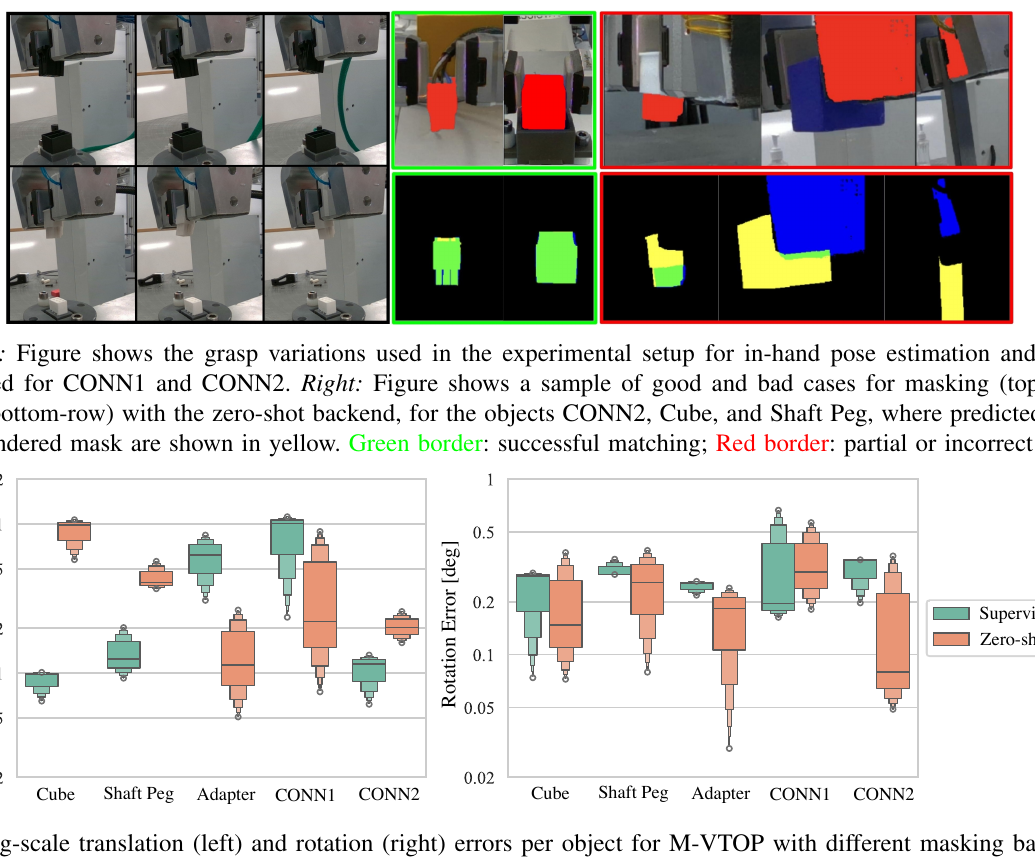
Original Figures 6–7: zero-shot masking / matching successes and failures above; log-scale final errors for supervised and zero-shot backends below, supporting the paper's sub-mm translation / sub-degree rotation report. Source: M‑VTOP paper. Image copyright belongs to the authors; reproduced here for academic analysis.
Most final Figure 7 translation errors are below 1 mm and rotation errors below 1°, with substantial object differences:
Cube zero-shot translation error exceeds the supervised backend.
Electrical connectors are sensitive to yaw / roll; attached cables also apply torque.
CONN2 still achieves only 67% (2/3) with M‑VTOP + SAM2.
The full system runs at 0.4 Hz, acceptable for slow closed-loop alignment but not real-time tracking. Rendering many particles across sensors and proposal matching dominate cost.
10. Key limitations in the authors’ discussion
Unstable zero-shot masks: geometry, texture, and lighting changes cause under-segmentation.
Tactile resolution limits precision: low-resolution sensors work but struggle with tight-fit insertion.
Limited binary-contact information: particle sets are usually already narrow at contact, so soft-distance cues barely move the posterior.
Rigid-object / stable-grasp assumptions: large motion relative to the gripper makes the motion model underestimate uncertainty.
Compute: linear in particles and quadratic in per-modality mask proposals; with few proposals, approximately linear in particles overall.
Known environment: FCL signed distances need receptacle / environment geometry and calibration.
Code status: MERL provides the published PDF and BibTeX, but no official complete repository was found at this site’s review time.
11. Reproduction and improvements
Report particle counts, proposal counts, and renderer / IoU timings to locate the 0.4 Hz bottleneck.
Replace exhaustive particle rendering with stratified / learned proposals or differentiable pose refinement.
Add tactile depth / normals to local surface likelihoods, beyond mask cleanup.
Introduce no-contact negative likelihood for c=0, with explicit penetration tolerances.
Use SE(3) Karcher means / modes rather than naive weighted pose averages to handle multimodality and quaternion averaging.
Increase real repetitions, report per-object confidence intervals, and measure final 6D errors with independent motion capture / calibrated fixtures.
M‑VTOP shows that multimodal fusion need not learn a large joint embedding. Calibrated forward renderers can combine each sensor’s evidence in a common geometric belief space, at the cost of compute and model / calibration dependence. More efficient proposals and continuous optimization are the next step.