Marrying NeRF with Feature Matching for One-Step Pose Estimation
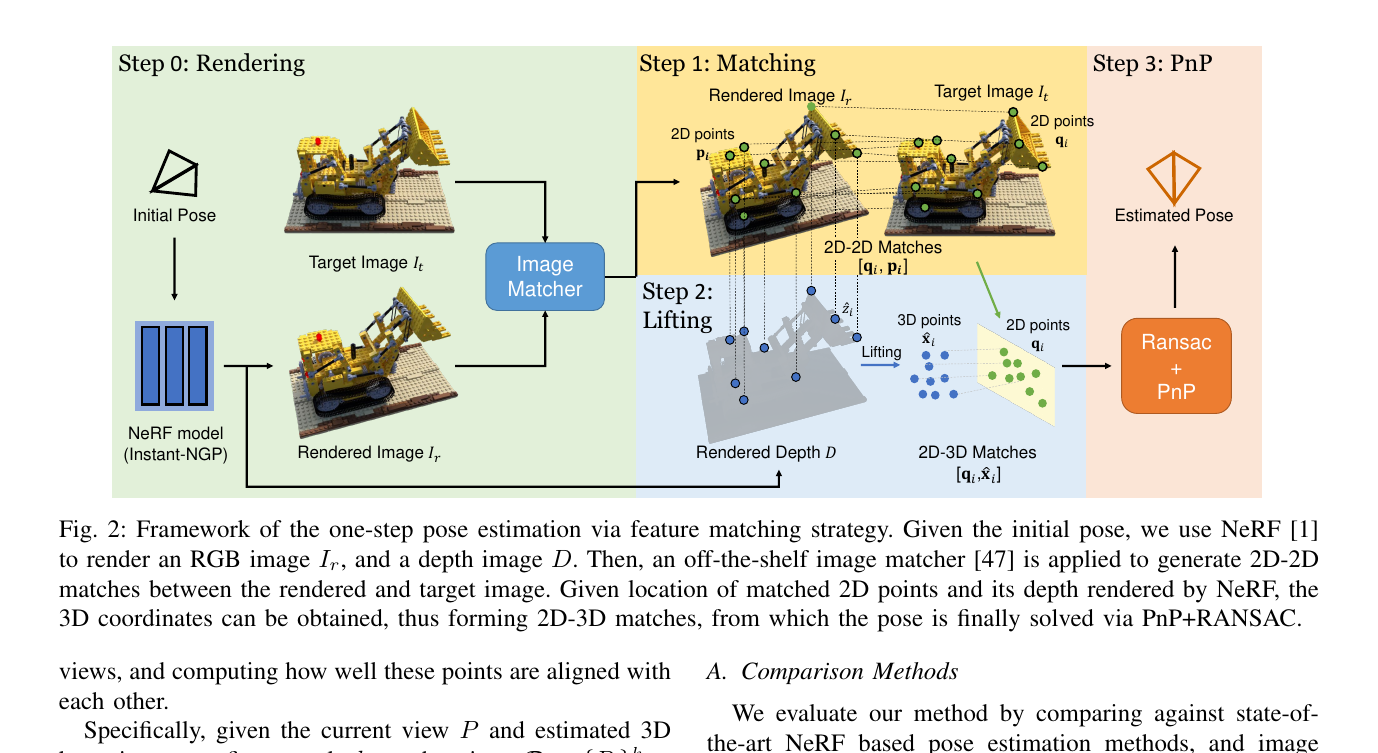
The method renders NeRF RGB / depth from an initial pose, obtains LoFTR 2D–2D matches, lifts them into 2D–3D correspondences, and performs a single RANSAC-PnP correction. 3D consistency mining and keypoint-guided refinement address spurious geometry and occlusion, respectively.
NeRF-rendered RGB and depth feed LoFTR: match a target image to an initial-pose render, back-project rendered pixels into 3D, then solve pose once with RANSAC-PnP. This greatly reduces iNeRF iterations but still needs an initial rendering pose.
3. Task boundaries
Inputs: one target RGB image, camera intrinsics, an instance-specific NeRF, and an initial camera pose.
No CAD, but object-level Instant-NGP must first train on multi-view images, taking about 5 minutes according to the paper.
“One-step” means one render–match–lift–PnP cycle, not initialization-free global localization.
Evaluation uses NeRF Synthetic and LLFF scenes, closer to camera localization than BOP occluded multi-object 6D pose protocols.
4. Method overview
Render RGB and depth from the initial pose.
LoFTR establishes render-to-target 2D–2D matches.
Rendered depth and camera matrices lift render pixels into world-coordinate 3D points.
RANSAC-PnP solves the new pose from 2D–3D correspondences.
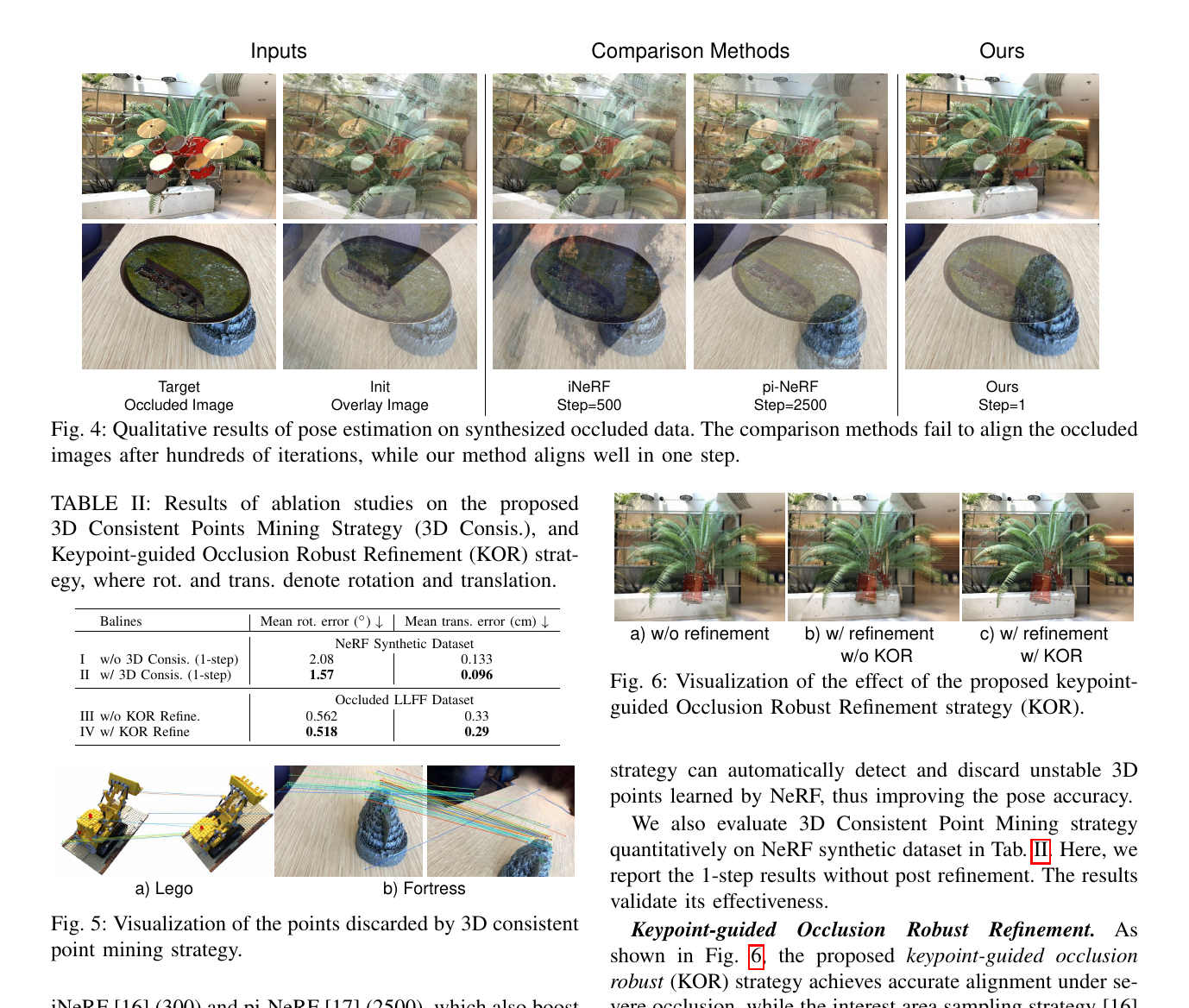
Recompute 3D points from nearby views to reject cross-view-inconsistent NeRF geometry.
Optionally refine locally around reliable matches for occlusion robustness.
Original Figure 2: rendering, matching, depth lifting, and RANSAC-PnP. Source: paper PDF. Image copyright belongs to the paper's authors and publisher; reproduced here for academic analysis.
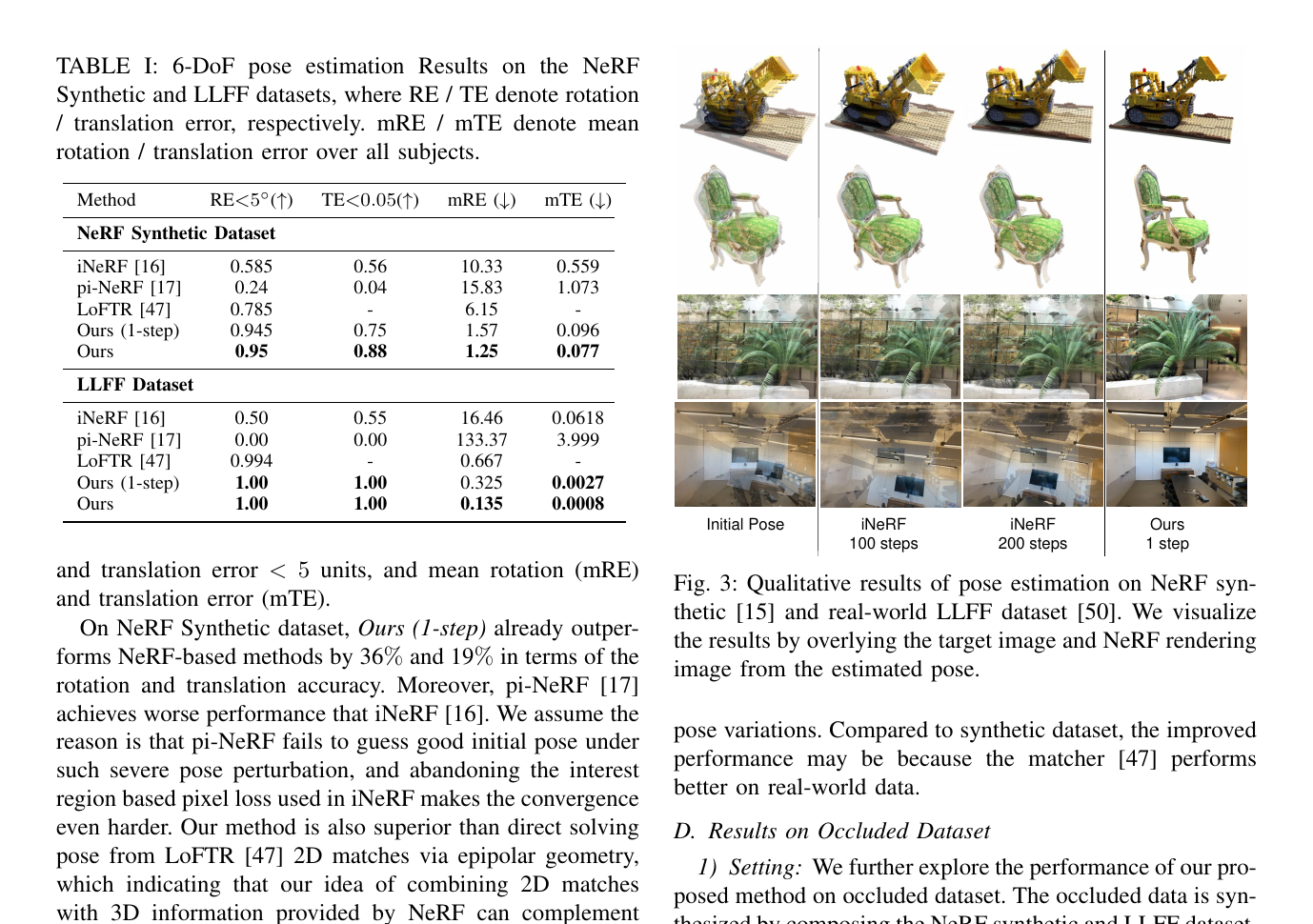
LLFF one-step and full methods both reach 100% / 100% accuracy; full-method mean rotation error 0.135°, translation error 0.0008.
About 6 FPS, approximately 90× faster than iterative baselines according to the paper.
6. Coarse-reading assessment
The useful idea is NeRF as an object representation supplying on-demand RGB, depth, and 3D correspondences. Initial views, feature matching, and NeRF geometry still constrain performance. Relatively clean evaluation scenes do not establish direct applicability to severe robotic-grasping occlusion, symmetry, or clutter.
Available src/paper-notes/nerf-feature-matching-icra2024/deep.md
In-depth paper notes
Support reproduction, comparison, related-work writing, and identifying opportunities for further research.
Paper Reading Notes (Deep): Marrying NeRF with Feature Matching for One-step Pose Estimation
1. Basic information
Authors / affiliations: Ronghan Chen, Yang Cong, Yu Ren; Shenyang Institute of Automation, Chinese Academy of Sciences; South China University of Technology; and others
Explicit correspondence geometry replaces hundreds of inverse-NeRF photometric optimization steps. NeRF generates RGB, depth, and liftable 3D points at an initial view; LoFTR connects rendered and target images; PnP solves camera pose once.
2.1 Guide to figures and tables
Figure / table
Content
Reading focus
Figure 2
One-step pipeline
How NeRF depth turns 2D–2D matches into 2D–3D correspondences
Table I / Figure 3
Synthetic / LLFF main results
Separate one-step estimates from full refinement results
Figures 4–6 / Table II
Occlusion, geometry filtering, ablations
Which failures the two additional modules address
Original Figure 2: render RGB / depth at an initial pose, use LoFTR to match the target, lift rendered pixels into 3D, and solve with RANSAC-PnP. Source: paper PDF. Image copyright belongs to the paper's authors and publisher; reproduced here for academic analysis.
3. Problem setting and interpretation pitfalls
Condition
Required?
One query RGB image and intrinsics
Yes
Object-specific NeRF
Yes
Multi-view images for NeRF training
Yes
CAD / mesh
No
Initial camera pose
Yes
Test-time gradient optimization
No in the main pipeline; short refinement in the full version
“One-step” is relative to iNeRF’s hundreds of pose-gradient steps. An initial pose is needed to render, so this is not IFFNeRF-style initialization-free retrieval. It quickly corrects an imperfect initialization to the target pose.
4. Method details
4.1 NeRF as a geometric interface beyond differentiable representation
Instant-NGP learns radiance / density from posed multi-view object images. Given initial pose P, volume rendering produces color Ir and expected depth:
z^(p,P)=i∑ωiti,
Here ωi are ray volume-rendering weights. The method does not backpropagate through P; it uses z^ as explicit geometry.
4.2 Match–lift–PnP
LoFTR matches target It and render Ir into (qi,pi). Render pixels follow
x^i=Pz^iK−1p~i
back-projection into world coordinates, forming 2D–3D pairs (qi,x^i) for RANSAC-PnP. This avoids nonconvex photometric optimization and delegates local alignment to a pretrained matcher.
4.3 3D Consistent Point Mining
NeRF depth need not coincide with true surfaces. Few views, pose noise, and floaters can yield inconsistent 3D coordinates across viewpoints. For each candidate point, rerender / reproject from k nearby cameras and reject unstable points by coordinate variance, moving NeRF from rendering toward geometric solving.
4.4 Keypoint-guided Occlusion Robust Refinement
Ordinary inverse-NeRF RGB losses over whole target images receive many false residuals from occluders. Here pixels are sampled only around successfully matched keypoints, favoring target regions for short refinement. This changes sampling through reliable sparse anchors rather than segmenting occlusion.
5. Experiments and results
The paper uses 8 NeRF Synthetic scenes and forward-facing LLFF. Rotation / translation thresholds define accuracy, with mean rotation error mRE and translation error mTE also reported. LLFF translation is in scene coordinates and cannot directly be converted to millimeters.
Original Table I / Figure 3: one-step and full-refinement results plus NeRF Synthetic alignment examples. Source: paper PDF. Image copyright belongs to the paper's authors and publisher; reproduced here for academic analysis.
Data
Method
Rot. / Trans. accuracy
mRE
mTE
Synthetic
iNeRF
58.5% / 56.0%
10.33°
0.559
Synthetic
Ours, 1-step
94.5% / 75.0%
1.57°
0.096
Synthetic
Ours, full
95.0% / 88.0%
1.25°
0.077
LLFF
iNeRF
50.0% / 55.0%
16.46°
0.0618
LLFF
Ours, 1-step
100% / 100%
0.325°
0.0027
LLFF
Ours, full
100% / 100%
0.135°
0.0008
Including about 50 ms rendering, 60 ms matching, 15 ms PnP, and other components, the paper reports about 6 FPS, around 90 times faster than its iterative comparisons. Approximately 5 minutes of object-level NeRF training is excluded from online latency.
5.1 Interpreting ablations
On Synthetic, 3D consistency improves one-step errors from about 2.08∘/0.133 to 1.57∘/0.096, showing that depth noise contaminates PnP.
Keypoint-guided refinement lowers occluded-data errors from about 0.562∘/0.33 to 0.518∘/0.29, a positive but not order-of-magnitude gain.
The full method is more accurate than one-step solving; “one-step” mainly supplies strong initialization, not a final system entirely without refinement.
Original Figures 4–6: synthetic occlusion examples, points removed by 3D consistency, and refinement sampling around matches. Source: paper PDF. Image copyright belongs to the paper's authors and publisher; reproduced here for academic analysis.
6. Strengths, limitations, and applications
Strengths
Naturally connects neural rendering with mature 2D–3D geometric solving.
Clear inference stages separate rendering, matching, depth, and PnP errors.
CAD-free, with shorter instance preparation than many expensive training approaches.
NeRF depth lacks CAD’s scale and surface-precision guarantees.
Synthetic occlusion tests do not replace real hand-object interaction or stacked scenes.
7. Research implications
A practical pattern is NeRF as a database generating depth-equipped templates from current views, beyond a differentiable renderer alone. Extensions include multiple-initialization retrieval, symmetry-aware PnP, NeRF-depth uncertainty weighting, and replacing instance NeRFs with cross-instance-generalizable 3D Gaussian / foundation feature fields.