NOPE: Novel Object Pose Estimation from a Single Image
Rather than synthesizing pixels, NOPE predicts discriminative embeddings for 342 relative views from one reference and retrieves against the query embedding, recovering relative rotation and multimodal ambiguity. On unseen ShapeNet categories, top-1 Acc30 / median error is 59.8 / 24.4°, and top-5 is 87.1 / 6.6°. Single-reference T-LESS VSD recall is 46.49, with 40.5 Acc30 under 25% occlusion.
the same rigid object visible in reference and queryobject-centered cropsrelative-rotation target rather than metric translation342 sampled viewpoints at inferenceShapeNet category-disjoint pretraining
Full paper metadataAuthors, affiliations, research area, datasets, metrics, method tags, and reading statusExpandCollapse
Authors
Van Nguyen Nguyen, Thibault Groueix, Georgy Ponimatkin, Yinlin Hu, Renaud Marlet, Mathieu Salzmann, Vincent Lepetit
the same rigid object visible in reference and queryobject-centered cropsrelative-rotation target rather than metric translation342 sampled viewpoints at inferenceShapeNet category-disjoint pretraining
Reading Notes
Overview / Deep Dive
Available src/paper-notes/nope-cvpr2024/coarse.md
Paper overview notes
Quickly assess the paper's scope, problem setting, core method, experimental findings, and whether to read it in depth.
Paper Reading Notes (Coarse): NOPE
1. Basic information
Title: NOPE: Novel Object Pose Estimation from a Single Image
Authors: Van Nguyen Nguyen, Thibault Groueix, Georgy Ponimatkin, Yinlin Hu, Renaud Marlet, Mathieu Salzmann, Vincent Lepetit
Affiliations: LIGM, École des Ponts; Adobe; Magic Leap; Valeo.ai; EPFL
From one reference RGB of a novel object, NOPE predicts mean discriminative embeddings for 342 candidate relative viewpoints and retrieves the nearest to a query embedding. No CAD or instance-specific training is needed, and symmetry / unseen-part ambiguity remains as a pose distribution.
3. Guide to figures and tables
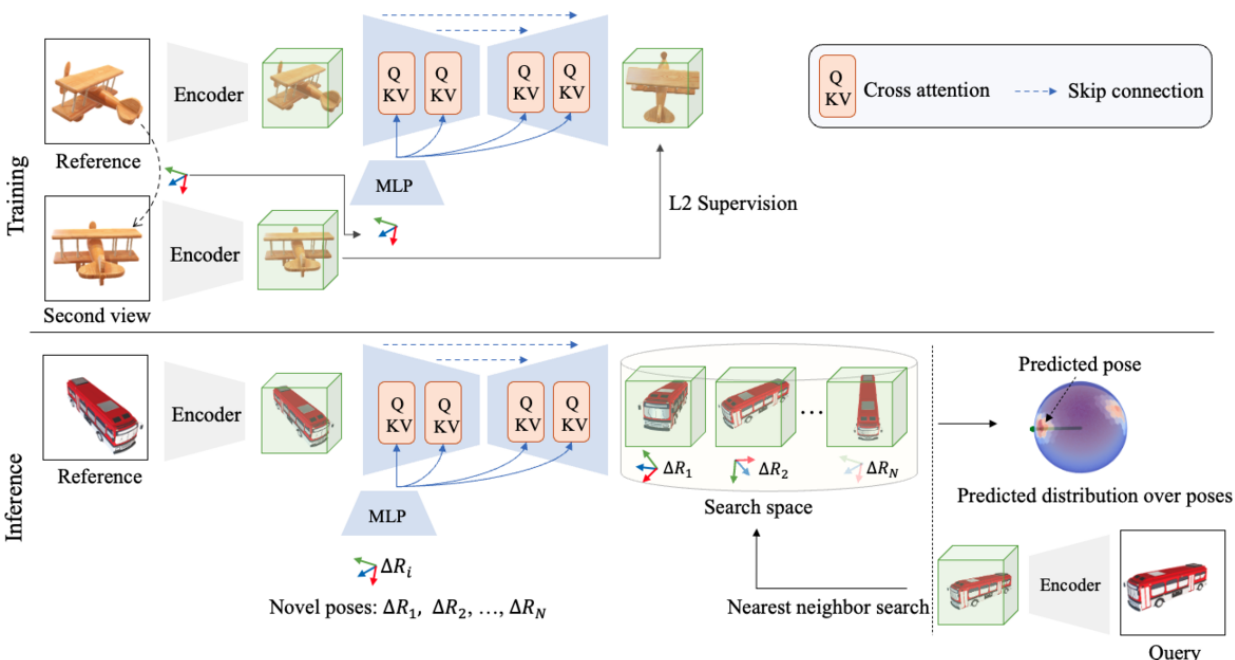
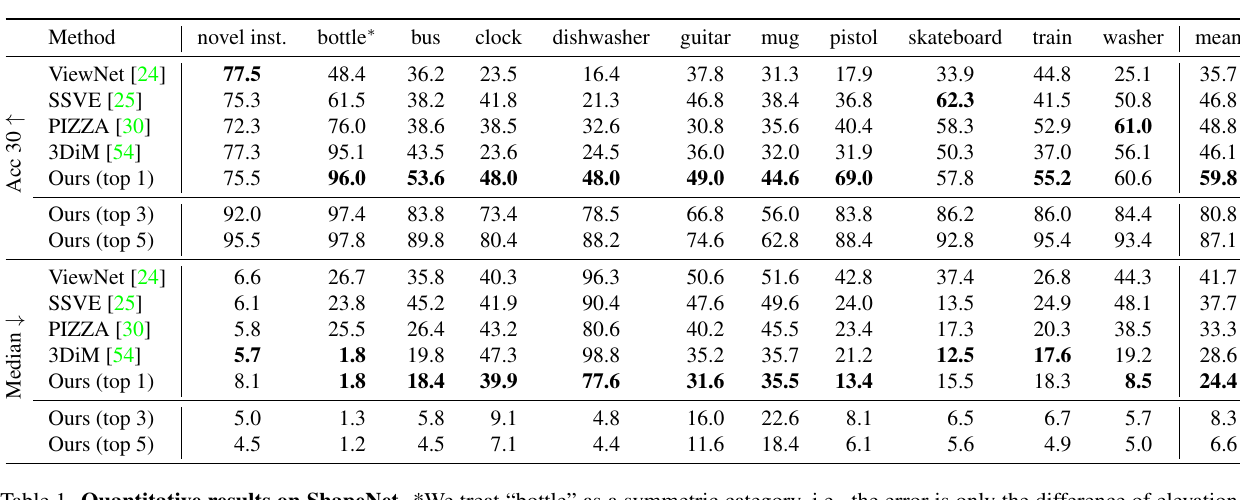
Original Figure 3: rotation-conditioned U-Net predicts a second-view embedding from a reference embedding during training. At inference, 342 candidate embeddings are generated together and matched to the query for a pose distribution. Source: published CVPR 2024 paper. Image copyright belongs to the authors and IEEE/CVF; reproduced here for academic analysis.Original Table 1: unseen-category top-1 Acc30 / median error is 59.8 / 24.4°. Including symmetric or near-ambiguous alternatives through top-3 / top-5 gives 80.8 / 8.3° and 87.1 / 6.6°. Source: published CVPR 2024 paper. Table copyright belongs to the authors and IEEE/CVF; reproduced here for academic analysis.
4. Problem setting
Inputs: one reference RGB crop and one query RGB crop of the same rigid object.
Outputs: query-to-reference 3D rotation and a distribution over a discrete SO(3) search space.
Not required: CAD, depth, object videos, or test-object retraining.
Not output: metric translation, detection, or full camera-frame 6D pose.
Training / test: 13 ShapeNet training categories and 10 disjoint test categories, plus evaluation on real T-LESS images.
An MLP encodes candidate relative rotation as a pose token, injected through cross-attention at U-Net scales.
L2 training predicts a second-view embedding rather than novel-view RGB.
A subdivided icosahedron supplies 342 viewpoints; all candidate embeddings are generated together.
Query-to-candidate nearest neighbors give pose likelihoods from distances; top peaks give top-1, and multiple peaks express symmetry / occlusion ambiguity.
6. Experiments at a glance
Unseen ShapeNet categories: top-1 Acc30 59.8, median 24.4° versus PIZZA 48.8 / 33.3°.
top-3: 80.8 / 8.3°; top-5: 87.1 / 6.6°.
T-LESS, one reference, all-view sampling: seen / novel / mean VSD recall 47.03 / 45.69 / 46.49.
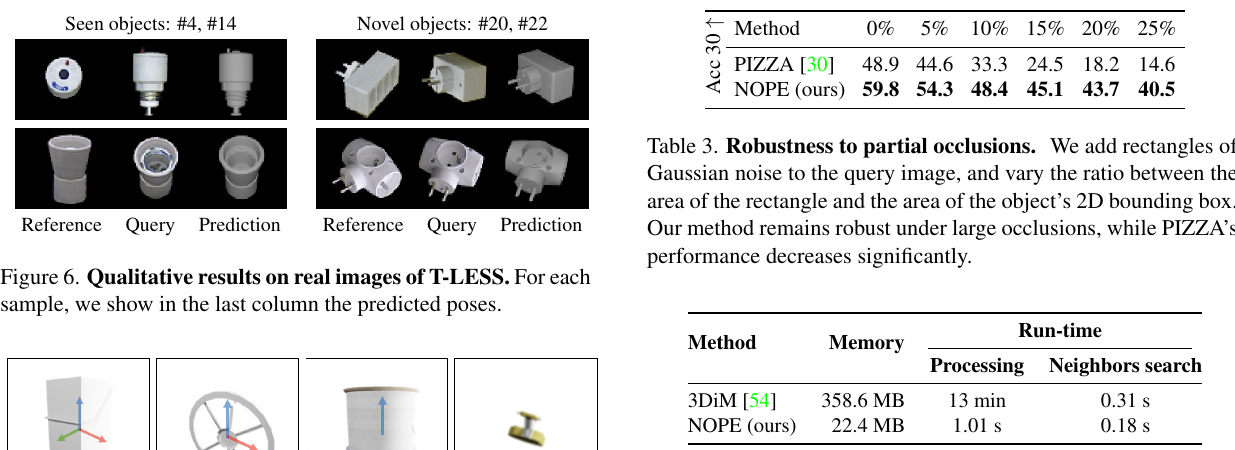
25% artificial occlusion: NOPE Acc30 40.5 versus PIZZA 14.6.
Generating 342 views: 22.4 MB, 1.01 s; nearest-neighbor matching: 0.18 s. Corresponding 3DiM figures: 358.6 MB, 13 min, 0.31 s.
7. Quick assessment
Strengths: generates expected pose-discriminative embeddings rather than pixel appearances; multimodal outputs better reflect symmetry than forced unique rotations.
Main limits: rotation only; supplied object crops; 342 discrete viewpoints limit angular resolution, and unseen reference details remain unrecoverable.
Table caveat: top-3 / top-5 measure candidate-set hits, not single-output top-1 accuracy; CAD-based T-LESS methods receive more information and differ in protocol.
Support reproduction, comparison, related-work writing, and identifying opportunities for further research.
Paper Reading Notes (Deep): NOPE
1. Key assessment
NOPE studies an extremely sparse onboarding protocol: one reference RGB image of a novel object unseen during training, then relative rotation from another query RGB. No CAD, depth, multi-view scan, or instance-specific fine-tuning is used.
A single view cannot reveal the back of an object; pixel-level novel-view synthesis must invent unseen content. Even plausible generated images may not match the actual instance appearance, weakening them as precise pose templates. NOPE instead:
Does not generate RGB.
Generates mean discriminative embeddings over possible appearances at candidate viewpoints.
Constructs pose likelihood from query distances to these expected embeddings.
Retains multiple high-probability peaks for symmetry, occlusion, and unseen-part ambiguity.
Unseen-category top-1 Acc30 reaches 59.8 and top-5 87.1. Generating 342 viewpoints takes 1.01 s, compared with 13 min for diffusion baseline 3DiM.
2. Is the output really 6D pose?
Input:
Reference image Ir.
Query image Iq.
Both should be centered crops of the same object.
Outputs:
ΔR=RqRr⊤∈SO(3),
plus a distribution over discrete SO(3) / viewpoint space.
The paper does not estimate:
metric translation;
object scale;
detection / segmentation;
Absolute camera-space pose, unless reference absolute rotation is externally known.
Thus, pose in the title means single-reference relative 3D rotation. It is inappropriate to compare NOPE directly with full BOP absolute-pose R,t pipelines using the same metric.
3. Training: predict embeddings rather than pixels
Original Figure 3. Reference embeddings and relative-pose conditions predict second-view embeddings during training; testing generates embeddings for 342 candidate rotations together and matches the query by nearest neighbors. Source: published CVPR 2024 paper. Image copyright belongs to the authors and IEEE/CVF; reproduced here for academic analysis.
Freeze pretrained VAE encoder E to obtain:
er=E(Ir),eq=E(Iq),
Embedding dimensions are 32×32×8.
An MLP converts target relative rotation ΔR to a pose embedding. Multiscale U-Net blocks receive this condition through cross-attention and predict:
e^q=F(er,ΔR).
Supervision is simple L2:
L=∥F(er,ΔR)−eq∥22.
Each training batch includes two images of one object and GT relative rotation. The VAE stays frozen; only U-Net and the pose MLP update.
Why L2 averaging can help
Given a reference and target rotation, unseen regions admit multiple appearances. The L2-optimal prediction approaches the conditional mean:
F(er,ΔR)≈E[eq∣er,ΔR].
If a query samples this conditional distribution, its squared embedding distance from the mean relates to likelihood. NOPE need not guess one rear texture, only learn the statistical region of embeddings expected at that pose.
4. Inference and pose distributions
Starting with a regular icosahedron, two recursive subdivisions produce 342 candidate viewpoints:
P={ΔR1,…,ΔR342}.
Generate e^i=F(er,ΔRi) for each, then compare the query:
i⋆=argimin∥e^i−eq∥2.
Normalize distances into p(ΔRi∣Ir,Iq). Unambiguous objects yield one peak; continuous / discrete symmetry or hidden handles can yield rings or multiple modes.
This uncertainty is a similarity-induced discrete distribution, without probability calibration or confidence-interval coverage guarantees.
Original Table 1. Top-k checks whether GT is covered by the k highest-probability candidates; large top-5 gains reveal symmetry / multimodality rather than every candidate missing GT. Source: published CVPR 2024 paper. Table copyright belongs to the authors and IEEE/CVF; reproduced here for academic analysis.
Unseen-category means:
Method
Acc30 ↑
Median ↓
ViewNet
35.7
41.7°
SSVE
46.8
37.7°
PIZZA
48.8
33.3°
3DiM
46.1
28.6°
NOPE top-1
59.8
24.4°
NOPE top-3
80.8
8.3°
NOPE top-5
87.1
6.6°
Top-1 exceeds PIZZA by +11.0 Acc30 and median -8.9°. Yet top-1 median errors are 77.6° for dishwasher, 39.9° for clock, and 35.5° for mug, exposing near-symmetry and local-detail difficulties. Top-5 reduces dishwasher to 4.4°: a correct mode is often present, but the largest peak is wrong.
6. T-LESS: unequal information in comparisons
One-reference T-LESS:
Method
Additional input
Seen
Novel
Avg VSD recall
CAD-based Nguyen et al.
GT CAD
60.15
58.70
59.57
CAD-based MultiPath
GT CAD
43.17
43.33
43.24
PIZZA, all views
1 RGB reference
20.05
15.90
18.39
NOPE, all views
1 RGB reference
47.03
45.69
46.49
NOPE, front views
1 RGB reference
49.30
48.46
48.96
NOPE clearly beats same-protocol PIZZA and exceeds CAD-based MultiPath, but trails the strongest GT-CAD method. Front-view references work better, highlighting the importance of discriminative reference structure.
Original Figure 6 and Tables 3–4: one reference supports seen / novel T-LESS objects. At 25% occlusion, Acc30 remains 40.5; embeddings for 342 views require only 22.4 MB and 1.01 s. Source: published CVPR 2024 paper. Figure / table copyright belongs to the authors and IEEE/CVF; reproduced here for academic analysis.
Occlusion experiment:
Query-box occlusion
0%
5%
10%
15%
20%
25%
PIZZA Acc30
48.9
44.6
33.3
24.5
18.2
14.6
NOPE
59.8
54.3
48.4
45.1
43.7
40.5
From 0→25% occlusion, NOPE loses 19.3 points versus PIZZA’s 34.3, supporting relative robustness of embedding-template matching to partial occlusion.
Runtime on one V100:
NOPE candidate generation: 1.01 s;
nearest-neighbor: 0.18 s;
storage: 22.4 MB;
3DiM generation: 13 min, 358.6 MB.
NOPE is much faster than diffusion synthesis, but 1.19 s per object is still not real-time video tracking.
7. Qualitative results and failures
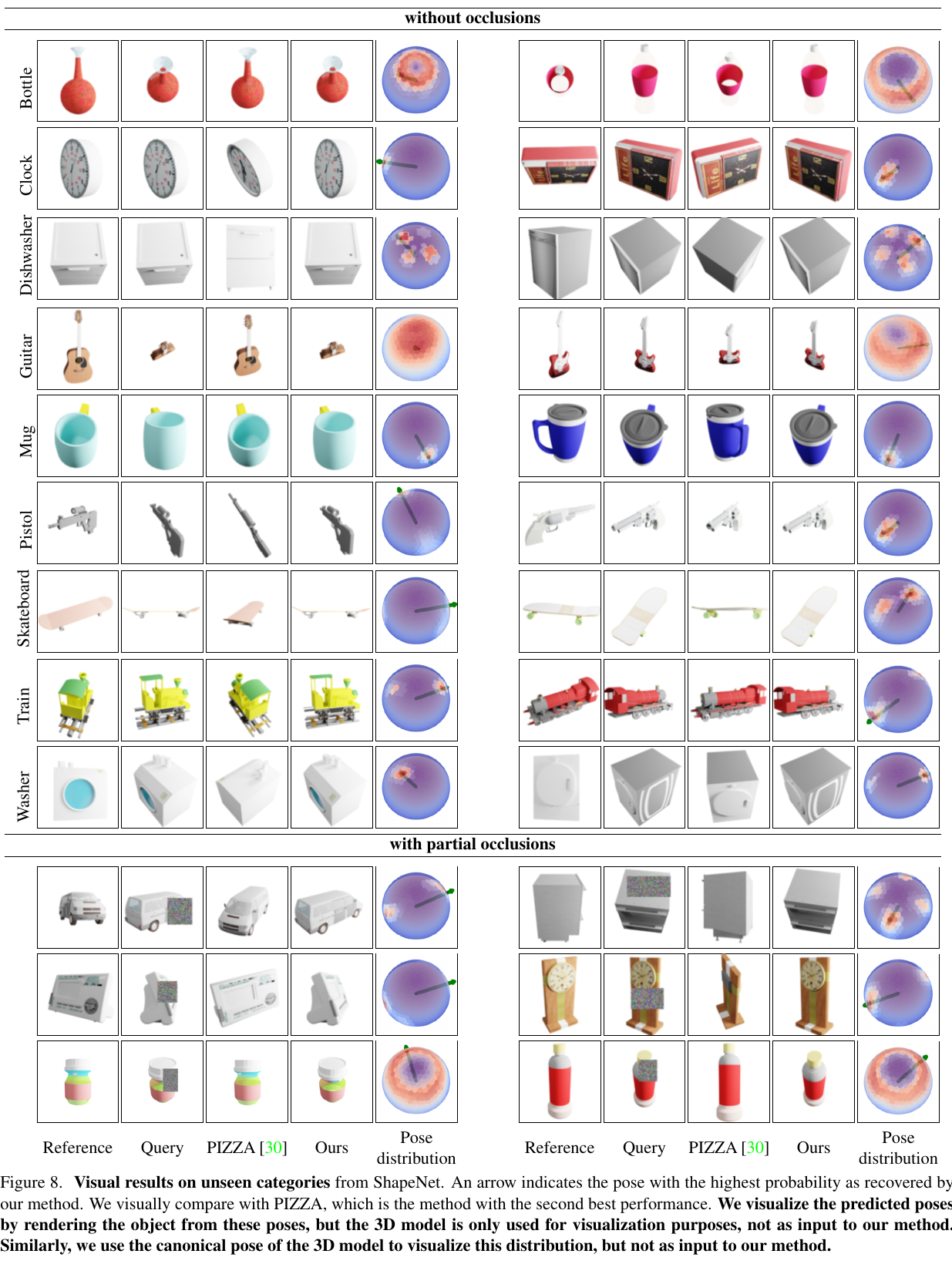
Original Figure 8: each group shows reference, query, PIZZA, NOPE, and pose distribution. Bottom occlusion examples retain correct modes. Meshes only visualize predicted rotations; they are not NOPE inputs. Source: published CVPR 2024 paper. Image copyright belongs to the authors and IEEE/CVF; reproduced here for academic analysis.
Failures concentrate on:
Dishwasher / clock: near-symmetry broken only by small parts.
Mug: handles invisible in reference or query.
Guitar: thin projections from some views carry little appearance information.
Nondiscriminative reference views.
Limited nearest-neighbor resolution among 342 viewpoints.
Symmetry takes different forms: continuous axial bottle symmetry yields rings, while nearly symmetric dishwashers produce similar but nonequivalent peaks, making top-1 selection harder.
8. Related approaches
PIZZA directly regresses neighboring-frame relative pose; NOPE explicitly generates and searches viewpoint embeddings for larger viewpoint gaps and multiple modes.
DVMNet also uses two RGB images without CAD for relative rotation, but solves 3D voxel correspondence in closed form; NOPE retrieves in discrete pose space and outputs distributions.
Oryon requires two RGB-D images + text to locate targets in scenes and estimate relative R,t; NOPE needs only RGB crops but returns rotation alone.
9. Limitations and reproduction checks
Given object crops; detection / segmentation errors are not evaluated.
No translation or scale output.
Reference quality is a system variable; real onboarding may need active viewpoint selection.
342-view discretization and top-k evaluation amplify multimodal gains.
Pose likelihoods are uncalibrated.
ShapeNet is synthetic and object-centered; T-LESS only partly tests real clutter domain gaps.
Training takes about 20 h on 4×V100.
No public code in the paper; reproduction needs the frozen encoder, U-Net conditioning, and viewpoint sampling reconstructed.
Bottles use elevation-only evaluation under category symmetry; reproduce this metric exactly.
Mesh visualization must not be described as CAD input to the method.
10. Overall assessment
NOPE’s central idea is not to force a unique invented appearance or pose in an unidentifiable problem: generate statistical embeddings useful for pose discrimination and retain alternatives in the output distribution.
Category-disjoint top-1 +11 Acc30, +25.9 under 25% occlusion, and orders-of-magnitude speed gains over 3DiM provide substantial evidence. A full 6D pipeline still requires translation, detection, and faster inference. As a single-reference, CAD-free relative-rotation baseline, NOPE offers a clear approach to single-view invisibility and symmetric alternatives.