Omni6D: Large-Vocabulary 3D Object Dataset for Category-Level 6D Object Pose Estimation
Omni6D synthesizes over 800,000 RGB-D observations in Replica scenes from 4,688 scanned textured meshes across 166 categories, with instance-level symmetry along three axes and unseen-category tests. Baselines use ground-truth masks. Translation and size generalize, but rotation degrades sharply under large-vocabulary and cross-category settings.
Omni6D uses 4,688 real-scanned textured OmniObject3D meshes, physically simulated and rendered in Replica interiors, to generate over 800K RGB-D observations across 166 categories. Instance-level three-axis rotational-symmetry labels redefine evaluation and expose weak rotation generalization as category vocabularies grow.
3. Guide to figures and tables
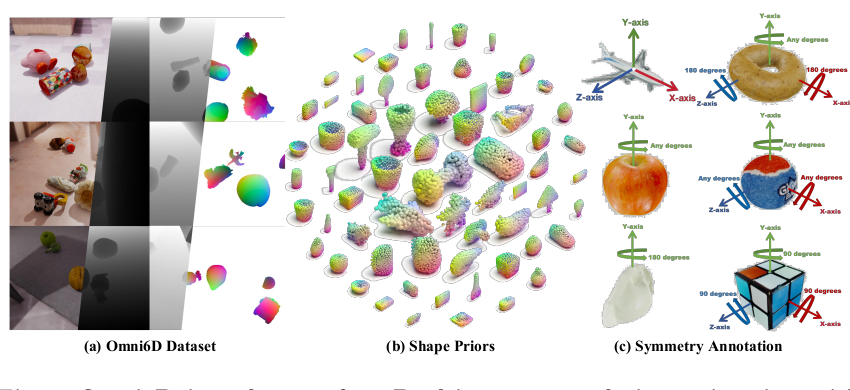
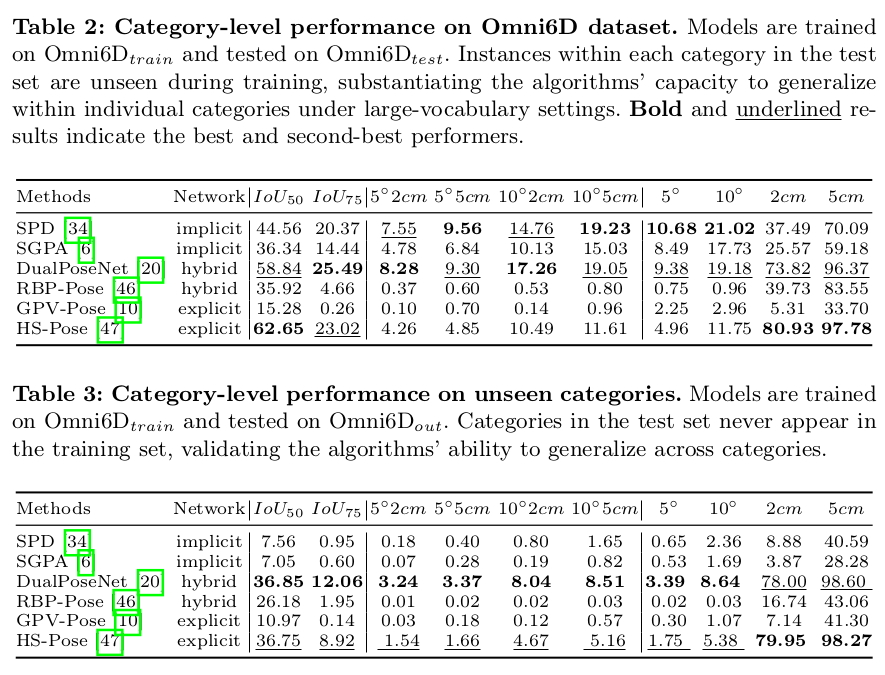
Original Figure 1: rendered RGB, depth, and NOCS on the left, shape diversity across 166 categories centrally, and discrete / continuous x / y / z symmetries on the right. Real-scanned describes mesh sources; training images are synthetic BlenderProc renders. Source: published ECVA paper. Image copyright belongs to the authors and Springer Nature; reproduced here for academic analysis.Original Tables 2–3: best seen-category IoU50 is HS-Pose's 62.65. On unseen categories, DualPoseNet / HS-Pose achieve only 36.85 / 36.75 IoU50 and strict 5°2cm 3.24 / 1.54. Source: published ECVA paper. Table copyright belongs to the authors and Springer Nature; reproduced here for academic analysis.
4. Dataset composition
Object assets: 4,688 real-scanned textured OmniObject3D instances, with standardized canonical poses and scale.
Images: place 6–8 objects in each of 9 Replica rooms, use free-fall simulation for occlusion / nonupright poses, and render 10 camera views.
Scale / modalities: over 800K observations at 640×480, with RGB-D, instance masks, NOCS, pose, metric size, category, and symmetry.
Unseen categories: Omni6Dout has 52 models, 17 unseen training categories, and 4,762 images.
Small real set: Omni6D-Real has 30 scenes, 39 categories, 73 instances, and about 1,000 Azure Kinect images for synthetic-to-real checks.
5. Symmetry-aware evaluation
Annotate each object’s x / y / z axes separately:
Sym-0: no rotational symmetry.
Sym-1: continuous symmetry at arbitrary angles.
Sym-2: equivalent integer multiples of 90°.
Sym-3: equivalent integer multiples of 180°.
Evaluation enumerates equivalent three-axis rotations and minimizes pose error. Discrete states reduce each instance to at most 43=64 candidates rather than dense angular sampling. This excludes geometrically equivalent poses from errors and permits different symmetries within one semantic category.
6. Experiments at a glance
All baselines use GT instance masks, isolating pose / size backends from large-vocabulary detection and classification.
Seen categories: HS-Pose IoU50 / 2cm / 5cm 62.65 / 80.93 / 97.78, but 5°2cm only 4.26. Translation / size are much easier than rotation.
Unseen categories: DualPoseNet IoU50 36.85, 5°2cm 3.24; HS-Pose 36.75 / 1.54. Cross-category shape priors do not ensure rotation generalization.
Expanding from 3 to 48 categories lowers HS-Pose 5°2cm from 62.52 to 14.42, even with progressive fine-tuning. Small vocabularies overestimate scalability.
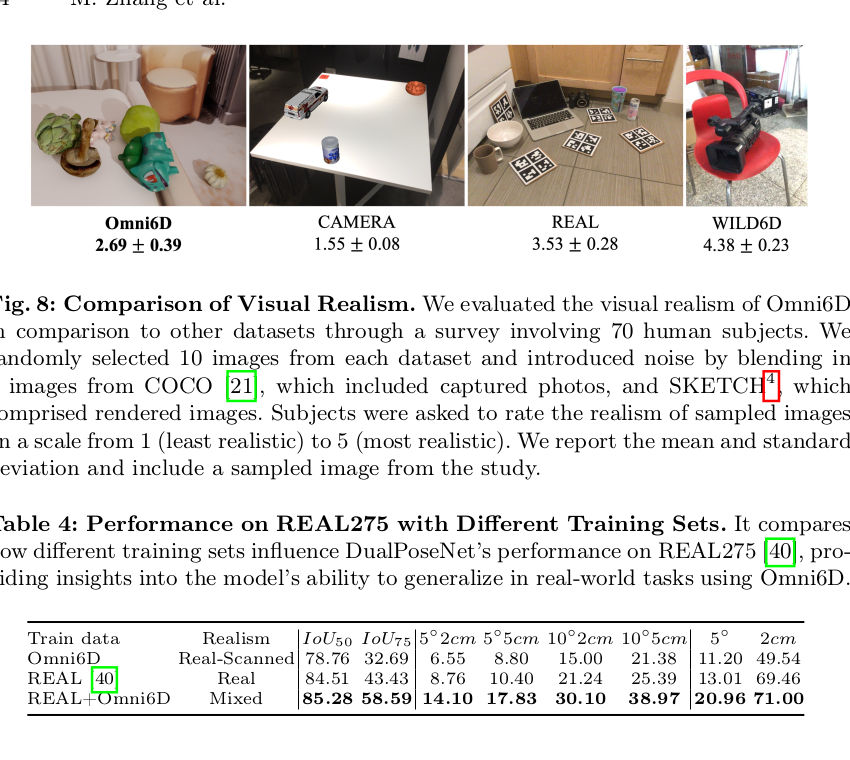
DualPoseNet on REAL275: Omni6D-only training IoU50 / IoU75 78.76 / 32.69; REAL+Omni6D 85.28 / 58.59. Synthetic data helps without fully replacing real supervision.
7. Quick assessment
Value: expands six common tabletop categories to 166, with instance symmetries, unseen-category tests, and real-transfer checks.
Key finding: rotation generalization becomes the main bottleneck as vocabulary / shape diversity grow; strong IoU / translation scores can hide pose failures.
Limits: mainly synthetic, small real set, GT-mask experiments, unresolved long tails and rendering domain gaps.
Support reproduction, comparison, related-work writing, and identifying opportunities for further research.
Paper Reading Notes (Deep): Omni6D
1. Key assessment
Omni6D advances category-level pose from within-category generalization over a few classes toward large vocabularies, long tails, and cross-category generalization:
166 categories and 4,688 instances expose both within- and cross-category shape variation.
Free-fall placement breaks the upright bias common in NOCS / CAMERA.
Symmetry moves from category conventions to per-instance three-axis annotations.
Omni6Dout explicitly tests unseen training categories.
The central conclusion is that translation / size generalize more readily, while rotation is sensitive to category expansion. IoU50 or 5cm alone can overstate system capability.
2. What exactly is real?
Original Figure 1. Assets are real-object scans with geometry / texture, but RGB-D, NOCS, masks, and poses are rendered in Replica scenes. Source: published ECVA paper. Image copyright belongs to the authors and Springer Nature; reproduced here for academic analysis.
The table labels Omni6D 3D models Real-Scanned, which can be misreported as 800K real images. The precise breakdown is:
Real scans: 4,688 textured OmniObject3D meshes.
Synthetic scenes: 9 Replica rooms.
Synthetic placement: BlenderProc 2.5.0 free fall of 6–8 objects per scene, with random object scale 0.8–1.2.
Synthetic cameras: 10 views per scene, radius 8–9 m, elevation 30°–90°.
Scanned shape / texture is more realistic than primitive CAD, but rendering, Replica lighting, sensor noise, and compositing domain gaps remain.
3. Scale, splits, and annotations
There are 166 categories, 4,688 instances, and over 0.8M captures. A 7:2:1 instance split defines Omni6Dtrain / val / test, making test instances unseen but categories seen.
Omni6Dout adds:
52 object models.
17 categories entirely unseen during training.
4,762 images.
These splits separate two generalization types:
test: unseen instance within seen categories;
out: unseen instances from unseen categories.
Omni6D-Real adds 30 real scenes, 39 categories, 73 instances, and about 1K Azure Kinect images. SAM assists masks; ICP registration provides object poses. It is a small domain-transfer sanity check rather than a replacement for large real benchmarks.
4. Instance-level three-axis symmetry
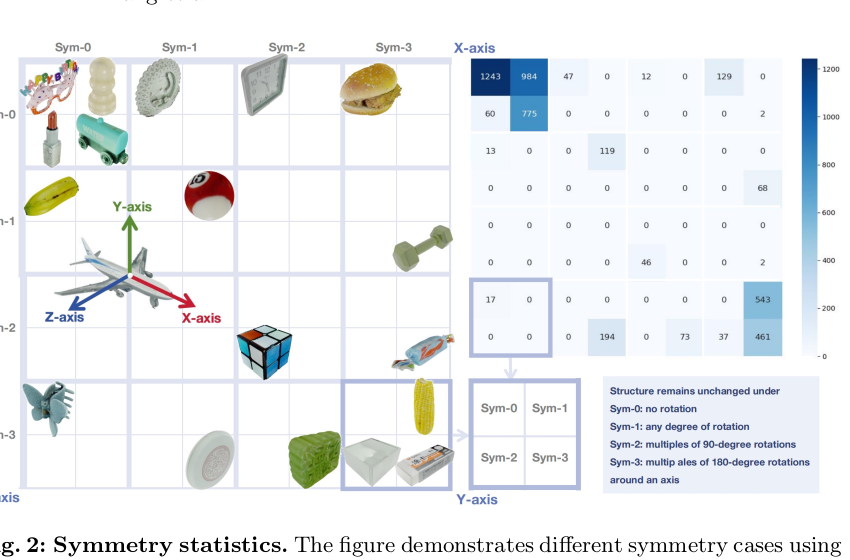
Original Figure 2: each instance's x / y / z axes receive no, continuous, 90°, or 180° rotational symmetry labels; the right matrices count combinations. Source: published ECVA paper. Image copyright belongs to the authors and Springer Nature; reproduced here for academic analysis.
For predicted rotation R^, GT R, and equivalent-rotation set S, symmetry-aware error is:
eR=S∈Smind(R^,RS),
Here d is the SO(3) geodesic angle. Sym-0 / 1 / 2 / 3 denote no equivalent rotation, arbitrary axial angles, 90° multiples, and 180° multiples. Combining three axes needs at most 43 evaluations.
This improves on category-wide axial symmetry: bottle, lamp, or toy instances may differ through handles, logos, or geometry. Approximation boundaries remain:
Continuous symmetry is approximated by discrete evaluation.
Shape invariance need not reflect texture.
Multiaxis discrete combinations may duplicate rotations.
Canonical frames still follow human conventions.
5. Why the distribution is harder
The analysis finds:
Centroids resemble CAMERA / REAL distributions, but occlusion and cloud spatial variation are stronger.
Wider relative object-size distributions.
Free fall makes orientation relative to up more uniform, reducing upright priors.
Agglomerative clustering of VAE shape priors groups geometrically similar but semantically different categories.
Performance correlates more with instance counts in shape clusters than semantic-class sample counts. Models may learn shared geometric modes rather than labels alone; category-balanced sampling without shape diversity may not improve generalization.
6. Seen- and unseen-category main results
Original Tables 2–3. All methods receive GT masks; Table 2 tests novel instances of seen categories, while Table 3 tests unseen categories. Source: published ECVA paper. Table copyright belongs to the authors and Springer Nature; reproduced here for academic analysis.
6.1 Seen categories
Method
IoU50
IoU75
5°2cm
10°5cm
2cm
5cm
SPD
44.56
20.37
7.55
19.23
37.49
70.09
DualPoseNet
58.84
25.49
8.28
19.05
73.82
96.37
HS-Pose
62.65
23.02
4.26
11.61
80.93
97.78
HS-Pose leads in translation / IoU but struggles on strict joint thresholds. Its 5cm is 97.78 while 5°2cm is only 4.26: center / size can be right without useful orientation.
6.2 Unseen categories
Method
IoU50
IoU75
5°2cm
10°5cm
2cm
5cm
SPD
7.56
0.95
0.18
1.65
8.88
40.59
DualPoseNet
36.85
12.06
3.24
8.51
78.00
98.60
HS-Pose
36.75
8.92
1.54
5.16
79.95
98.27
Explicit translation / size heads in DualPoseNet and HS-Pose preserve high 2cm / 5cm despite rotation collapse. Unseen-category generalization needs angular thresholds alongside 5cm.
7. Category-scale experiments
Training vocabularies grow through 3, 6, 12, 24, and 48 categories, comparing scratch training with preceding-stage fine-tuning. Fine-tuning usually helps, but performance still declines; HS-Pose 5°2cm falls from 62.52 at 3 categories to 14.42 at 48.
This indicates:
More classes are not simply more independent samples.
Capacity, shared shape priors, and conditioned heads interfere.
Curriculum / fine-tuning helps optimization without resolving representation conflicts.
Structures successful on six NOCS classes should not automatically be extrapolated to large vocabularies.
8. Synthetic-to-real results
Original Figure 8 and Table 4. A 70-person realism survey gives mean 2.69±0.39; DualPoseNet REAL275 IoU75 rises from Omni6D-only 32.69 to REAL+Omni6D 58.59. Source: published ECVA paper. Figure / table copyright belongs to the authors and Springer Nature; reproduced here for academic analysis.
In the 70-person survey, Omni6D scores 2.69±0.39, above CAMERA’s 1.55±0.08 but below REAL’s 3.53±0.28 and WILD6D’s 4.38±0.23. Scanned assets plus indoor PBR look more realistic, without reaching photorealism.
DualPoseNet on REAL275:
Training set
IoU50
IoU75
5°2cm
10°5cm
Omni6D
78.76
32.69
6.55
21.38
REAL
84.51
43.43
8.76
25.39
REAL + Omni6D
85.28
58.59
14.10
38.97
Omni6D supports useful pretraining / augmentation: joint-training IoU75 is 15.16 points above REAL-only. Omni6D-only still trails on strict pose, leaving synthetic-to-real transfer unresolved.
9. Evaluation boundaries and limitations
GT masks exclude large-vocabulary detection, classification, and mask errors.
Real-scanned meshes are not real images; renderer / sensor gaps persist.
About 1K real images are limited, with mask / registration annotation errors.
166 categories still follow OmniObject3D assets, not open-world long tails.
Category labels and shape clusters differ; class-conditioned architectures may be unsuitable inductive biases.
Symmetry-minimized errors may treat texture-distinguishable orientations as equivalent.
Mainly single frames; video scanning and temporal modeling remain future work.
The appendix extends Omni6D-xl to 13,161 instances / 339 categories; main experiments and conclusions use base Omni6D.
10. Usage and reproduction checklist
State clearly that assets are real scans and observations synthetic renders.
Keep the 7:2:1 instance split; never share meshes across train / test.
Report seen and unseen categories separately.
Report IoU, rotation-only, translation-only, and joint thresholds.
Separate GT-mask backends from actual detector / segmenter systems.
Minimize over per-instance three-axis symmetry sets.
Analyze head / common / tail classes and shape-cluster frequencies.
Fix BlenderProc, Replica rooms, cameras, scales, and free-fall settings.
Stratify real depth noise, transparency / reflection, and heavy occlusion.
Track capacity, sampling, and catastrophic interference as classes grow.
11. Overall assessment
Omni6D changes the question from accuracy on six tabletop categories to orientation under 166 categories, long-tailed shapes, and unseen categories. Results show clearly that strong translation / size scores do not solve 6D pose.
Use it with its boundaries intact: mainly synthetic RGB-D from real-scanned assets, GT-mask tables, and a small real set. Within these limits, it is a valuable stress test for large-vocabulary pose, instance symmetry, and degradation with category scale.