known 149-category vocabularycategory canonical alignmentSOPE synthetic training setsegmented object point cloud and RGB cropDINOv2 and PointNet++iterative diffusion sampling
Full paper metadataAuthors, affiliations, research area, datasets, metrics, method tags, and reading statusExpandCollapse
Authors
Jiyao Zhang, Weiyao Huang, Bo Peng, Mingdong Wu, Fei Hu, Zijian Chen, Bo Zhao, Hao Dong
Affiliations
Peking University / Waseda University / Shanghai Jiao Tong University / Beijing Academy of Artificial Intelligence
Original paper terminology:AUC at 3D IoU thresholds / Volume Under Surface at rotation / translation thresholds / tracking mIoU / rotation error / translation error / FPS
known 149-category vocabularycategory canonical alignmentSOPE synthetic training setsegmented object point cloud and RGB cropDINOv2 and PointNet++iterative diffusion sampling
Reading Notes
Overview / Deep Dive
Available src/paper-notes/omni6dpose-eccv2024/coarse.md
Paper overview notes
Quickly assess the paper's scope, problem setting, core method, experimental findings, and whether to read it in depth.
Paper Reading Notes (Coarse): Omni6DPose
1. Basic information
Title: Omni6DPose: A Benchmark and Model for Universal 6D Object Pose Estimation and Tracking
Authors: Jiyao Zhang, Weiyao Huang, Bo Peng, Mingdong Wu, Fei Hu, Zijian Chen, Bo Zhao, Hao Dong
Affiliations: Peking University; Waseda University; Shanghai Jiao Tong University; Beijing Academy of Artificial Intelligence
Across 149 categories, Omni6DPose combines real ROPE evaluation (332K images, 1.5M+ annotations, 581 instances), synthetic SOPE training (475K images, 5M+ annotations, 4,162 instances), and pose-aligned meshes. GenPose++ uses DINOv2 + PointNet++ conditional diffusion, energy filtering, and DBSCAN aggregation for large-vocabulary pose and tracking.
3. Guide to figures and tables
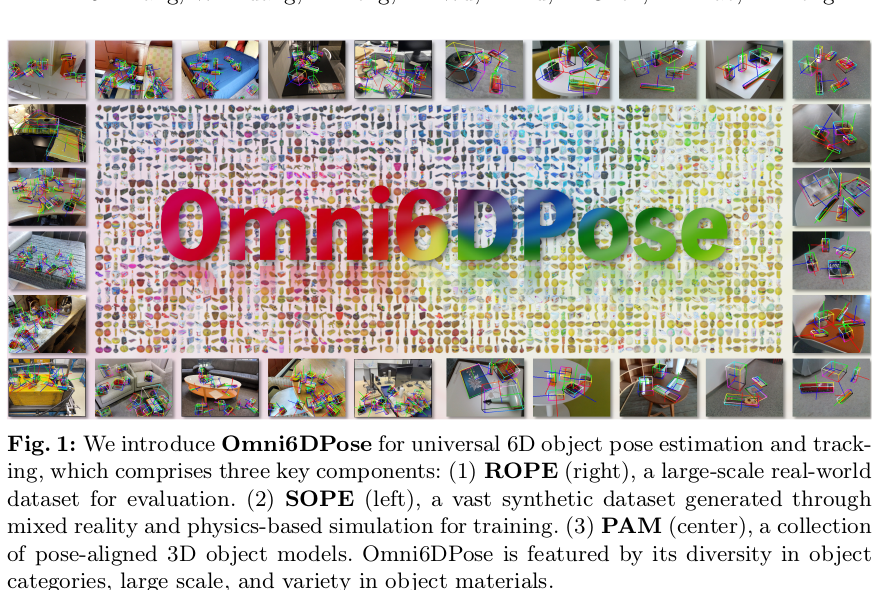
Original Figure 1: real RGB-D ROPE evaluation on the right, mixed-reality / depth-simulated SOPE training on the left, and manually canonicalized PAM meshes centrally. All share 149 categories. Source: published ECVA paper. Image copyright belongs to the authors and Springer Nature; reproduced here for academic analysis.Original Table 2: SOPE training, ROPE testing, and GT segmentation give GenPose++ AUC@IoU50 19.1 and VUS@5°5cm 15.1, still far from reliable universal pose. Source: published ECVA paper. Table copyright belongs to the authors and Springer Nature; reproduced here for academic analysis.
SOPE: 149 categories, 4,162 objects, 475K synthetic images, 5M+ annotations, with RGB, masks, NOCS, IR-left / right, and simulated depth.
PAM: shared pose-aligned models and metadata, manually standardized to category canonical frames.
Real capture: RealSense D415 videos with 2–6 objects and 762–1,349 frames. SfM / bundle adjustment recover cameras; multikeyframe 2D–3D pairs initialize object poses before manual cross-view refinement.
Synthesis: aligned objects composited into Matterport3D, ScanNet++, and IKEA real backgrounds; rendered structured-light IR stereo is matched into depth, reproducing transparent / specular depth defects.
5. GenPose++ method
GT masks provide segmented clouds and RGB crops.
PointNet++ geometry and frozen DINOv2 semantics undergo pointwise fusion.
Limits: GT-mask main pose tables; strict IoU75 AUC only 2.0; diffusion slower than CATRE; different BundleTrack / category-tracker initialization prevents equal-condition ranking.
Intended readers: large-vocabulary pose, diffusion distributions, transparent / reflective objects, depth simulation, tracking, and large real datasets.
Available src/paper-notes/omni6dpose-eccv2024/deep.md
In-depth paper notes
Support reproduction, comparison, related-work writing, and identifying opportunities for further research.
Paper Reading Notes (Deep): Omni6DPose
1. Key assessment
Universal here does not mean open-vocabulary or category-training-free. It means:
Training / test share 149 categories.
Test instances are unseen during training.
No test-instance CAD is provided.
Shared category-level representations support estimation and tracking.
Broad shapes, sizes, and transparent / specular materials.
This is much broader than six-category NOCS, but still known category, unseen instance, not arbitrary text categories or unknown-category zero-shot pose.
2. ROPE, SOPE, and PAM
Original Figure 1. ROPE supplies real evaluation, SOPE synthetic training, and PAM manually aligned meshes. Use final abstract / Table 1 counts of 581 / 4,162 instances. Source: published ECVA paper. Image copyright belongs to the authors and Springer Nature; reproduced here for academic analysis.
2.1 ROPE: real evaluation
149 categories;
581 object instances;
363 RGB-D videos;
332K images;
1.5M+ pose annotations;
RGB, depth, IR, CAD, mask, pose / scale metadata;
Transparent and specular objects.
EinScan H2 or Revopoint POP 3 scans take about 15 minutes for simple Lambertian small objects, up to 1 hour for complex, transparent, or large ones. Category canonical alignment takes about 1 minute per object.
RealSense D415 videos have 2–6 objects and 762–1,349 frames. Without appearance markers, SfM recovers camera-to-world Tc from scene features; farthest-point sampling selects keyframes. Manual 2D / 3D keypoints and cross-frame reprojection initialize object pose To before manual refinement across keyframes.
This improves consistency over per-frame annotation but assumes textured SfM scenes, stationary objects, and human resolution of material / symmetry ambiguity. Unlike PACE, no external-GT angular / millimeter annotation audit is given.
2.2 SOPE: synthetic training
149 categories;
4,162 instances;
475K images;
5M+ annotations.
Assets come from OmniObject3D, PhoCal, GoogleScan, and custom scans. Spatially context-aware mixed reality uses 19,658 Matterport3D, 2,572 ScanNet++, and 540 IKEA real backgrounds, compositing objects with random illumination / materials.
Depth is not ideal z-buffer output. Blender renders structured-light IR-left / right, then stereo matching produces holes, mismatches, and material-dependent noise. This matters for transparent / reflective pose: real D415 geometry failures are not simple Gaussian noise.
2.3 PAM: shared frames
PAM stores aligned meshes and metadata. Manual category canonicalization establishes common orientation for supervision but can introduce label ambiguity. For similar-looking objects with different functional axes, learning conventions may be harder than extracting image evidence.
3. GenPose++: semantic-conditioned generation
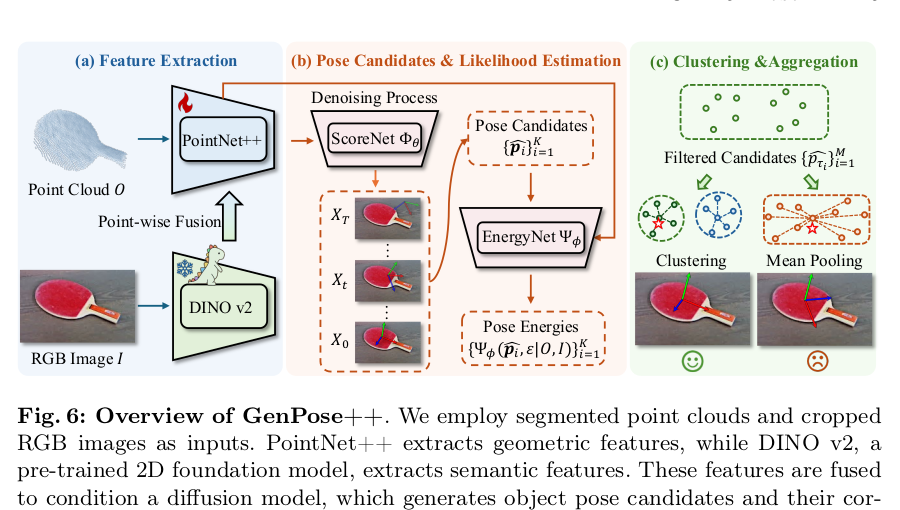
Original Figure 6: PointNet++ / DINOv2 encode geometry / semantics; diffusion scores generate candidates, energy removes low scores, and DBSCAN separates discrete symmetry modes before within-cluster averaging. Source: published ECVA paper. Image copyright belongs to the authors and Springer Nature; reproduced here for academic analysis.
Inputs are masked cloud O∈R3×N and RGB crop I. Unlike depth-only GenPose, GenPose++ uses:
PointNet++: local 3D geometry;
Frozen DINOv2 for appearance and category semantics.
Pointwise fusion aligning local RGB features with 3D points, beyond global concatenation.
Conditional score network Φθ learns through denoising score matching:
∇plogqt(p∣O,I),
Starting at p(1)∼N(0,σmax2I), probability-flow ODE integration runs from t=1 to ϵ to generate K candidates, with noise schedule σmin=0.01,σmax=50.
An independent energy network Ψϕ ranks candidates and retains δ=40%. This is candidate ranking / outlier filtering, not strict likelihood normalization.
4. Why means can break discrete symmetry
For objects with 180° discrete symmetry such as table-tennis paddles, posteriors may have two separated modes. Averaging their rotation representations can produce a mean valid for neither.
DBSCAN clusters filtered rotation candidates:
ϵ≈0.45 rad.
MinPts = 5;
No predefined cluster count.
Select the largest cluster.
Mean-pool only within it.
This makes the decision from multimodal probabilities to one pose explicit, with limits:
Largest clusters need not be visually correct, especially under uneven sampling.
Distance, rotation representation, and translation weighting affect clustering.
Outputs remain one pose rather than multiple equivalent hypotheses for downstream use.
Removing clustering loses only 1.6 mean VUS@10°5cm points; benefits concentrate in discrete-symmetry subsets.
A scale network regresses metric size from pose-conditioned observations. Removing it lowers IoU25 from 39.0 to 13.8 with unchanged pose VUS, showing that much box-overlap improvement comes from size rather than rotation / translation.
5. AUC / VUS are not single-threshold AP
GT instance segmentation is assumed to isolate pose from detection.
5.1 AUC@IoUn
Integrate accuracy-threshold curves above 3D IoU threshold n, reporting n=25 / 50 / 75. This differs from single-point AP@IoU50 and cannot be directly compared with NOCS mAP.
5.2 VUS@n°mcm
A success-rate surface spans rotation thresholds 0…n∘ and translation thresholds 0…m cm; volume under surface aggregates that range rather than one 5°5cm point. Normalization, grid sampling, and symmetry handling still matter.
6. Main ROPE estimation results
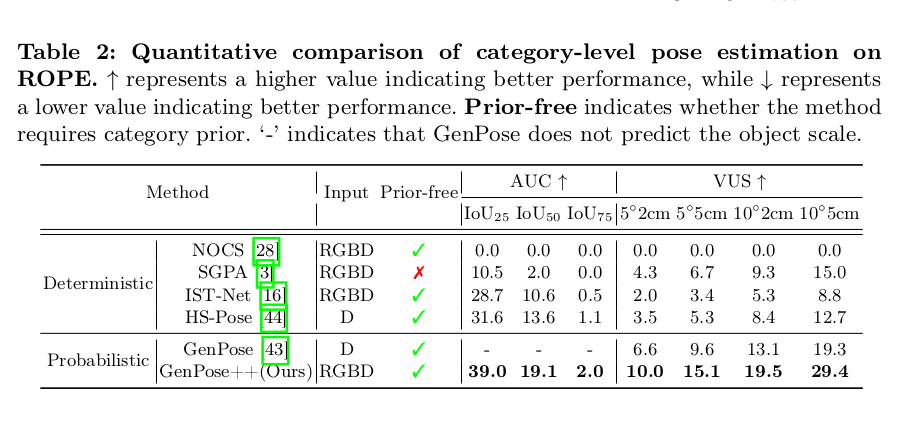
Original Table 2. All train on SOPE and test on ROPE. Except self-detecting NOCS, methods use GT detection / segmentation; NOCS zeros therefore do not isolate pose-head failure. Source: published ECVA paper. Table copyright belongs to the authors and Springer Nature; reproduced here for academic analysis.
Method
Input
AUC IoU25 / 50 / 75
VUS 5°2cm / 5°5cm / 10°5cm
SGPA
RGB-D
10.5 / 2.0 / 0.0
4.3 / 6.7 / 15.0
IST-Net
RGB-D
28.7 / 10.6 / 0.5
2.0 / 3.4 / 8.8
HS-Pose
D
31.6 / 13.6 / 1.1
3.5 / 5.3 / 12.7
GenPose
D
—
6.6 / 9.6 / 19.3
GenPose++
RGB-D
39.0 / 19.1 / 2.0
10.0 / 15.1 / 29.4
GenPose++ gains 5.5 VUS@5°5cm points over GenPose, supporting RGB semantic conditioning at scale. Absolute results remain low: IoU75 AUC 2.0 and VUS@5°5cm 15.1 do not establish reliable universal pose.
NOCS has all-zero results but uniquely performs detection and pose; others receive GT segmentation. Detector failures therefore confound this row, partially conflicting with the stated pose-only focus.
All baselines disable symmetry-specific augmentation because six-category NOCS rules do not scale to 149 categories. Distribution learning avoids hand-coded per-category augmentation but still relies on SOPE / PAM pose labels representing multiple modes.
7. What ablations show
Configuration
IoU25
IoU50
VUS 5°5cm
VUS 10°5cm
Full
39.0
19.1
15.1
29.4
w/o scale prediction
13.8
3.4
15.1
29.4
w/o clustering
38.6
18.7
14.1
27.8
w/o simulated depth
35.3
16.5
11.9
24.3
w/o point-wise fusion
34.2
15.4
10.6
21.9
Main pose gains are pointwise fusion +7.5 VUS@10°5cm, depth simulation +5.1, and clustering +1.6. Local RGB / geometry integration and realistic depth noise matter more to means than the conceptually prominent clustering module.
8. Tracking conditions differ
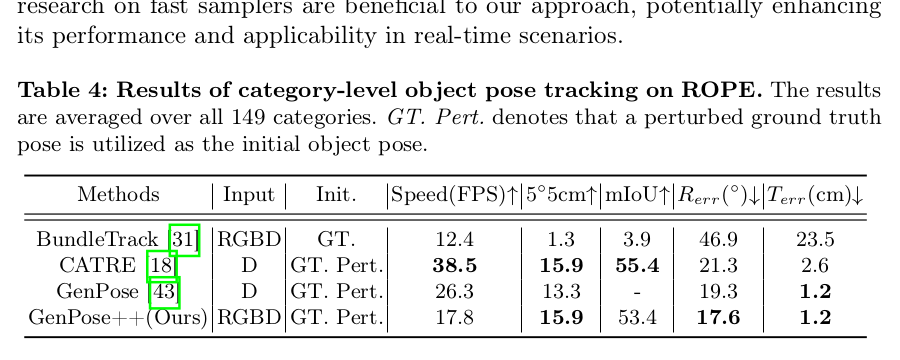
Original Table 4: GenPose++ reaches 17.8 FPS and 15.9 VUS@5°5cm. BundleTrack starts from GT, versus perturbed GT for three category trackers; it is training-free / unseen-object, while they learn SOPE canonical category space. Source: published ECVA paper. Table copyright belongs to the authors and Springer Nature; reproduced here for academic analysis.
Method
Initialization
FPS
VUS 5°5cm
mIoU
Rerr
Terr
BundleTrack
GT
12.4
1.3
3.9
46.9°
23.5cm
CATRE
Perturbed GT
38.5
15.9
55.4
21.3°
2.6cm
GenPose
Perturbed GT
26.3
13.3
—
19.3°
1.2cm
GenPose++
Perturbed GT
17.8
15.9
53.4
17.6°
1.2cm
GenPose++ ties CATRE in VUS with lower rotation error but about 46% of its speed. The paper suggests 17.8 FPS supports some manipulation; actual real-time performance also depends on segmentation, depth preprocessing, and hardware, without complete latency breakdowns.
BundleTrack’s RGB keypoints and global depth optimization struggle with weak texture and transparent / specular depth noise. It neither learns SOPE canonical spaces nor shares the same task: unseen-object tracking differs from the other three rows.
9. Limitations and interpretation pitfalls
Universal still means the 149 training categories, not open vocabulary.
GT-mask pose tables do not measure large-vocabulary detection.
NOCS’s own detector differs from other GT-mask baselines.
No external angular / millimeter audit of ROPE annotations.
Body text varies between 580 / 581 and 5,000 / 4,162; use final abstract / Table 1 scales.
Canonical alignment and symmetry remain partly conventional.
AUC / VUS cannot be directly compared with single-threshold NOCS mAP.
Tracking initialization, priors, and task scopes differ.
Diffusion PF-ODE iterations reduce speed; fast samplers remain future work.
Mixed reality / simulated depth ablations show benefits, not elimination of sim-to-real gaps.
10. Reproduction checklist
Distinguish ROPE, SOPE, PAM, and Meta; match real / synthetic metadata.
Use final counts of 581 / 4,162 instances.
Fix 149-category canonicalization and symmetry metadata.
Retain IR pairs, stereo depth, and perfect depth for ablations.
Compare GT / SAM / learned masks.
Use pointwise DINOv2 / PointNet++ fusion, not only global features.
Retain top 40% energy candidates.
Record DBSCAN rotation distances, ϵ, MinPts, and cluster failures.
Report pose, scale, IoU, and symmetry subsets separately.
Align tracking perturbations, masks, size, category priors, and hardware.
Time segmentation + sampling + aggregation end-to-end.
11. Overall assessment
Omni6DPose supplies complete infrastructure for the 2024 expansion from small tabletop categories to 149-category real video. ROPE / SOPE / PAM coordination, transparent / reflective materials, and structured-light simulation have engineering value; API, data, and GenPose++ are public.
GenPose++ supports foundation RGB semantics, sensor-aware depth, and multimodal pose distributions at scale. Yet 15.1 VUS@5°5cm and 2.0 IoU75 AUC show how far the problem remains from solved. The useful perspective is which large real-benchmark failures old methods / metrics miss, beyond treating it as another SOTA model.