OmniNOCS: A Unified NOCS Dataset and Model for 3D Lifting of 2D Objects
OmniNOCS unifies 10 sources into canonical NOCS data covering 97 categories, 380k images, and over 450k instances. NOCSformer predicts masks, NOCS, metric size, rotation, and centroids from external 2D boxes. On held-out NOCS-Real275, 3D IoU mAP@25 / 50 is 43.5 / 10.6, exceeding transferred Cube R-CNN but far below the target-domain-supervised NOCS model's 79.6 / 72.4.
OmniNOCS completes and unifies 10 sources including KITTI, nuScenes, ARKitScenes, Objectron, and Hypersim into canonical NOCS for 97 categories, 380K images, and over 450K instances. Shared NOCSformer takes RGB and 2D boxes, predicting masks, NOCS, metric size, orientation, and centroids. Transfer exceeds generic box-regression baselines, but target-domain localization still trails specialized supervision substantially.
3. Guide to figures and tables
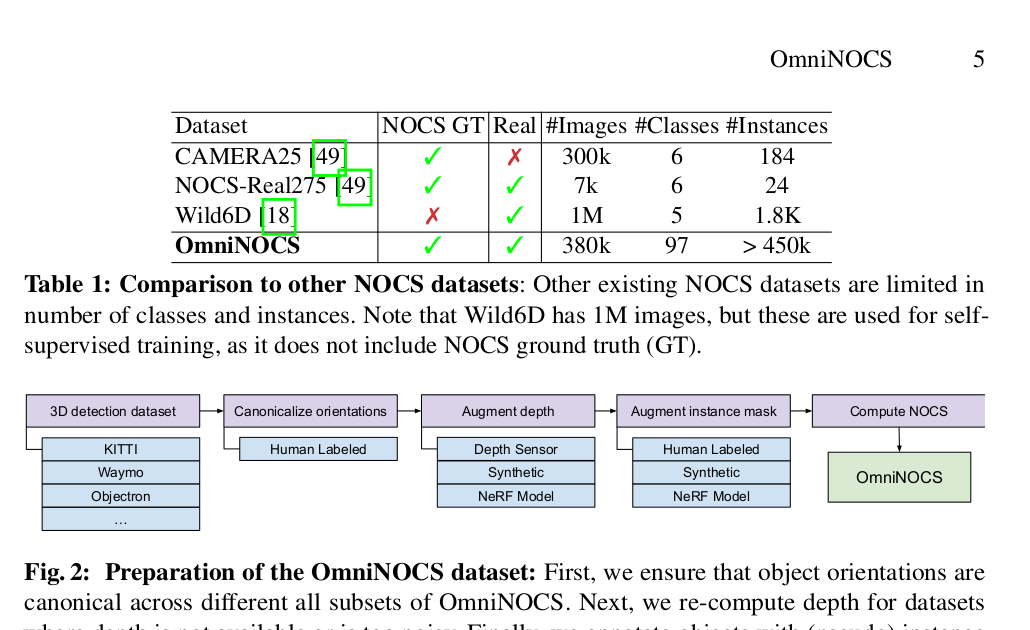
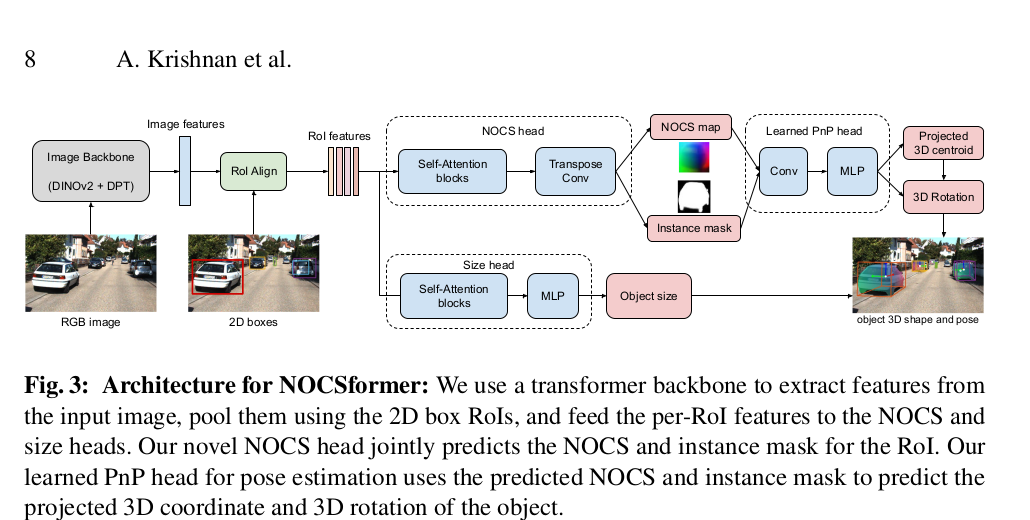
Original Table 1 and Figure 2: unify canonical orientations across 3D detection sources, complete depth / masks, then compute NOCS. The published body reports 97 categories, 380k images, and over 450k instances. Source: published ECVA paper. Figure / table copyright belongs to the authors and Springer Nature; reproduced here for academic analysis.Original Figure 3: frozen DINOv2, trainable DPT, and RoIAlign encode each 2D box. Transformer heads predict NOCS / masks, size recovers metric scale, and learned PnP outputs projected centers / 3D rotations. Source: published ECVA paper. Image copyright belongs to the authors and Springer Nature; reproduced here for academic analysis.
4. Problem setting
Input: one RGB image and externally supplied 2D boxes.
Output per RoI: mask, dense NOCS, metric 3D size, canonical orientation, centroid / oriented box; NOCS lifting also yields visible-surface clouds.
Learning: one shared 97-category model without class-specific heads / mean sizes. This is not open-vocabulary zero-shot inference; test categories need training-vocabulary coverage.
Supervision: NOCS, masks, size, rotation, centroids, plus NOCS reprojection loss.
System boundary: 2D box discovery is external, so Cube R-CNN detection / localization comparisons use unequal inputs.
5. Data and method overview
Combine 10 outdoor, indoor, synthetic, and object-centric sources.
Unify axes per dataset / category; manually select among 6 box-axis orientations when conventions are inconsistent.
Complete depth with LiDAR, depth cameras, stereo, synthetic data, or per-sequence NeRF.
Complete masks with humans, SAM, existing segmentation, or NeRF meshes.
Transform surfaces into canonical frames and normalize by tight-box diagonals.
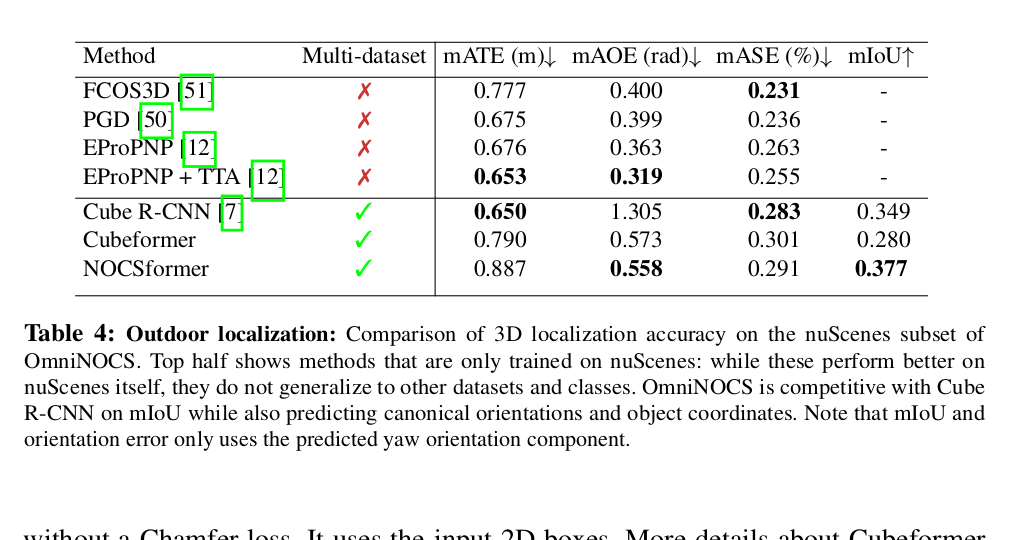
nuScenes subset: mATE 0.887 m trails Cube R-CNN 0.650 m; mAOE 0.558 rad beats 1.305 rad; mIoU 0.377 vs 0.349.
Transformer versus Mask R-CNN heads: PSNR +5.23 dB and mask IoU +21.27 points; discretization versus continuous regression adds +4.11 dB PSNR.
7. Quick assessment
Strengths: resolves inconsistent source frames; supplies data, direct NOCS metrics, shared models, and transfer tests, with richer outputs than cuboids.
Limits: external boxes, conventional symmetric / mirrored canonical frames, heterogeneous annotation noise, and substantial localization gaps to target supervision.
Intended readers: category pose, NOCS, monocular 3D detection, large multidataset training, and canonical-coordinate annotation.
Available src/paper-notes/omninocs-eccv2024/deep.md
In-depth paper notes
Support reproduction, comparison, related-work writing, and identifying opportunities for further research.
Paper Reading Notes (Deep): OmniNOCS
1. Key assessment
OmniNOCS identifies three infrastructure barriers to large-vocabulary NOCS:
Inconsistent object axes across 3D detection datasets.
Sparse or missing dense depth.
2D / 3D boxes without instance masks.
NOCS needs pixel-to-surface correspondence transformed into a consistent object frame; missing any component prevents map construction. Manual axis canonicalization, LiDAR / stereo / NeRF depth, and multiple mask sources complete the chain for 97 categories, 380k images, and over 450k instances.
NOCSformer uses one shared model to lift boxes into masks, NOCS, metric size, pose, and visible shape, without per-dataset / per-class heads or mean sizes. Transfer exceeds Cube R-CNN-style regression but does not eliminate domain supervision; target-trained NOCS remains much stronger for NOCS-Real275 localization.
2. Dataset composition
Original Table 1 and Figure 2. Unify box orientations, complete depth / masks, then transform camera-frame surfaces into canonical NOCS. Source: published ECVA paper. Figure / table copyright belongs to the authors and Springer Nature; reproduced here for academic analysis.
Ten sources:
Source
Depth
Mask
Images
Categories used
KITTI
LiDAR
Manual
7.4k
7
SUN RGB-D
depth camera
segmentation model
10k
72
Objectron
NeRF
NeRF + manual
132k
9
nuScenes
LiDAR
segmentation model
30k
9
Hypersim
synthetic
synthetic
64k
31
ARKitScenes
depth camera
segmentation model
60k
15
Cityscapes 3D
Stereo
Manual
3.4k
8
Virtual KITTI
synthetic
synthetic
4.1k
3
NOCS-Real275
Depth camera
Manual
7k
6
Waymo Open
LiDAR
Manual
62k
7
After merging / deduplication there are 97 categories and 380k images, not simple row sums. The paper additionally reports:
307k real, 73k synthetic;
107k outdoor;
102k complex indoor;
140k object-centric video;
Over 450k instances.
Scene-type counts are not mutually exclusive exhaustive subsets and should not be forced to sum to all 380k.
3. From heterogeneous detection data to NOCS
3.1 Canonical orientation
Categories need semantically consistent axes: for cars, X points forward and Z upward. Internally consistent sources receive fixed dataset / class rotation offsets. For sources such as Hypersim with inconsistent instance axes, humans select canonical orientation among 6 box-axis arrangements.
Conventions are unavoidable: symmetric objects admit equivalent orientations, and one is chosen arbitrarily. Labels are single-canonical even when the physical problem has multiple solutions.
3.2 Depth augmentation
Outdoor data prioritizes sparse LiDAR.
Noisy original Cityscapes depth is replaced with stereo-model depth.
Objectron lacks dense depth, so per-video NeRFs render it.
Indoor RGB-D / synthetic data use native / synthetic depth.
NOCS density, boundary noise, and scale-error distributions therefore differ across subsets. Large scale does not imply homogeneous precision.
3.3 Instance mask augmentation
ARKitScenes / SUN RGB-D prompt SAM with projected 3D boxes. Objectron fuses NeRF depth into meshes, then uses pixel-depth-to-surface distances for multi-frame masks and occlusion. Other sources use manual, existing-model, or synthetic masks.
3.4 NOCS definition
Camera-frame point xcam becomes:
xnocs=s1objTcamxcam,
Here s is the tight 3D-box diagonal. Unit-diagonal normalization preserves canonical orientation and relative shape.
One scalar is used, not independent XYZ scaling; metric shape needs separately predicted size.
4. NOCSformer
Original Figure 3. Boxes are inputs, not predictions. NOCS / mask, size, and orientation / centroid heads share DINOv2-DPT RoI features. Source: published ECVA paper. Image copyright belongs to the authors and Springer Nature; reproduced here for academic analysis.
4.1 Backbone and RoI
Frozen self-supervised DINOv2 ViT weights.
Trainable DPT fuses intermediate layers and upsamples 8×.
RoIAlign extracts 28×28 grids from external boxes.
Freezing reduces optimization difficulty, but heads still need large supervised training; NOCSformer is not a zero-shot foundation model.
4.2 NOCS / mask head
Ten self-attention blocks plus transpose convolution jointly predict NOCS / masks. Each axis predicts logits over 50 nonoverlapping bins, with softmax yielding continuous coordinates rather than direct linear regression.
Shared spatial reasoning for coordinates and foreground extent substantially exceeds small convolutional Mask R-CNN heads at scale.
4.3 Size and learned PnP
Self-attentive size heads use neither class-specific layers nor class-mean sizes. Predicted size converts normalized NOCS to metric coordinates.
Learned PnP predicts:
Allocentric rotation using a 6D representation.
The centroid’s 2D projection.
After converting rotation to egocentric coordinates, metric points, centroid rays, and corresponding pixels recover object depth. Classical PnP is discussed but considered more sensitive to noisy NOCS than learned solving.
4.4 Supervision
The total loss includes:
mask L2;
NOCS 50-bin cross-entropy + coordinate L1;
GT-pose-based NOCS reprojection.
normalized size CE + L1;
Rotation-matrix L1 and centroid L2.
Cross-dataset zero-shot means only that target NOCS-Real275 was held out; other data across 97 categories densely supervise NOCS / pose.
5. Beyond 3D boxes
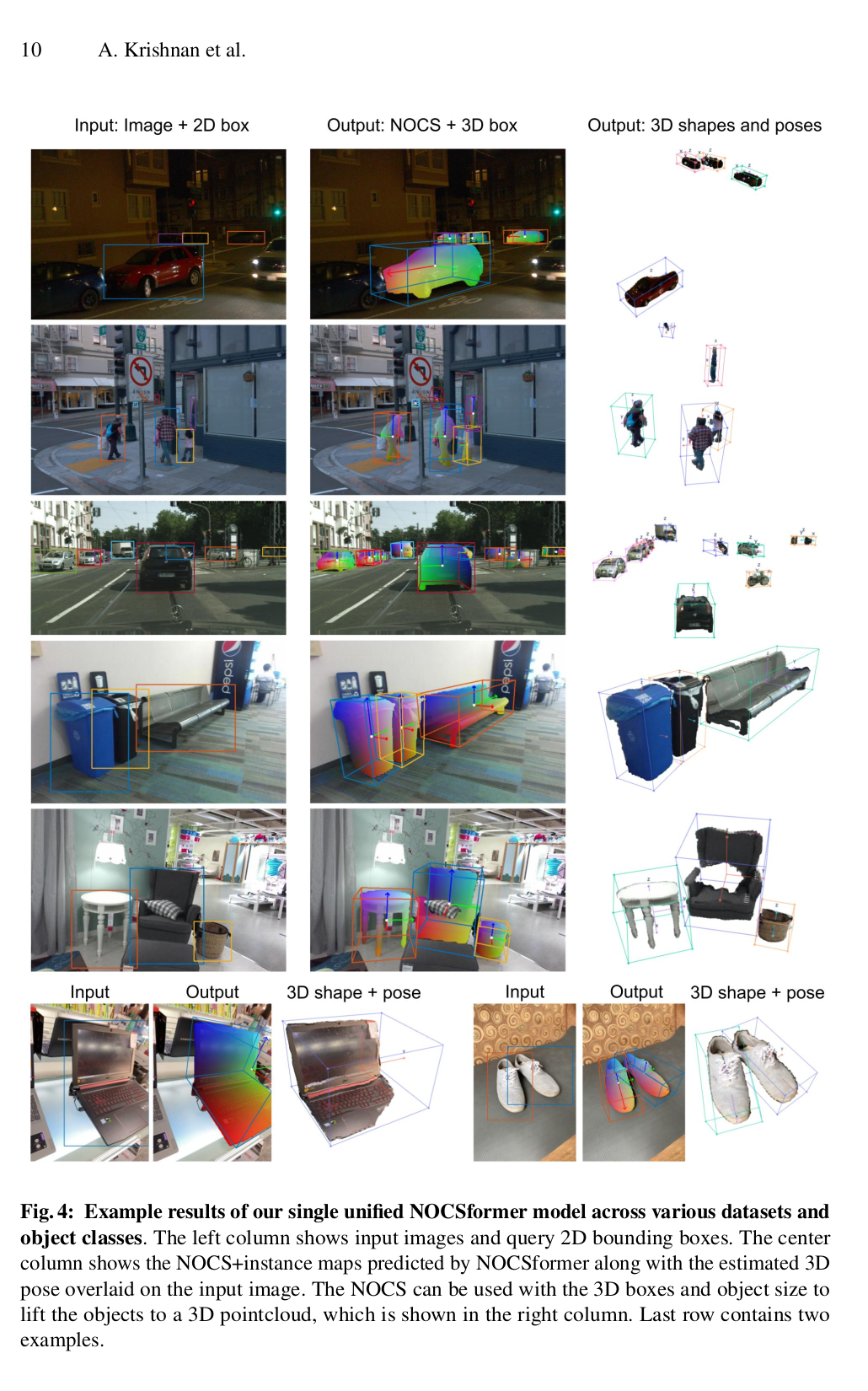
Original Figure 4: images / query boxes enter; central columns show NOCS, masks, and pose overlays; right columns lift NOCS / size into metric visible clouds. Source: published ECVA paper. Image copyright belongs to the authors and Springer Nature; reproduced here for academic analysis.
Beyond cuboid regression, NOCSformer also provides:
canonical dense visible-surface coordinates;
instance mask;
metric visible shape;
oriented 3D box / pose.
These clouds cover currently visible surfaces, not complete watertight reconstructions; occluded backs are not generated.
6. Direct NOCS metrics
NOCS mAE / mPSNR use GT / predicted-mask intersections; separate mask mIoU discourages sparse predictions scoring highly only on easy regions.
Test set
Method
NOCS mAE↓
NOCS PSNR↑
Mask IoU↑
NOCS-Real275
target-trained NOCS baseline
0.121
16.345
86.10
NOCS-Real275
transferred NOCSformer
0.107
18.527
89.03
OmniNOCS 75-class subset
NOCSformer
0.094
20.245
78.50
Held-out NOCS-Real275 dense coordinates / masks exceed the old target-trained model, but this does not imply superior final localization, as the next section shows.
7. Localization and transfer
Original Table 4: NOCSformer improves multidataset mAOE / mIoU but trails Cube R-CNN in mATE; nuScenes-specific methods remain stronger in that target domain. Source: published ECVA paper. Table copyright belongs to the authors and Springer Nature; reproduced here for academic analysis.
7.1 nuScenes subset
Method
Multidataset
mATE m↓
mAOE rad↓
mASE↓
mIoU↑
EProPNP + TTA
No
0.653
0.319
0.255
—
Cube R-CNN
Yes
0.650
1.305
0.283
0.349
Cubeformer
Yes
0.790
0.573
0.301
0.280
NOCSformer
Yes
0.887
0.558
0.291
0.377
Canonical orientation / overlap exceed the other two multidataset baselines, but translation is worst. Target-trained EProPNP + TTA remains clearly better in mATE / mAOE.
7.2 Held-out NOCS-Real275
Method
Target-domain training
Depth
3D IoU mAP@25
mAP@50
NOCS model
Yes
Yes
79.6
72.4
Cube R-CNN
No
No
14.9
4.1
NOCSformer
No
No
43.5
10.6
Gains over transferred Cube R-CNN are large, but gaps to target-trained NOCS remain 36.1 / 61.8 points. The steep @25-to-@50 drop suggests stronger coarse-localization than precision-pose transfer.
Cube R-CNN also detects boxes, while NOCSformer receives them; detection false positives / negatives affect the former’s mAP. The paper acknowledges unequal system comparisons.
7.3 Canonical orientation
On five KITTI-val classes, gravity-axis accuracy@5° is 99.95% and heading-axis accuracy@10° 59.65%, versus Cube R-CNN 18.29% / 21.55%. This supports unified canonical axes over Chamfer-invariant cuboid supervision for stable orientation.
8. Ablations and limitations
The full head reaches 20.431 dB NOCS PSNR and 81.69 mask IoU:
Hourglass head: -3.064 dB / -3.16 points;
Mask R-CNN head: -5.23 dB / -21.27 points;
Replacing 50-bin discretization with continuous regression: -4.11 dB.
Explicit paper limitations:
Multiple equivalent canonical frames make single-label symmetry losses unnatural.
Mirrored geometry such as left / right shoes requires reflection handling.
Boxes must come from external detectors or humans.
Additional site observations:
Depth / mask noise differs by source, without annotation-source error stratification.
Manual canonicalization reaches 97 categories, with unresolved cost / semantic disputes for larger open vocabularies.
Sharing 97 categories does not establish unseen-category open vocabulary.
NOCS clouds cover visible surfaces only.
No end-to-end detector + NOCSformer speed, memory, or throughput.
Precise target localization still relies substantially on domain-specific training and depth.
9. Reproduction checklist
Obtain each source’s licenses, versions, and train / validation splits.
Fix class ontology, axes, and class-specific rotation offsets.
Record manual 6-way canonicalization protocol and agreement.
Reproduce valid pixels / scale for LiDAR, stereo, NeRF, and camera depth separately.
Save mask sources; audit manual / SAM / model / synthetic subsets.
Report NOCS mAE / mPSNR / mask IoU, 3D boxes, and canonical orientation.
Separate held-out transfer from target-trained baselines; better transfer does not imply better target-domain performance.
10. Overall assessment
OmniNOCS contributes data engineering and task definition beyond a model increment, expanding NOCS to 97 categories, multiple cameras, indoor / outdoor scenes, and object-centric videos. Direct metrics isolate coordinate quality from final pose.
NOCSformer shows shared canonical transfer to unseen domains, exceeding transferred Cube R-CNN and old target-trained NOCS coordinate heads. Precise localization remains unresolved, with large @50 gaps to target supervision. The key lesson is that large-vocabulary pose first needs unified frames, annotation sources, and evaluation boundaries.