OmniPose6D: Towards Short-Term Object Pose Tracking in Dynamic Scenes from Monocular RGB
OmniPose6D generates 40,000 dynamic synthetic sequences of 100 frames each from 4,000+ OmniObject3D meshes. Its baseline samples CoTracker trajectories within the first-frame mask, trains uncertainty-aware refinement with five pixel-error levels, and selects co-visible points. COLMAP recovers first-frame-relative, up-to-scale object motion in 8-frame windows. Evaluation requires 7-DoF ground-truth alignment; each window takes around 10 seconds on an RTX 3090.
rigid objectinitial mask and video mask propagationsufficient object texture and parallaxCoTracker-style point trackingCOLMAP bundle adjustment7-DoF ground-truth alignment for metric evaluation
Full paper metadataAuthors, affiliations, research area, datasets, metrics, method tags, and reading statusExpandCollapse
Authors
Yunzhi Lin, Yipu Zhao, Fu-Jen Chu, Xingyu Chen, Weiyao Wang, Hao Tang, Patricio A. Vela, Matt Feiszli, Kevin Liang
Original paper terminology:KITTI translation error threshold AP / KITTI rotation error threshold AP / ATE threshold AP after 7-DoF alignment / RPE translation / rotation threshold AP
rigid objectinitial mask and video mask propagationsufficient object texture and parallaxCoTracker-style point trackingCOLMAP bundle adjustment7-DoF ground-truth alignment for metric evaluation
Reading Notes
Overview / Deep Dive
Available src/paper-notes/omnipose6d-iros2025/coarse.md
Paper overview notes
Quickly assess the paper's scope, problem setting, core method, experimental findings, and whether to read it in depth.
Paper Reading Notes (Coarse): OmniPose6D
1. Basic information
Title: OmniPose6D: Towards Short-Term Object Pose Tracking in Dynamic Scenes from Monocular RGB
Authors: Yunzhi Lin, Yipu Zhao, Fu-Jen Chu, Xingyu Chen, Weiyao Wang, Hao Tang, Patricio A. Vela, Matt Feiszli, Kevin J. Liang
Affiliations: Meta; Georgia Institute of Technology
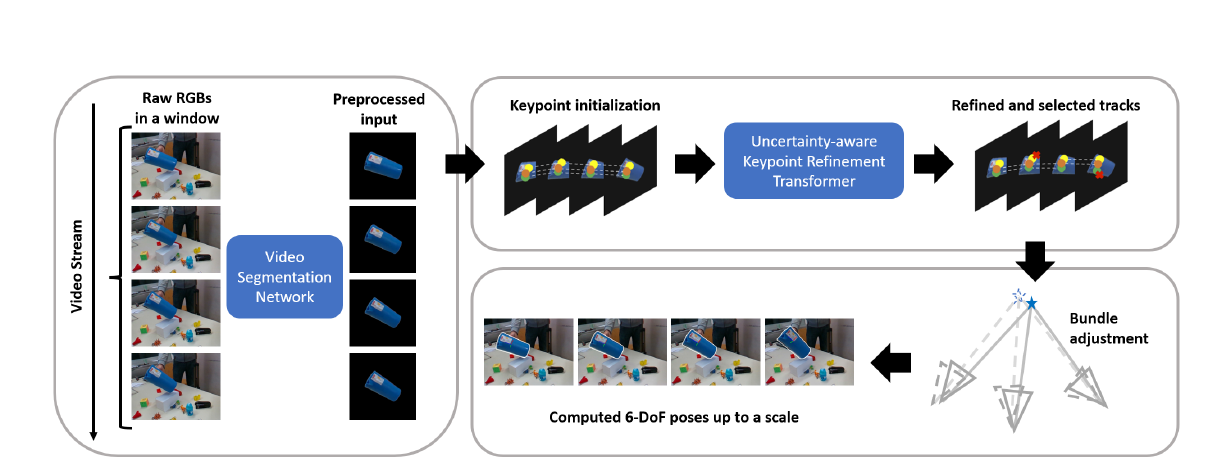
OmniPose6D generates 40K dynamic sequences of 100 frames from OmniObject3D meshes in BlenderProc. CoTracker tracks from first-frame masks enter an uncertainty-aware transformer, which retains reliable covisible points. COLMAP bundle adjustment then recovers first-frame-relative, up-to-scale object motion from 8 monocular RGB frames.
3. Guide to figures and tables
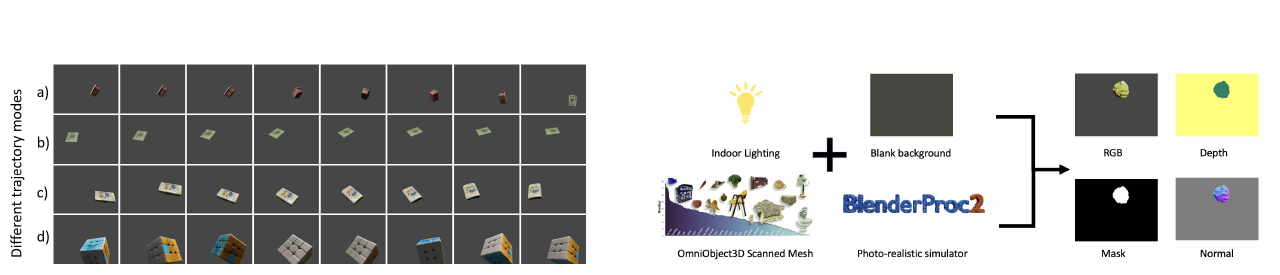
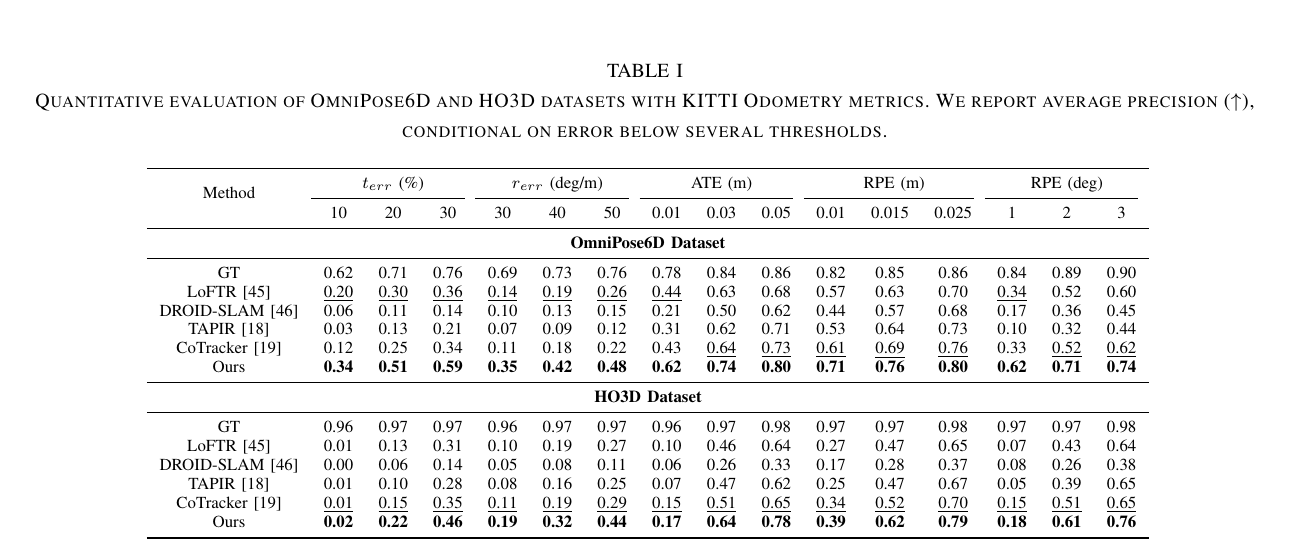
Original Figures 2–3: random walk, circling camera, noisy trajectories, and real-data trajectories. Scanned OmniObject3D meshes yield RGB, depth, masks, normals, and poses through BlenderProc. Source: authors' public manuscript. Image copyright belongs to the authors and IEEE; reproduced here for academic analysis.Original Table I: the method generally leads LoFTR, DROID-SLAM, TAPIR, and CoTracker across KITTI-odometry threshold AP on OmniPose6D / HO3D. All monocular predictions first receive GT-based 7-DoF alignment. Source: authors' public manuscript. Table copyright belongs to the authors and IEEE; reproduced here for academic analysis.
4. Problem setting
Task: rigid-object relative pose tracking in 8-frame windows.
Input: monocular RGB video and first-frame masks propagated by Track Anything.
Output: 6-DoF changes relative to the first frame, with translation only up to global scale.
No object CAD, category priors, test-time scans, or depth.
Not metric absolute camera-frame pose or online long-term tracking.
5. Dataset
Scale: 40,000 sequences × 100 frames, about 4 million frames.
Objects: 4,000+ cleaned OmniObject3D meshes, 203 categories, with 21 held out for validation.
Four groups of 10,000: random walk, circling camera, noisy trajectory, and HO3D real trajectories.
One foreground object per sequence, with blank backgrounds.
Labels include RGB, depth, pose, normals, and segmentation. Training adds boundary occlusion, color jitter, Gaussian / motion blur, shade, flips, and crop jitter.
6. Method overview
Track Anything propagates first-frame masks and crops object regions.
Speed: about 10 seconds per 8 frames on RTX 3090, an offline pipeline.
8. Quick assessment
Strengths: clear short-window model-free, RGB-only dynamic-pose benchmark; explicit links among data, tracks, uncertainty selection, and SfM.
Strongest evidence: synthetic fine-tuning consistently improves most HO3D metrics; both synthetic and HO3D exceed direct CoTracker + SfM.
Interpret carefully: metric ATE / RPE are conditional AP after GT-based 7-DoF alignment; the method does not recover real translation scale.
Main limits: offline 10 seconds per 8 frames; SfM fails with little texture, coplanar points, out-of-plane rotation, or insufficient translation / parallax.
Availability: no verifiable official code / data download links from paper or author pages at this site’s check time; not marked open source.
Available src/paper-notes/omnipose6d-iros2025/deep.md
In-depth paper notes
Support reproduction, comparison, related-work writing, and identifying opportunities for further research.
Paper Reading Notes (Deep): OmniPose6D
1. Key assessment
Two related contributions should be evaluated separately:
Data / task: short-term model-free monocular relative-object pose in dynamic scenes, with 40K synthetic sequences.
Method: object-motion synthetic fine-tuning, uncertainty classification, and track selection atop CoTracker, followed by standard SfM / COLMAP.
It turns point tracking into selecting stable, geometrically informative object tracks for multi-view geometry. Outputs remain first-frame-relative and up to scale, evaluated after GT-based 7-DoF alignment; this differs from CAD-input metric-translation trackers.
2. What 6D pose means here
Given monocular window {It}t=18 and a first-frame target mask, estimate per-frame rigid motion relative to the first. Besides object rigidity, implicit assumptions include:
Relative object motion can be treated as virtual-camera motion around a static object.
Monocular SfM cannot recover absolute scale. Object motion, camera motion, or both appear as relative motion; the method does not separate object motion from camera ego-motion.
3. Dataset
Original Figures 2–3. Four trajectory types are shown on the left; scanned meshes, lighting, blank backgrounds, and BlenderProc RGB / depth / masks / normals on the right. Source: authors' public manuscript. Image copyright belongs to the authors and IEEE; reproduced here for academic analysis.
3.1 Scale and objects
40,000 sequences;
100 frames each, approximately 4,000,000 total.
4,000+ scanned OmniObject3D meshes after Blender cleanup / decimation.
203 categories, including 21 validation categories.
One foreground object per sequence.
Scanned geometry / texture is more realistic than manual ShapeNet CAD, but blank backgrounds bypass scene realism through crops / masks rather than full interior synthesis.
3.2 Four motion types
Each has 10,000 sequences:
Random Walk: fixed camera, random 3D object motion.
Circling Camera: varying heights / views around objects.
Real Dataset Trajectories: short HO3D training hand-object motions transferred to different meshes.
The fourth narrows synthetic-to-interaction motion gaps, using HO3D training trajectories. Evaluation uses the official held-out set, without directly using test poses, but represents domain-targeted synthetic pretraining rather than unrelated-domain generalization.
3.3 Labels and augmentation
BlenderProc outputs RGB, depth, poses, normals, and instance masks. GT depth / poses project first-frame grid points into other views; depth consistency / cycle-projection errors determine visibility.
Random perturbed black circles at mask boundaries mimic hand / object occlusion, with radius 0.1–0.5 of mask size. Color jitter, Gaussian / motion blur, shade, flips, and crop shifts / scales add noise; occlusions remain simpler than real continuous hands.
4. From masks to tracks
Original Figure 4. Track Anything propagates regions; first-frame grid points receive CoTracker-style refinement and uncertainty selection before COLMAP bundle adjustment. Source: authors' public manuscript. Image copyright belongs to the authors and IEEE; reproduced here for academic analysis.
Track Anything propagates supplied / manual initial masks and crops to 512×512. Tracks / uncertainty can reject some boundary errors without perfect segmentation, but sustained wrong-object propagation lacks global geometric recovery.
Training:
N=8 frames per sample.
Adjacent samples are at most K=4 original frames apart.
Initial mask grid size = 3.
Randomly select 500 tracks for memory.
Network resolution 384×512.
CoTracker CNN downsamples 8× to 128D features.
Alternating temporal / group attention refines 4 times.
Distance-change threshold tdis=2.0 and scale-change threshold tscale=1.3.
Near-static frames violate SfM geometry and are filtered. The benchmark therefore favors windows with observable motion.
5. Uncertainty-aware refinement
The network jointly outputs:
Per-point per-frame 2D positions P^.
Visibility v.
uncertainty level.
Pixel error ei is prediction-to-GT L2 distance, divided into five bins:
[1,3,5,10,∞]pixels.
Balanced cross-entropy trains uncertainty softmax. Total loss:
L=Lkeypoint+5Lvisibility+5Luncertainty.
Keypoint losses weight four refinement updates with discount γ=0.8. Training uses AdamW, LR 5×10⁻⁴, 1-cycle, 100 epochs, 5,000 samples per epoch, batch 32, and 16 V100 GPUs.
Inference rejects invisible points, ranks the most likely uncertainty class, and retains reliable fraction R=0.95. Removing only the worst 5% avoids starving SfM of correspondences. Appendix Figure 7 also favors ratios >0.8.
6. From tracks to poses
Restore selected keypoints to image coordinates and organize all view pairs with valid covisible points. Default COLMAP mapping performs:
pairwise geometric estimation;
camera / object-relative pose initialization;
multi-view bundle adjustment.
Treating objects as local static worlds makes inverse virtual-camera motion represent relative object motion. The first frame is reference; poses remain defined only up to similarity.
Separating learned tracking from classical SfM is interpretable but inherits initialization, coplanarity, low-parallax, outlier, and window-connection constraints.
7. Evaluation: the main interpretation pitfall
KITTI-odometry-style metrics include:
Translation error terr (%).
Rotation error rerr (deg/m).
Absolute Trajectory Error (ATE);
Relative Pose Error (RPE translation / rotation).
Each table value is average precision below a specified error threshold, not mean error; higher is better. Monocular predictions first undergo Umeyama 7-DoF similarity alignment:
3D rotation;
3D translation;
1D global scale.
Metric thresholds such as ATE@0.03 m and RPE@0.015 m therefore follow GT-assisted frame / scale alignment. They measure trajectory shape and relative consistency, not independently recovered real translation scale.
GT rows need not equal 1: GT-visible correspondences enter the same SfM and remain limited by occlusion, coplanarity, and solving. They are pipeline-specific reference upper bounds.
8. Main results
Original Table I. The upper section tests 21 unseen synthetic categories; the lower is HO3D v3. Bold marks best predictions; GT correspondences reference the same SfM upper bound. Source: authors' public manuscript. Table copyright belongs to the authors and IEEE; reproduced here for academic analysis.
8.1 OmniPose6D validation
Five random sequences per each of 21 classes give 105 originals, split into 8-frame windows.
CoTracker gains are +0.13, +0.10, and +0.10. Synthetic data transfers to real interaction, with a remaining gap: RPE rot@2° falls from 0.71 to 0.61.
9. Ablations: data beyond uncertainty alone
HO3D with CoTracker weights:
Training source
ATE@0.03
RPE trans@0.015
RPE rot@2°
Original pretraining
0.52
0.54
0.50
OmniPose6D scratch
0.60
0.54
0.53
Pretraining + OmniPose6D fine-tuning
0.65
0.60
0.60
Synthetic dynamic-pose data is a major contributor complementary to TAP-Vid-Kubric pretraining.
uncertainty strategy:
Strategy
ATE@0.03
RPE trans@0.015
RPE rot@2°
No uncertainty
0.65
0.60
0.60
Remove by level
0.62
0.62
0.59
Retain 95% by ranking
0.64
0.62
0.61
Ranking slightly helps some RPE / rotation measures but lowers ATE@0.03 by 0.01 versus no uncertainty. Gains cannot all be attributed to uncertainty; fine-tuning, crops, refinement, and selection act together.
10. Additional real datasets
The appendix evaluates:
YCBInEOAT: 5 YCB objects, 9 approximately 1,000-frame dual-arm robot videos.
Near-linear YCBInEOAT object motion with little rotation challenges SfM. Ours does not lead every metric: RPE rot@2° 0.24 trails DROID-SLAM 0.34. On DexYCB, Ours generally leads listed predictions, e.g. RPE rot@2° 0.34 versus CoTracker 0.21.
Cross-dataset operation does not make every dynamic sequence observable: too little translation or near-linear motion can hinder monocular SfM.
11. Failure cases
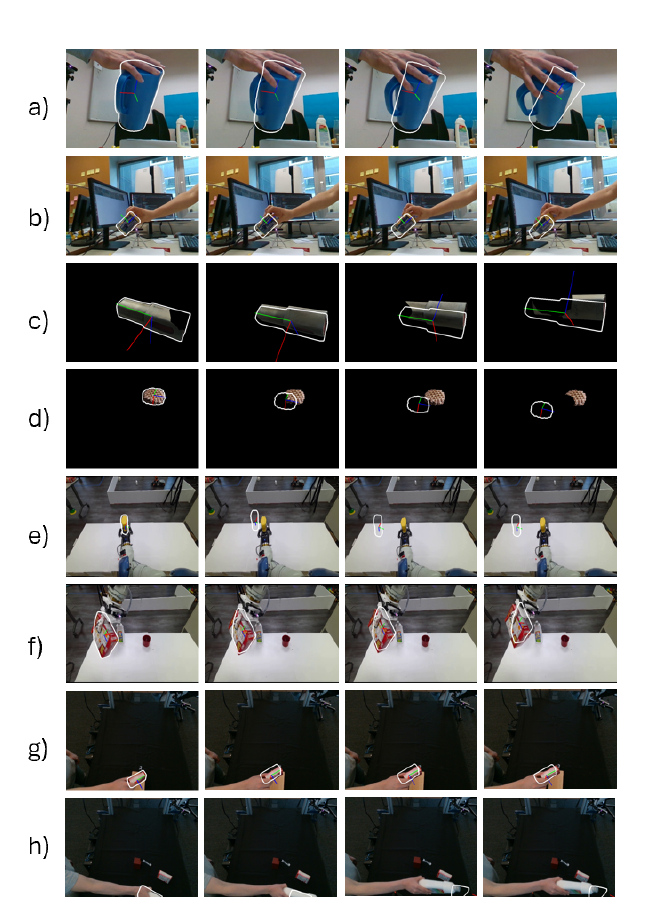
Original Figure 9: a–b OmniPose6D, c–d HO3D, e–f YCBInEOAT, g–h DexYCB. Site verification note: these labels follow the authors' caption. Panels a–b show hand-object scenes and c–d blank-background renders, suggesting a possible dataset-label mismatch; attribution awaits clarification, without relabeling by this site. Low texture, initially coplanar points, large out-of-plane rotation, small translation, and occlusion combine to cause failure. Source: authors' public manuscript. Image copyright belongs to the authors and IEEE; reproduced here for academic analysis.
Low texture combined with large out-of-plane rotation.
Small translation / parallax prevents relative-pose initialization.
DexYCB adds strong hand occlusion and small distant objects. The pipeline is offline and point selection heuristic.
12. Speed and deployment
An 8-frame 512×512 crop window takes about 10 seconds on RTX 3090, including refinement and COLMAP / BA. Amortized 1.25 s/frame cannot directly serve real-time robot control.
Cross-window consistency, accumulated drift, recovery, long-video memory, and latency remain unresolved. Short-term tracking is explicitly a foundation for future long-term methods.
13. Availability and reproducibility
At this site’s verification time:
arXiv and author publication pages were accessible.
No verifiable author-provided official code repository found.
No OmniPose6D download / license page found.
Papers with Code listed no implementation.
Metadata therefore marks it unavailable as open source. Even if released later, reproduction needs:
OmniPose6D clearly defines short-window CAD-free RGB-only relative-object motion, with supporting synthetic data and shared baselines. Generic trackers alone are insufficient; object-rotation data and reliable-track selection improve synthetic and real HO3D performance.
Deployable metric tracking remains distant: up-to-scale outputs, GT-assisted alignment, 10 seconds per 8 frames, SfM texture / parallax dependence, and unavailable code / data links. It is best positioned as a data and short-term relative-pose benchmark.