OP-Align: Object-level and Part-level Alignment for Self-supervised Category-level Articulated Object Pose Estimation
OP-Align uses E2PN's 60 rotation anchors to align a single partial point cloud globally to a category-shared canonical reconstruction. Predicted joint directions, pivots, and states align parts separately, while distance differences self-supervise part segmentation. It reaches 41 FPS and outperforms EAP on synthetic data, but real-data joint strict mAP is only 12.57. It requires known part counts, joint types, and training ground truth to calibrate evaluation frames.
single-frame RGB-D object point cloudexternal object segmentation mask
Requirements
known object categoryknown number of partsknown revolute / prismatic joint types and topologydepth and camera intrinsicsobject detector / segmentation modelcategory-specific self-supervised training
Full paper metadataAuthors, affiliations, research area, datasets, metrics, method tags, and reading statusExpandCollapse
Authors
Yuchen Che, Ryo Furukawa, Asako Kanezaki
Affiliations
Tokyo Institute of Technology / Accenture Japan Ltd.
known object categoryknown number of partsknown revolute / prismatic joint types and topologydepth and camera intrinsicsobject detector / segmentation modelcategory-specific self-supervised training
Reading Notes
Overview / Deep Dive
Available src/paper-notes/op-align-eccv2024/coarse.md
Paper overview notes
Quickly assess the paper's scope, problem setting, core method, experimental findings, and whether to read it in depth.
Paper Reading Notes (Coarse): OP-Align
1. Basic information
Title: OP-Align: Object-level and Part-level Alignment for Self-supervised Category-level Articulated Object Pose Estimation
Authors: Yuchen Che, Ryo Furukawa, Asako Kanezaki
Affiliations: Tokyo Institute of Technology; Accenture Japan Ltd.
Year / venue: 2024 / ECCV (official Oral + Poster)
Without training pose, part-segmentation, or joint labels, OP-Align first uses 60 discrete rotation anchors to align a partial single-frame cloud to category canonical reconstruction. Joint directions, pivots, and states then align each part. It reaches 41 FPS and exceeds self-supervised EAP on synthetic data, while real segmentation / pivots still trail supervised 3DGCN substantially.
3. Guide to figures and tables
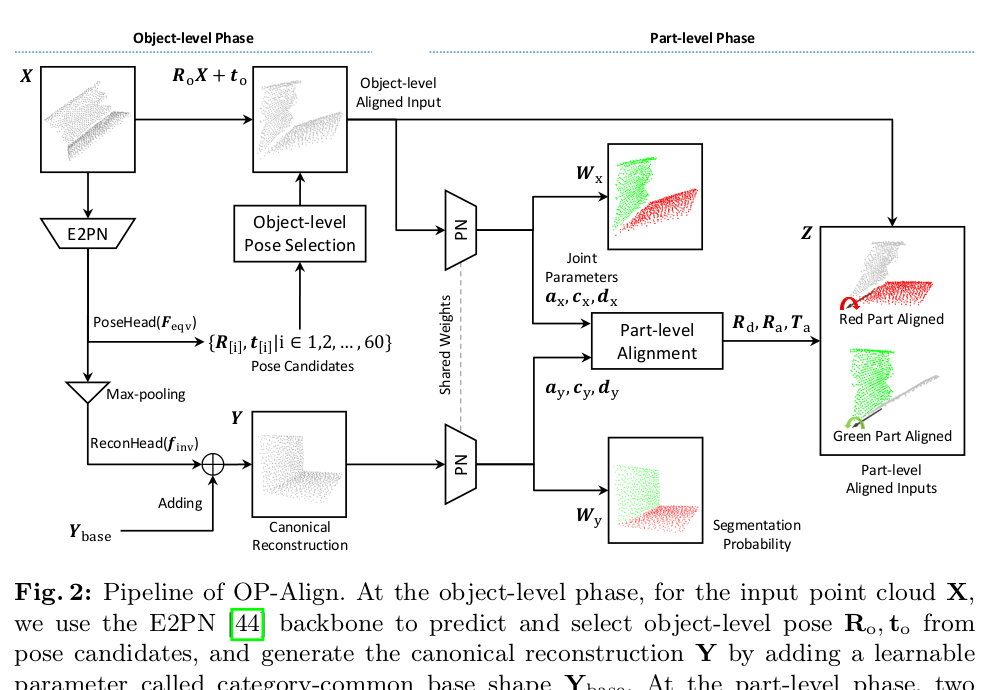
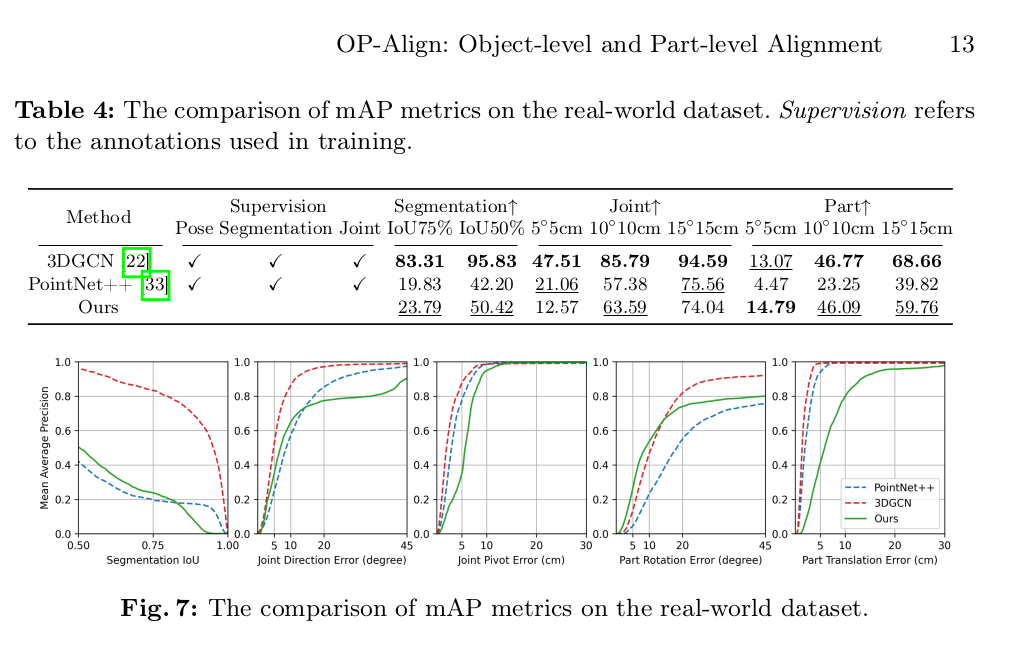
Original Figure 2: E2PN generates 60 pose candidates, selecting minimum reconstruction distance for global pose. Shared PointNets predict segmentation, joint directions, pivots, and states for part alignment. Source: published ECVA paper. Image copyright belongs to the authors and Springer Nature; reproduced here for academic analysis.Original Table 4 and Figure 7: label-free training gives strict / medium / loose part-pose mAP 14.79 / 46.09 / 59.76, but segmentation IoU@75 only 23.79 and strict joint mAP 12.57. Source: published ECVA paper. Figure / table copyright belongs to the authors and Springer Nature; reproduced here for academic analysis.
4. Problem setting
Input: segmented single-frame RGB-D object clouds, randomly sampled to 1,024 points; RGB is unused.
Output: pointwise part probabilities, joint directions / pivots, and per-part rotation / translation.
Generalization: same known categories, unseen test instances; separate models per category.
Known priors: part count, revolute / prismatic types, and topology; J=P−1, with each joint joining two distinct parts.
Self-supervision boundary: losses use no manual pose / shape / segmentation / joint labels, but evaluation calibrates emergent reconstruction frames to annotated frames using training GT and RANSAC.
5. Method overview
E2PN generates SE(3)-equivariant features for 60 icosahedral rotation anchors.
PoseHead predicts rotation / translation per anchor; minimum input–reconstruction Chamfer selects global pose.
ReconHead decodes invariant features plus a learnable shared base shape into canonical reconstruction.
Shared-weight PointNets process aligned inputs / reconstructions for parts and joint pivots / directions / states.
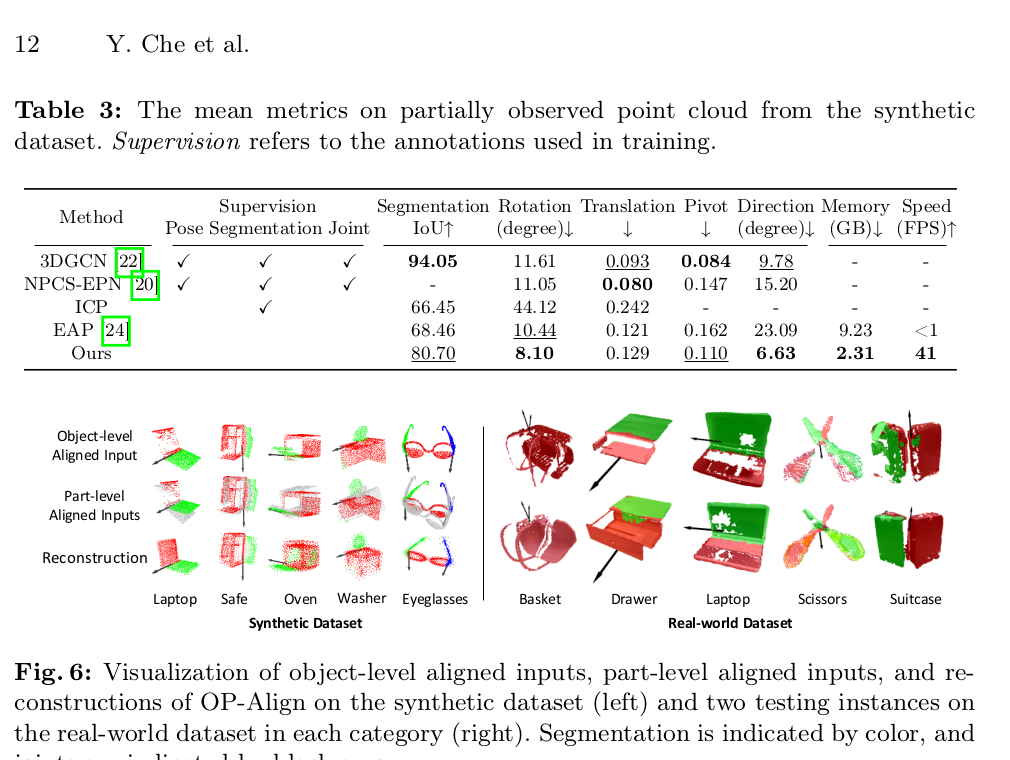
Versus EAP: segmentation 68.46→80.70, rotation 10.44°→8.10°, direction 23.09°→6.63°; translation slightly worsens 0.121→0.129.
Real data: most metrics exceed supervised PointNet++, but generally trail supervised 3DGCN. Comparable supervision-level results concern some part-pose thresholds, not segmentation / joints generally.
7. Quick assessment
Strengths: clear alignment roles, low label requirements, improved speed / memory over EAP, public real data and code.
Limits: per-category models, known counts / types / topology, missing-depth corruption of distance supervision, and training-GT evaluation-frame calibration.
Intended readers: category articulated pose, self-supervised 3D representations, articulated datasets, and SE(3)-equivariant point networks.
Available src/paper-notes/op-align-eccv2024/deep.md
In-depth paper notes
Support reproduction, comparison, related-work writing, and identifying opportunities for further research.
Paper Reading Notes (Deep): OP-Align
1. Key assessment
OP-Align decomposes articulated variation into two levels constrained by unlabeled geometry, beyond multiplying rigid pose heads:
Part-level alignment simulates joints, matching each part to canonical reconstruction.
Global alignment alone cannot align different joint states; directly supervised part segmentation is expensive. Correct part transforms instead bring that part closer to reconstruction while leaving others distant. Distances supervise membership indirectly, and membership weights distances in return.
The loop works on clean synthetic clouds at 41 FPS. Real missing points, outliers, and small parts weaken distance discrimination; results and failures reveal the supervision limit.
2. Inputs, outputs, and self-supervision boundaries
2.1 Inputs and outputs
Input X∈R3×N is a single-frame partial cloud back-projected from RGB-D, intrinsics, and masks. Training / inference sample N=1024 points without RGB features.
For categories with P parts and J=P−1 joints, outputs are:
Part probabilities W∈RP×N.
Joint pivots cj∈R3 and directions dj∈R3.
Revolute angles or prismatic displacements.
Per-part Ri,ti.
Part count and joint types are known, with each joint joining two distinct parts. This is not topology discovery or a universal articulated-structure model.
2.2 Self-supervision does not remove all evaluation labels
Training losses use no manual pose, part segmentation, pivot, or direction labels, consistent with self-supervised training.
Emergent canonical frames need not match annotated frames. Evaluation runs trained models on training samples, combines reconstruction-to-input poses with GT, and uses RANSAC for a common pose per reconstruction part. Test predictions then enter annotated coordinates through this calibration.
Distinguish:
Learning: no pose / shape / part / joint labels.
Benchmark frame calibration: training-set GT.
Test inference: only one cloud and known structural priors.
This preserves the training contribution without claiming label independence across the entire quantitative protocol.
3. Two-level alignment
Original Figure 2. Global pose, canonical reconstruction, segmentation, and joints form a loop through two alignment levels and weighted cloud distances, rather than independent branches. Source: published ECVA paper. Image copyright belongs to the authors and Springer Nature; reproduced here for academic analysis.
Here Ybase is a learnable category-shared base, stabilizing structure across instances while ReconHead expresses detail.
The authors state that Ro,to need not be precise before joint motion is handled; it reduces global-pose variance for subsequent nonequivariant PointNet processing.
Revolute states rotate by ay−ax around that direction.
Prismatic states translate by dy(ay−ax) along it.
Pivot translation moves input pivots to reconstruction pivots.
Each Zj,i aligns only one side’s part, leaving others displaced. This selective alignment makes reconstruction distances informative for segmentation.
For shared parts, legal joint-side-to-label assignments σ(j,i) are selected through segmentation-weighted Chamfer minimization. This matters for basket / eyeglasses parts connected to multiple joints.
3.3 Regularization against degeneration
Beyond object-level losses, part terms include:
Lp: segmentation-weighted alignment distances.
LregW: prevents every point joining one part.
LregP: shared parts aligned by different joint sides should coincide.
LregA: fixes reconstruction joint states at canonical zero.
LregJ: keeps pivots near objects rather than outside.
Weights are (λo,λp,λregS,λregD,λregW,λregP,λregA,λregJ)=(10,10,100,10,10,10,10,10). Per-category training uses 20,000 iterations, batch 24, Adam LR 10−4 halved every 5,000 iterations.
4. Datasets and evaluation
4.1 Synthetic data
EAP renders HOI4D / Shape2Motion meshes into single-view clouds for laptop, safe, oven, washer, and eyeglasses.
Metrics cover segmentation IoU, part rotation / translation, joint directions, and pivot-to-GT-axis point-to-line distances.
4.2 New real data
Captured with ASUS Xtion RGB-D:
Category
Train instances
Test instances
Train images
Test images
Joints
basket
4
2
974
449
2 revolute
drawer
4
2
884
452
1 prismatic
laptop
4
2
740
412
1 revolute
scissors
4
2
922
421
1 revolute
suitcase
4
2
813
381
1 revolute
Eight random states per instance, about 30 frames each; SAM / Mask R-CNN masks. Segmentation, part poses, pivots, and directions are supplied for evaluation.
Real mAP uses multiple thresholds. All part rotations / translations must pass together; joints test directions / pivots, segmentation IoU@50 / 75. Symmetric categories maximize mean IoU across label permutations, adding part-label tolerance.
5. Synthetic results: better than EAP, not every metric
Original Table 3 and Figure 6. Main EAP gains concern segmentation, rotation, and directions; translation slightly worsens. Right-side examples include synthetic / real test instances. Source: published ECVA paper. Figure / table copyright belongs to the authors and Springer Nature; reproduced here for academic analysis.
Method
Supervision
Seg. IoU↑
Rot.↓
Trans.↓
Pivot↓
Direction↓
Memory↓
FPS↑
3DGCN
pose + seg. + joint
94.05
11.61°
0.093
0.084
9.78°
—
—
EAP
None
68.46
10.44°
0.121
0.162
23.09°
9.23 GB
<1
OP-Align
None
80.70
8.10°
0.129
0.110
6.63°
2.31 GB
41
Versus EAP:
segmentation +12.24 points;
Rotation improves 2.34°.
Direction improves 16.46°.
About one-quarter memory; speed rises from below 1 FPS to 41.
Translation worsens slightly, 0.121→0.129.
Aggregate improvements are substantial, not universal across columns. Versus supervised 3DGCN, rotation / directions improve but segmentation, translation, and pivots worsen; unequal supervision prevents equal-cost ranking.
6. Real results: closer part pose, weaker joints / segmentation
Original Table 4 and Figure 7. Left-to-right curves show segmentation IoU, joint direction, joint pivot, part rotation, and part translation. Source: published ECVA paper. Figure / table copyright belongs to the authors and Springer Nature; reproduced here for academic analysis.
Method
Supervision
Seg. IoU@75 / 50
Joint strict / medium / loose
Part strict / medium / loose
3DGCN
pose + seg. + joint
83.31 / 95.83
47.51 / 85.79 / 94.59
13.07 / 46.77 / 68.66
PointNet++
pose + seg. + joint
19.83 / 42.20
21.06 / 57.38 / 75.56
4.47 / 23.25 / 39.82
OP-Align
None
23.79 / 50.42
12.57 / 63.59 / 74.04
14.79 / 46.09 / 59.76
Strict part mAP 14.79 slightly exceeds 3DGCN 13.07; medium thresholds nearly tie, but loose mAP trails by 8.90 points. Larger segmentation / joint gaps remain, especially joint strict 12.57 vs 47.51.
An equivalent pivot sufficient to align parts need not coincide with the physical mechanism. Geometric alignment objectives and semantic joint parameters are not identical.
7. Ablations, failures, and limits
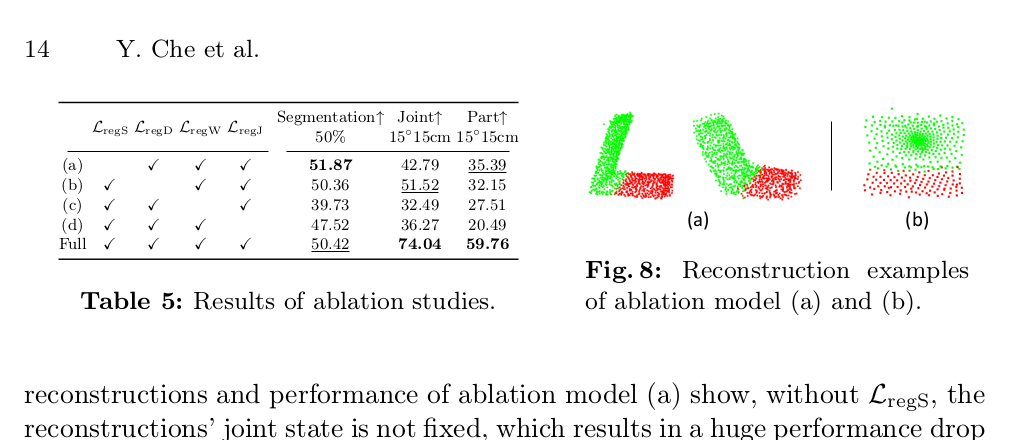
Original Table 5 and Figure 8: removing key regularizers degenerates reconstruction or joints; full-model joint / part loose mAP is 74.04 / 59.76. Source: published ECVA paper. Figure / table copyright belongs to the authors and Springer Nature; reproduced here for academic analysis.
Without shape-variance regularization, joint / part loose mAP falls to 42.79 / 35.39 and canonical joint state is unstable.
Without density regularization, reconstruction points cluster locally.
Without segmentation regularization, multipart objects collapse to one part and invalid joints.
Without pivot regularization, pivots drift outside and part loose mAP falls to 20.49.
Basket handles have median 16.9% of object points and little effect on overall shape. Reconstruction can already fit well without handle alignment, removing the incentive to discover it.
Broader risks:
Unseen joint regions allow multiple plausible structures from one partial cloud.
Per-category training lacks cross-category validation.
Known P, joint types, and topology exclude unknown counts / variable topology.
41 FPS measures pose-network inference, excluding detection, SAM / Mask R-CNN, RGB-D capture, and back-projection.
No cross-camera / dataset, heavy-occlusion strata, or confidence outputs.
8. Reproduction checklist
Verify 60 E2PN anchors, rotation conventions, and RoX+to direction.
Use 1,024 points, no RGB, and matching normalization.
Separate global CD/DCD, part-weighted distances, and assignment σ.
Share PointNet weights.
Check revolute / prismatic composition order of Rd,Ra,Ta.
Implement all eight losses / weights, especially joint / segmentation regularizers.
Calibrate evaluation canonical frames with training GT + RANSAC and state this explicitly.
Reproduce symmetric part-label permutation.
Separate network FPS from detection, segmentation, and cloud-construction latency.
Stratify small-part ratio, visibility, missing depth, and mask quality.
9. Overall assessment
OP-Align uses global alignment to reduce pose variation and part alignment to generate segmentation signals, learning single-frame category articulated pose without training labels and increasing EAP’s sub-1 FPS to 41 FPS.
Alignment success is not physical joint recovery. Some real part-pose thresholds approach supervised baselines, while segmentation / pivots lag; known topology and evaluation-frame calibration remain required. Within these boundaries, it is a useful entry point to self-supervised articulated pose.