Robust Category-Level 3D Pose Estimation From Diffusion-Enhanced Synthetic Data
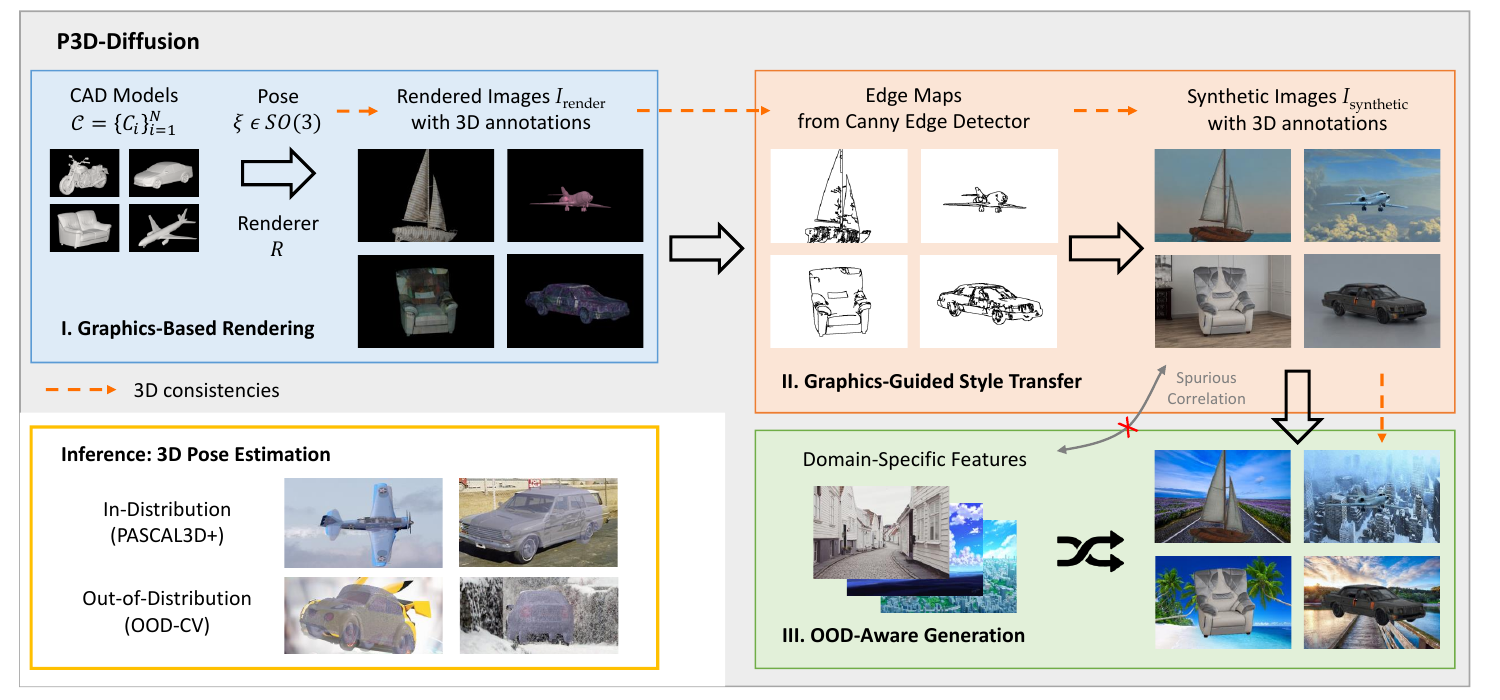
P3D-Diffusion fixes category-level 3D rotation labels with a renderer and augments appearance using Canny-edge-conditioned diffusion, DTD texture priors, and category-independent random backgrounds. CC3D adapts synthetic features to unlabeled real images through neural-mesh vertex correspondences. On PASCAL3D+, 10% real rotation labels yield 30° / 10° accuracy of 86.7 / 62.4 and MedErr 8.4°; 50% labels yield 90.7 / 71.4 / 6.9°. Translation / scale are not estimated, and diffusion-induced pose-label drift is not directly quantified.
single RGB object image at inferencecategory CAD models and rendered edge maps for synthetic trainingunlabeled real RGB images for CC3D adaptationoptional sparsely labeled real RGB images
Requirements
known object category and PASCAL3D+-style object cropcategory-level CAD models and cuboid neural meshgraphics renderer and edge-conditioned diffusion model for data generationunlabeled target-domain imagestest-time neural-mesh pose optimizationoptional 3D rotation labels for few-shot fine-tuning
Full paper metadataAuthors, affiliations, research area, datasets, metrics, method tags, and reading statusExpandCollapse
Authors
Jiahao Yang, Wufei Ma, Angtian Wang, Xiaoding Yuan, Alan Yuille, Adam Kortylewski
Affiliations
Peking University / Johns Hopkins University / University of Freiburg / Max Planck Institute for Informatics
known object category and PASCAL3D+-style object cropcategory-level CAD models and cuboid neural meshgraphics renderer and edge-conditioned diffusion model for data generationunlabeled target-domain imagestest-time neural-mesh pose optimizationoptional 3D rotation labels for few-shot fine-tuning
Reading Notes
Overview / Deep Dive
Available src/paper-notes/p3d-diffusion-wacv2024/coarse.md
Paper overview notes
Quickly assess the paper's scope, problem setting, core method, experimental findings, and whether to read it in depth.
Paper Reading Notes (Coarse): Robust Category-Level 3D Pose Estimation From Diffusion-Enhanced Synthetic Data
1. Basic information
Short name: P3D-Diffusion + CC3D
Authors: Jiahao Yang, Wufei Ma, Angtian Wang, Xiaoding Yuan, Alan Yuille, Adam Kortylewski
Affiliations: Peking University, Johns Hopkins University, University of Freiburg, Max Planck Institute for Informatics
Precisely view-labeled CAD renders become edges that condition realistic diffusion appearances, with backgrounds randomized independently of categories. A 3D-aware Neural Mesh Model and CC3D then align unlabeled real-image vertex features to the synthetic domain, improving PASCAL3D+ / OOD-CV orientation with few real rotation labels.
This estimates 3D rotation (azimuth, elevation, in-plane rotation), without metric translation, size, or full 6D pose. It is category-level orientation estimation; Table 2 accuracies are neither ADD(-S) nor BOP 6D results.
2.1 Guide to the paper’s figures and tables
Figure / table
Reading focus
Figure 1
CAD renders, edge-guided diffusion, background randomization, and OOD evaluation
Figure 2
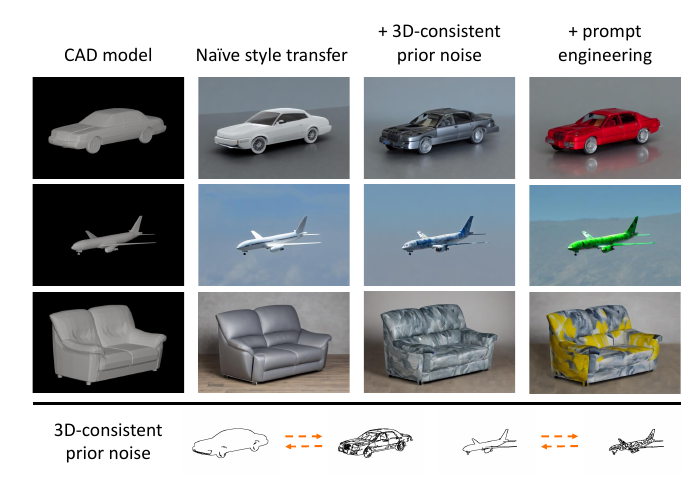
Naive style-transfer color / texture collapse; DTD priors and prompts for diversity
Table 2
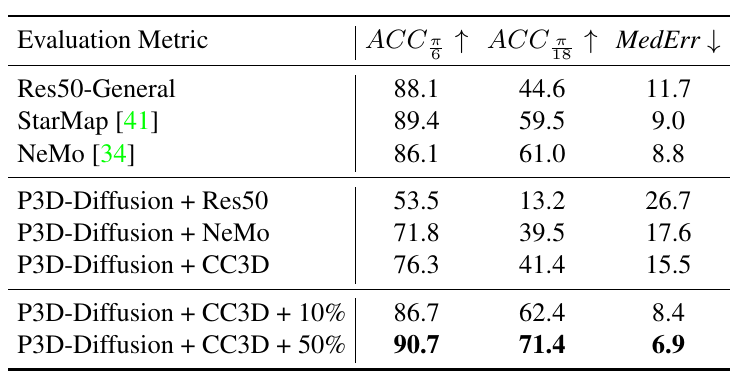
PASCAL3D+ versus full supervision with 0%, 10%, 50% real rotation labels
Table 3
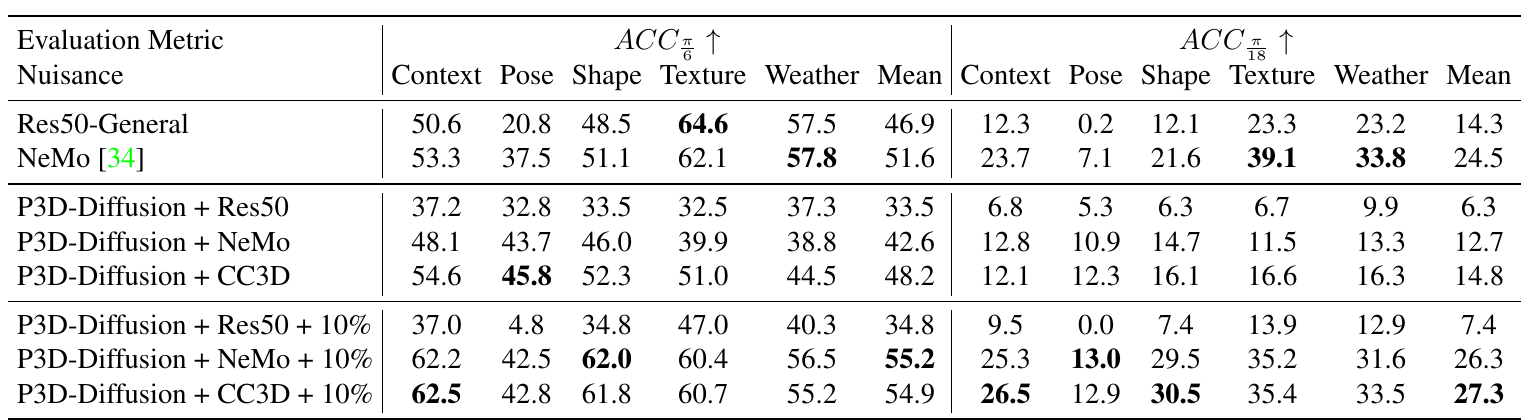
OOD-CV shape, pose, texture, context, and weather shifts
Original Figure 1: random $SO(3)$ CAD views render labels; Canny conditioning preserves pose structure during diffusion styling. Independently sampled backgrounds reduce category-context shortcuts; CC3D adapts neural meshes to real images. Source: CVF Open Access. Image copyright belongs to the paper's authors and publisher; reproduced here for academic analysis.
3. Problem setting
Task: category-level 3D orientation, allowing within-category geometry / appearance variation.
Training resources: category CAD, sampled rotations, Blender renders, DTD textures, 100 internet backgrounds, unlabeled real images; optionally 7 / 20 / 50 real labels per category, or 10% / 50% of full data.
Inference: one real object RGB image, using Neural Mesh Model / PASCAL3D+ detection and crop protocols.
Output: rotation matrices or azimuth / elevation / in-plane parameters.
Not output: translation, metric size, full 6D pose, or instance-CAD registration.
Objects: known train / test categories, mainly PASCAL3D+ / OOD-CV manufactured objects.
4. Core motivation
Real 3D labels are costly; CAD provides free labels with substantial sim-to-real gaps. The design separates:
Controllable geometry labels: renderer rotations.
Realistic / diverse appearance: edge-guided diffusion, DTD, random-color prompts.
Real data often encode car-road / boat-water shortcuts. Independently pairing 100 backgrounds with categories breaks correlations during generation rather than relying solely on model regularization.
5. Method overview
5.1 P3D-Diffusion data generation
For CAD Ci, rotation ξ∈SO(3), and background Bj:
To avoid uniformly similar, textureless generations:
Random DTD textures produce 3D-consistent prior noise in edges.
Random color / category prompts, e.g. red car, green aeroplane.
7,000 synthetic images per category.
Random selection among 100 category-independent internet backgrounds.
Original Figure 2: naive transfer gives similar colors / weak texture; DTD prior noise and random-color prompts diversify appearance. Visual diversity does not quantitatively establish unchanged rotation labels for every generated image. Source: CVF Open Access. Image copyright belongs to the paper's authors and publisher; reproduced here for academic analysis.
5.2 Neural Mesh Model and CC3D
Category cuboid meshes store learnable features per vertex. Known training poses relate ResNet50 image features to vertices; inference optimizes pose by gradient descent to match rendered vertex and image features.
CC3D adaptation:
Train neural meshes on synthetic images / exact rotations.
OOD-CV: 10 PASCAL3D+ categories with single-factor shape, pose, texture, context, or weather shifts.
Metrics: geodesic rotation error; ACC π/6 below 30°, ACC π/18 below 10°; lower median angular MedErr is better.
6.2 Main PASCAL3D+ results
Original Table 2: CC3D without real labels gives 76.3 / 41.4 / 15.5; 10% real labels give 86.7 / 62.4 / 8.4, slightly exceeding supervised NeMo's strict accuracy 61.0; 50% gives 90.7 / 71.4 / 6.9. Columns are 30° accuracy, 10° accuracy, median angular error. Source: CVF Open Access. Image copyright belongs to the paper's authors and publisher; reproduced here for academic analysis.
Training
ACC 30°
ACC 10°
MedErr
NeMo full supervision
86.1
61.0
8.8°
P3D-Diffusion + CC3D, no real pose labels
76.3
41.4
15.5°
P3D-Diffusion + CC3D + 10% labels
86.7
62.4
8.4°
P3D-Diffusion + CC3D + 50% labels
90.7
71.4
6.9°
Matching full supervision with 10% and exceeding it with 50% holds within Table 2, with unequal total data: CC3D also has 7,000 synthetic images per category and unlabeled real images. This measures manual 3D label efficiency, not total data / compute efficiency.
6.3 OOD-CV
Original Table 3: without real labels, CC3D mean 30° / 10° accuracy is 48.2 / 14.8, above same-data P3D-NeMo 42.6 / 12.7. With 10% labels it reaches 54.9 / 27.3; strict mean leads, but loose mean trails P3D-NeMo +10%'s 55.2. Not every OOD metric leads. Source: CVF Open Access. Image copyright belongs to the paper's authors and publisher; reproduced here for academic analysis.
No real labels: CC3D ACC 30° mean = 48.2, near supervised Res50 46.9 but below NeMo 51.6; ACC 10° mean = 14.8, above Res50 14.3, below NeMo 24.5.
With 10% labels: 54.9 / 27.3; loose mean trails P3D-NeMo 55.2, strict mean improves.
Generalization: break category-background correlations as well as randomizing texture.
Design: render-and-compare consistency can filter pseudo-labels beyond classifier confidence with 3D templates.
Baseline: category orientation, few-shot pose, and sim-to-real / OOD studies; not direct ADD(-S) / BOP instance-6D comparisons.
Deep-reading value: diffusion training data, weak rotation supervision, and OOD generalization.
9. Coarse-reading conclusion
Diffusion produces data with precise renderer labels, rather than directly predicting pose; neural meshes constrain synthetic-real correspondence. Its label efficiency / OOD evidence is useful, provided it remains category-level single-image orientation, without translation or guarantees of zero label drift.
Available src/paper-notes/p3d-diffusion-wacv2024/deep.md
In-depth paper notes
Support reproduction, comparison, related-work writing, and identifying opportunities for further research.
Paper Reading Notes (Deep): Robust Category-Level 3D Pose Estimation From Diffusion-Enhanced Synthetic Data
1. Basic information
Abbreviation: P3D-Diffusion + CC3D
Authors: Jiahao Yang, Wufei Ma, Angtian Wang, Xiaoding Yuan, Alan Yuille, Adam Kortylewski
Affiliations: Peking University; Johns Hopkins University; University of Freiburg; Max Planck Institute for Informatics
CAD rendering fixes 3D rotation labels; Canny-edge-conditioned diffusion changes appearance, and category-independent random backgrounds weaken spurious correlations. A Neural Mesh Model then adapts from synthetic to unlabeled real images: pseudo-poses establish real-feature / 3D-vertex correspondences for CC3D consistency loss. The result improves category-level orientation estimation with few PASCAL3D+ labels and under OOD-CV distribution shifts.
The most important task boundary
Here, 3D Pose means 3D orientation / rotation: azimuth, elevation, in-plane rotation, or an equivalent rotation matrix. The method does not estimate:
3D translation in the camera frame;
metric object scale;
instance-level CAD-to-image 6D alignment;
full SE(3) pose under the BOP definition.
This site includes it as category-level orientation and synthetic-data generalization research. All results are angular metrics and must be kept separate from ADD(-S), VSD, and BOP AR rankings.
2.1 Guide to the paper’s figures and tables
Figure / table
Paper claim
Boundary to examine
Figure 1
Rendering controls rotation, edge-guided diffusion improves realism, and random backgrounds break category–environment shortcuts.
Edge constraints do not guarantee zero pose-label drift after generation.
Figure 2
DTD texture priors and random color prompts mitigate color / texture mode collapse.
Qualitative examples, without quantified diversity or geometry preservation.
Table 2
10% real labels can match fully supervised baselines, while 50% can substantially outperform them.
Each category also uses 7,000 synthetic images plus unlabeled real images; the comparison concerns human pose-label efficiency.
Table 3
Synthetic variation and CC3D improve OOD-CV robustness.
They do not lead on every nuisance or threshold; texture / weather remain weaknesses.
Original Figure 1: upper left, CAD, random $SO(3)$ rotations, and rendering produce precise labels; upper right, render edges condition diffusion; lower right, foreground categories and backgrounds are sampled independently; lower left, category-level rotation is evaluated on PASCAL3D+ and OOD-CV. Neural-mesh adaptation with CC3D is not detailed here. Source: CVF Open Access. Image copyright belongs to the authors and publisher; reproduced here for paper analysis.
3. Problem setting and task boundaries
3.1 Task definition
From a single object RGB image I, predict rotation Rpred∈SO(3), interpreted as viewing-camera azimuth, elevation, and in-plane rotation. Error is geodesic distance on the rotation manifold:
Δ(Rpred,Rgt)=2\logm(RpredTRgt)F.
Three metrics are reported:
ACCπ/6: fraction of samples with Δ<30∘;
ACCπ/18: fraction of samples with Δ<10∘;
MedErr: median angular error in degrees.
3.2 Training inputs and outputs
Stage
Input
Output / supervision
Graphics rendering
Category CAD, random rotation ξ, materials / lighting
Rendered image, edge map, precise rotation label
Diffusion enhancement
Canny edges, color + category prompt, random background
Realistic-looking synthetic RGB retaining the rendered rotation label
Synthetic NMM training
Synthetic RGB and rotation labels
Feature extractor and feature prototype at each neural-mesh vertex
Unsupervised adaptation
Unlabeled real RGB
Initial pseudo-pose, mesh–image correspondence, CC3D domain loss
Semi-supervised fine-tuning
Optional few real rotation labels plus pseudo-labels
Final category-level orientation model
3.3 Inference
The Neural Mesh Model does not predict rotation in one pass through a classification head. It:
Extracts a 2D feature map with ResNet50;
Projects a cuboid neural mesh under a candidate pose;
Compares projected vertex features Cr with image features fi;
Optimizes pose parameters by gradient descent on feature reconstruction loss.
This is analysis-by-synthesis / render-and-compare. It is often more interpretable than one-pass classification, but runtime, initialization, and local minima require engineering evaluation. The main paper provides no complete latency / FPS table.
3.4 Priors and assumptions
The target category is known and category-level CAD models are available;
Training / testing follow PASCAL3D+ object crops and categories;
CAD render edges sufficiently constrain diffusion to preserve pose;
Synthetic pretraining yields enough accurate initial pseudo-poses on real images;
High mesh–image feature similarity correlates with correct pseudo-pose;
Cuboid meshes cover most visible object regions;
One rotation label reasonably represents category instances, without symmetry / annotation ambiguity dominating evaluation.
4. Research context
4.1 Two conventional approaches to category-level rotation
Classification / regression: discretize viewpoints into bins or regress angles directly. Res50-General is the representative baseline here.
Keypoint / render-and-compare: predict semantic keypoints for PnP, or render a 3D template and minimize reconstruction error. NeMo / Neural Mesh Models follow the latter route.
Classification is computationally direct but can depend on texture / background statistics. A 3D-aware neural mesh explicitly encodes vertex-to-image-feature correspondences, giving few-shot learning more structure.
4.2 Relationship to NeMo / NVSM
NeMo: a category-level cuboid neural mesh stores discriminative features at vertices and recovers rotation through inverse rendering.
NVSM: semi-supervised neural view synthesis and matching, a strong cited baseline with 7 / 20 labels.
This paper adds P3D-Diffusion on the data side and CC3D on the model side, aligning synthetic and real vertex features through pseudo-correspondences.
CC3D therefore extends NeMo synthetic training and unsupervised domain adaptation, rather than inventing a pose representation from scratch.
4.3 Where diffusion is used
Diffusion neither predicts rotation nor participates in test-time pose search. It performs graphics-guided style transfer only during data generation:
Structural condition: Canny edges;
Text condition: random color plus category;
3D-consistent prior noise: random DTD textures on CAD produce texture edges that change with surface projection / viewpoint;
Output: a more photographic foreground object composited with a random background.
The cited approach is ControlNet, Adding Conditional Control to Text-to-Image Diffusion Models.
5. Research motivation
5.1 Why rendering alone is insufficient
Large-scale CAD rendering gives precisely sampled rotation labels, but public CAD often lacks quality materials, and realistic lighting / specular effects are difficult to simulate. Networks can recognize synthetic style, while natural images change the feature distribution.
5.2 Why unconstrained generation is insufficient
Direct text-to-image generation of a car from the side has three problems:
View labels cannot be mapped precisely to SO(3) rotations;
Generation may change silhouettes, parts, or perspective;
Generated data may reproduce internet object–context bias.
The paper lets the renderer determine geometry / pose while diffusion changes appearance under edge control.
5.3 Why CC3D is still needed
More realistic diffusion images still differ from real features. Conventional feature-level adaptation lacks knowledge of which pixels correspond to one 3D surface point and may align unrelated regions.
The neural mesh supplies 3D vertex identity. A pseudo-pose maps a real feature to vertex r for alignment with synthetic Cr. This is more specific than global distribution matching: the same 3D location must be consistent across domains.
6. Method I: P3D-Diffusion
6.1 Basic generation formulation
Given CAD models C={Ci}i=1N and backgrounds B={Bj}j=1K:
Irender=R(Ci,ξ),ξ∈SO(3).
Naive generation combines rendering and background, but this method further uses:
E=CannyEdge(Irender),Isynthetic′=Ψ(E)⊕Bj,
Here Ψ is a pretrained edge-conditioned diffusion model and ⊕ denotes foreground / background compositing.
6.2 Where precise labels come from
Rotation labels come directly from rendering parameters ξ. Their validity relies on this chain:
Canny edges preserve silhouettes and major internal render edges;
ControlNet follows these edges;
Generated structure does not drift in a way that changes viewing rotation in 3D;
Thus ξ can remain the label of Isynthetic′.
Authors’ claim: graphics-guided generation preserves 3D consistency while making images realistic.
My analysis: a reasonable engineering approximation, but supported only by qualitative images and downstream performance. No keypoint reprojection, silhouette IoU, pose reannotation, or multiview measurement quantifies label preservation. It is likely usable for simple vehicles / chairs; thin, strongly articulated, or highly symmetric objects need further auditing.
6.3 Mitigating generation mode collapse
Initial edge-to-image outputs show similar colors and weak texture. Two interventions are added:
DTD textures: randomly texture CAD before rendering. View-dependent surface projections produce 3D-consistent prior noise, encouraging more local material variation in diffusion outputs.
Prompt engineering: use [random color] [category], such as red car / green aeroplane.
Original Figure 2: CAD render, naive style transfer, DTD-texture-based 3D-consistent prior noise, then random color prompting. Appearance diversity improves visually, but LPIPS, CLIP diversity, and geometric consistency are not quantified. Source: CVF Open Access. Image copyright belongs to the authors and publisher; reproduced here for paper analysis.
6.4 OOD-aware background generation
The paper discusses backgrounds through causality / spurious correlation: task semantics correlate with domain-specific context, such as cars on roads and boats on water. Models may infer category / pose from context, succeeding in-domain but failing elsewhere.
The implementation is simple:
Search the internet for wallpaper + street / jungle / market / beach, collecting 100 backgrounds;
Sample Bj independently of foreground category;
Create atypical combinations such as cars on beaches and boats in markets;
Compare against P3D-Diffusion-Spurious, which binds categories to typical backgrounds.
This is a concrete data-randomization intervention rather than complex causal identification.
6.5 Data scale
7,000 synthetic images per category;
CAD from PASCAL3D+ / OOD-CV;
Textures from the Describable Texture Dataset;
100 backgrounds;
Randomly sampled rotations;
Blender renderer.
The main text does not systematically specify diffusion version, sampling steps, guidance scale, resolution, per-image generation time, or rejection rate. Reproduction needs the code / supplement.
7. Method II: Neural Mesh Model and CC3D
7.1 Neural-mesh representation
A category object is represented as:
N={V,C},
where:
V={Vr∈R3}r=1R are cuboid mesh vertices;
C={Cr∈Rc}r=1R are learnable vertex features;
F=ΦW(I) is the ResNet50 2D feature map.
Synthetic training has GT rotations, allowing projection of mesh vertices to establish Cr↔fi correspondences. Cr is updated by a running average of corresponding training-image features.
7.2 Contrastive feature loss
Following neural mesh / CoKe approaches, features distinguish different foreground locations and foreground from background. The main text gives:
The negative sign encourages larger distances between different-location features when minimized, forming a spatially discriminative neural texture.
7.3 Reconstruction / inverse-rendering loss
At test time, project the mesh at candidate pose m. A Gaussian feature likelihood compares foreground pixels to corresponding vertex features and background pixels to background feature b:
Lrec(F,N,m,b)=−logp(F∣N,m,b).
Optimize m so that the current neural-mesh pose most likely renders the observed image features. This loss also trains neural features.
7.4 Domain-consistency loss
For real-image feature map F~ in the new domain, if a pseudo-pose associates vertex r with real feature f~r:
Ldomain(C,{F~})=r=1∑R∥f~r−Cr∥2.
Total loss:
Ljoint=Lcon+Lrec+αLdomain,
α brings terms to comparable scales.
7.5 Pseudo-label generation and filtering
Train NMM on synthetic data;
Optimize pose mest for each unlabeled real image;
Project the mesh to obtain foreground and vertex correspondences;
Average inner products between normalized image / vertex features:
Sconfidence=γ1i∈FG∑fi⋅Cr,
Here γ is the foreground-pixel count;
5. Select the 100 most confident real images and their pseudo-poses per category;
6. Optimize Ljoint using these pseudo-labels.
This 3D render-and-compare consistency is closer to pose matching than ordinary softmax confidence. However, top-100 selection likely favors common, unoccluded views resembling synthetic appearances, leaving difficult OOD examples underrepresented.
7.6 Training configuration
backbone: ImageNet-pretrained ResNet50;
Mesh: category cuboid dimensions are set manually / by rules to cover most object regions;
CC3D unsupervised adaptation: top-100 self-consistent pseudo-labels per category.
The paper does not report per-image test pose-optimization time, initialization count, iterations, memory, or complete training GPU-hours.
8. Experimental protocols
8.1 PASCAL3D+
11,045 training images;
10,812 validation images;
12 manufactured-object categories;
Category and object-pose annotations.
Three distinct evaluation scopes must be kept separate:
Table 1 few-shot: only 6 vehicle categories (aeroplane, bicycle, boat, bus, car, motorbike), with 7 / 20 / 50 labels per category;
Table 2 full comparison: full PASCAL3D+ scope, comparing 0%, 10%, and 50% labels with fully supervised training;
Table 4 ablation: 5 categories (aeroplane, boat, car, motorbike, train), so its full-model numbers differ from Table 2.
8.2 OOD-CV
OOD-CV covers 10 PASCAL3D+ categories and separates individual nuisances into:
context;
pose;
shape;
texture;
weather.
This diagnoses which shifts cause failures more clearly than one average over a mixed OOD set.
8.3 Baselines
Method
Representation / training
Relationship to this work
Res50-General
ResNet50 rotation classification
Baseline without explicit 3D structure
StarMap
Category-agnostic keypoints and viewpoint
Fully supervised comparison
NeMo
Neural-mesh render-and-compare
Main foundation for CC3D
NVSM
Semi-supervised neural view synthesis / matching
Strong few-shot baseline at 7 / 20 / 50 labels
P3D-Diffusion + Res50
Synthetic data and ordinary classification
Isolates data effects without a 3D-aware model
P3D-Diffusion + NeMo
Synthetic data and neural mesh
Isolates P3D data and NMM effects
P3D-Diffusion + CC3D
Synthetic data and 3D-aware domain adaptation
Full method
9. Main results I: few-shot PASCAL3D+
Table 1 reports 7 / 20 / 50 labels per category over 6 vehicle categories:
Method
Mean ACC 30°
Mean ACC 10°
Mean MedErr
Res50-General
45.3
24.8
28.5°
StarMap
40.0
10.1
41.3°
NeMo
53.1
31.8
38.5°
NVSM
60.4
33.6
30.1°
P3D-Diffusion + NeMo
80.0
57.1
13.9°
P3D-Diffusion + CC3D
81.1
58.6
13.6°
NeMo full supervision
89.3
66.7
7.7°
More specifically, CC3D with 7 / 20 / 50 labels gives:
ACC 30°: 79.1 / 80.6 / 83.5;
ACC 10°: 56.6 / 57.2 / 61.9;
MedErr: 16.2° / 15.0° / 9.7°.
Assessment: synthetic data contributes much more than the incremental CC3D gain over P3D-NeMo. Mean changes for P3D-NeMo→CC3D are only +1.1 / +1.5 / -0.3°, versus +26.9 / +25.3 / -24.6° for original NeMo→P3D-NeMo (the original NeMo mean MedErr is unusually higher than its 50-label value). Thus P3D-Diffusion data receives the strongest initial support in the few-shot table, followed by small, consistent CC3D benefits.
10. Main results II: fully supervised PASCAL3D+ comparisons
Original Table 2: CC3D without real pose labels and fine-tuning with 10% / 50% labels. Fully supervised baselines use all real annotations; CC3D variants additionally use synthetic and unlabeled real data. Interpret this as fewer human rotation annotations, rather than only 10% of total training data. Source: CVF Open Access. Image copyright belongs to the authors and publisher; reproduced here for paper analysis.
Method
Real pose-label fraction
ACC 30°
ACC 10°
MedErr
Res50-General
100%
88.1
44.6
11.7°
StarMap
100%
89.4
59.5
9.0°
NeMo
100%
86.1
61.0
8.8°
P3D + Res50
0%
53.5
13.2
26.7°
P3D + NeMo
0%
71.8
39.5
17.6°
P3D + CC3D
0%
76.3
41.4
15.5°
P3D + CC3D
10%
86.7
62.4
8.4°
P3D + CC3D
50%
90.7
71.4
6.9°
10.1 No real labels
CC3D versus P3D-NeMo:
ACC 30°: 71.8→76.3, +4.5 points;
ACC 10°: 39.5→41.4, +1.9 points;
MedErr: 17.6°→15.5°, a 2.1° reduction.
This directly validates cross-domain 3D consistency, but leaves a substantial gap to fully supervised StarMap / NeMo, particularly about 18–20 points at the 10° threshold.
10.2 10% real labels
ACC 30°: 86.7, near the fully supervised 86.1–89.4 range;
ACC 10°: 62.4, above fully supervised NeMo at 61.0 and StarMap at 59.5;
MedErr: 8.4°, slightly better than NeMo at 8.8°.
The claim of matching full supervision with 10% labels is broadly supported, but ACC 30° remains 2.7 points below StarMap; it does not surpass every fully supervised method on all three metrics.
10.3 50% real labels
90.7 / 71.4 / 6.9 outperforms all three fully supervised baselines in the table. Against the strongest baseline in each column:
ACC 30°: 90.7 vs 89.4, +1.3;
ACC 10°: 71.4 vs 61.0, +10.4;
MedErr: 6.9° versus 8.8°, a 1.9° reduction.
The largest gain is at the strict 10° threshold, indicating that synthetic data plus CC3D improves more than coarse orientation classification.
11. Main results III: OOD-CV
Original Table 3: 30° / 10° accuracy for context, pose, shape, texture, and weather. Without real labels, CC3D has higher means than P3D-NeMo. With 10% labels, 30° means are 55.2 for P3D-NeMo and 54.9 for CC3D, whereas 10° means are 27.3 for CC3D and 26.3 for P3D-NeMo. Leadership depends on the threshold. Source: CVF Open Access. Image copyright belongs to the authors and publisher; reproduced here for paper analysis.
11.1 Mean results
Method
Real pose labels
Mean ACC 30°
Mean ACC 10°
Res50-General
full supervision
46.9
14.3
NeMo
full supervision
51.6
24.5
P3D + Res50
0%
33.5
6.3
P3D + NeMo
0%
42.6
12.7
P3D + CC3D
0%
48.2
14.8
P3D + NeMo
10%
55.2
26.3
P3D + CC3D
10%
54.9
27.3
Without real labels, CC3D gains +5.6 / +2.1 points over P3D-NeMo, supporting vertex-level OOD adaptation. With 10% labels, they are close: CC3D leads at strict 10°, while NeMo’s 30° mean is 0.3 higher.
11.2 Nuisance details
Context: CC3D + 10% gives 62.5 / 26.5, its strongest OOD entry, closely related to background randomization.
Texture: 60.7 / 35.4, a large improvement with labels. Unlabeled CC3D at 51.0 / 16.6 still trails fully supervised NeMo at 62.1 / 39.1 substantially.
Weather: 55.2 / 33.5; without labels, 44.5 / 16.3. The paper identifies insufficient texture / weather realism in synthetic images.
11.3 Avoiding overgeneralization
Fully supervised NeMo’s ACC 30° mean of 51.6 exceeds unlabeled CC3D at 48.2;
Fully supervised NeMo’s ACC 10° mean of 24.5 substantially exceeds unlabeled CC3D at 14.8;
CC3D +10% does not lead every column: shape 30° and weather 30° are slightly below P3D-NeMo +10%;
Closing the gap is more accurate than claiming universal equivalence / superiority to full supervision.
12. Ablation studies
12.1 Style transfer and UDA
Table 4 uses a 5-category PASCAL3D+ subset:
Setting
ACC 30°
ACC 10°
MedErr
full model
79.2
52.0
14.1°
Without style transfer
75.9
47.8
17.1°
Without unsupervised adaptation
76.5
49.0
16.0°
Without both
70.6
46.5
23.6°
Interpretation:
Independent style-transfer gains are about +3.3 / +4.2 / -3.0°;
Independent UDA gains are about +2.7 / +3.0 / -1.9°;
Combined gains exceed either alone, supporting complementary realism and domain alignment.
Table 4’s full model is 79.2 / 52.0 / 14.1, versus Table 2’s 76.3 / 41.4 / 15.5 because category subsets differ; this is not directly a reproduction discrepancy.
12.2 OOD-aware backgrounds
Table 5 compares category-independent random backgrounds with category-correlated P3D-Diffusion-Spurious:
Dataset
Data variant
ACC 30°
ACC 10°
MedErr
PASCAL3D+
random background
76.3
41.4
15.5°
PASCAL3D+
spurious background
77.0
42.8
14.8°
OOD-CV
random background
48.2
14.8
37.0°
OOD-CV
spurious background
42.7
16.4
45.7°
Interpretation:
Typical backgrounds slightly help in-domain, consistent with shortcut learning;
Random backgrounds raise OOD-CV ACC 30° by 5.5 points and reduce MedErr by 8.7°;
Yet OOD ACC 10° drops from 16.4 to 14.8, so the main benefit is fewer large-angle errors, rather than better strict-threshold precision;
Substantially better OOD robustness is supported at 30° and median error, but not uniformly across metrics.
12.3 Missing key ablations
The main text does not separately report:
Label drift with versus without edge conditioning;
Separate downstream gains from DTD prior noise and color prompting;
Filtering versus retaining generated images;
Scaling backgrounds from 10→100→1,000;
Top-100 pseudo-labels versus thresholding / curriculum;
Aligning only high-confidence vertices within CC3D;
Test-time pose initialization and iteration count.
13. Robustness and failure cases
13.1 Occlusion and clutter
PASCAL3D+ contains natural images, but results are not broken down by occlusion ratio, truncation, or clutter. Neural-mesh projection needs enough foreground-feature / vertex matches; severe occlusion may lower both pseudo-pose quality and confidence, preventing hard examples from entering top-100 self-training.
13.2 Textureless / weakly textured objects
There is a 3D geometry prior, but vertex features still come from RGB. Manually added texture drives generation diversity and may encourage reliance on rich local appearance, offering uncertain transfer to plain industrial objects. Texture-shift results also show a substantial strict-10° gap.
13.3 Reflective / transparent objects
Not covered. Diffusion may generate specular-looking textures without accurately simulating view-dependent reflection, transmission, or sensor imaging. Label preservation is more hazardous for transparent / mirror-like objects.
13.4 Symmetry and category-label ambiguity
The paper compares against one GT rotation matrix without BOP-style symmetry equivalence. Visually equivalent symmetric poses may incur large angular errors; training annotations may also enforce an unobservable canonical direction.
13.5 Generation failures
Possible failures include:
Edge-conditioned generation adding or removing local structures;
Correct silhouettes but semantically misplaced parts;
DTD texture edges interpreted as actual object parts;
Foreground / background compositing leakage;
Implausible scale, contact, or perspective from random backgrounds;
Prompt colors shifting category appearance away from real distributions.
No automated quality filter or failure rate is reported.
14. Do experiments support the contributions?
Authors’ claim
Evidence
Sufficiency
My assessment
P3D-Diffusion narrows the synthetic-to-real gap
P3D-NeMo versus NeMo / P3D-Res50 in Tables 1–2
Fairly strong
Large downstream gains, but realism and label fidelity lack direct quantification
CC3D improves ordinary synthetic transfer
P3D-NeMo versus P3D-CC3D in Tables 1–3
Strong
Additional gains in-domain and OOD, especially unlabeled OOD
10% labels approach full supervision
Table 2
Strong within scope
ACC 30° trails the best baseline; ACC 10° / MedErr slightly improve, with substantial extra synthetic and unlabeled data
50% labels outperform full supervision
Table 2
Strong
All three metrics exceed listed baselines, especially ACC 10°
OOD-aware backgrounds break spurious correlation
Table 5
Partial
ACC 30° / MedErr improve substantially, but ACC 10° declines; only one background strategy is tested
Generated images retain precise 3D labels
Edge design, Figures 1/2, downstream results
Insufficient
No direct label-drift / geometry-consistency measurement
15. Critical analysis
15.1 Strengths
Clear task decomposition: rendering controls pose, diffusion appearance, CC3D domain correspondence, and random backgrounds shortcuts.
3D-aware adaptation: vertex identity aligns features of the same 3D location, rather than blindly matching global distributions.
Strong annotation-efficiency evidence: 10% / 50% label results matter when human rotation annotation is expensive.
Concrete OOD evaluation: OOD-CV separates five nuisance types, exposing differences across context, texture, and weather.
Useful comparison levels: Res50, NeMo, and CC3D distinguish contributions from a 2D backbone, 3D-aware backbone, and 3D-aware UDA.
15.2 Weaknesses
Incomplete 6D pose: no translation / scale, leaving a substantial gap to common instance-level manipulation protocols.
Insufficiently tested label-preservation assumption: diffusion can respect edges while changing 3D semantics.
Unreported total resources: generating 7,000 diffusion images per category, storage, and filtering time are absent from data-efficiency accounting.
Unknown inference efficiency: gradient-based render-and-compare may be slow and sensitive to initialization.
Pseudo-label selection bias: top-100 images per category may cover only easy samples and common views.
Narrow coverage: 100 backgrounds, PASCAL3D+ CAD, and manufactured categories do not establish generalization to open categories or industrial objects.
Incomplete statistics: no multi-seed variance; 10% / 50% subsets are described as one random selection after shuffling.
15.3 Implicit assumptions
Edge maps suffice to preserve pose;
Category cuboid-vertex identities remain semantically consistent across instances;
Ldomain does not amplify pseudo-pose errors;
Random backgrounds do not create stronger compositing-artifact shortcuts;
Synthetic material variation covers major real texture / weather changes;
A single PASCAL3D+ canonical rotation adequately describes symmetric categories.
15.4 Practical feasibility
The approach is attractive for coarse / moderate category-level orientation of vehicles or furniture, especially with costly real pose labels and plentiful CAD. Robotic grasping would additionally need at least:
3D translation and metric scale;
Robustness to instance-mask / detector errors;
Symmetry-aware evaluation and multimodal output;
Occlusion / clutter handling;
Inference latency measurements;
RGB-D or multiview geometry constraints;
Testing on transparent, reflective, and weakly textured industrial objects.
16. Reproduction guide
16.1 Minimal data pipeline
Select 1–2 PASCAL3D+ categories and official CAD models.
In Blender, sample SO(3) rotations uniformly / according to the paper, saving camera parameters.
Apply random DTD textures and render RGB, silhouettes, depth, normals, and Canny edges.
Generate object images with matching ControlNet checkpoints, sampling steps, seeds, and prompt templates.
Composite with category-independent backgrounds.
Manually sample outputs and audit pose-label drift through silhouette IoU, edge alignment, and keypoint reprojection error.
16.2 Minimal model pipeline
Reproduce NeMo / NMM baselines on annotated real data.
Train the ResNet50 feature extractor and cuboid neural mesh with P3D synthetic labels.
Run multistart pose optimization on unlabeled real images.
Compute Sconfidence and select top-100 pseudo-labels per category.
Add Ldomain while preserving Lcon / Lrec and their original settings.
Reevaluate PASCAL3D+ at 0% / 10% / 50% labels and all five OOD-CV nuisances.
16.3 Information to record
ControlNet / base diffusion checkpoints and licenses;
Build a geometry-audited diffusion data engine, jointly conditioned on silhouettes, depth, normals, and canonical correspondence. Differentiable pose reestimation assigns each synthetic image label confidence. Train jointly with a foundation-feature neural mesh and extend to category-level SE(3) with symmetry-aware multiple hypotheses.
19. Open questions
Conceptual questions
Do category cuboid vertices really represent the same local semantics across instances?
Do random backgrounds reduce shortcuts or merely broaden low-frequency statistics?
What balances diffusion realism against pose-label fidelity?
Mathematical questions
Does the implementation of the negative-distance Lcon add normalization, margins, or temperature?
What value and schedule are used for α?
Does confidence weight visible vertices or all foreground pixels?
Experimental questions
What variance results from repeated 10% / 50% label sampling?
What pose errors emerge from human reannotation of generated images?
Why do random backgrounds reduce OOD Table 5 accuracy at 10°?
How much gain comes from rendering texture randomization alone, without diffusion?
Has 7,000 images per category saturated performance?
Engineering questions
Per-image diffusion generation time and total GPU budget;
Test-time pose-optimization latency and multistart count;
Whether code fully supplies generation, CC3D, and benchmark configurations;
Redistribution and copyright status of the 100 internet backgrounds.
20. Final assessment
Authors’ claims
P3D-Diffusion supplies realistic, diverse synthetic data with precise 3D annotations; CC3D uses neural-mesh geometry for cross-domain consistency. Together they approach full supervision with 10% real labels, exceed listed fully supervised baselines with 50%, and improve OOD robustness.
My analysis
Core annotation-efficiency and synthetic-transfer results have strong support: PASCAL3D+ gives 86.7 / 62.4 / 8.4° with 10% labels and 90.7 / 71.4 / 6.9° with 50%; unlabeled CC3D also clearly improves P3D-NeMo. OOD claims require restraint: CC3D +10% has the best 10° mean, but a slightly lower 30° mean than P3D-NeMo +10%, while random backgrounds do not benefit strict 10° accuracy.
The largest gaps are pose-label fidelity after diffusion and complete engineering costs. This method recovers only category-level rotation and should not be treated as complete 6D object pose. It is valuable for studying controlled rendering, generation, and 3D-aware adaptation together, but supplies only the data and representation front end of a robotic SE(3) pose solution.