PACE: A Large-Scale Dataset with Pose Annotations in Cluttered Environments
PACE provides 300 real cluttered videos, 55K frames, and 258K pose annotations spanning 238 objects, 43 categories, and rigid / articulated objects, plus 100K PACE-Sim frames. PPF reaches 52.2 BOP AR on known instances versus only 4.4–9.0 for learned methods. Controlled experiments separate performance collapses caused by sim-to-real transfer and scaling to the full object set.
real RGB-D videosynthetic PBR RGB-Dscanned object CAD modelspart-level articulated annotations
Requirements
calibrated three-camera capture system for annotationobject scans and canonical alignmentsynthetic training dataGT detections for reported pose baselinesGT first pose for trackingGT masks / sizes for several tracking baselines
Full paper metadataAuthors, affiliations, research area, datasets, metrics, method tags, and reading statusExpandCollapse
Authors
Yang You, Kai Xiong, Zhening Yang, Zhengxiang Huang, Junwei Zhou, Ruoxi Shi, Zhou Fang, Adam W. Harley, Leonidas Guibas, Cewu Lu
Affiliations
Stanford University / Shanghai Jiao Tong University / Horizon Robotics / UC San Diego
Original paper terminology:BOP Average Recall / VSD / MSSD / MSPD / 3D IoU AP / angle-threshold AP / translation-threshold AP / ADD AUC / ADD-S AUC / 5°5cm tracking accuracy
calibrated three-camera capture system for annotationobject scans and canonical alignmentsynthetic training dataGT detections for reported pose baselinesGT first pose for trackingGT masks / sizes for several tracking baselines
Reading Notes
Overview / Deep Dive
Available src/paper-notes/pace-eccv2024/coarse.md
Paper overview notes
Quickly assess the paper's scope, problem setting, core method, experimental findings, and whether to read it in depth.
Paper Reading Notes (Coarse): PACE
1. Basic information
Title: PACE: A Large-Scale Dataset with Pose Annotations in Cluttered Environments
Authors: Yang You, Kai Xiong, Zhening Yang, Zhengxiang Huang, Junwei Zhou, Ruoxi Shi, Zhou Fang, Adam W. Harley, Leonidas Guibas, Cewu Lu
Affiliations: Stanford University; Shanghai Jiao Tong University; Horizon Robotics; UC San Diego
Three calibrated RealSense D415 cameras capture 300 cluttered real videos, yielding 55K frames, 258K pose annotations, 238 objects, and 43 categories. PACE covers instance / category estimation, model-based / model-free tracking, and rigid / articulated objects. Its main result is not a new SOTA, but evidence that methods scoring highly on BOP / NOCS fail sharply in large, cluttered real scenes.
3. Guide to figures and tables
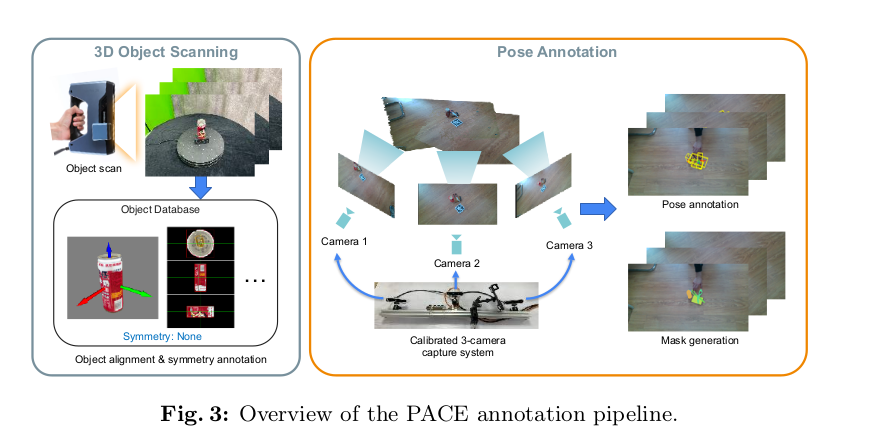
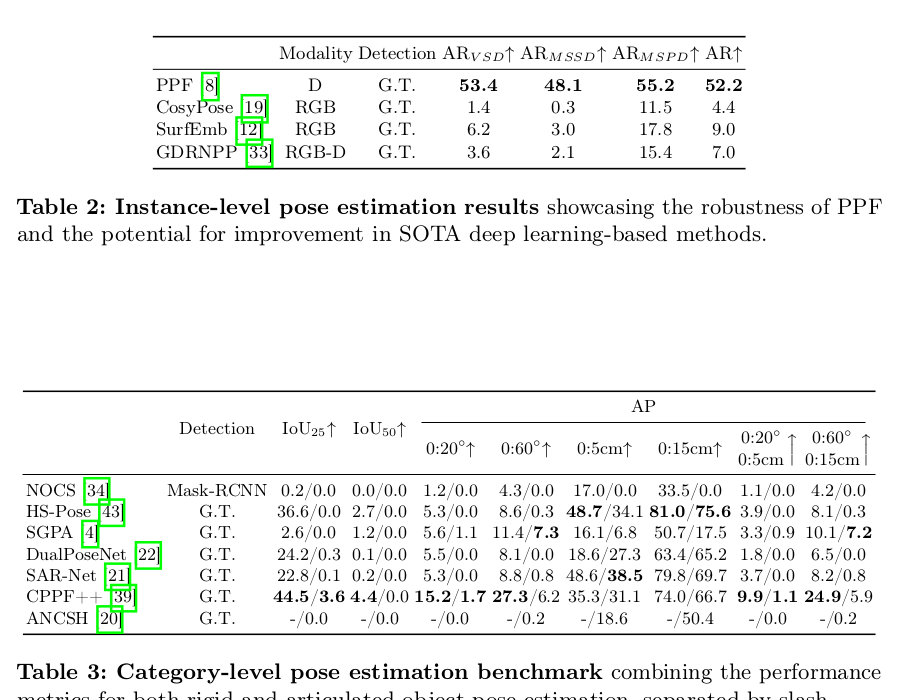
Original Figure 3: scan objects, align canonical frames and annotate symmetry, then capture calibrated multiview RGB-D for poses and occlusion-aware masks. Source: published ECVA paper. Image copyright belongs to the authors and Springer Nature; reproduced here for paper analysis.Original Tables 2–3: conventional RGB-D PPF reaches 52.2 BOP AR, far above CosyPose / SurfEmb / GDRNPP at 4.4 / 9.0 / 7.0. Category-level slash-separated values denote rigid / articulated objects; strict pose scores are generally low. Source: published ECVA paper. Table copyright belongs to the authors and Springer Nature; reproduced here for paper analysis.
Environments: 10 background / lighting conditions, 1–7 objects per sequence, distances of 0.5–1.5 m, and 1280×720 RGB-D.
Object types: rigid objects and articulated scissors, cutters, clips, boxes, and similar multipart objects, with CAD, part hierarchy, canonical alignment, and rotational symmetry.
PACE-Sim: 100K photorealistic PBR frames, 2.4M annotations, and 931 objects, with separate instance / category synthetic training subsets.
Default split: real data is 20% validation / 80% test, plus synthetic category validation. A separate 80/10/10 real split supports failure analysis and must remain separate from the default leaderboard.
5. Annotation pipeline
Scan each object with Einscan Pro 2X in about 5–10 minutes; align bounding-box centers / directions and annotate symmetry.
Mount three RealSense D415 cameras on a frame. SuperPoint + SuperGlue, a trifocal tensor, and bundle adjustment estimate rotation; ArUco translation supplies metric scale missing from SfM.
Background-marker PnP / tracking annotates static objects, with manual drift correction every 40 frames; markers are then inpainted.
Initialize moving-object tracks with BundleTrack. Every 10 frames, inspect 3D cloud alignment and three-view 2D agreement, correcting manually.
Render CAD depth for occlusion-aware masks; subtract SAM hand masks during hand occlusion.
Reannotation on NOCS-REAL275 Scene 1 gives mean differences of 0.9° / 2.3 mm.
For rigid category pose, CPPF++ reaches 44.5 / 24.9 on IoU25 / joint 0:60°–0:15cm AP; articulated scores are only 3.6 / 5.9.
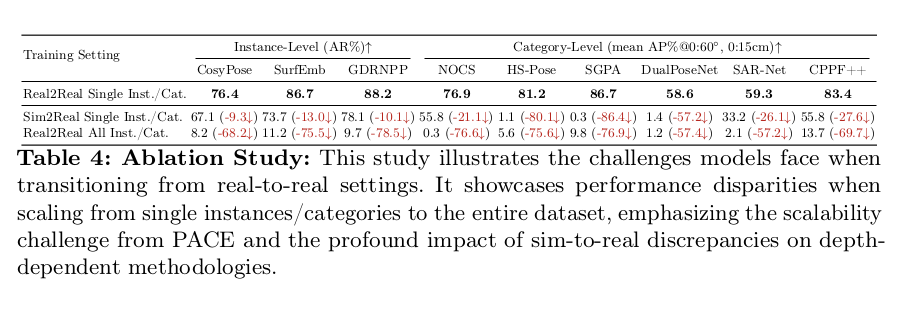
Real2Real single-object / category fitting reaches 58.6–88.2, but single-object / category Sim2Real drops 9.3–86.4 points. Scaling Real2Real to all objects / categories drops 57.2–78.5 points.
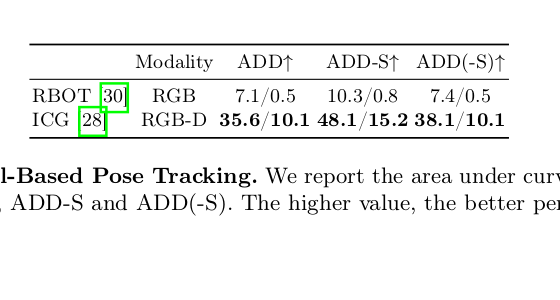
In model-based tracking, ICG ADD(-S) AUC is 38.1 for rigid objects and 10.1 for articulated objects.
Best model-free rigid 5°5cm accuracy is only CAPTRA’s 12.9%; for articulated objects, BundleTrack leads with 11.2%.
7. Quick assessment
Value: one dataset connects known-instance and unseen-instance category pose, tracking, articulation, clutter, and movement, exposing gaps between static benchmarks and real video systems.
Key finding: failures extend beyond synthetic-to-real transfer. Even within Real2Real, models severely underfit when expanded from one object / class to all.
Limitations: pose benchmarks assume GT detections; several tracking protocols use GT masks / sizes / initial poses. Treating each articulated part as a category is not joint-aware, and large / expensive tables, cameras, and laptops are absent.
Audience: researchers studying real clutter, pose tracking, articulation, annotation, synthetic-to-real transfer, and scalable pose learning.
Available src/paper-notes/pace-eccv2024/deep.md
In-depth paper notes
Support reproduction, comparison, related-work writing, and identifying opportunities for further research.
Paper Reading Notes (Deep): PACE
1. Key assessment
PACE challenges benchmark saturation. HS-Pose, DualPoseNet, and SAR-Net often approach 100% AP@15°5cm for REAL275 bottles / bowls / cans, yet transfer to corresponding PACE objects is mostly near zero. Four evaluation tracks dissect these failures:
known-instance pose estimation;
unseen-instance category-level pose estimation;
model-based pose tracking;
model-free category-level tracking.
Table 4 is more revealing: without changing synthetic / real domains, expanding from one object / category to all still loses 57–79 points. PACE exposes distinct domain and scale / diversity gaps.
2. Scale and task matrix
PACE-Real:
Item
Scale
RGB-D videos
300
Frames
55K
pose annotations
258K
Scanned objects
238
Categories
43
Environments
10
Objects per sequence
1–7
PACE-Sim supplies 100K PBR frames, 2.4M annotations, and 931 objects, with separate synthetic training subsets for instance / category pose.
Default real data has 20% validation and 80% test, with methods mainly trained on PACE-Sim. A separate 80/10/10 real split analyzes domain / scale. Mixing Table 4’s real training set into default testing causes leakage.
Both rigid and articulated objects appear. AKB48 articulated categories include scissors, cutters, clips, and boxes, decomposed into hierarchical parts with individual poses. This supports articulation-aware tracking beyond videos with only root poses.
3. Why three-camera annotation?
Original Figure 3: scans and canonical / symmetry annotation define model frames. Three fixed cameras provide depth scale, multiview consistency, and triple observations. Source: published ECVA paper. Image copyright belongs to the authors and Springer Nature; reproduced here for paper analysis.
The three RealSense D415 cameras provide more than extra pictures:
3D alignment and three-view 2D projections are checked together;
Static-object marker PnP becomes more stable;
Each action yields triple observations.
SuperPoint / SuperGlue correspondences, a trifocal tensor, and bundle adjustment estimate extrinsics. SfM translation is only up to scale; metric ArUco translation t′ calibrates scale:
s=t^⋅t^t^⋅t′.
Repeated-texture matching failures receive manual correspondences. Camera one defines the reference frame; Intel dynamic calibration estimates intrinsics.
4. Separate static / dynamic annotation paths
Static objects:
Background markers establish a world frame;
Marker tracking propagates pose;
Correct drift manually every 40 frames;
Inpaint markers using a previously captured marker-free background.
Dynamic objects:
BundleTrack initializes trajectories from RGB correspondences and a pose graph;
Manually inspect CAD / cloud alignment every 10 frames;
Check all three 2D projections;
Correct drift manually.
Moving-object annotation is most labor-intensive. BundleTrack is an initializer, not an automatic GT source; dense manual verification determines the final annotations.
Reannotation of NOCS-REAL275 Scene 1 with official GT gives mean 0.9° rotation / 2.3 mm translation differences. This supports local accuracy in one simpler scene, without fully quantifying uncertainty under severe PACE occlusion, fast motion, or articulation.
Masks come from CAD depth rendering, subtracting SAM hand masks during interaction. Small pose errors affect mask boundaries; hand undersegmentation / oversegmentation also changes visibility ratios.
5. Instance pose: why learned methods trail PPF
Original Tables 2–3: all instance baselines use GT detections. Category baselines also use GT detections, except NOCS with its own Mask R-CNN. Source: published ECVA paper. Table copyright belongs to the authors and Springer Nature; reproduced here for paper analysis.
Metrics follow BOP:
AR=(ARVSD+ARMSSD+ARMSPD)/3.
Method
Modality
VSD AR
MSSD AR
MSPD AR
Mean AR
PPF
Depth
53.4
48.1
55.2
52.2
CosyPose
RGB
1.4
0.3
11.5
4.4
SurfEmb
RGB
6.2
3.0
17.8
9.0
GDRNPP
RGB-D
3.6
2.1
15.4
7.0
PPF directly matches local point-pair geometry to CAD without PBR learning; the three learned methods train on synthetic PBR. Its 52.2 versus 4.4–9.0 is not simply conventional superiority; at least these factors differ:
PPF directly uses online depth and CAD geometry;
RGB methods are more sensitive to appearance / rendering gaps;
Shared networks suffer capacity / interference at large instance counts;
PBR inadequately models RealSense depth noise.
All receive GT detections, eliminating detector recall as a cause; real end-to-end operation would be harder.
PACE AP averages thresholds from zero to a bound rather than counting hits at one threshold:
AP@0:20°: averaged every 1°;
AP@0:5cm: averaged every 0.25cm;
Joint AP@0:20°,0:5cm: angle and translation jointly satisfied;
3D IoU25 / IoU50 are also reported.
Table 3 separates rigid / articulated results. Rigid CPPF++ leads at IoU25 44.5, 0:20° 15.2, and joint 0:60°/0:15cm 24.9, but trails HS-Pose / SAR-Net on translation alone. For articulation:
CPPF++ IoU25 3.6, joint 0:60°/0:15cm 5.9;
ANCSH joint AP is only 0.2;
Most IoU50 and strict joint scores are zero.
To adapt rigid-category methods, movable parts become separate categories. This ignores kinematics and parent–child consistency: it exposes rigid-method limitations without fairly bounding full articulated formulations.
7. Separating domain and scaling gaps
Original Table 4: high Real2Real single fitting contrasts with Sim2Real domain gaps and severe Real2Real-all degradation when sharing models across many objects / categories, even within-domain. Source: published ECVA paper. Table copyright belongs to the authors and Springer Nature; reproduced here for paper analysis.
Controlled fitting uses the can category and object #57:
Setting
Instance-level scope
Category-level scope
Real2Real Single
76.4–88.2 AR
58.6–86.7 mean AP
Sim2Real Single
67.1–78.1 AR
0.3–55.8 mean AP
Real2Real All
8.2–11.2 AR
0.3–13.7 mean AP
Depth-based HS-Pose / SGPA single-category Sim2Real drops from 81.2 / 86.7 to 1.1 / 0.3, showing particularly severe synthetic-depth / real-noise gaps.
Real2Real All still loses 57.2–78.5 points against Single; the authors observe plateaued training loss / underfitting. Rendering gaps alone cannot explain PACE. Larger models, object conditioning, retrieval / foundation features, balanced sampling, and modular geometry solvers are potential directions.
8. Tracking: correct initialization is not enough
Original Table 5: RGB-D ICG rigid / articulated ADD(-S) AUC is 38.1 / 10.1; RGB-only RBOT reaches just 7.4 / 0.5. Source: published ECVA paper. Table copyright belongs to the authors and Springer Nature; reproduced here for paper analysis.
Model-based:
Method
Modality
Rigid / articulated ADD(-S) AUC
RBOT
RGB
7.4 / 0.5
ICG
RGB-D
38.1 / 10.1
Model-free:
Method
Rigid / articulated 5°5cm
Rigid / articulated IoU25
BundleTrack
6.4 / 11.2
9.1 / 14.1
CAPTRA
12.9 / 4.4
45.8 / 20.6
6-PACK
9.2 / 3.9
23.1 / 16.7
All trackers receive first-frame GT poses; mask-dependent methods use GT masks, and evaluation uses GT box sizes. Even with these priors, best strict accuracy remains below 13%.
Rerr / Terr are evaluated only when IoU>25%, producing survivorship bias: BundleTrack’s low mean errors exclude frames after losing track. Interpret conditional errors alongside IoU25 and 5°5cm.
9. Limitations and usage boundaries
No default real training split; training mainly uses PACE-Sim;
Stratify by visibility, motion speed, depth noise, object count, and part count;
Check single-object / category fitting before scaling to all;
Quantify synthetic RGB and depth gaps separately;
Constrain parent–child transforms and joint limits for articulation;
Log tracking failure time, recovery, and drift alongside successful-frame errors;
Add detection / segmentation recall in end-to-end systems.
11. Overall assessment
PACE’s main value is controlled evidence of two cliffs: synthetic→real domain transfer and single→all learning scale. PPF’s 52.2 AR advantage over three deep baselines in known-instance pose also shows the strength of explicit geometry amid large vocabularies, clutter, and depth noise.
This is not a complete end-to-end benchmark: many evaluations use oracle detections / masks / initial poses / sizes, and articulated adaptation is preliminary. Its explicit boundaries make PACE a useful stress test of what remains after clean-benchmark saturation when entering dynamic real scenes.