PartPose: Attentive 6D Pose Estimation by Focusing on Graspable Parts of Multi-Part Deformable Objects
PartPose targets mixed rigid–deformable objects such as drink pouches, wired appliances, and objects with cords. DINOv2 transfers reference keypoints, SAM segments graspable rigid ROIs, Bayesian optimization selects ROI geometry, and FoundationPose performs local render-and-compare. Across nine objects, overall translation / rotation success is 98.2% / 96.4%, with real grasp success of 87.2%. CAD, RGB-D, manual reference points, and visible rigid parts are required; fully deformable targets are unsupported. The formal publication is RA-L 2025, with ICRA 2026 only hosting its journal-paper presentation.
RGB-D test imagesingle RGB reference image with one keypointobject 3D model
Requirements
known 3D modelcamera intrinsicsRGB-D sensingone manually annotated reference keypointoffline multi-view robot poses for ROI optimizationa visible rigid and graspable object part
Full paper metadataAuthors, affiliations, research area, datasets, metrics, method tags, and reading statusExpandCollapse
Authors
Ryo Okumura, Tadahiro Taniguchi
Affiliations
Panasonic Holdings Corporation / Kyoto University / Ritsumeikan University
Original paper terminology:translation success rate at 30 mm / rotation success rate at 0.3 rad / robotic picking success rate / translation error / rotation error / inference latency
known 3D modelcamera intrinsicsRGB-D sensingone manually annotated reference keypointoffline multi-view robot poses for ROI optimizationa visible rigid and graspable object part
Reading Notes
Overview / Deep Dive
Available src/paper-notes/partpose-ral2025/coarse.md
Paper overview notes
Quickly assess the paper's scope, problem setting, core method, experimental findings, and whether to read it in depth.
Paper Reading Notes (Coarse): PartPose
1. Basic information
Title: PartPose: Attentive 6D Pose Estimation by Focusing on Graspable Parts of Multi-Part Deformable Objects
Code / data: no public download links in the paper
Reading mode: Overview
2. Positioning in one sentence
Instead of forcing a rigid body plus deforming cable / pouch / string into one rigid assumption, PartPose finds a graspable rigid ROI and restricts FoundationPose render-and-compare to it. Across nine objects, translation, rotation, and real grasp success reach 98.2%, 96.4%, and 87.2%.
2.1 Guide to the paper’s figures and tables
Figure / table
Focus
Assessment
Method redraw
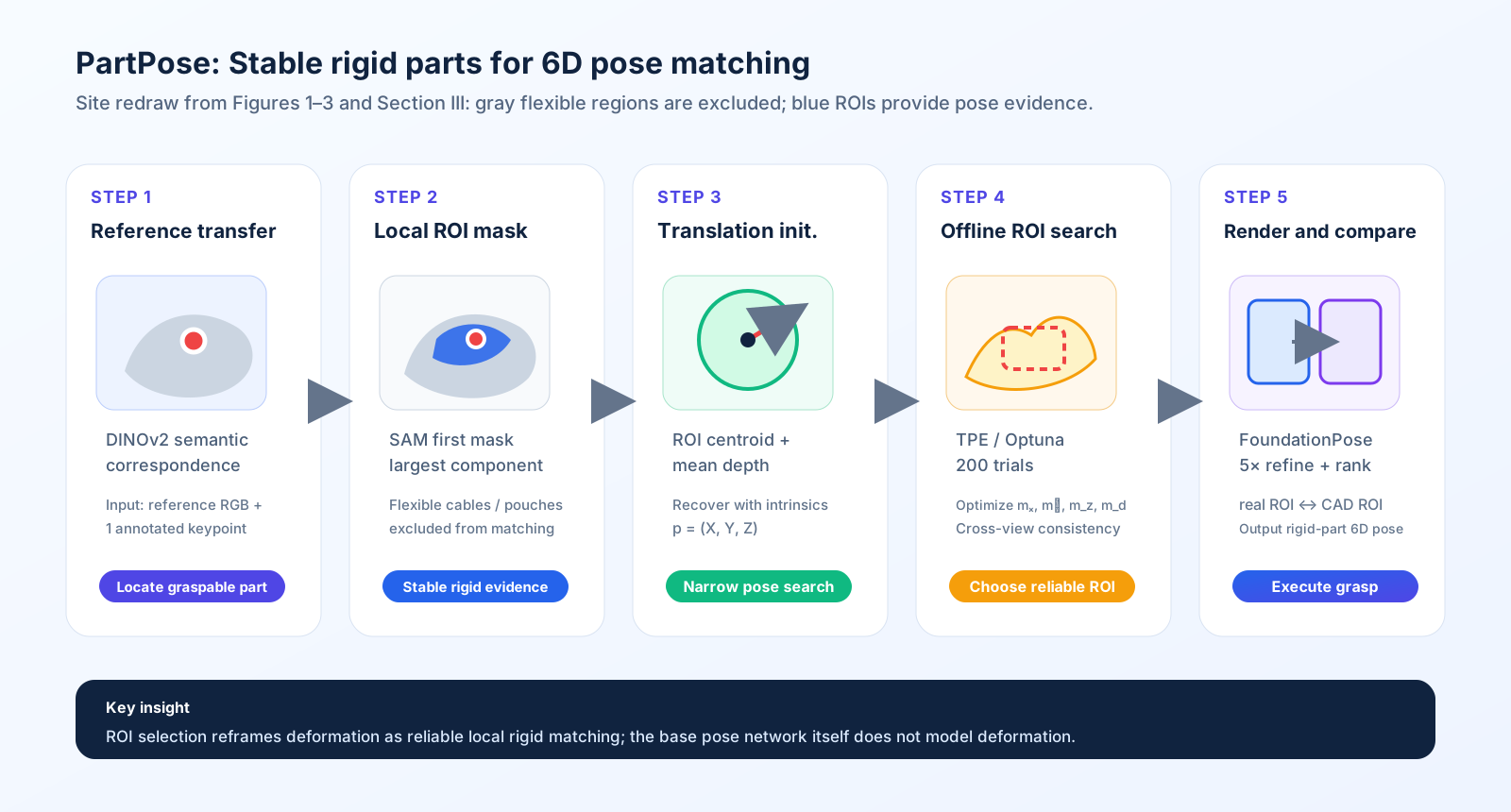
Reference-point transfer, local segmentation, translation initialization, ROI optimization, and refinement
Main contribution: choosing reliable evidence rather than a new pose backbone
Table II redraw
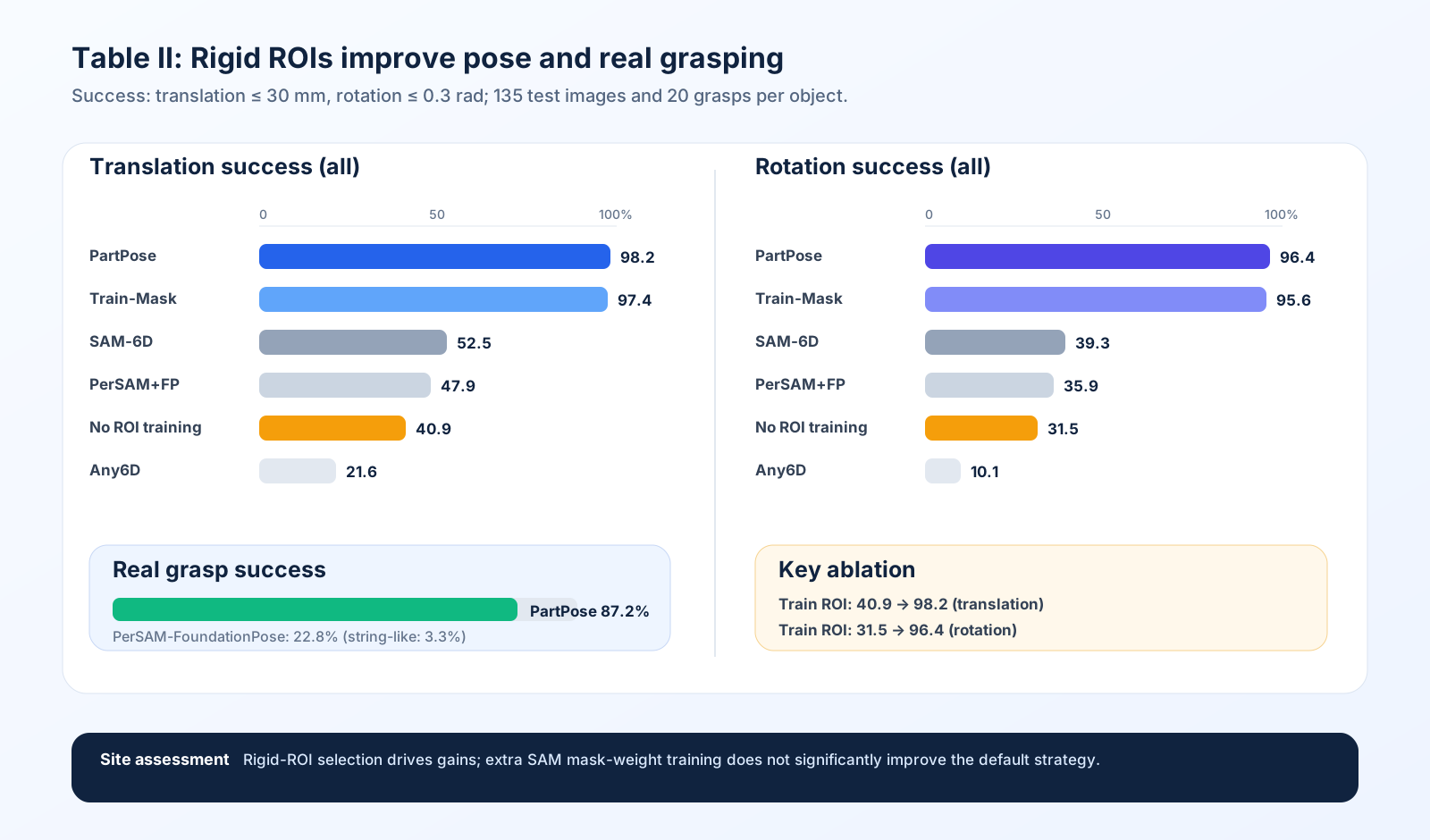
Translation / rotation / grasp success and ablations
ROI training drives gains; extra SAM mask-weight training adds little
Table III redraw
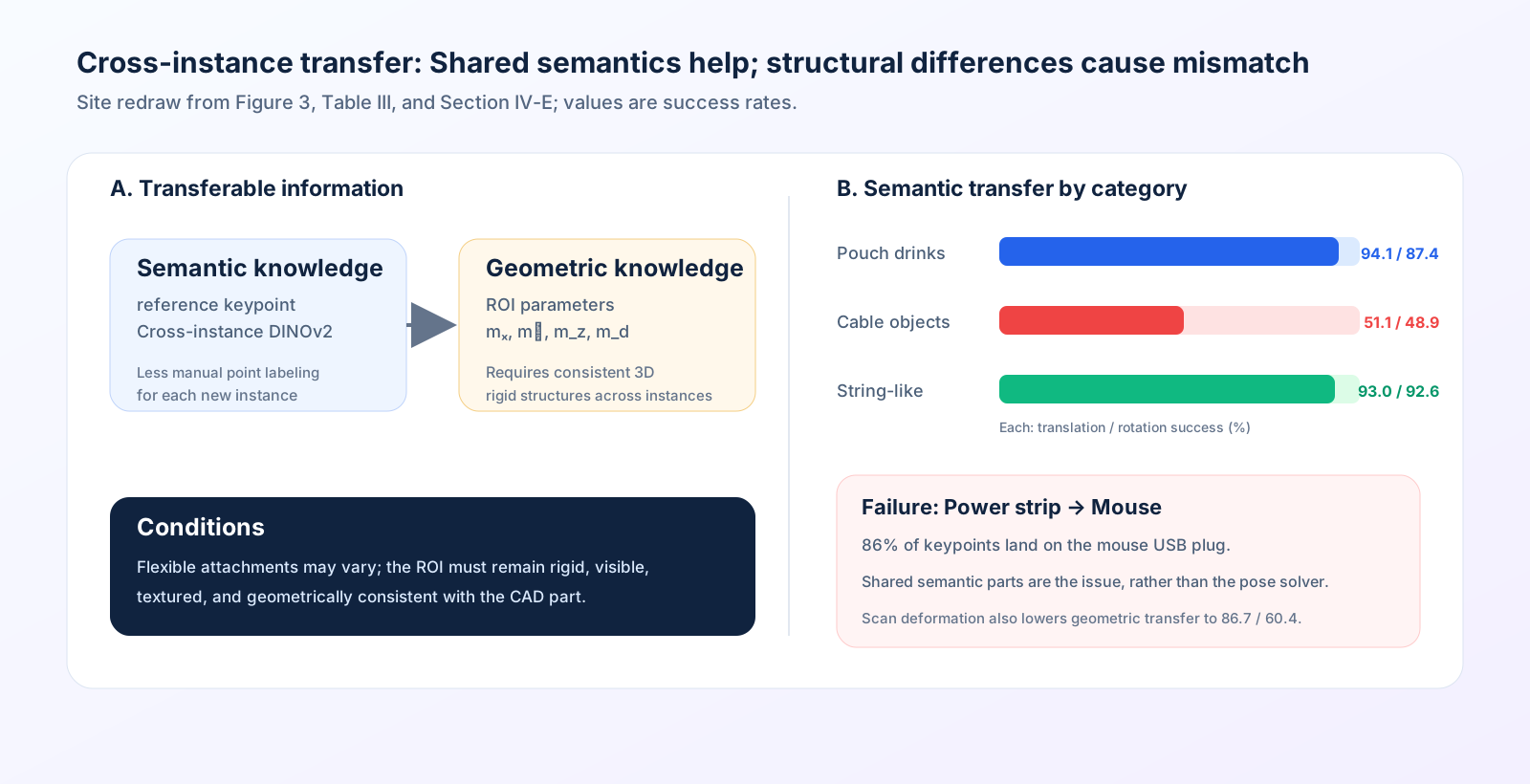
Cross-instance semantic / geometric transfer
Semantically consistent categories transfer; cable appliances degrade through wrong part matches
Redrawn by this site from original Figures 1–3 and Section III: deformable regions are excluded from matching, with refinement restricted to a stable rigid ROI. Method source: published RA-L paper; the public author version uses CC BY 4.0.
3. Problem setting
Task: instance-level 6D pose of multipart deformable objects for real robotic grasping.
Targets: drink pouches, wired power strips / mice / adapters, and string- or chain-attached objects.
Inputs: test RGB-D, object 3D model, intrinsics, and one reference RGB with a manually marked keypoint per object.
Output: 6D pose associated with the graspable rigid part, composed with a predefined grasp pose for the robot end effector.
Prior: a visible, relatively rigid part comparable between real RGB and the 3D model must exist.
Not applicable: fully flexible objects, completely occluded rigid ROIs, textureless ROIs, or unreliable semantic point transfer.
This differs from generic BOP pose: deformable geometry disagrees between object and model, making same-rigid-surface ADD / VSD unsuitable. Translation / rotation thresholds and grasp success are used instead.
4. Core motivation
Model-based FoundationPose assumes real objects and models share rigid geometry. Cables, pouches, and strings violate this: their mismatches may dominate render-and-compare, causing the rigid body to align incorrectly even with a correct whole-object mask.
The principle is simple: if the robot grasps a stable rigid part, that part should supply pose evidence.
5. Method overview
Manually mark a reference keypoint near the rigid ROI center.
Transfer it to test RGB through DINOv2 semantic correspondences.
Prompt SAM, take the first mask, and retain its largest connected component.
Recover initial translation p=(X,Y,Z) from ROI centroid, mean masked depth, and intrinsics.
Offline, optimize ROI 3D offset / diameter m=(mx,my,mz,md) with TPE / Optuna against cross-view pose consistency.
Crop real and CAD-rendered ROIs for FoundationPose refinement / ranking: 5 refinement iterations at initialization and 2 during tracking.
Cross-instance experiments reuse reference points for semantic transfer and ROI parameters for geometric transfer. The former reduces annotation; the latter requires closely aligned instance scans.
6. Experimental overview
Objects: 3 categories × 3 instances, 9 total.
Training capture: 5 deformable configurations × 8 views per object, forming 20 image pairs for ROI optimization.
Test capture: 5 configurations × 27 views, 135 images per object.
GT reliability: 5 annotators repeat judgments on 3 objects; mean difference 2 mm / 0.03 rad, maximum 6 mm / 0.07 rad.
Redrawn by this site from original Table II and Section IV-D. PartPose translation / rotation success is 98.2% / 96.4%, with 87.2% grasp success; removing ROI training reduces pose success to 40.9% / 31.5%. Source: public author version (CC BY 4.0).
Three linked findings are more convincing than one highest score:
Large gains over PerSAM-FoundationPose show that correct whole-object masks alone do not solve local deformation.
Training-Free-PartPose degrades sharply: arbitrary crops are insufficient and offline ROI selection matters.
Pose gains accompany grasp success rising from 22.8% to 87.2%, aligning evaluation with the downstream task.
7. Strengths and limitations
Strengths
Clear problem scope addresses violated rigidity rather than generic robustness.
Reuses mature DINOv2, SAM, and FoundationPose with a direct engineering path.
Real UR5e grasp execution supplements offline pose scores.
Ablations isolate ROI optimization beyond mask-weight / backbone effects.
Limitations / risks
Still requires a 3D model, RGB-D, an annotated reference point, and calibrated offline multiview acquisition.
Initial pose takes about 1.9 s; 0.014 s applies only to initialized tracking.
Only 9 objects in 3 categories under controlled cameras, lighting, and distance.
Transfer is unstable: 86% of power-strip-to-mouse points land on the USB plug, degrading cable-object results.
Yes. Its engineering lesson is to define the stable part relevant to the task before choosing pose frames, supervision, and metrics when the full object is nonrigid. This is useful for assembly, logistics, and wired tools, beyond designing pose backbones.
Available src/paper-notes/partpose-ral2025/deep.md
In-depth paper notes
Support reproduction, comparison, related-work writing, and identifying opportunities for further research.
Paper Reading Notes (Deep): PartPose
1. Basic information and publication status
Title: PartPose: Attentive 6D Pose Estimation by Focusing on Graspable Parts of Multi-Part Deformable Objects
Publication: IEEE Robotics and Automation Letters, Vol. 10, No. 12, pp. 13082–13089, 2025
Public author version:ResearchGate, with CC BY 4.0 stated on the page and manuscript
Conference relationship: ICRA 2026 PaperCept lists a presentation, while DOI, volume, and publisher identify RA-L 2025 as the canonical publication. This site includes it in the ICRA 2026 journal-presentation appendix without adding it to proceedings counts.
Reading mode: Deep Dive
2. Positioning in one sentence
PartPose reframes multipart deformable-object pose as finding a stable, graspable rigid ROI comparable between real images and CAD, then performing render-and-compare only there. Flexible cables, pouches, and strings no longer distort whole-object rigid matching.
2.1 Guide to the paper’s figures and tables
Redrawn by this site from original Figures 1–3 and Section III. The key is restricting FoundationPose evidence to rigid ROIs: DINOv2 transfers a point, SAM provides a local mask, TPE optimizes ROI geometry, then local render-and-compare estimates pose. Source: published RA-L paper; the public author version uses CC BY 4.0.Redrawn by this site from original Table II: translation / rotation success and real grasp success. All values come from the original table; success rates are not reinterpreted as BOP AR. Source: CC BY 4.0 author version.Redrawn by this site from original Figure 3, Table III, and Section IV-E. Semantic keypoints transfer well for pouch / string categories, but systematically mismatch cable appliances; geometric transfer also depends on consistent scans. Source: RA-L paper.
3. Problem setting and task boundaries
3.1 What pose is actually estimated?
Given test RGB-D (Iit,Iid), object model M, and intrinsics K, estimate object-to-camera rigid transform ciTo. Unlike standard rigid objects, some real surfaces deform and do not maintain rigid correspondence with M.
PartPose retains the object-model frame, selecting an ROI within it rather than defining a new deformation-dependent frame:
m=(mx,my,mz,md),
The first three parameters offset the ROI origin from the model origin; md is its bounding-sphere diameter. Output remains the full model-frame pose, but local rigid evidence supplies most loss / ranking information.
3.2 Inputs, outputs, and priors
Stage
Input
Output
Assumption
Offline preparation
Scan / CAD, 5 training configurations, 8 calibrated views, reference point
Per-object ROI m∗
Known robot-camera poses and a stable rigid part
Single-frame initialization
Test RGB-D, intrinsics, reference image / point, M, m∗
This evaluates an object frame usable for rigid-part grasping, rather than full reconstruction of deformation.
3.3 Difference from articulated / deformable pose
No cable, string, or pouch shape / articulation prediction;
No nonrigid correspondence field or deformable registration;
Grasping is assumed to depend only on one rigid part, deliberately ignoring other regions.
This is both an advantage and a strict limit: rigid-part pose in multipart deformable objects, rather than generic deformable pose.
4. Research context
FoundationPose, SAM-6D, and FreeZe typically reference rigid meshes / reconstructions. Partial matching handles background / occlusion, but deforming target regions are not automatically distinguished from regions that should satisfy rigidity.
The contribution is a task-prior layer:
Semantic correspondences locate a user-specified graspable part;
A local mask restricts pose evidence;
Multiview consistency selects a suitable 3D ROI;
Existing pose refinement / ranking is reused.
It changes what FoundationPose sees rather than replacing it.
5. Method details
5.1 Reference keypoint transfer
One manually annotated reference point kr lies near the graspable ROI center. DINOv2 patch similarity produces test point kit.
This is a spatial SAM prompt, rather than enough multipoint correspondences for PnP: low-cost semantics become local geometric observation.
Cross-instance tests transfer source points to same-category targets. Shared caps / labels help, whereas broadly functional cable-appliance categories may map to wrong parts.
5.2 Local ROI segmentation
SAM returns multiple masks; the first is used rather than jointly optimizing mask weights. Retain the largest contour / connected component, with image centroid (u,v).
There are two ROI levels:
2D mask ROI: current graspable part in real RGB-D;
3D model ROI: renderable model region defined by m=(mx,my,mz,md).
They must correspond under the correct pose for meaningful render-and-compare.
5.3 Translation initialization
Mean masked depth gives Z. Back-project with (u,v) and K for camera-frame position p=(X,Y,Z), after retaining the largest mask component to suppress fragments.
This locates hypotheses near the right region without recovering full rotation. Invalid transparent / reflective depth, background leakage, and occlusion-biased mean depth are risks.
5.4 Offline Bayesian ROI optimization
During training, estimate poses from views c1,c2 and convert them to world coordinates using known robot-camera transforms:
wTo(1)=wTc1c1To,qquadwTo(2)=wTc2c2To.
Reliable ROIs should produce consistent world poses. Use Euclidean translation difference and quaternion geodesic rotation distance:
dR=2arccos(∣q1⋅q2∣).
The objective weights are wt=1.0 and wr=0.1. Optuna TPE runs 200 trials, usually converging within 50. Five configurations × eight views form four random pairs per configuration, 20 consistency observations total. One RTX 3090 Ti takes about 3.3 h.
This is a notable design: cross-view pose consistency weakly supervises ROI selection without pixelwise rigid-part labels.
5.5 Local render-and-compare
After translation initialization, FoundationPose generates hypotheses. For each:
Locate the model ROI with m;
Crop real images around p;
Render at the candidate pose and crop the same spatial range;
Predict pose corrections with refinement;
Select the final hypothesis by ranking.
Initialization uses 5 refinements. Tracking uses only the previous pose as one hypothesis and 2 refinements, substantially increasing speed.
UR5e and ROBOTIS HAND RH-P12-RN two-finger gripper
3D models
KEYENCE VL-700 scans
Working distance
About 30 cm
Training
5 configurations × 8 views per object
Testing
5 configurations × 27 views = 135 images per object
Grasping
20 trials per object, 180 total
Private data prevents independent failure inspection / reevaluation. This is a small controlled test of deformable attachments disrupting rigid matching, rather than a broad BOP benchmark.
6.2 Why not ADD / VSD?
ADD applies predicted / GT transforms to the same rigid surface. Actual deformable parts differ from scanned geometry, so surface distances penalize valid deformation alongside pose error.
The paper uses:
translation error;
quaternion rotational distance;
Success at translation ≤30 mm / rotation ≤0.3 rad;
Real robotic picking success.
These fit the problem, but thresholds are fairly loose and translation / rotation are scored separately. Direct BOP AR / ADD(-S) rankings are inappropriate.
6.3 Ground truth and risks
GT averages 5 estimates visually verified by overlays, rather than external motion capture. Five participants repeatedly annotate pouch drink 2, power strip, and beads:
Mean difference: 2 mm / 0.03 rad;
Maximum difference: 6 mm / 0.07 rad.
These are well below 30 mm / 0.3 rad, supporting stable success judgments. Still, manually aligned model-rendering GT can share biases with model-based matching; external mocap would be stronger.
6.4 Main results
Method
Translation success
Rotation success
Grasp success
PartPose
98.2%
96.4%
87.2%
PartPose-Train-Mask
97.4%
95.6%
Not reported
SAM-6D
52.5%
39.3%
Not reported
PerSAM-FoundationPose
47.9%
35.9%
22.8%
Training-Free-PartPose
40.9%
31.5%
Not reported
Any6D
21.6%
10.1%
Not reported
PartPose performs well across categories:
Translation: pouch 96.3, cable 99.3, string 99.0;
Rotation: pouch 91.1, cable 99.0, string 99.0;
Grasping: pouch 83.3, cable 95.0, string 83.3.
PerSAM-FoundationPose string-like grasp success is only 3.3%, consistent with whole-object masks including strongly deforming strings in rigid alignment.
6.5 Ablations: what matters?
Removing ROI optimization drops translation / rotation success from 98.2 / 96.4 to 40.9 / 31.5. Local matching alone is insufficient; ROI center / scale must be chosen for consistency.
Extra SAM mask-weight training gives 97.4 / 95.6, slightly below default PartPose. Mean errors are:
PartPose: 7.4±12.2 mm, 0.2±0.4 rad;
Train-Mask: 8.4±17.8 mm, 0.2±0.5 rad.
A t-test at 5% significance finds no difference, so mask-weight training cannot be claimed beneficial.
Rotation-weight sensitivity: with wr∈{0.01,0.03,0.1,0.3,1.0}, mean rotation error stays about 0.2 rad and translation means at 5–7 mm. No significant difference from wr=0.1 is reported, supporting insensitivity within this range.
6.6 Cross-instance transfer
Semantic transfer retains high pouch / string success: 94.1 / 87.4 and 93.0 / 92.6 for translation / rotation. Cable objects fall to 51.1 / 48.9.
This is not simply cable difficulty: category semantics are inconsistent. In power-strip-to-mouse transfer, 86% of keypoints fall on the USB plug—a related visual / functional part, but not the intended rigid grasp ROI.
Geometric transfer is tested only on pouches, falling to 86.7 / 60.4. Scans retain deformable configurations, preventing direct reuse of source ROI frames; CAD-level consistency is needed across instances.
7. Runtime and deployment
Hardware: Intel i9-14900K + RTX 3090 Ti:
Stage
Time
keypoint transfer
0.20 s
ROI segmentation
0.02 s
hypothesis refinement + ranking
1.7±0.3 s
Total single-frame initialization
About 1.9 s
Initialized tracking
0.014 s / frame
Real-time 0.014 s applies to tracking with a previous pose, one hypothesis, and two refinements. First localization is not real-time; prolonged complete occlusion or large jumps require second-scale reinitialization.
Task depends on rigid parts: cable topology / pouch-shape manipulation needs more than PartPose output.
10. Reproduction challenges
Code and data are not public.
DINOv2, SAM, FoundationPose, Optuna / TPE, and custom robot acquisition must be integrated.
Accurate robot–camera extrinsics and training-view poses are essential to unbiased consistency objectives.
ROI parameters, full SAM / prompt postprocessing details, and random seeds are not supplied.
GT needs visual judgments and pose averaging, beyond running a network.
Begin with three diagnostics before full grasping:
Visualize points on intended rigid parts;
Check flexible-region leakage into the largest mask component;
Plot world-frame pose residuals over TPE trials across views.
11. Potential improvements
11.1 Multiple-ROI beliefs
One occluded / deformed ROI fails. Treat rigid parts as mixture components, dynamically weighted by visibility, render residuals, and covariance for cluttered warehouses.
11.2 Discover rigid, graspable parts automatically
Combine VLM / part segmentation / temporal rigidity: semantics identify handles, caps, or housings; multiview video establishes rigidity; grasp affordances add relevance. Remove manual points while avoiding purely semantic power-strip→USB-plug mismatches.
11.3 Link ROI choice to uncertainty
Fixed TPE optima minimize average inconsistency. A practical system should output covariance / multimodal posteriors, downweight occluded or invalid-depth ROIs, and trigger active camera views when needed.
11.4 Model-free representations to reduce CAD cost
The authors propose model-free extensions. Single / multiview 3DGS, TSDF, or point maps could replace CAD, but must not freeze flexible configurations into wrong geometry. CAD-free does not mean model-error-free.
11.5 Stronger task evaluation
Expand to:
Larger object libraries and cross-warehouse lighting;
Graded rigid-ROI occlusion;
Transparent / reflective rigid parts;
Relocalization after long tracking;
Cable tangling, collisions, and dragging after grasping—failures involving the flexible parts.
12. Overall assessment
The main modeling insight is that a semantically whole object does not imply every pixel should obey one rigid pose loss.
A small structural change turns this into a pipeline supported by pose results, ablations, and real grasps. It remains a small controlled system needing CAD, depth, manual points, and offline acquisition. Automatic discovery, multiple-ROI beliefs, and active sensing are the next steps toward warehouse deployment.