PIZZA: A Powerful Image-only Zero-Shot Zero-CAD Approach to 6 DoF Tracking
Given only an initial target box in RGB video, PIZZA uses unseen-object segmentation and RAFT to maintain shared crops. A two-frame CNN or multiframe Transformer regresses inter-frame axis–angle rotation, image-plane displacement, and relative depth changes. Test objects require no CAD, depth, reference images, or object-specific training. Without a metric first-frame pose, the recovered 6D motion trajectory is relative to the initial frame, with global rotation and scale ambiguity.
Class-agnostic segmentation and optical flow maintain RGB-video masks. A two-frame CNN or multiframe Transformer regresses relative rotation, image-plane displacement, and depth-ratio change, tracking 6D motion without target CAD, depth, reference images, or object-specific training.
Method inputs and outputs
Item
Content (compiled for this site)
Inference input
Monocular RGB, intrinsics, and a first-frame target box; internal segmentation / flow maintain regions.
Output
Framewise relative rotation / translation changes recursively form a first-frame-relative 6D trajectory, without unconditional absolute metric pose.
Requirements
No target CAD, depth, or reference library. Unknown initial orientation permits an arbitrary frame; unknown size / initial depth leaves translation up to one common scale. Metric absolute evaluation needs initial pose / scale.
2.1 Guide to the paper’s figures and tables
Figure / table
Role
Reading focus
Figure 1
Inputs, outputs, real sequences
First-frame box is input; models only draw contours
Figures 2—3
2D tracking, masks, shared crops
Background removal and temporal coordinates precede motion regression
Figure 4
Translation parameterization
Unknown size prevents direct metric ΔT regression
Figure 5
Two-frame / multiframe architectures
History reduces recursive drift
Tables 2—5
ModelNet, ShapeNet, Laval, MOPED
Compare CAD / depth / reference dependencies
Figures 11, 13
Drift and front-end failures
History cannot eliminate monocular Z ambiguity or mask errors
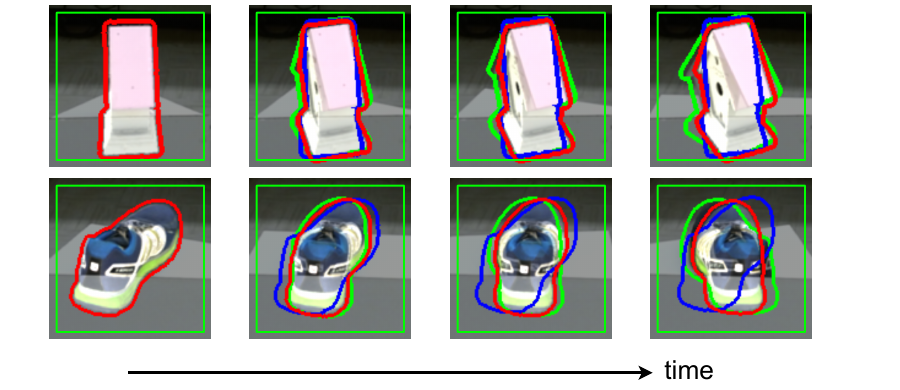
Original Figure 1: after first-frame box initialization, track 3D translation / rotation. Green is GT; blue / red show two-frame / multiframe estimates. Initial GT pose and 3D models are used only for visualization. Source: arXiv. Image copyright belongs to the authors and publisher; reproduced here for paper analysis.
Targets: unseen instances, possibly unseen categories; no category canonical space is learned.
Inputs: RGB, intrinsics, first-frame box, plus internal class-agnostic segmentation and RAFT.
Direct output: adjacent-frame relative rotation ΔRt−1,t and translation parameters.
Trajectory: recursively compose motions relative to the first frame.
Assumptions: rigid, segmentable / trackable targets with motion reasonably covered by training perturbations.
3.2 Zero-Shot, Zero-CAD, and Image-only
Term
Meaning
Does not imply
Zero-Shot
No target-specific training
No training at all; shared synthetic pretraining remains
Zero-CAD
No target CAD during inference
No CAD in ModelNet / ShapeNet / BOP training renders
Image-only
No sequence depth
No intrinsics, initialization, segmentation, or flow
6D tracking
Interframe 3D rotation / translation
Absolute object frames / metric scale without initial pose
This is neither category NOCS nor single-frame absolute pose. Without target CAD, object origin, orientation, and true size lack external definitions, leaving a gauge-dependent relative trajectory:
Known R1, Z1, and center permit metric pose propagation;
Identity R1 and arbitrary positive Z1 define the chosen initial orientation / shared scale.
4. Core motivation
Known-object trackers often require CAD, depth, or object training, limiting immediate open-world use.
One unknown-object RGB image lacks absolute scale / frame, while video still carries relative-motion appearance changes.
Clutter confuses generic regressors; synthetic complex backgrounds alone do not solve this.
Recursive two-frame prediction drifts; history can constrain current estimates.
5. Method overview
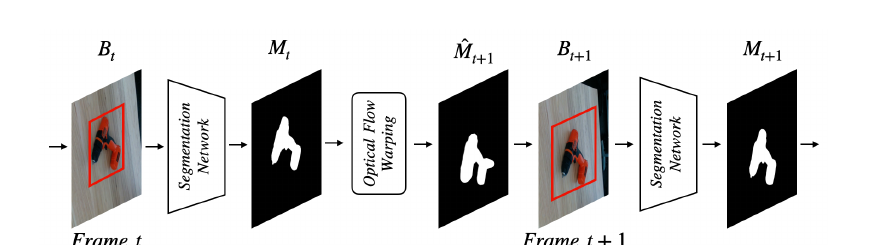
Original Figure 2: warp the current mask by flow to form a coarse next mask / box, then resegment for a better mask. Source: paper PDF. Image copyright belongs to the authors and publisher; reproduced here for paper analysis.
RAFT warps masks, derives new boxes, and prompts resegmentation.
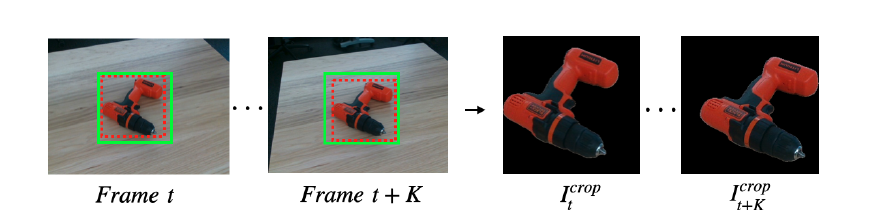
One minimal shared crop covers all boxes across K frames; black backgrounds preserve consistent local coordinates.
5.2 Translation beyond direct XYZ regression
Predict:
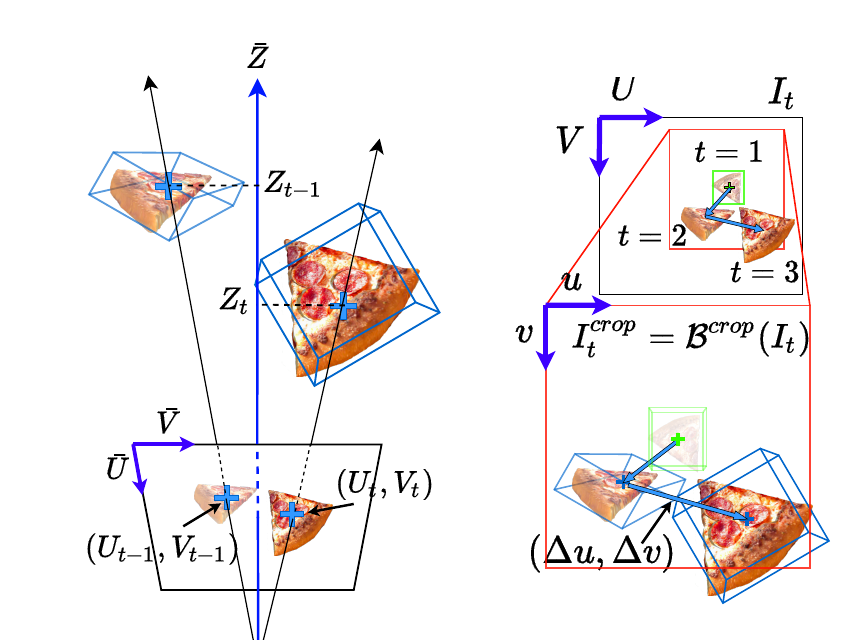
Cropped-center displacement (Δu,Δv);
Depth-ratio offset St−1,t=Zt/Zt−1−1.
Undo crop scaling, then combine intrinsics K and previous center / depth:
Tt=ZtK−1[Ut,Vt,1]⊤,ΔTt−1,t=Tt−Tt−1.
All frames share one unknown scale; without initial metric depth, translation remains up to scale.
5.3 Relative rotation and two networks
Adjacent rotation is:
ΔRt−1,t=RtRt−1⊤.
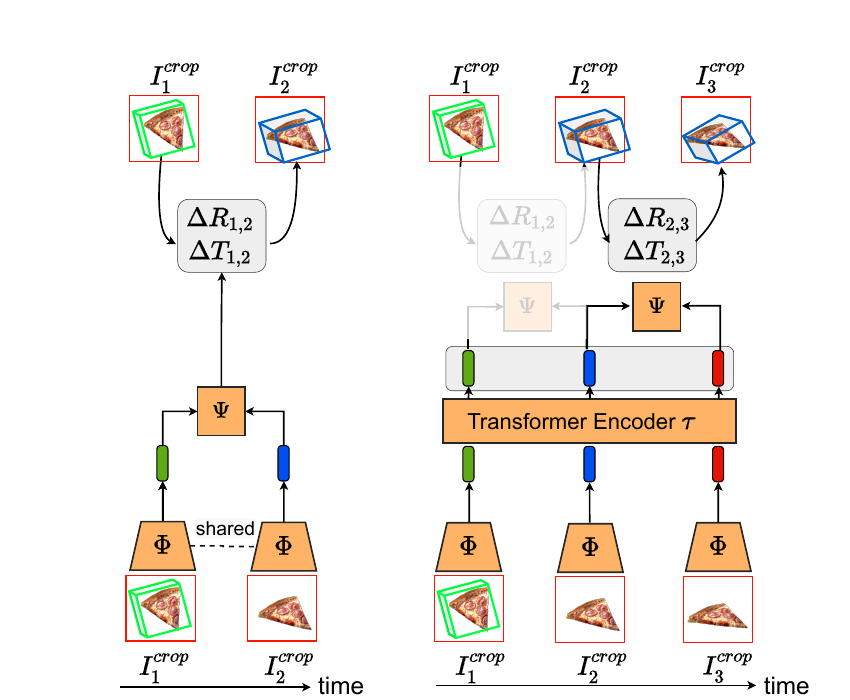
Axis-angle ω∈R3 regresses ΔR. Two-frame input is It−1,It; multiframe crops pass through shared ResNet-18 and one Transformer layer, followed by rotation / translation MLPs for current relative motion.
Original Figure 5: left, direct two-frame regression; right, contextualize historical features with a Transformer and use the final two for current motion. Source: paper PDF. Image copyright belongs to the authors and publisher; reproduced here for paper analysis.
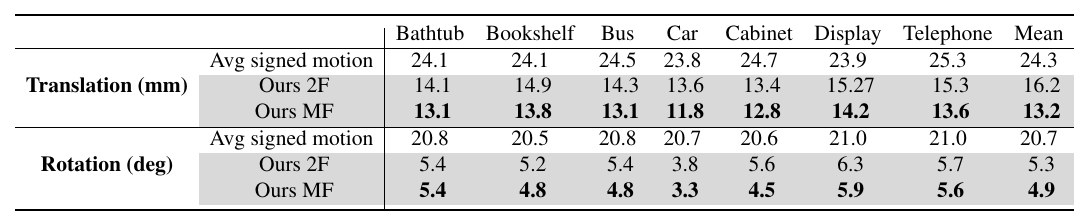
Original Table 3: over 15-frame ShapeNet videos, multiframe improves all categories, reducing mean 16.2 mm / 5.3° to 13.2 mm / 4.9°. Source: paper PDF. Image copyright belongs to the authors and publisher; reproduced here for paper analysis.
6.1 Interpreting main results
Experiment
Result
Scope
Two-frame ModelNet
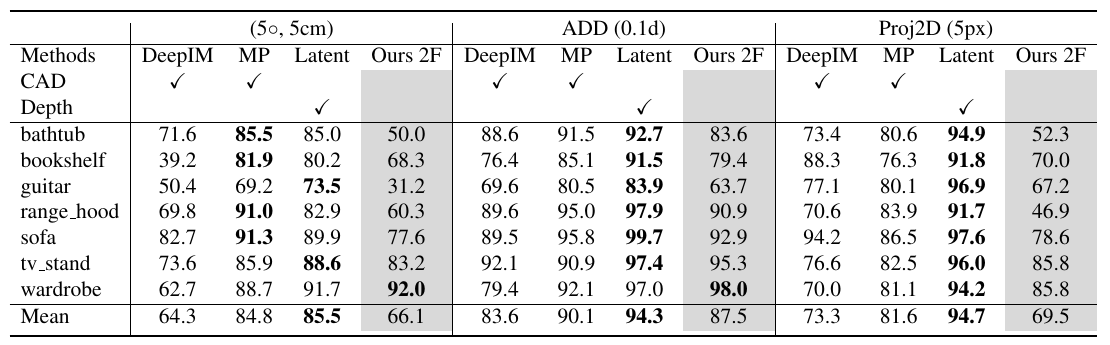
PIZZA: 66.1 at 5°/5cm, 87.5 ADD-0.1d, 69.5 Proj2D-5px
Multiframe 13.2 mm / 4.9°, two-frame 16.2 mm / 5.3°
Supports reduced drift from history
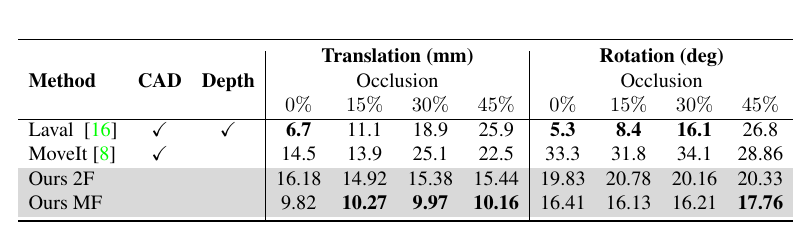
Laval, 45% occlusion
Multiframe 10.16 mm / 17.76°
Better than Laval-generic 25.9 mm / 26.8° and MoveIt 22.5 mm / 28.86°
MOPED
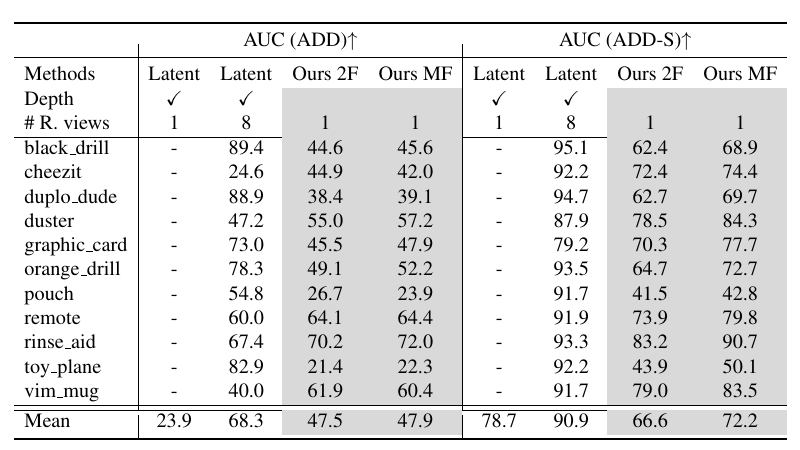
Multiframe ADD AUC 47.9, ADD-S AUC 72.2
Near / above single-reference LatentFusion on some metrics, well below 8 references
Original Table 4: CAD-free / depth-free multiframe PIZZA remains stable under high occlusion; CAD + depth Laval-generic wins at 0% occlusion. Source: paper PDF. Image copyright belongs to the authors and publisher; reproduced here for paper analysis.
Competitive performance with fewer inputs is broadly supported, without uniform SOTA: protocols differ, and low-occlusion Laval, ModelNet Proj2D, and 8-reference MOPED have stronger alternatives.
7. Strengths and limitations
Strengths
Reduces target priors to a first-frame box, avoiding target CAD / depth / references / fine-tuning.
Explicitly addresses unknown monocular scale instead of pretending metric ΔT is directly observable.
Shared crops, masks, and temporal context target identifiable error sources.
Synthetic unseen categories and two real datasets support generalization; source is public.
Limitations / risks
No absolute initializer: without initial metric pose, only a chosen-gauge trajectory is recovered.
Remaining drift: history reduces accumulation without loop closure, optimization, or relocalization.
Weak Z observability: large depth motion can create tiny appearance changes.
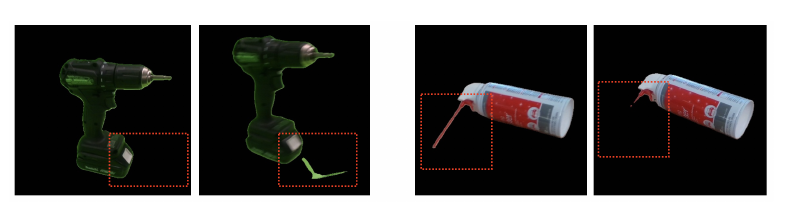
Front-end cascades: mask leakage / omissions and flow drift become false motion cues.
Not unlimited tracking: Laval supplies GT pose every 15 frames.
No explicit symmetry: ADD-S evaluates equivalence, while rotation regression outputs one solution.
Original Figure 13: changing segmentation inside red boxes can be mistaken for rigid motion. Source: paper PDF. Image copyright belongs to the authors and publisher; reproduced here for paper analysis.
8. Research takeaways
Define the task first: unknown CAD-free objects lack absolute frames; state reference frames, scale gauges, and initialization.
Reusable: image-plane displacement plus relative depth ratio, with shared temporal crops.
Baseline scope: selected-object RGB-only zero-CAD relative tracking, separate from single-frame CAD-based absolute rankings.
Extensions: stronger video segmentation, uncertainty / depth hypotheses, keyframe relocalization, and sliding-window graphs.
Reproduction: initial conditions, intrinsics, crop scale, ΔR composition, Z ratio updates, and 15-frame resets.
Available src/paper-notes/pizza/deep.md
In-depth paper notes
Support reproduction, comparison, related-work writing, and identifying opportunities for further research.
Paper Reading Notes (Deep): PIZZA: A Powerful Image-only Zero-Shot Zero-CAD Approach to 6 DoF Tracking
The first frame defines a gauge; later frames estimate relative motion. Unseen-object masks and shared crops remove background interference, (Δu,Δv,Zt/Zt−1−1) maintains common translation scale without CAD, and multiframe context reduces recursive drift.
Method inputs and outputs
Item
Content (compiled for this site)
Inference
RGB, intrinsics K, initial target box; segmentation / RAFT propagate masks, while shared background-masked crops feed adjacent or historical frames.
Output
Interframe rotation ΔR and translation changes accumulate from initial conditions. Without physical initialization, the initial frame and common scale remain free.
Training
Other-object CAD renderings, masks, and GT poses; target CAD, depth, and GT motion are absent from ordinary inference.
Objective
Axis-angle rotation plus image-plane displacement / depth ratio, rather than unknown absolute object size.
Details
Crop transforms, intrinsics, and previous depth convert (Δu,Δv,s) into 3D translation; s is relative depth, not size. Without metric initialization, t cannot be labeled in centimeters / meters.
Conditions
Boxes, calibration, masks, and flow remain essential. Absolute benchmarks add first-frame GT pose, distinct from box-only relative tracking.
2.1 Guide to the paper’s figures and tables
Figure / table
Content
Question
Figure 1
Task and real sequences
Roles of models and initial GT pose
Figure 2
Mask propagation / resegmentation
Why the 2D front end bottlenecks tracking
Figure 3
Shared crops
Avoid removing actual motion through independent centering
Figure 4
Translation
Preserve a common unknown scale
Figure 5
Two-frame / multiframe networks
Transformer context is image features or pose history?
Tables 2—5
Synthetic / real results
Compare unequal information fairly
Figure 7
Laval / MOPED examples
Interpret red / blue / green contours
Figure 11
Drift
Does history eliminate accumulation?
Figure 13
Segmentation failure
Changing foreground corrupts rigid-motion cues
Original Figure 1: a box selects the object for relative tracking. Initial GT pose / models draw evaluation contours; they are not ordinary target-sequence inputs. Source: arXiv. Image copyright belongs to the authors and publisher; reproduced here for paper analysis.
3. Problem setting and task boundaries
3.1 Formal definition
Given RGB sequence:
S={I1,…,IN},
Recover camera-relative object pose (Rt,Tt). The network predicts adjacent motion:
ΔRt−1,t=RtRt−1⊤,ΔTt−1,t=Tt−Tt−1.
Then recursively compose:
Rt=ΔRt−1,tRt−1,Tt=Tt−1+ΔTt−1,t.
Its absolute interpretation depends on initialization:
Without metric depth / size, arbitrary positive Z1 leaves translation up to common scale.
3.2 Inputs and dependencies
Input / module
Required?
Role / boundary
RGB video
Yes
Only target-sequence sensor modality
Initial target box / center
Yes
Instance selection, not automatic discovery
Intrinsics K
Yes
Projected centers and depth gauges to 3D
Class-agnostic segmentation
Yes
Predicted foreground masks, not supplied GT
RAFT flow
Yes
Mask propagation / next ROI
Target CAD / mesh
No
Other-object CAD can train the model
Target depth
No
Image-only setting
Target references
No
No Gen6D / OnePose-style onboarding
Initial 6D pose
Conditional
Needed for metric absolute trajectories
3.3 Instance or category level?
Generalization to unseen categories does not make this category-level pose:
No NOCS, category frame, or shape prior;
The initial box selects one instance;
The first frame defines its gauge rather than a category-wide frame.
A precise label is instance-level unseen / open-world relative 6D tracking.
3.4 Three title qualifiers
Zero-Shot: no target retraining, with shared pretraining still needed.
Zero-CAD: no target CAD at inference, with other CAD used synthetically.
Image-only: no target depth; intrinsics, boxes, learned masks, and flow remain dependencies.
4. Research context
PIZZA connects temporal trackers DeepIM, MoveIt, Laval-generic, and LatentFusion with novel-object methods Gen6D / OnePose:
Method
Target information
Modality
Output
Relationship
DeepIM / MultiPath
CAD
RGB
Iterative initialized refinement
Two-frame ModelNet baselines
Laval-generic
CAD
RGB-D
15-frame tracking
Stronger-input Laval baseline
MoveIt
target CAD
RGB
learned frame-to-frame motion
Laval baseline
LatentFusion
registered target references
RGB-D
latent 3D reconstruction + pose
ModelNet / MOPED baseline
Gen6D / OnePose
Posed / registered references
RGB
Absolute novel-object pose
CAD-free with more onboarding
PIZZA
Initial box; initial pose for absolute evaluation
RGB video
Recursive relative motion
Minimal target priors
The novelty combines unseen categories, no target CAD, RGB-only, and no target-reference acquisition in an evaluable setting, rather than introducing the first relative regressor.
5. Research motivation
5.1 Why avoid single-frame absolute pose?
An unseen CAD-free image cannot define:
Object origin;
canonical orientation;
Physical size / metric depth.
Absolute regression would supervise unidentifiable quantities. Relative prediction leaves those freedoms in the first-frame gauge.
5.2 Background interference
Known-object weights can ignore irrelevant appearance, whereas unseen-object regressors face competing background, camera, and clutter motion. Complex-background randomization alone is insufficient; explicit masks stabilize predictions.
5.3 Why multiple frames?
Small pairwise biases accumulate. The Transformer uses historical image evidence to reduce each current step’s error, without directly optimizing a pose graph.
6. Method details
6.1 Overall pipeline
Supply initial box B0.
Segment unseen object mask M0.
RAFT warps Mt into It+1, producing M^t+1.
From M^t+1 derive Bt+1, then resegment Mt+1.
Share one crop across K historical frames and remove backgrounds.
ResNet-18 encodes each crop into 256 dimensions.
Concatenate the last two directly, or contextualize them with a Transformer first.
Two MLPs predict ω and (Δu,Δv,s).
Recover ΔR,ΔT using crop scales, intrinsics, and prior pose, then update the trajectory.
Original Figure 2: propagation associates masks; resegmentation corrects warps, supplying boxes / foreground to the motion network. Source: paper PDF. Image copyright belongs to the authors and publisher; reproduced here for paper analysis.Original Figure 3: $K$ frames share a green crop covering all red boxes, with backgrounds masked. Independent centering / resizing would remove real 2D translation / scale changes. Source: paper PDF. Image copyright belongs to the authors and publisher; reproduced here for paper analysis.
6.2 Translation parameterization
At frame t, let center projection be (Ut,Vt) and camera depth Zt:
The key is propagating all Zt from one Z1. Even arbitrary Z1 gives one common scale instead of unrelated per-frame scales.
Original Figure 4: left, 3D center motion becomes projected displacement and $Z$ change; right, shared-crop / resize outputs return to full-image coordinates. Source: paper PDF. Image copyright belongs to the authors and publisher; reproduced here for paper analysis.
Translation uses smooth-L1:
LΔT=ℓ1(Δu,Δu⋆)+ℓ1(Δv,Δv⋆)+λℓ1(s,s⋆),λ=1.
6.3 Rotation parameterization
Axis-angle rotation:
ω∈R3,∥ω∥ is the angle,ω/∥ω∥ is the rotation axis.
Loss:
Lω=∥ω−ω⋆∥22.
Euler, axis-angle, quaternion, and rotation-6D perform similarly for small tracking motion in the appendix; compact axis-angle is selected, without explicit symmetric alternatives.
6.4 Two-frame and multiframe
Original Figure 5: shared encoder / regressors, with a Transformer added to the feature sequence. The last two contextualized features still predict adjacent motion. Source: paper PDF. Image copyright belongs to the authors and publisher; reproduced here for paper analysis.
Module
Structure
Output
Role
Φ
ResNet-18, 224×224
256-D frame features
Shared appearance / motion encoding
T
1 Transformer layer, 12 heads, FFN 512, no dropout
Contextualized sequence
Aggregate arbitrary history
ΨR
800—400—200 MLP
3-D axis-angle
Relative rotation
ΨT
800—400—200 MLP
Δu,Δv,s
Relative translation
MLP middle layers use BatchNorm / ReLU. Learnable motion modules train jointly; segmentation / RAFT are separate. These are published 256-D / 12-head settings: 256 is not divisible by 12, so standard equally split attention cannot be configured directly this way. Verify hidden dimensions / projections in implementation; no replacement values are assumed here.
6.5 Two gauges
Algorithm 1 explicitly permits:
R1=I: arbitrary initial orientation;
Arbitrary Z1>0: a chosen translation scale.
Initial boxes alone do not unconditionally yield absolute 6D pose:
Laval: 14,190 test images, 297 sequences, 11 objects;
MOPED: 3,079 test images, 11 household objects.
BlenderProc renders LINEMOD, HomebrewedDB, HOPE, RU-APC, and other BOP CAD. Training / real-test categories deliberately differ, jointly testing category and domain generalization.
7.2 Motion sampling
ModelNet pairs:
Initial translation (0,0,500 mm);
Random rotation;
Gaussian per-axis angular perturbations, standard deviation 15°, total <45°;
Δx,Δy standard deviation 10 mm; Δz standard deviation 50 mm.
ShapeNet videos:
Initial Z sampled uniformly over 0.4—2 m;
Per-axis rotation motion standard deviation 20°;
Per-axis translation standard deviation 20 mm;
100 frames per CAD.
These define the regressor’s range. Fast motion, severe blur, and large out-of-view excursions are not well covered.
8. Experimental analysis
8.1 Metrics
5°/5cm recall: rotation and translation jointly satisfy thresholds.
ADD-0.1d: mean transformed point distance below 10% of diameter.
ADD-S: nearest neighbors handle symmetry.
Proj2D-5px: projected point error below 5 pixels.
Sequence error: rotation / translation every 15 frames.
Models used by ADD / ADD-S / Proj2D evaluation are not inference inputs.
8.2 ModelNet pairs
Original Table 2: PIZZA 2F avoids CAD / depth; DeepIM / MP use CAD, LatentFusion depth / references. Means report 5°/5cm, ADD-0.1d, and Proj2D-5px. Source: paper PDF. Image copyright belongs to the authors and publisher; reproduced here for paper analysis.
Method
Extra inputs
5°/5cm
ADD-0.1d
Proj2D-5px
DeepIM
CAD
64.3
83.6
73.3
MultiPath
CAD
84.8
90.1
81.6
LatentFusion
depth + references
85.5
94.3
94.7
PIZZA 2F
RGB pair
66.1
87.5
69.5
Authors’ claim: competitive with less information, beating DeepIM at 5°/5cm and ADD.
My analysis: supported, but not table-wide SOTA. Input-prior efficiency is the main value; weaker Proj2D highlights crop / center and rotation effects on contours.
8.3 ShapeNet history gains
Original Table 3: all seven unseen categories improve; mean translation falls 16.2→13.2 mm and rotation 5.3→4.9°. Source: paper PDF. Image copyright belongs to the authors and publisher; reproduced here for paper analysis.
Translation improves about 18.5%, rotation 7.5%. History helps center / scale more, while short small rotations are already easier from adjacent frames.
8.4 Laval occlusion
Original Table 4: multiframe has lowest translation at 15%--45% occlusion and lowest rotation at 45%; CAD + depth Laval-generic wins at 0%. Source: paper PDF. Image copyright belongs to the authors and publisher; reproduced here for paper analysis.
High-occlusion translation stays near 10 mm, supporting short-gap history / masks, with two limits:
GT pose resets every 15 frames, not unlimited free-running trajectories;
Unequal inputs test competitiveness with fewer priors rather than strict same-modality rankings.
8.5 MOPED
Original Table 5: 2F / MF ADD AUC is 47.5 / 47.9 and ADD-S AUC 66.6 / 72.2. LatentFusion uses depth and 1 / 8 references. Source: paper PDF. Image copyright belongs to the authors and publisher; reproduced here for paper analysis.
Single-reference LatentFusion gives 23.9 ADD AUC / 78.7 ADD-S; 8 references give 68.3 / 90.9. PIZZA improves single-reference ADD but trails ADD-S by 6.5—12.1 points, with larger gaps to 8 references. Interpret comparable-to-one-reference per metric.
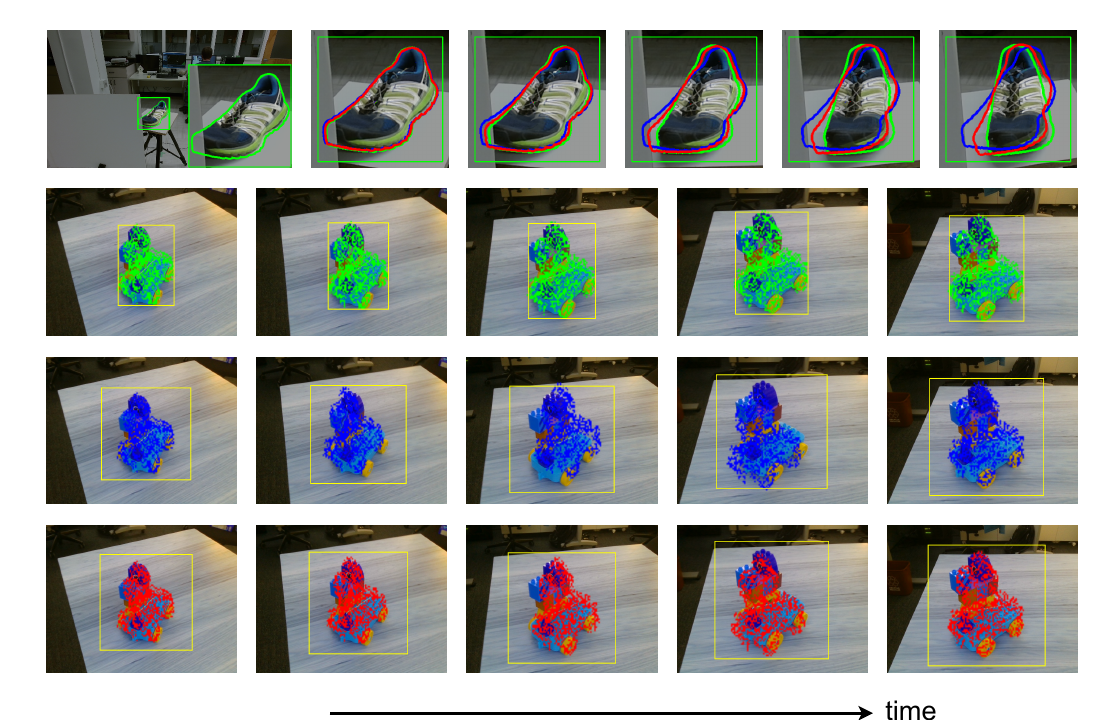
Original Figure 7: green GT, blue two-frame, red multiframe. First row: Laval shoe; last three: MOPED duplo dude. Source: paper PDF. Image copyright belongs to the authors and publisher; reproduced here for paper analysis.
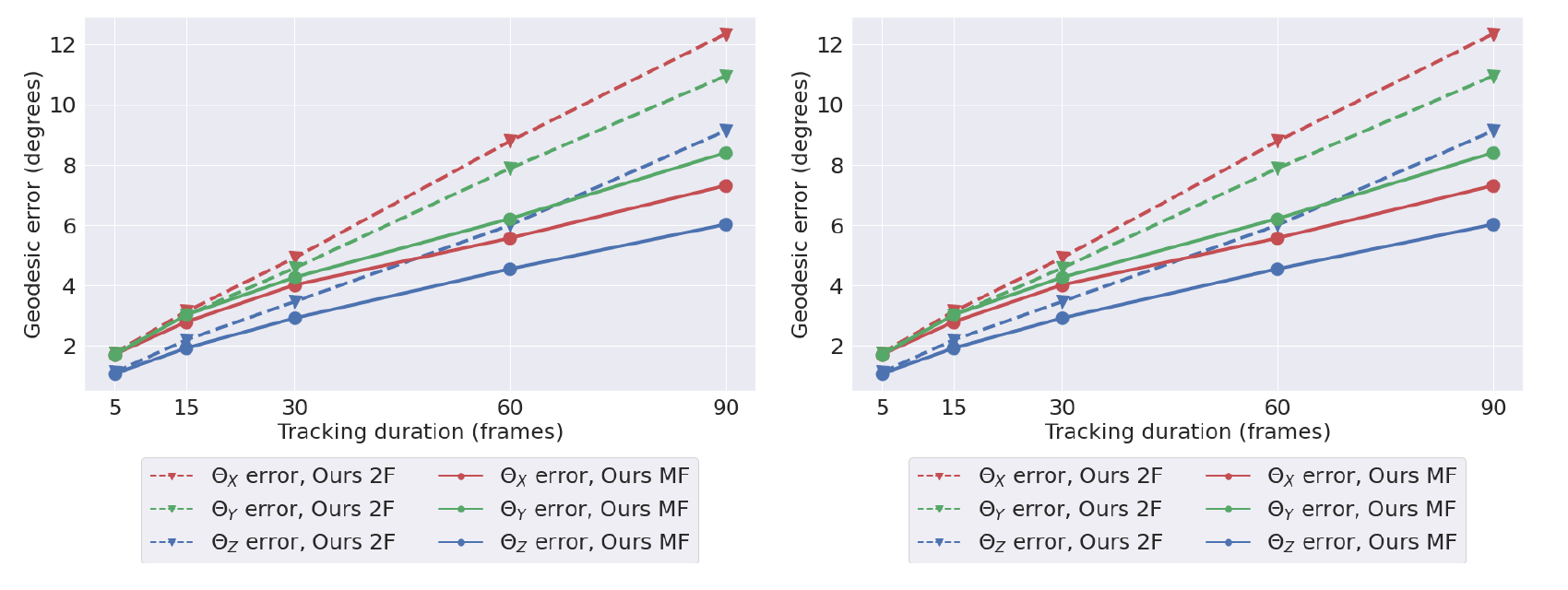
Original Figure 11: this stored crop repeats the same rotation-error plots in degrees on both sides; the translation plot described in the authors' caption is absent. Rotation errors rise from 5 to 90 frames, with multiframe generally lower. Slower translation growth along $X/Y$ is stated in the authors' text and cannot be verified from this crop. Source: paper PDF. Image copyright belongs to the authors and publisher; reproduced here for paper analysis.
9.1 Monocular Z motion
ΔTz dominates translation error: optical-axis motion can cause little appearance / scale change, especially after resizing, with weak texture or symmetry.
9.2 Segmentation-induced motion ambiguity
Original Figure 13: red boxes show changing inclusion of drill attachments / hoses, mistaken by pose regression for object motion. Source: paper PDF. Image copyright belongs to the authors and publisher; reproduced here for paper analysis.
9.3 Other risks
No recovery: prior-mask / flow dependence lacks global redetection / identity recovery.
Large-motion shifts: fast motion may exceed Gaussian training perturbations.
Long-term gauge drift: scale / center bias accumulates without BA / loop closure.
Transparency / reflection / blur: no dedicated robustness evidence.
10. Engineering and reproduction
10.1 Inference chain
The system requires more than one network pass:
segmentation;
RAFT optical flow;
Mask warping and box updates;
re-segmentation;
shared crop / resize;
ResNet + Transformer + MLP;
Pose reconstruction and composition.
MIT code relies on older PyTorch / MMCV / CUDA and external segmentation / RAFT. Modern reproduction can fail through front-end versions, crop conventions, or transform composition rather than architecture.
10.2 Details to align
Pixel conventions for K and resized intrinsics;
Shared crop origin, width / height, and αu,αv;
Forward / backward mask-warp flow;
Left composition ΔR=RtRt−1⊤;
Rodrigues units and numerical stability;
Update direction S=Zt/Zt−1−1;
GT versus arbitrary R1,Z1 initialization;
Laval 15-frame GT resets.
11. Critical analysis
Strengths
Honest treatment of undefined absolute CAD-free pose; translation matches observability.
Masks, crop coordinates, and temporal context form a complete system.
Multiple synthetic / real tests cover category and domain shifts.
Title / abstract can imply metric absolute pose from RGB alone; gauge conditions are clearer in Algorithm 1.
Incomplete quantitative mask, flow, crop, and length ablations.
Pairwise outputs lack trajectory loss / global consistency.
Short real protocols and few objects underrepresent long, fast, out-and-back, cluttered tracking.
Heavy segmentation without end-to-end timing.
Assumptions
Accurate initialization boxes;
Rigid, identity-consistent objects;
Known consistent intrinsics;
Motion covered by synthetic perturbations;
Stable unseen-object masks;
External metric initial pose when absolute trajectories are required.
Practical feasibility
Useful for AR, robotic tracking, or later manipulation when users / detectors select a target and only continuous motion is needed. Reliable long-term absolute tracking also needs:
Calibrated initial pose / scale;
Loss detection and relocalization;
uncertainty-aware depth motion;
sliding-window global optimization;
Lighter, steadier video masks;
Hardware / real-time measurements.
12. Extensions
Video foundation segmentation: memory-based masks with uncertainty replace warp / resegmentation.
SE(3) temporal modeling: predict distributions in Lie algebra rather than independent ω,Δu,Δv,s, with trajectory losses.
Multiple Z hypotheses: preserve alternative ΔTz depth ratios for later disambiguation.
Keyframe reanchoring: high-confidence local gauges reduce drift.