Category-Level 6D Object Pose Estimation in Agricultural Settings Using a Lattice-Deformation Framework and Diffusion-Augmented Synthetic Data
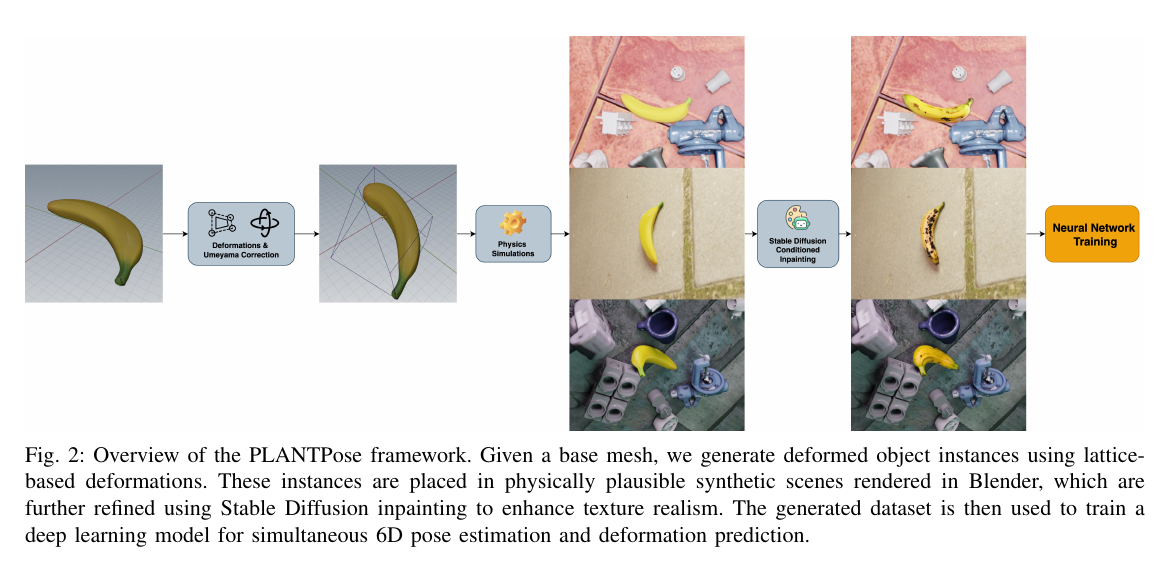
PLANTPose explicitly represents category-instance deformation with a 24D cubic B-spline lattice and removes its rigid component with Umeyama alignment. Blender physics scenes and depth-conditioned Stable Diffusion generate training images. A small ViT jointly predicts rotation, deformation, and projections from RGB, while PnP recovers camera-frame translation.
A category base mesh represents bananas, with 24 corner-coordinate offsets on a 2×2×2 lattice describing instance deformation. Blender generates physically plausible shapes / poses; depth-conditioned Stable Diffusion changes texture. From one RGB image, joint rotation, deformation, and projection constraints support PnP recovery of camera-frame translation.
3. Guide to figures and tables
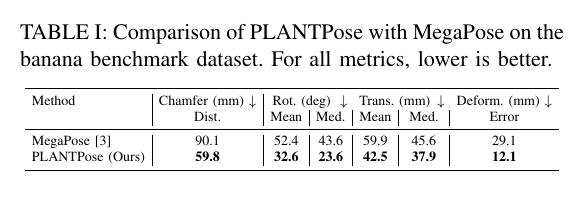
Original Figure 2: lattice deformation and Umeyama remove spurious rigid motion before Blender physics. Stable Diffusion inpainting improves object texture; generated data supervises pose and deformation. Source: authors' public manuscript. Image copyright belongs to the authors and IEEE; reproduced here for paper analysis.Original Table I: PLANTPose improves Chamfer, rotation, translation, and deformation errors over MegaPose using the same average banana mesh. Source: authors' public manuscript. Table copyright belongs to the authors and IEEE; reproduced here for paper analysis.
Outputs: 6D rotation / translation and 24D deformation relative to the category base mesh.
Setting: unseen agricultural-category instances varying in shape, size, ripeness, and texture.
Data: 4,000 deformed synthetic scenes × 3 camera views, about 12,000 training images.
5. Method overview
Deform the base mesh with 3D offsets at 8 corners (24D) and smooth cubic B-splines.
Umeyama aligns original / deformed clouds to remove global rigid components from deformation labels.
BlenderProc randomizes object drops, occlusion, cameras, and lighting.
Stable Diffusion + depth ControlNet inpaints only objects after rendering, adding unripe, ripe, or rotten textures.
A 30.9M-parameter small ViT predicts 6D rotation representation, translation, and 24D deformation.
Train jointly with rotation MSE, deformation MSE, and 2D projection loss. Map crop coordinates to full images, then use deformed 3D points and intrinsics in PnP.
6. Experiments at a glance
Custom benchmark: 6 bananas at different shapes / ripeness, 100 RealSense D435 images, iPhone 14 Pro LiDAR scans, and manual annotation.
PLANTPose versus MegaPose: Chamfer 59.8 versus 90.1 mm, mean rotation 32.6° versus 52.4°, mean translation 42.5 versus 59.9 mm, deformation 12.1 versus 29.1 mm.
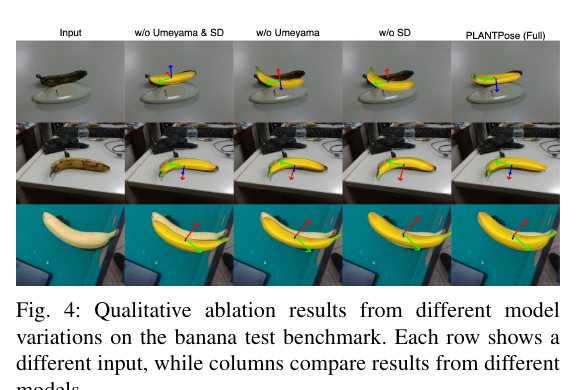
Without Stable Diffusion, mean Chamfer / translation is 71.5 / 48.9 mm; without Umeyama, 73.1 / 50.3 mm; without both, 89.7 / 61.1 mm.
7. Quick assessment
Strengths: interpretable low-dimensional meshes connect category pose and instance shape, with synthetic training, scanned real evaluation, and informative SD / Umeyama ablations.
Limitations: one banana category and 100 test images; separate category training; occasional diffusion pose changes; no real grasp success.
Available src/paper-notes/plantpose-iros2025/deep.md
In-depth paper notes
Support reproduction, comparison, related-work writing, and identifying opportunities for further research.
Paper Reading Notes (Deep): PLANTPose
1. Key assessment
Agricultural-category variation extends beyond texture and scalar size to nonrigid shape. Matching an average banana mesh can compensate shape errors with wrong pose. PLANTPose explicitly absorbs instance shape in a 24D lattice and estimates 6D pose separately.
The main design disentangles deformation labels from rigid motion. Random corners cause bending plus global translation / rotation; raw offsets would conflate these. Umeyama alignment removes rigid components, and ablations show this is essential to pose–shape separation.
2. Task boundaries
Given a category base mesh and one RGB crop, predict:
Rotation R∈SO(3);
Translation t∈R3;
Lattice corner offsets δ∈R24.
No inference depth is used, but the method requires:
A known category and base mesh;
YOLOv11 detection / crop;
camera intrinsics;
A category-trained PLANTPose network.
This is not arbitrary-CAD novel-object pose or generic deformable registration. Only bananas are trained; the mesh is a fixed training prior, not dynamic input.
3. Data and method pipeline
Original Figure 2: Deformations & Umeyama Correction generates low-dimensional shapes and removes rigid components. Physics determines pose / occlusion; Stable Diffusion changes texture domains. Source: authors' public manuscript. Image copyright belongs to the authors and IEEE; reproduced here for paper analysis.
3.1 A 2×2×2 lattice and cubic B-splines
The mesh bounding box defines a lattice. Eight corners have 3D offsets Ci,j,k, totaling 24 parameters. Normalize vertex p to (u,v,w)∈[0,1]3, then weight cubic B-spline bases:
δx(u,v,w)=i,j,k=0∑3Wi(u)Wj(v)Wk(w)Ci,j,kx,
The y,z components follow similarly, giving p′=p+δ(u,v,w). Offsets extend / clamp to a 4×4×4 control grid for cubic boundary behavior. C2 continuity yields smoother deformation than vertexwise noise and fixed-length network outputs.
This suits low-frequency bending, thickness, and banana silhouettes, but not topology changes, fractures, branching foliage, or high-frequency detail.
3.2 Removing spurious pose with Umeyama
After random lattice deformation, use
(s,R,t)=Umeyama(Poriginal,Pdeformed)
to estimate the best similarity transform, fixing s=1, then correct lattice points to remove global rotation / translation from shape labels. Otherwise, δ and R,t can explain the same deformation, making supervision ambiguous.
This assumes one-to-one mesh vertex correspondence. Real scans enter only Chamfer / ICP evaluation, not training deformation labels.
3.3 Physics synthesis and diffusion texture refinement
BlenderProc builds walls, floors, materials, lighting, and distractors. Deformed objects fall and settle physically; cameras sample around a point of interest, rendering 3 views per deformation.
After rendering, Stable Diffusion inpaints object regions to cover ripeness, spots, and rot missing from PBR. Depth-conditioned ControlNet aims to preserve shape / pose; prompts span unripe, ripe, rotten, and natural colors.
This is more controlled than direct text generation, but the authors acknowledge occasional slight 6D pose changes despite depth. Retaining original annotations then introduces label noise.
3.4 Network and losses
A small ViT (30.9M parameters, ImageNet-21k pretraining, 32×32 patches) processes object crops through three heads:
Rotation: 6D continuous representation orthonormalized into R;
Projection loss compares shape / rotation / translation projections with GT mesh-vertex pixels. Undo crop offsets / scale to full-image coordinates, then solve PnP with deformed 3D points, 2D projections, and intrinsics for camera-frame translation.
The text somewhat mixes the translation head, projection loss, and final PnP translation. Reproduction must determine whether predicted translation is a crop-projection intermediate or a PnP initializer.
4. Real banana benchmark
Acquisition includes:
6 bananas varying in shape and ripeness;
100 RealSense D435 RGB images;
Separate iPhone 14 Pro LiDAR scans;
Manual image-pose annotations.
Without vertexwise scan / base correspondence, shape uses Chamfer distance. Rotation / translation errors follow ICP scan-to-base alignment; deformation error compares shapes after removing predicted pose.
ICP helps establish GT coordinates, making scan quality / local minima relevant. With only 100 images, per-banana, visibility, and ripeness statistics are absent.
5. Main results
Original Table I: lower is better throughout. MegaPose uses the same average mesh without instance deformation. Source: authors' public manuscript. Table copyright belongs to the authors and IEEE; reproduced here for paper analysis.
Method
Chamfer (mm)
Mean / median rotation (°)
Mean / median translation (mm)
Deformation (mm)
MegaPose
90.1
52.4 / 43.6
59.9 / 45.6
29.1
PLANTPose
59.8
32.6 / 23.6
42.5 / 37.9
12.1
Against MegaPose, Chamfer drops 30.3 mm, mean rotation 19.8°, mean translation 17.4 mm, and deformation 17.0 mm. One unequal-task comparator mainly supports explicit deformation over an average mesh on this benchmark, rather than general category-level SOTA.
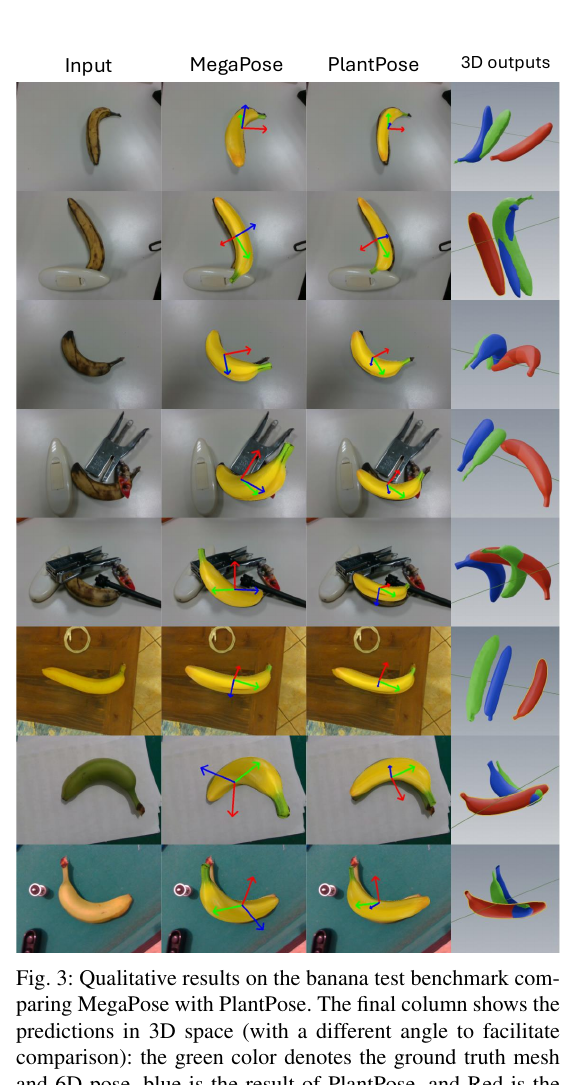
Original Figure 3: green GT, blue PLANTPose, red MegaPose. The final column shows geometry / pose differences from another view. Source: authors' public manuscript. Image copyright belongs to the authors and IEEE; reproduced here for paper analysis.
PLANTPose better follows curvature and length; average-mesh errors affect MegaPose pose as well. Some 3D rotation / shape mismatches remain, and 32.6° mean rotation error falls short of fine agricultural manipulation.
6. Ablations
Setting
Chamfer
Mean / median rotation
Mean / median translation
Deformation
Full
59.8
32.6 / 23.6
42.5 / 37.9
12.1
w/o Stable Diffusion
71.5
37.7 / 23.0
48.9 / 48.7
13.9
w/o Umeyama
73.1
36.5 / 26.2
50.3 / 45.8
12.7
w/o Umeyama and SD
89.7
36.1 / 26.7
61.1 / 61.9
26.5
Stable Diffusion mainly improves real-texture transfer; Umeyama prevents deformation labels absorbing rigid motion. Not every column worsens: without SD, median rotation is 23.0° versus full-model 23.6°. Describe overall trends rather than universal per-metric gains.
Original Figure 4: without Umeyama, shape and pose become entangled; without Stable Diffusion, unseen texture more often disrupts overall pose. Source: authors' public manuscript. Image copyright belongs to the authors and IEEE; reproduced here for paper analysis.
7. Limitations and reproduction risks
The authors identify:
Separate training for each category;
Future dynamic base-CAD inputs for cross-category transfer;
Report per-instance errors and release scans, intrinsics, and annotation protocols.
9. Overall assessment
PLANTPose combines interpretable shape, Umeyama disentanglement, and diffusion texture in a complete data–model pipeline. Benchmark / ablations support this single-category prototype, while 32.6° rotation error, 100 test images, and separate category training leave substantial gaps to general deployable agricultural pose.