PoseGaussian: 6D Pose Estimation for Unseen Objects via Sparse-View Object-Level 3D Gaussian Splatting
PoseGaussian reconstructs an object-level 3D Gaussian Splatting representation from sparse RGB-D reference views. Learned ICP initialization and differentiable rendering refinement with appearance and depth consistency estimate unknown-object 6D pose.
Sparse RGB-D references reconstruct object-level 3DGS. Learned ICP initialization and differentiable RGB / depth consistency then estimate unseen-object poses.
2.1 Guide to the paper’s figures and tables
Figure / table
Purpose
Overview reading tips
Figure 1
Reconstruction, initialization, refinement
Renderable geometry becomes a pose prior
Table 1
LINEMOD ADD(S)-0.1d
Sparse-reference gains
Table 2
GenMOP
Objects and reference budgets
Table 3
Components
Separate reconstruction, ICP, refinement
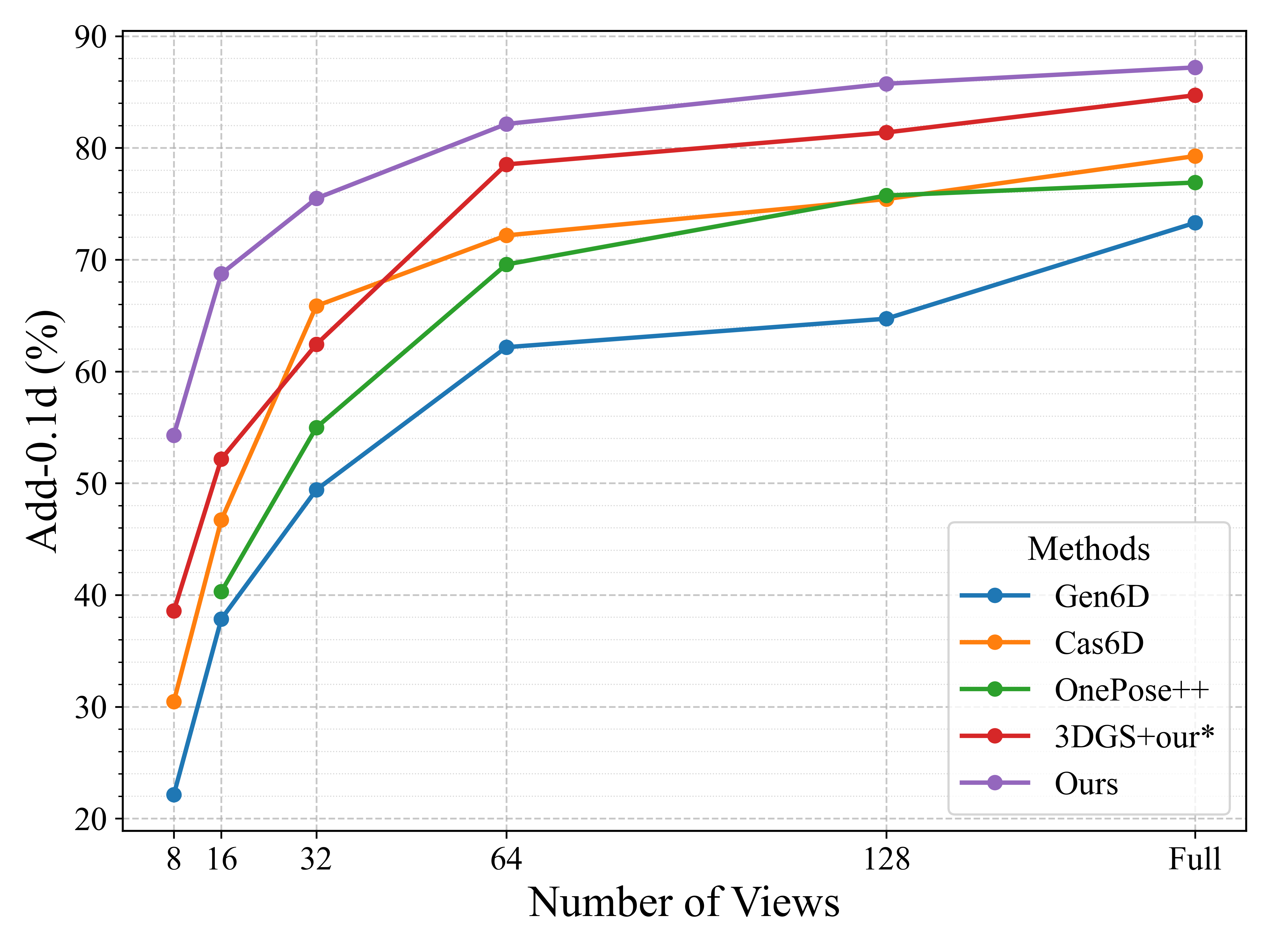
Figure 8
View count / quality
Test sparse-view claims
Original view-count experiment: 8, 16, 32, 64, 128, Full on the horizontal axis; ADD-0.1d (%) vertically. Curves compare Gen6D, Cas6D, OnePose++, 3DGS+our*, and Ours. This is a performance chart rather than a pipeline diagram. Source: CVF Open Access. Image copyright belongs to the authors and publisher; reproduced here for paper analysis.
3. Problem setting
Sparse same-object RGB-D references and query image / depth.
No target CAD; offline object-level 3DGS reconstruction.
Problem: sparse-view floaters, unstable geometry, and overfitting propagate reconstruction errors into pose.
Answer: improve initialization / density control, then combine ICP and differentiable refinement.
2. Positioning in one sentence
Depth regularizes object Gaussians; learned ICP and RGB-D render-and-compare refine pose in SE(3).
2.1 Guide to the paper’s figures and tables
Figure / table
Deep-dive questions
Figure 1
How do reconstruction, initialization, and refinement connect?
Table 1
Stability with few references versus Gen6D, OnePose++, Cas6D?
Table 2
Broad GenMOP gains or easy-object effects?
Figure 8
Separate reconstruction / pose gains from 4 to 8 views?
Table 3
Complementarity of structure, ICP, appearance / depth?
Original view-count experiment: 8, 16, 32, 64, 128, Full on the horizontal axis; ADD-0.1d (%) vertically. Curves compare Gen6D, Cas6D, OnePose++, 3DGS+our*, and Ours. This is a performance chart rather than a pipeline diagram. Source: CVF Open Access. Image copyright belongs to the authors and publisher; reproduced here for paper analysis.
3. Problem setting and boundaries
About 8 RGB-D references reconstruct object-centric 3DGS; query observations align to it.
Unseen-instance pose, not category canonical pose; each object needs capture.
Masks / depth are required. RGB variants estimate depth with ZoeDepth, introducing errors into reconstruction / refinement.
Gaussians encode geometry, color, scale, and renderability rather than hand-built CAD.
Selector replacements hurt initialization and refinement.
Appearance / depth consistency provide complementary constraints.
More references generally help, with more acquisition / onboarding cost.
9. Analysis and lessons
Geometrically motivated roles translate representation quality into pose signals.
Reconstruction time / memory, motion, reflection, transparency, and bad depth remain risks.
Gaussian uncertainty, visible-region confidence, and shared reconstruction could reduce overtrust in floaters.
Active views, incremental training, or feed-forward initialization may reduce 2.21-minute onboarding.
11. How reconstruction affects pose
11.1 Key numbers
Separate LINEMOD reference budgets. Mean ADD(S)-0.1d:
Setting
Gen6D
OnePose++
IG-6DoF / Cas6D
PoseGaussian
Rich references (>200)
76.9
85.1
87.2 (IG-6DoF)
About 2.1 points above latest baseline
Sparse unseen references
47.83 (16)
40.30 (16)
—
54.30 (8)
Unequal budgets do not prove universally highest scores. Eight views beat some 16-view unseen baselines; rich-reference results exceed IG-6DoF by about 2.1 points.
GenMOP ADD-0.1d with 200 references: Gen6D / Cas6D / OnePose++ / IG-6DoF / Ours 49.54 / 53.52 / 44.60 / 56.10 / 59.53. Ours with 8 gives 27.56; 16-view baselines give 34.00 / 37.01 / 24.19. Ours Projection-5 is 88.42 with 200 and 71.69 with 8.
11.2 Table 3 ablations
Variant
ARMSPD
ARMSSD
ARVSD
Mean AR
Ours
87.5
71.4
55.4
71.4
No density control
85.0
67.3
48.9
67.1
No view warping
85.9
68.9
50.6
68.5
vanilla 3DGS
82.1
64.2
45.2
63.8
Gen6D selector
68.7
53.7
44.8
55.7
Cas6D selector
71.4
55.6
45.3
57.4
Gen6D instead of 3DGS refinement
79.2
67.4
52.1
66.2
Initialization replacements hurt most: rendering cannot recover arbitrary coarse poses. Vanilla reconstruction also matters. Appearance / depth-consistency details require supplementary verification beyond the main table.
11.3 Engineering
8 references sorted by coverage; two jittered views each, 1–3° rotation and 0.5%–1.5% object-scale translation.
About 10k iterations; first 6k densify every 500 and prune every 100 steps, with decreasing probability.
RTX 3090 Ti; mean 2.21-minute reconstruction is onboarding, not per-frame latency.
ZoeDepth-derived query depth transmits errors to ICP / normalized-depth rendering.
11.4 Authors’ claims and my assessment
Authors’ claims
My assessment
Sparse object 3DGS stabilizes pose
LINEMOD / GenMOP and count curves support it; separate reconstruction, initial alignment, and final accuracy.
Depth reduces floaters
Vanilla mean AR drops 71.4→63.8; stratify low texture, reflection, missing depth.
Dedicated rendering beats generic refinement
Gen6D replacement gives 66.2, still initialization-dependent.
12. Reproduction and failures
Record view count / coverage, scales, Gaussian count, ICP residuals, render losses, and final errors. Unseen backsides, background-contaminated depths, reflective / transparent Gaussians, and appearance-induced local minima are typical failures. Quality-triggered active capture is preferable to blindly extending iterations for robot onboarding.