initial posepart-level point cloudcategory-level articulated objecttemporal sequence
Full paper metadataAuthors, affiliations, research area, datasets, metrics, method tags, and reading statusExpandCollapse
Authors
Xianhui Meng, Yukang Huo, Li Zhang, Liu Liu, Haonan Jiang, Yan Zhong, Pingrui Zhang, Cewu Lu, Jun Liu
Affiliations
University of Science and Technology of China / China Agricultural University / Hefei University of Technology / Zhejiang University of Technology / Fudan University / Shanghai AI Laboratory / Peking University / Shanghai Jiao Tong University
Title: Exploring Category-level Articulated Object Pose Tracking on SE(3) Manifolds
Method: PPF-Tracker
Authors / affiliations: Xianhui Meng, Yukang Huo, Li Zhang, Liu Liu, Haonan Jiang, Yan Zhong, Pingrui Zhang, Cewu Lu, Jun Liu; University of Science and Technology of China, China Agricultural University, Hefei University of Technology, Zhejiang University of Technology, Fudan University, Shanghai AI Lab, Peking University, Shanghai Jiao Tong University
PPF-Tracker tracks category-level articulated objects across frames, predicting 6D pose increments in SE(3) / se(3). Weighted point-pair voting, dynamic keyframes, and joint kinematic constraints reduce accumulated drift from framewise estimation.
3. Problem setting
Task: continuous tracking of per-part 6D poses and scales for category-level articulated objects.
Input: a point cloud / RGB-D video sequence with initial poses.
Output: an SE(3) pose and 3D scale for each part in every frame.
Key assumption: the object consists of rigid parts connected by joints with usable kinematic constraints.
Applications: robotic manipulation, embodied intelligence, AR/VR, and continuous object understanding.
4. Core motivation
Independent framewise estimation ignores motion continuity and is prone to drift.
Articulated part poses are interdependent; joint axes and kinematic structure should enter pose tracking.
Conventional point-pair descriptors weight all pairs equally and cannot emphasize more discriminative geometric relationships.
5. Method overview
Quasi-canonicalization: use a dynamic keyframe as the local reference and map consecutive frames into a quasi-canonical space.
Weighted PPF voting: compute SE(3)-invariant point-pair parameters and predict quantities related to translation, rotation, and scale.
Lie algebra increment: predict pose increments in se(3) and return to SE(3) via the exponential map.
Kinematics-aware refinement: optimize part poses with geometric and joint energies to preserve structural consistency.
Dynamic keyframe selection: combine Chamfer and Hausdorff distances into an energy and update the keyframe when it falls below a threshold.
6. Experimental overview
Datasets: PM-Videos constructed from PartNet-Mobility; ReArt-Videos constructed from ReArt-48; real-world tests on RobotArm-Videos.
Metrics: rotation error, translation error, 3D IoU, and inference time per frame.
Baselines: category-level articulated pose tracking methods including A-NCSH, CAPTRA, ContactArt, and GAPS.
Main results: across PM-Videos categories such as Laptop, Eyeglasses, Dishwasher, and Scissors, PPF-Tracker generally improves rotation / translation errors and 3D IoU over the compared methods. Reported mean Eyeglasses errors are approximately 3.3° in rotation and 0.036 m in translation.
Speed: about 0.06–0.16 s/frame across several settings, approaching real-time operation.
Are the authors’ claims supported? Broadly yes: synthetic, semisynthetic, and real-world results are accompanied by keyframe and kinematic constraint ablations supporting the core designs.
7. Strengths and limitations
Strengths
Expressing articulated tracking directly in SE(3) / se(3) provides a clear geometric interpretation.
Dynamic keyframes address accumulated error over long sequences; kinematic constraints maintain consistency between parts.
Reports pose errors, scale IoU, speed, and real-world generalization together.
Limitations / risks
Requires initial poses, making it closer to a tracking refiner than a detector starting from scratch.
Depends on point clouds / RGB-D and articulated structure; RGB-only input, severe occlusion, or unknown topology would be harder.
PM-Videos and ReArt-Videos are reconstructed or reorganized datasets; reproducing data generation takes additional work.
8. Research takeaways
Reusable idea: combine dynamic references, Lie algebra increments, and structural energy constraints into an interpretable pose tracking pipeline.
Suitable baseline? Yes for category-level articulated object tracking; not a direct baseline for single-frame unseen rigid object estimation.
Worth a deep read? Yes. Focus on weighted PPF parameterization, joint energies, and dynamic keyframes’ effect on long-term drift.
Questions to investigate: sensitivity to initialization errors, changing joint types, part occlusion, and scale drift.
Available src/paper-notes/ppf-tracker/deep.md
In-depth paper notes
Support reproduction, comparison, related-work writing, and identifying opportunities for further research.
Deep Reading Notes: Exploring Category-level Articulated Object Pose Tracking on SE(3) Manifolds
1. Basic information
Title: Exploring Category-level Articulated Object Pose Tracking on SE(3) Manifolds
Method: PPF-Tracker
Authors / affiliations: Xianhui Meng, Yukang Huo, Li Zhang, Liu Liu, Haonan Jiang, Yan Zhong, Pingrui Zhang, Cewu Lu, Jun Liu; multiple Chinese universities and Shanghai AI Lab
The paper reformulates category-level articulated pose tracking as learning se(3) increments between consecutive frames: keyframe-based quasi-canonicalization precedes weighted PPF estimation of SE(3)-invariant part increments, followed by structured refinement with geometric and joint energies.
2.1 Guide to the paper’s figures and tables
Figure / table
Content
Reading focus
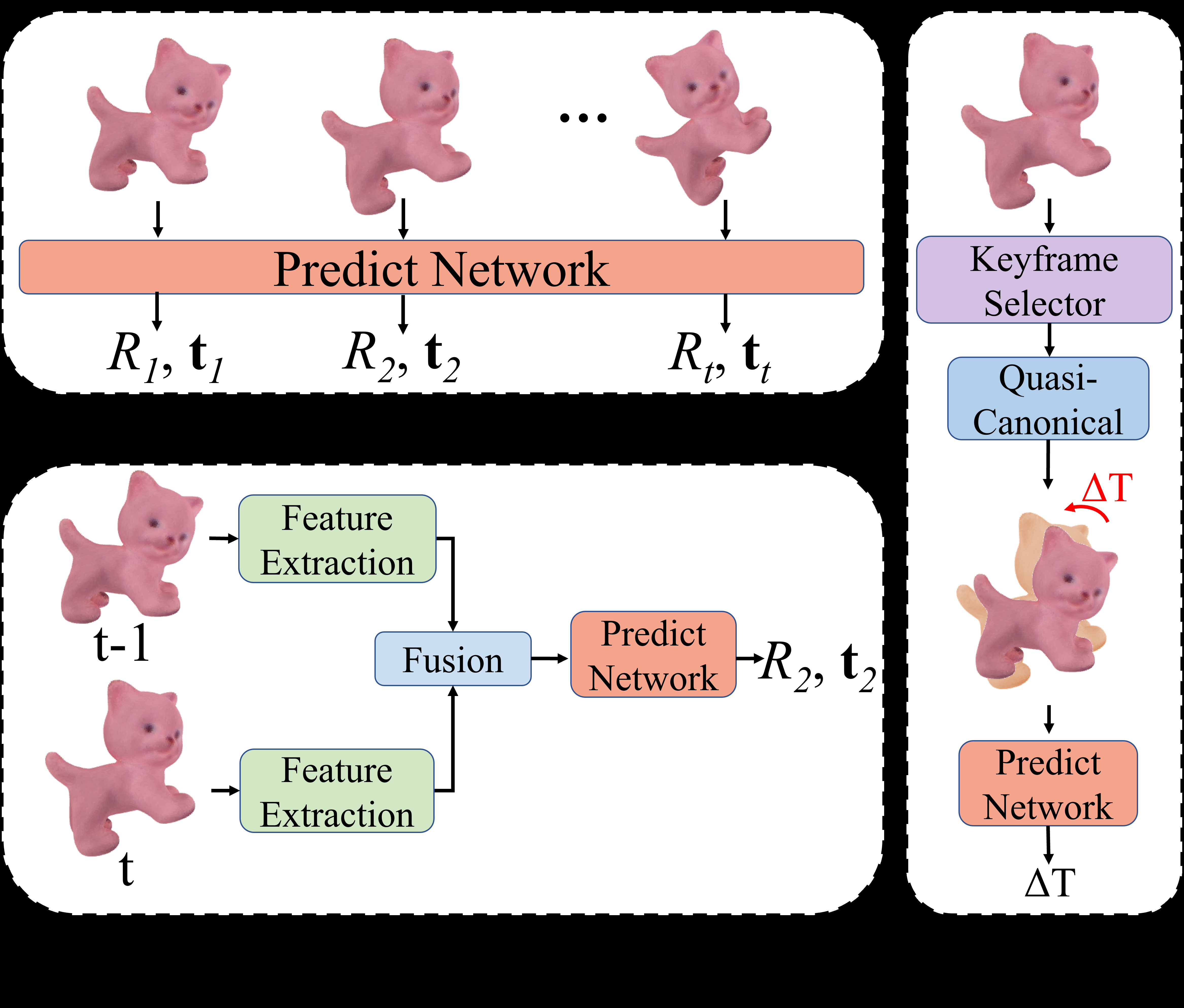
Figure 1
Framewise prediction, inter-frame fusion, and the proposed approach
The main contribution combines temporal information, keyframes, and incremental updates
Figures 2–4
Overall architecture, temporal segments, and quasi-canonicalization
Understand how frames in each segment share a keyframe transformation
Figures 5–6
Weighted point pairs and voting
Inspect how geometric point pairs produce translation / orientation votes
Tables 1–4
PM-Videos, ReArt-Videos, and RobotArm-Videos results
Read accuracy, scale IoU, and inference time together
Table 2
Kinematic constraint and keyframe selection ablations
Direct evidence on drift reduction and structural consistency
Original Figure 1: comparison of framewise prediction, inter-frame fusion, and PPF-Tracker tracking paradigms. Source: official AAAI PDF. Image copyright belongs to the authors and publisher; reproduced here for paper analysis.
3. Problem setting and task boundaries
Let the object have K rigid parts and J joints. Inputs are a point cloud sequence {Pt}t≥0 and initial poses T0k.
Outputs are Ttk∈SE(3) and scale stk∈R3 for each part in every frame.
The basic tracking relation is:
Ttk=ΔTtkTt−1k,
Here, ΔTtk is the current frame’s increment relative to the preceding frame.
The articulated structure is assumed known or definable, and initial poses are available; this is not category-level detection without initialization.
Input may be point clouds / RGB-D. Evaluation focuses on per-part poses across frames, rather than one rigid pose for the entire object.
4. Research context
Earlier category-level pose methods focus on single-frame canonicalization, segmentation, or keypoints; for articulated objects, these can overlook part motion and temporal continuity.
A-NCSH, CAPTRA, ContactArt, and GAPS are the main comparisons. PPF-Tracker combines point-pair invariance, temporal keyframes, and kinematic refinement.
PPFs are invariant to rigid transformations, but conventional PPFs weight all pairs equally; weighted PPFs increase the contribution of discriminative pairs.
Tracking is formulated on a Lie group rather than regressing rotation matrices as Euclidean vectors, aiming to avoid orthogonality and numerical stability issues.
5. Research motivation
The authors’ central hypotheses
Temporal continuity of part poses should be an explicit prior.
Keyframes divide long sequences into locally stable temporal segments, reducing accumulated error.
Joint axes constrain some articulated motions; optimizing parts independently can produce physically inconsistent results.
My analysis
The contribution extends beyond a PPF variant: geometric invariance, temporal memory, and structural constraints form a hierarchical tracking system. It resembles an interpretable optimizer / tracker more than a fully end-to-end black-box estimator.
6. Method details
6.1 Overall pipeline
Divide the sequence into temporal segments using dynamic keyframes.
Transform each segment’s point clouds into quasi-canonical space using its keyframe transformation.
Sample point pairs, compute weighted PPFs, and use PointNet++ to predict each part’s SE(3)-invariant parameters.
Recover translation / orientation through point-pair voting and predict scale.
Represent increments in Lie algebra and apply the exponential map to obtain ΔTtk.
Optimize part poses using geometric and joint kinematic energies.
When the current prediction agrees sufficiently with the observed point cloud, the dynamic selector makes this frame the next segment’s reference.
6.2 Key modules
Module
Input
Output
Role
Connection to the next module
Quasi-canonicalization
Current point cloud, keyframe pose
Quasi-canonical point cloud
Align a local segment to a stable reference
Feeds PPF voting
Dynamic Keyframe Selection
Predicted and observed point clouds
Keyframe update decision
Chamfer + Hausdorff energy determines when to update
Sets the next segment’s reference
Weighted PPF
Sampled point pairs
Invariant features / votes
Encode local geometry and suppress low-value pairs
PointNet++ predicts parameters
Lie algebra increment
PPF predictions
Δξ∈se(3)
Model rotation and translation increments in tangent space
Exponential map returns to SE(3)
Kinematics-aware optimization
Part poses, joint axes
Refined part poses
Minimize geometric and joint consistency energies together
Produces final per-part poses
6.3 Training and supervision
Pointwise voting uses KL divergence to supervise translation / orientation; scale uses MSE and masks use BCE.
The total loss is:
Ltotal=0.3Ltrans+0.3Lorient+0.2Lscale+0.2Lmask.
Kinematic refinement combines geometric energy Egeo and joint energy Ekin between adjacent parts as Ecomp=Egeo+Ekin.
Training runs for 200 epochs on an RTX 4090. PM-Videos is reconstructed because the original PartNet-Mobility generation scripts and configurations were not fully released.
6.4 Inference and engineering complexity
The network estimates the current increment; geometric / kinematic optimization performs structured postprocessing.
Dynamic keyframes reduce accumulated errors but add Chamfer / Hausdorff computations and the engineering hyperparameter ϕ=0.01.
Reported speed is about 0.06–0.16 s/frame depending on category and part count; this is not a high-frame-rate tracker, though it approaches interactive operation.
Reproduction challenges include PM-Videos / ReArt-Videos generation, part and joint annotations, point-pair sampling, and energy optimization iteration counts.
7. Experimental analysis
7.1 Datasets
PM-Videos: synthetic category-level articulated tracking dataset built from PartNet-Mobility.
ReArt-Videos: semisynthetic tracking dataset based on ReArt-48.
RobotArm-Videos: real robot / real-world videos including Box, Stapler, Cutter, Scissors, and Drawer categories.
7.2 Main results
On PM-Videos, PPF-Tracker generally achieves the lowest rotation / translation errors or highest 3D IoU across Laptop, Eyeglasses, Dishwasher, Scissors, Drawer, and other categories. For Eyeglasses, mean rotation error is about 3.3°, translation error about 0.036 m, and inference about 0.12 s/frame. RobotArm-Videos rotation errors span about 2.26°–19.43° and translation errors about 0.002–0.155 m, showing substantial category difficulty differences.
7.3 Ablation studies
Ablation
Result
Strength of evidence
No kinematic constraints
Rotation about 8.6/9.1°, translation about 0.109/0.122 m
Compared with full model 3.2/3.4°, 0.038/0.045 m, supports joint constraints
No keyframe
Largest errors
Supports local references for long-term tracking
Fixed keyframe
Better than no keyframe, weaker than dynamic
Supports flexible dynamic updates
Dynamic keyframe
Best
Threshold sensitivity and cross-object generalization need further study
7.4 Robustness and failures
Semisynthetic and real-world results demonstrate some synthetic-to-real generalization.
Kinematic constraints suppress independent part drift, but incorrect joint axes or extensive part invisibility may propagate errors through those constraints.
Large initialization errors, unknown joint topology, transparent / reflective materials, and fast nonrigid motion are not systematically studied.
8. Critical analysis
Strengths
Pose increments in se(3) avoid the geometric issues of direct rotation matrix regression.
Keyframes, motion increments, and joint energies offer clear paths for interpreting errors.
Experiments cover synthetic, semisynthetic, and real-world settings and report speed.
Weaknesses and implicit assumptions
Strong dependence on initial poses, part structure, and joint information limits fully open settings.
Reconstructed PM-Videos may differ from previous works’ generation protocols; fair comparison requires rerunning code.
Kinematic optimization can improve accuracy but may also hard-code incorrect structural priors into outputs.
Practical feasibility
Suitable for continuous robotic tracking of initialized articulated objects. Detection from scratch needs additional segmentation, initial pose proposals, and structural recognition.
9. Future work and possible improvements
Unify initial pose proposals, part segmentation, joint discovery, and tracking.
Use uncertainty-aware PPF votes for occlusion and missing local geometry.
Learn a keyframe policy instead of using a fixed energy threshold.
Combine differentiable kinematic solvers with end-to-end training.
Evaluate failures under rapid motion, joint friction, soft parts, and unknown topology.
10. Implications for my research
Dynamic keyframes and se(3) increments could stabilize object pose sequences.
For multi-object tracking, separate local object trackers from scene-level association.
Report framewise error, accumulated drift, per-part consistency, and speed rather than only single-frame ADD / IoU.
11. Open questions
How large can initialization errors become before tracking fails?
Must the dynamic keyframe energy threshold be adapted to category and point cloud density?
Are joint axes known during training or estimated from input?
How should a fair comparison with RGB-only articulated tracking be configured?