Reading Notes
Overview / Deep Dive
Available src/paper-notes/raypose-iccv2025/coarse.md
Paper overview notes
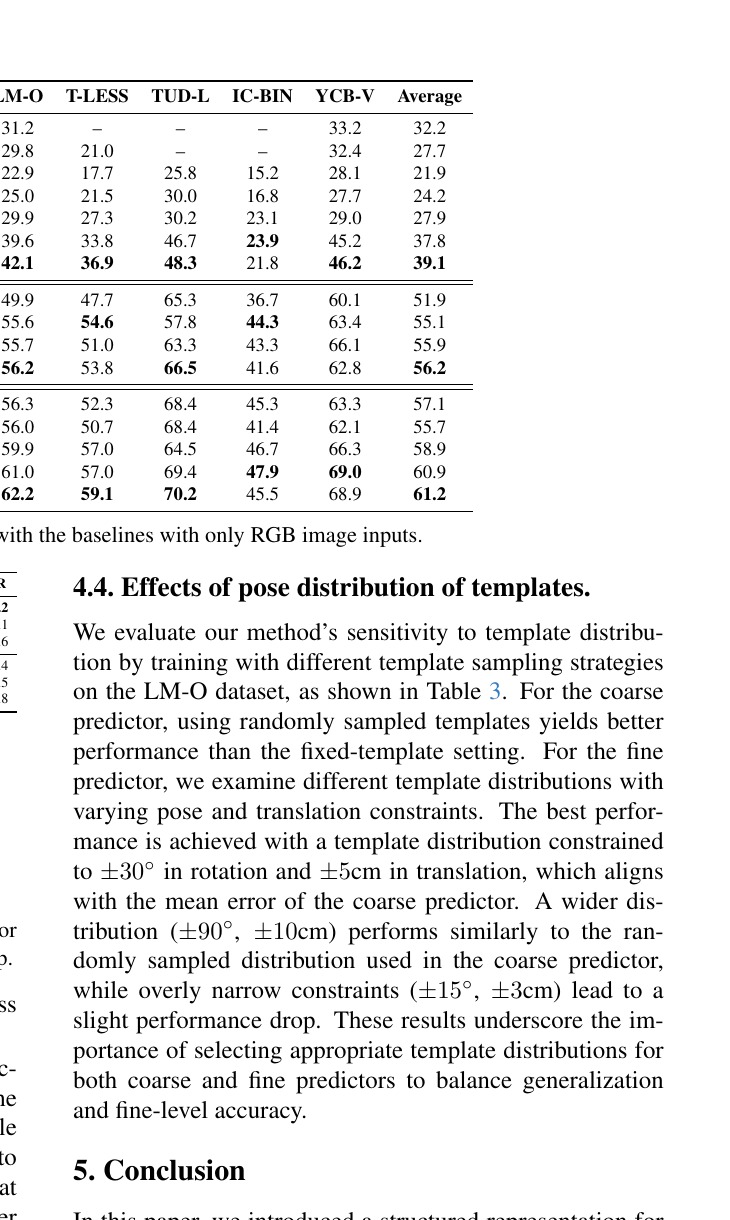
Quickly assess the paper's scope, problem setting, core method, experimental findings, and whether to read it in depth.
Overview Notes: RayPose: Ray Bundling Diffusion for Template Views in Unseen 6D Object Pose Estimation
1. Basic information
- Year / venue: 2025 / ICCV; reading mode: coarse.
- Task: estimate an unseen query object’s 6D pose from multiple template views with known poses.
- Source: ICCV Open Access.
2. Positioning in one sentence
RayPose represents pose as object-centered camera-ray bundles and translation maps. A diffusion transformer denoises query poses conditioned on multiview posed templates, reducing dependence on nearest-template retrieval.
2.1 Guide to the paper’s figures and tables
| Figure / table | What to inspect |
|---|---|
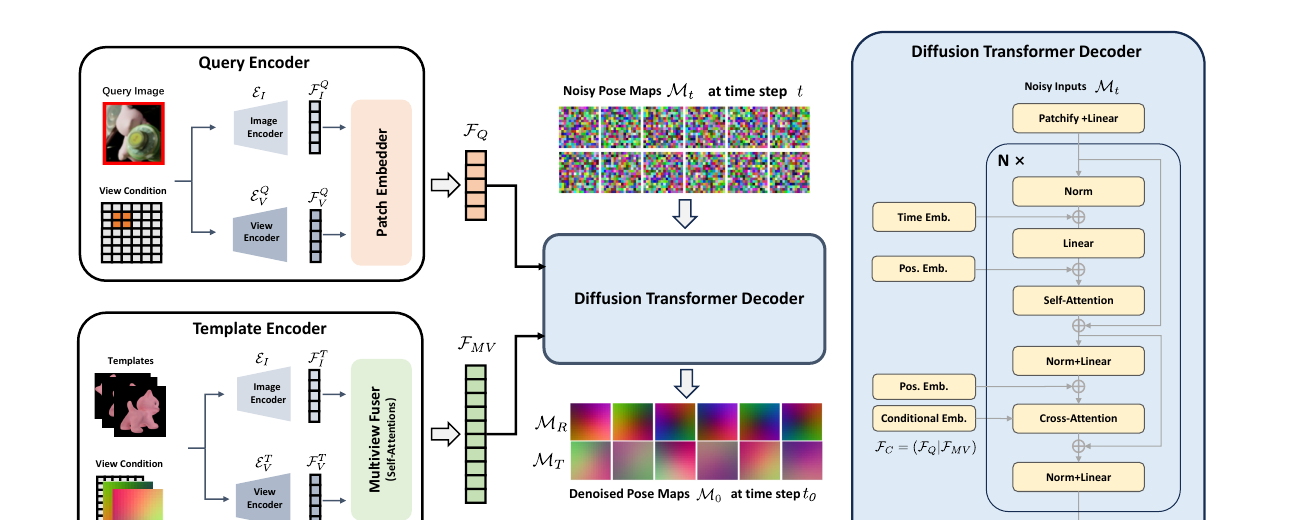
| Figure 2 | Information flow through query and template encoders, the multiview fuser, and diffusion decoder. |
3. Method overview
- Rotation uses camera rays from the object center; translation uses dense offset maps, avoiding conditional diffusion directly over continuous variables.
- Query images and posed templates are encoded separately. Self-attention fuses template features, then a DiT decoder predicts clean pose maps.
- Coarse training randomly samples templates; fine training restricts sampling near the query view. The architecture stays the same while the training distribution changes.
4. Experimental overview
- Multiple instance-level unseen-object benchmarks evaluate pose accuracy under different template / reference conditions.
- Authors’ claim: competitive unseen 6D pose estimation, especially reducing catastrophic failures from retrieving the wrong nearest template.
- My analysis: rays provide geometrically interpretable denoising targets. Diffusion sampling, template pose accuracy, and multimodal solutions for reflective / symmetric objects still warrant separate evaluation within real BOP pipelines.
5. Strengths, weaknesses, and takeaways
- Strength: combines generative modeling with template geometry rather than image-only regression.
- Risk: posed template images remain necessary; speed, sampling steps, and symmetry handling require supplementary material / code checks.
- Takeaway: treat a template set as a conditioning distribution rather than requiring selection of one candidate image.