3D Representations / Reconstruction · 2025 · WACV · CCF C
Comparative Evaluation of 3D Reconstruction Methods for Object Pose Estimation
The benchmark captures 397–505 calibrated high-resolution views for each of 21 physical YCB-V objects, comparing BOP AR when COLMAP, RealityCapture, Nerfacto, VolSDF, MonoSDF, BakedSDF, and other reconstructions feed MegaPose / FoundationPose. Geometry completeness / accuracy, PSNR, and downstream pose rankings differ. Even the best reconstructions typically trail CAD by around 10%–20%; RealityCapture and Nerfacto offer favorable accuracy–time tradeoffs, and most methods approach full-data performance with 75–100 images. Small, reflective, finely textured, and physically changed objects are hardest. Benchmark registration still initializes ICP with CAD and manual coarse alignment, so this is not complete CAD-free onboarding.
calibrated multi-view RGB for reconstructionRGB YCB-V test images for MegaPoseRGB-D YCB-V test images for FoundationPosereconstructed mesh or implicit rendering
Requirements
known camera intrinsics and refined multi-view extrinsicsobject masks for reconstructionYCB-V CAD model for benchmark registration and oracle evaluationmanual coarse alignment followed by ICPknown object identityfixed MegaPose or FoundationPose downstream estimator
Full paper metadataAuthors, affiliations, research area, datasets, metrics, method tags, and reading statusExpandCollapse
Authors
Varun Burde, Assia Benbihi, Pavel Burget, Torsten Sattler
Affiliations
Czech Institute of Informatics, Robotics and Cybernetics, Czech Technical University in Prague
known camera intrinsics and refined multi-view extrinsicsobject masks for reconstructionYCB-V CAD model for benchmark registration and oracle evaluationmanual coarse alignment followed by ICPknown object identityfixed MegaPose or FoundationPose downstream estimator
Reading Notes
Overview / Deep Dive
Available src/paper-notes/reconstruction-pose-benchmark-wacv2025/coarse.md
Paper overview notes
Quickly assess the paper's scope, problem setting, core method, experimental findings, and whether to read it in depth.
Overview Notes: Comparative Evaluation of 3D Reconstruction Methods for Object Pose Estimation
1. Basic information
Short name: Reconstruction → Pose Benchmark
Authors: Varun Burde, Assia Benbihi, Pavel Burget, Torsten Sattler
Affiliation: Czech Institute of Informatics, Robotics and Cybernetics, Czech Technical University in Prague
This paper proposes a task-aware benchmark, not a new pose estimator. High-resolution calibrated images of 21 real YCB-V objects support reconstruction with MVS, NeRF, SDF, and explicit mesh methods. These reconstructions replace CAD models in MegaPose / FoundationPose, and BOP AR directly measures their usefulness for downstream 6D pose estimation.
The central finding is that geometric completeness, accuracy, PSNR, and visual appeal cannot reliably substitute for downstream pose evaluation. RealityCapture and Nerfacto offer strong accuracy–time tradeoffs. Reconstructions of simple, large, near-Lambertian objects can approach CAD oracles, while small, reflective, finely textured, or appearance-changed objects remain difficult. Even the best reconstructions typically retain a roughly 10%–20% pose quality gap from CAD.
2.1 Guide to the paper’s figures and tables
Figure / table
Question
Coarse assessment
Figure 1
Do geometric metrics, pose AR, reconstruction time, and PSNR agree?
Rankings differ; pose evaluation can distinguish methods that conventional reconstruction metrics cannot
Figure 2
Which objects are hardest when replacing CAD with reconstruction?
Large uniform / Lambertian objects need not be hard; small objects and shiny textures are harder
Figure 3
How many images are needed, and are incomplete meshes necessarily useless?
The authors describe near-best reconstruction at 75–100 images, not a universal plateau; incomplete meshes can work if discriminative parts survive
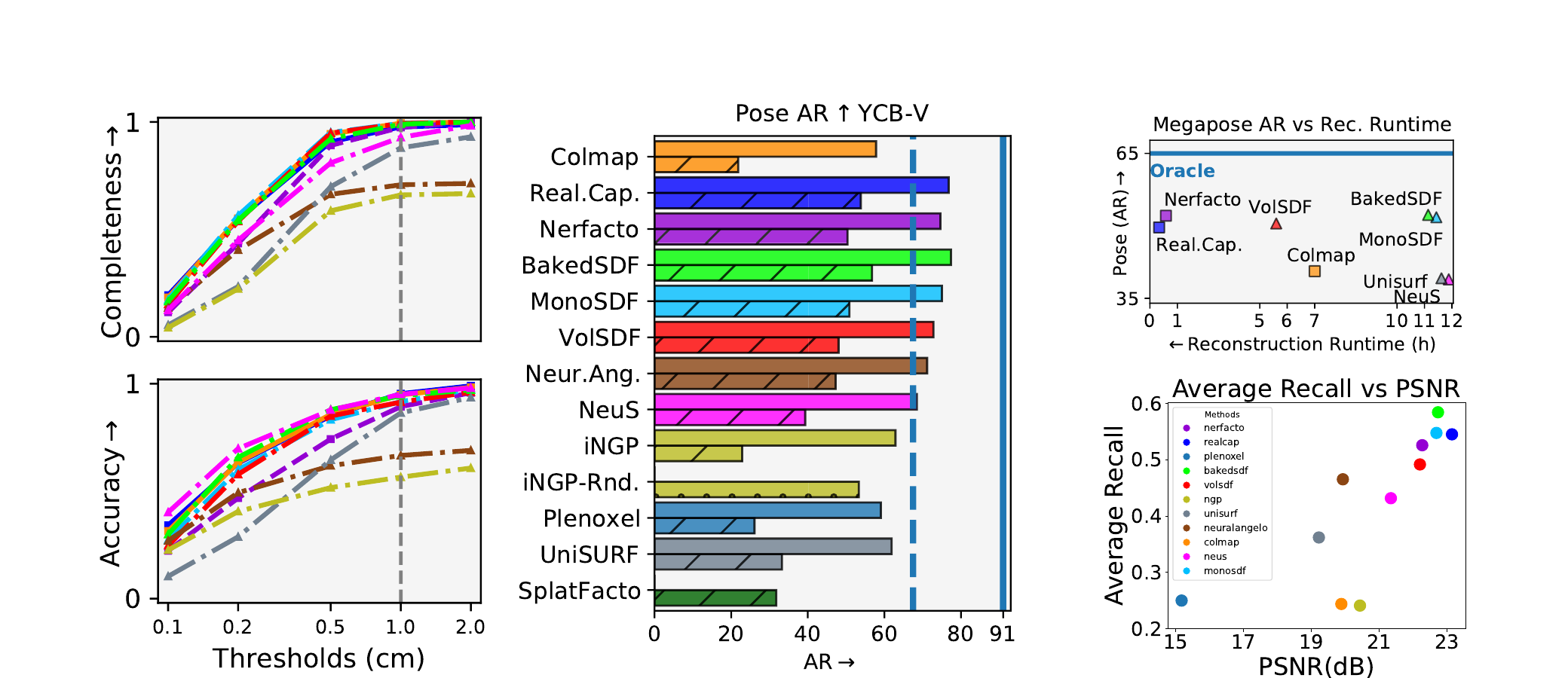
Original Figure 1: reconstruction completeness / accuracy on the left; BOP AR with reconstructed models in MegaPose and FoundationPose in the middle; time, PSNR, and MegaPose AR on the right. Metric rankings are not equivalent. Source: CVF Open Access. Image copyright belongs to the authors and publisher; reproduced here for paper analysis.
3. Problem setting
3.1 The actual question
Generalizable estimators such as MegaPose and FoundationPose need no retraining for each new object, but usually require accurate CAD. CAD may be unavailable, while taking RGB photos around an object is often easier. The paper asks:
Can image-reconstructed 3D models replace CAD in existing render-and-compare pose estimators?
This is an asset quality study rather than a new-network leaderboard. Reconstruction methods are the subjects; MegaPose and FoundationPose are fixed downstream measurement instruments.
3.2 Data flow
Stage
Input
Processing
Output / evaluation
Capture
21 physical YCB-V objects
Robot-mounted camera captures calibrated, unobstructed, high-resolution views
About 397–505 images per object, averaging 480
Reconstruction
Calibrated multiview RGB, masks
COLMAP, RealityCapture, Nerfacto, VolSDF, MonoSDF, BakedSDF, etc.
Meshes, colored meshes, or implicit rendering
Registration
Reconstruction + YCB-V CAD
Manual coarse alignment initializes ICP; background is cropped away
Reconstructed model in the YCB-V GT frame
Pose testing
YCB-V test RGB / RGB-D
MegaPose (RGB), FoundationPose (RGB-D)
VSD / MSSD / MSPD Average Recall and overall BOP AR
Control
Original YCB-V CAD
Same estimator and test images
CAD oracle
3.3 Priors and boundaries
This tests asset replacement for known object instances; object identity is given at test time.
Reconstruction uses newly captured, unobstructed, object-focused high-resolution images, not cluttered YCB-V test frames.
Multiview camera intrinsics / extrinsics are known and refined offline; reconstruction is not pose-free.
Each reconstruction is registered to the CAD frame to match YCB-V GT; manual coarse alignment initializes ICP.
Some original YCB objects are discontinued. Officially recommended look-alike replacements differ by about 4% of object dimensions on average and may have different textures.
CAD still supplies registration coordinates and the oracle. The experiment tests reconstruction at pose deployment, not an entirely CAD-free preparation workflow.
4. Benchmark dataset
4.1 Capture hardware and views
Basler Ace acA2440-20gc camera;
Mounted on a 7-DoF KUKA LBR IIWA 14 R820 robot flange;
Spherical camera positions around the object: latitude 0°–150°, longitude 0°–360°, 10° intervals;
397–505 images per object, averaging 480;
Resolution: 2448×2048;
Fixed exposure, with the full object visible;
Reported hand-eye / camera calibration error bounds: about 5 mm translation and 0.1° rotation;
Extrinsics receive two offline refinement stages: iNGP pose refinement and COLMAP bundle adjustment.
Released calibrated, undistorted images, object masks, and 3D reconstructions cover 21 YCB-V objects.
4.2 Why not reconstruct directly from YCB-V test images?
YCB-V test frames target pose evaluation, with clutter, occlusion, backgrounds, and limited object pixels that hinder complete reconstruction. New captures deliberately provide unobstructed, object-focused, high-resolution views. Separating asset capture from difficult pose tests avoids making input image quality the sole reconstruction bottleneck.
5. Compared methods
5.1 Downstream pose estimators
MegaPose: RGB render-and-compare estimation with unseen-object generalization;
FoundationPose: RGB-D render-and-compare estimation, a strong general CAD-based estimator at the time of writing.
Reconstruction rankings broadly agree across the two estimators, offering meaningful but limited evidence that asset quality effects extend beyond one downstream network.
Meshes support efficient rendering. Implicit networks can also synthesize views, but are typically slower: MegaPose + Nerfacto takes nearly 2 minutes per image on an A100. The main benchmark therefore emphasizes renderable meshes.
6. Evaluation metrics
6.1 Reconstruction metrics
Completeness: the fraction of reference CAD surface points with a reconstructed neighbor within a threshold;
Accuracy: the fraction of reconstructed surface points with a reference CAD neighbor within a threshold;
Distance thresholds range from 1 mm to 2 cm;
PSNR evaluates mesh appearance;
Reconstructions are subsampled to a fixed point count to reduce mesh density effects.
6.2 Downstream pose metrics
BOP metrics are used:
VSD: visible surface discrepancy, more closely related to global placement / navigation;
MSSD: maximum symmetry-aware surface distance, sensitive to small offsets near grasp points;
MSPD: maximum symmetry-aware projection distance, reflecting pixel misalignment in rendering and AR / VR;
Recall is averaged over thresholds for each error, then the three AR values are averaged into overall BOP AR.
The question therefore goes beyond visual mesh similarity to the effect of pose misalignment on surfaces, manipulation, and image projections.
7. Main results
7.1 Conventional metrics do not reliably predict pose quality
The paper gives several counterexamples:
RealityCapture and BakedSDF have similar completeness / accuracy, but BakedSDF gives slightly better poses;
Nerfacto has worse geometric metrics than MonoSDF, but similar downstream poses;
VolSDF and MonoSDF geometric curves nearly overlap, while pose evaluation distinguishes them;
RealityCapture has higher PSNR than BakedSDF but slightly worse poses;
COLMAP and NeuralAngelo have similar PSNR but substantially different pose quality.
Geometry and appearance still matter, but neither alone is sufficient for asset acceptance.
7.2 CAD oracles remain ahead
Even the best reconstructions generally retain a 10%–20% pose quality gap from CAD. VSD recall is closer to CAD, suggesting broadly correct placement; larger MSSD / MSPD drops indicate risks for precise manipulation and visual overlays respectively.
7.3 Accuracy–runtime tradeoff
RealityCapture runs on the weaker RTX 3060 yet approaches strong neural methods’ pose quality in less time. Nerfacto also offers a favorable accuracy–runtime tradeoff. Classical MVS has therefore not been comprehensively superseded by neural reconstruction.
7.4 Object properties determine replaceability
Large, Lambertian objects with uniform textures need not be difficult: reliable geometry can supply sufficient pose cues. Harder cases include:
Small objects (grouped as ≤8 cm), with limited reconstructed texture resolution;
Shiny / reflective surfaces, where view-dependent reflections conflict with baked textures;
Fine texture needed to disambiguate geometric symmetry but difficult to reconstruct;
Packaging differences between newly captured objects and legacy objects in YCB-V tests.
7.5 How many images are needed?
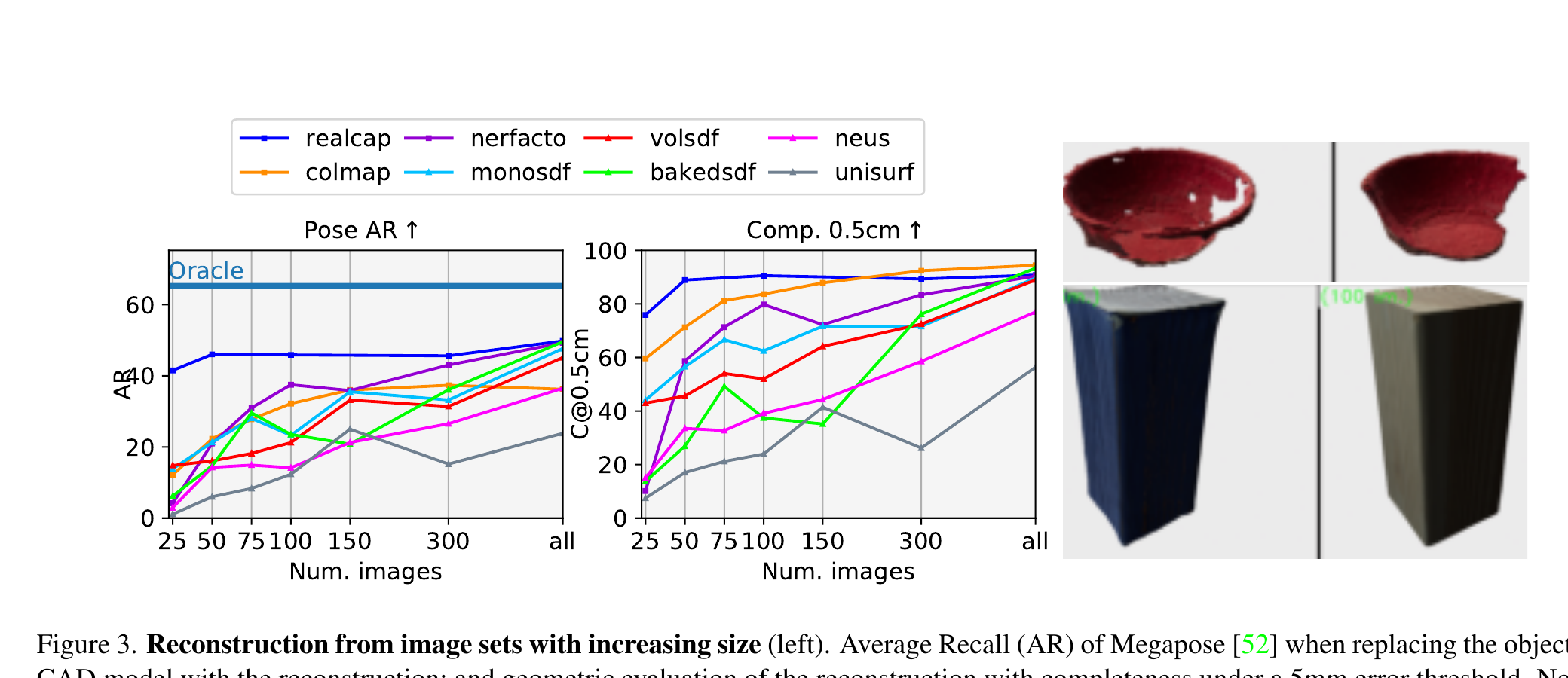
Original Figure 3: 25, 50, 75, 100, 150, 300, and all views are compared on the left; the authors describe 75–100 images as a useful budget, while several plotted curves keep improving afterward. On the right, visually incomplete or incorrectly textured reconstructions can still give good poses when discriminative parts remain. Source: CVF Open Access. Image copyright belongs to the authors and publisher; reproduced here for paper analysis.
More images generally help with diminishing returns. The authors describe 75–100 images as a useful reconstruction budget. This site notes that some neural pose AR curves still improve substantially with more views, so this is not a universal saturation threshold. RealityCapture is especially stable: under 1 minute on average for 25 images and about 2 minutes for 50. Some neural methods fail with few views; robot encoder noise can prevent monotonic improvement.
Figure 3 offers counterintuitive examples: two bowl reconstructions both lack surfaces, yet one matches CAD oracle AR=38 and the other gives AR=15. An incorrectly textured wood block reconstruction reaches AR=39, exceeding its CAD oracle AR=27. Preserving pose-discriminative parts such as edges matters more than a complete, visually pleasing mesh.
8. Strengths and limitations
Strengths
Evaluates reconstruction through a real downstream task rather than substituting PSNR / completeness for the objective.
Covers 21 physical YCB-V objects, two strong general pose estimators, and classical / neural reconstruction families.
Fixes reconstruction coordinate frames and disables method-specific pose refinement to reduce confounds.
Jointly studies geometry, appearance, poses, image budgets, and runtime for practical conclusions.
Releases captures, calibration, masks, reconstructions, and code for adding methods.
Limitations / risks
Benchmark construction still needs YCB-V CAD for ICP registration and oracles; the full capture-to-deployment workflow is not CAD-free.
Manual ICP initialization adds effort and can conceal automatic registration failures.
Discontinued YCB objects are replaced with look-alikes; mean 4% size differences and packaging changes confound method comparisons.
Only 21 tabletop objects are included, not large industrial parts, transparent objects, or scene-level assets.
Agreement across two estimators is useful but cannot establish consistent gains for every pose estimator.
Hardware, software, representations, and rendering paths differ across reconstruction methods; runtime is an engineering reference.
Many figure values are curves / bars; the text provides trends and a few exact examples, so arbitrary decimal precision is unwarranted.
9. Worth a deep read?
Highly recommended for missing-CAD settings, object onboarding, and joint NeRF / 3DGS / mesh–pose research.
This paper changes experimental design rather than providing a network to copy. Claims that better reconstruction improves pose should be tested with one fixed estimator, reporting BOP AR, runtime, image budgets, and object-property groups—not just attractive meshes, Chamfer distance, or PSNR.
10. Coarse reading conclusion
Two findings coexist:
Image-reconstructed 3D models already support useful 6D poses for many objects; classical RealityCapture is especially competitive in speed and accuracy;
CAD replacement remains unresolved: small, shiny, finely textured, appearance-changed objects and sparse views can widen the CAD gap.
The main methodological lesson is that downstream pose tasks should determine reconstruction acceptance. Completeness, PSNR, and visual appeal are diagnostic signals rather than final objectives, and do not reliably determine pose accuracy.
Available src/paper-notes/reconstruction-pose-benchmark-wacv2025/deep.md
In-depth paper notes
Support reproduction, comparison, related-work writing, and identifying opportunities for further research.
Deep Reading Notes: Comparative Evaluation of 3D Reconstruction Methods for Object Pose Estimation
1. Basic information
Short name: Reconstruction → Pose Benchmark
Authors: Varun Burde, Assia Benbihi, Pavel Burget, Torsten Sattler
Affiliation: Czech Institute of Informatics, Robotics and Cybernetics, Czech Technical University in Prague
This paper reframes reconstruction quality as asset quality within 6D pose systems. Multiple methods reconstruct each YCB-V object, replacing CAD in MegaPose / FoundationPose under fixed test images and BOP metrics. Completeness, accuracy, PSNR, and visual appeal do not reliably predict pose AR; downstream evaluation reveals whether useful geometry and appearance cues survive.
Five conclusions matter more than any single reconstruction ranking:
CAD replacement works for some objects: reconstructions of simple, large, Lambertian objects sometimes approach CAD oracles.
An overall gap remains: the best reconstructions typically retain about a 10%–20% pose quality gap from CAD.
Classical MVS remains strong: RealityCapture is fast, stable with sparse views, and competitive with strong neural methods; Nerfacto also offers a favorable accuracy–time tradeoff.
Assets need not be visually perfect: incomplete meshes or incorrect textures can support good poses if discriminative parts remain.
Specific properties dominate difficulty: small, reflective, finely textured objects and appearance differences from legacy test objects are particularly challenging.
The CAD-free boundary matters: new captures generate deployment assets, but YCB-V CAD still supports reconstruction evaluation, registration, and oracles. Each reconstruction needs manual coarse ICP initialization. This tests replacing CAD during pose inference, not a fully CAD-free onboarding workflow.
The authors identify a useful 75–100-image budget, not universal saturation; discriminative parts matter more than completeness
3. Research question and task boundaries
3.1 Why general pose estimators still depend on CAD
FoundationPose, MegaPose, and related methods generalize to unseen objects without per-test-object retraining, but render-and-compare, template generation, or correspondences usually need accurate 3D models. Industrial CAD, laser scans, and high-quality manual meshes are expensive; service robots cannot prepare CAD for every possible object.
Capturing RGB images around new objects is more realistic. The question therefore goes beyond visual resemblance:
Assets are the study subject, not estimator architecture.
4. Building the benchmark data
4.1 Why recapture instead of reusing YCB-V videos?
YCB-V test images deliberately challenge pose estimation with clutter, occlusion, complex backgrounds, and limited target pixels. These hinder complete, high-quality reconstruction. Reconstructing directly from test videos would confound unsuitable inputs with algorithm weaknesses, preventing fair comparison of reconstruction methods.
Pose component: established YCB-V / BOP test images and GT poses.
The question becomes whether assets reconstructed from favorable inputs can handle difficult downstream pose scenes.
4.2 Capture hardware and trajectory
Item
Setting
Camera
Basler Ace acA2440-20gc
Robot arm
7-DoF KUKA LBR IIWA 14 R820
Camera mounting
Robot flange
Image resolution
2448×2048
Latitude
0°–150°, 10° intervals
Longitude
0°–360°, 10° intervals
Images per object
397–505, averaging 480
Exposure
Fixed during scanning
Content
Full object within the field of view, unobstructed and object-focused
Releases
Calibrated / undistorted images, object masks, 3D reconstructions
Camera positions follow an evenly distributed spherical trajectory. IIWA stack, MoveIt, and CHOMP handle planning and collision avoidance.
4.3 Calibration and extrinsic refinement
OpenCV and MoveIt handle camera / hand-eye calibration, with reported errors up to 5 mm translation and 0.1° rotation. Robot kinematic extrinsics remain sensitive to encoder noise, especially near degenerate extended configurations.
To share camera poses across reconstruction methods, two offline refinement stages are used:
iNGP pose refinement;
COLMAP bundle adjustment.
Extrinsics are then fixed and method-specific pose refinement disabled, avoiding camera quality differences when one method optimizes cameras and geometry while another accepts fixed cameras.
4.4 Look-alike replacements and domain mismatch
Discontinued YCB-V products are replaced with recommended look-alikes that may differ from old CAD / test images in texture and scale. Mean size change is 4% of object dimensions. The captured physical scale is preserved rather than forced to match old CAD.
This has two implications:
Practical relevance: packaging changes routinely create mismatches between legacy images and new objects;
Causal confounding: pose drops can reflect product version changes as well as reconstruction algorithms.
Legacy / updated object grouping partly separates these effects, but users should still record object versions as metadata.
5. Benchmark Pipeline
5.1 Reconstruction
Inputs include calibrated multiview RGB, intrinsics, refined extrinsics, and masks. Possible outputs include:
textured mesh;
colored mesh;
Meshes extracted from SDF / density fields;
Direct novel-view rendering from implicit representations.
Meshes are preferred where possible for consistent coordinates and efficient downstream rendering. Direct implicit rendering is an additional comparison that can preserve view-dependent appearance but is usually expensive.
5.2 Mesh Registration
YCB-V GT uses original CAD coordinates, while reconstructions use robot / world coordinates. A rigid transform is needed to reuse GT. The procedure is:
Manually initialize coarse alignment;
Run ICP between reconstruction and YCB-V CAD;
Crop residual background after alignment.
This is a substantial implicit manual dependency. Fully CAD-free deployment would need another canonicalization / reference registration scheme; this paper does not solve it.
5.3 Pose Inference
Replace the estimator’s CAD with each reconstruction;
Run MegaPose on YCB-V RGB tests;
Run FoundationPose on RGB-D tests;
Run the same estimator with CAD for each object’s oracle;
Evaluate in BOP format.
The benchmark measures relative degradation: AR lost by substituting reconstruction for CAD in the same estimator, and stability of reconstruction rankings.
6. Compared reconstruction methods
6.1 Classical MVS
COLMAP
SfM / MVS produces dense point clouds, followed by Poisson surface reconstruction. Default reconstruction parameters are used and room backgrounds roughly cropped. When COLMAP’s texturing path is insufficient, colored meshes outperform external MVS texturing for pose; colored meshes are used in the main results.
RealityCapture
This commercial MVS system emphasizes efficiency. Running on RTX 3060 / Windows, RealityCapture has among the shortest reconstruction times and stable sparse-view performance, competing with strong learned methods under pose-oriented evaluation.
6.2 Surface / SDF Methods
Method
Representative design
Representation used for pose
UniSURF
Occupancy network approximating a surface
Extracted mesh
NeuS
Neural SDF + volume rendering
Marching Cubes mesh
VolSDF
SDF-constrained density
Mesh
MonoSDF
Monocular geometry / depth cues constrain the SDF
Mesh
BakedSDF
VolSDF-based mesh baking with vertex view-dependent appearance
Baked mesh
NeuralAngelo
Multiresolution hash grids for high-resolution surfaces
Mesh
6.3 Radiance / Grid Methods
Method
Representative design
Engineering consideration
iNGP
Hash-grid-accelerated NeRF
Extracted / colored meshes and direct implicit rendering are both evaluated
Nerfacto
Nerfstudio integration of NeRF improvements including adaptive sampling
Strong pose performance, but slow downstream direct rendering
Plenoxels
Explicit feature / density grids + spherical harmonics without an MLP
Faster training than conventional NeRF
SplatFacto
Nerfstudio splatting approach
Weaker pose performance in Figure 1
The paper reports that evaluating all methods with just one pose estimator takes roughly 8 A100 GPUs running for 8 days. This motivates representative coverage rather than claims of exhaustive reconstruction benchmarking.
6.4 Texturing and direct rendering
Learned mesh face colors are obtained by querying the networks;
RealityCapture uses proprietary texturing;
Main COLMAP / iNGP results use colored meshes because off-the-shelf MVS texturing hurts pose;
iNGP also supports direct network rendering;
Direct Nerfacto rendering within MegaPose takes nearly 2 minutes per pose image on one A100, making high-quality novel-view synthesis potentially unsuitable for large candidate-rendering budgets.
The interface between reconstruction representation and pose renderer is itself a research variable. Imperfect meshes do not rule out useful implicit rendering, while attractive PSNR does not guarantee pose-discriminative render-and-compare features.
7. Evaluation metrics
7.1 Geometry Completeness
Sample reference CAD surface points and find reconstructed nearest neighbors. Completeness is the fraction below a distance threshold: how much true surface is covered.
7.2 Geometry Accuracy
Sample reconstructed surface points and find nearest reference CAD points. Accuracy is the fraction below threshold: how much reconstructed surface lies near the reference.
Curves use 1 mm–2 cm thresholds. To reduce density-dependent nearest-neighbor statistics, each reconstruction is first subsampled to a fixed count.
7.3 Appearance PSNR
Rendered appearance PSNR measures mesh appearance, but averages pixel errors without knowing which textures / edges disambiguate poses or matching the estimator’s learned feature space.
7.4 BOP Pose Metrics
VSD
Visible Surface Discrepancy compares visible surfaces under GT / predicted poses. It handles symmetry, occlusion, and visibility; the paper relates it to global positioning / navigation.
MSSD
Maximum Symmetry-Aware Surface Distance measures the worst surface distance over equivalent symmetries. Small offsets near high-curvature grasp regions make it informative for manipulation risks.
MSPD
Maximum Symmetry-Aware Projection Distance measures pixel projection misalignment, relevant to AR / VR rendering alignment.
Recall is computed over error thresholds and averaged over thresholds and test images into each metric’s AR, then the three ARs are averaged into overall BOP AR.
These are not simple scalar translation / rotation errors: they apply poses to object models and assess symmetry-aware surface / projection misalignment.
8. Main results: why task-aware evaluation is necessary
Original Figure 1: geometric completeness / accuracy on the left; AR with reconstructed assets in MegaPose (hatched / dotted bars) and FoundationPose (solid bars) in the middle; reconstruction runtime, PSNR, and MegaPose AR on the right. The focus is unequal rankings, not simply the highest bar. Source: CVF Open Access. Image copyright belongs to the authors and publisher; reproduced here for paper analysis.
8.1 Overall CAD oracle gap
The CAD oracle lies at high AR on Figure 1’s far right; even strong reconstructions generally fall below it. The text summarizes a roughly 10%–20% gap. Adequate geometry in many cases does not mean CAD can universally be removed.
VSD recall is closer to baseline, suggesting broadly preserved positioning. Larger MSSD / MSPD drops reveal manipulation surface offsets and visual overlay misalignment respectively.
8.2 Counterexamples for geometric metrics
The evidence includes explicit ranking conflicts, not just correlations:
RealityCapture and BakedSDF have similar completeness / accuracy, but BakedSDF gives slightly better poses;
Nerfacto has worse geometry than MonoSDF but similar poses;
VolSDF and MonoSDF geometric curves nearly overlap, while pose evaluation distinguishes them;
Lower UniSURF / iNGP geometry agrees with lower pose performance.
Geometry provides a necessary foundation without a reliable monotonic mapping to pose. Error locations matter more than mean coverage: missing a broad plane but preserving distinctive edges can be better than complete geometry with discriminative details smoothed away.
8.3 Counterexamples for appearance metrics
RealityCapture has higher PSNR than BakedSDF but worse poses;
COLMAP and NeuralAngelo have similar PSNR but different poses;
iNGP direct implicit rendering outperforms iNGP mesh rendering for pose.
PSNR weights pixels equally, while estimators may emphasize contours, local textures, and synthetic–real feature consistency. High PSNR can reflect background or broad low-frequency colors without preserving discriminative cues.
8.4 Ranking agreement across two estimators
Figure 1 includes MegaPose and FoundationPose: despite RGB versus RGB-D inputs, top reconstruction rankings broadly agree. The authors suggest reconstruction improvements may therefore benefit pose estimators generally.
This site’s more cautious interpretation:
Agreement shows the findings are not purely a MegaPose artifact;
Both methods share CAD / render-and-compare principles, limiting extrapolation to keypoints, coordinate regression, or direct pose networks;
Universality would require more estimators with different representations and training approaches.
8.5 Accuracy–runtime tradeoff
RealityCapture and Nerfacto occupy favorable AR–runtime regions in Figure 1. RealityCapture runs on a weaker RTX 3060 yet is much faster than many single-A100 neural methods. BakedSDF has strong pose quality but substantially higher time costs.
For fast pose asset creation, advanced neural rendering need not be the best system choice. Put capture, reconstruction, meshing, pose runtime, and final AR on one Pareto plot.
9. Object property analysis
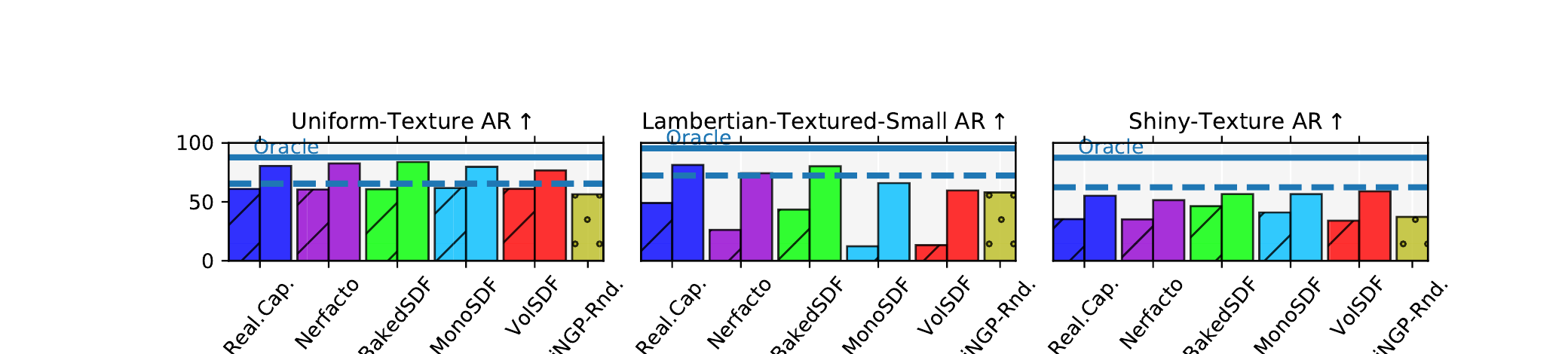
Original Figure 2: MegaPose / FoundationPose AR across three object property groups. Uniform textures do not automatically prevent useful reconstruction; small and shiny objects show more consistent drops. Source: CVF Open Access. Image copyright belongs to the authors and publisher; reproduced here for paper analysis.
The 21 objects are divided into 8 groups by shape, texture, material, and changes from original physical objects. Figure 2 shows 3 groups; others appear in the supplement.
9.1 Large, Lambertian, uniformly textured objects
These sometimes approach the CAD oracle. This does not establish that texture is universally unimportant; rather, for these objects:
Geometry is relatively easy to reconstruct;
Large contours and surfaces sufficiently constrain pose;
Texture adds little information, limiting the harm from texturing imperfections.
Stable geometry can therefore matter more than photorealistic texture for pose, challenging the intuition that textureless objects always make the hardest reconstruction assets.
9.2 Small objects (≤8 cm)
At fixed image resolution, small objects have fewer usable texels and lower reconstructed texture resolution. For approximately symmetric geometry, fine texture may distinguish orientation; blur / baking errors can remove it and cause symmetry confusion.
9.3 Shiny / reflective objects
Reflections vary with viewpoint and resist static UV textures. Although NeRF methods can represent view-dependent effects, Figure 2 shows no consistent dominance over RealityCapture. The authors identify room for improving texture generation and downstream interfaces.
9.4 Legacy vs updated objects
Updated packaging or materials can mismatch look-alike reconstruction textures with older YCB-V test objects. Better poses on legacy objects indicate appearance domain mismatch as a separate asset risk from geometry.
9.5 No universal winner
No top method consistently dominates on the hardest object types. Neither “NeRF solves reflections” nor “RealityCapture suits everything” follows. A more reasonable system estimates object properties before choosing reconstruction / rendering pipelines.
10. Image counts and sparse-view reconstruction
Original Figure 3: pose AR and 5 mm completeness from 25 to all images on the left; incomplete bowls and incorrectly textured wood blocks can still support high pose AR on the right. Source: CVF Open Access. Image copyright belongs to the authors and publisher; reproduced here for paper analysis.
10.1 Data budget curves
Uniform spherical subsets contain 25, 50, 75, 100, 150, 300, and all images. The authors describe 75–100 views as enough for near-best reconstructions; some neural pose AR curves in Figure 3 still improve substantially afterward. Treat this as an empirical budget for these captures, not universal saturation.
Curves are not strictly monotonic:
Some neural methods fail to converge reliably with 25 / 50 views;
Robot encoder noise depends on configuration rather than being i.i.d.;
Adding noisy camera poses may temporarily harm geometry;
Pose AR and 5 mm completeness do not change in lockstep.
Selecting well-covered, well-calibrated, informative views is more accurate advice than assuming every added image helps.
10.2 RealityCapture efficiency with sparse views
Figure 3’s caption reports:
25 images: under 1 min on average;
50 images: about 2 min on average;
Relatively stable pose performance as image counts decrease.
RealityCapture is thus a strong practical baseline. Neural reconstruction claims for onboarding should at least compare its Pareto curves at 25 / 50 / 100 views.
10.3 Poor appearance need not mean poor poses
Exact Figure 3 examples:
Two reconstructed bowls both miss surfaces; one matches CAD oracle AR=38, while the other reaches only AR=15;
Two wood blocks reach AR=39, exceeding CAD oracle AR=27, even though one has visibly incorrect texture.
The explanation is that reconstructed discriminative parts such as outer bowl edges can support matching. A more complete mesh can still fail if it loses key cues.
A reconstruction exceeding its CAD oracle does not prove greater reconstruction accuracy. Possible explanations include:
Textures better matching test appearance;
CAD material rendering gaps from real images;
Estimator biases that happen to favor particular artifacts;
Per-object sampling variation.
Do not extrapolate isolated AR=39 > 27 examples into general reconstruction superiority over CAD.
11. Are the claims supported?
Claim
Evidence
Strength
This site’s assessment
Standard reconstruction metrics cannot reliably predict pose
Figure 1 ranking conflicts
Strong
Supports the benchmark’s core claim
Classical methods compete with neural reconstruction
RealityCapture AR / runtime and sparse-view curves
Strong
Holds for this YCB-V pipeline
Top reconstruction rankings agree across two estimators
Figure 1 center
Moderate–strong
Supports two render-and-compare estimators, not every method
Reconstructions can replace CAD for some objects
Figure 2 groups approaching oracles
Moderate–strong
Supported for simple / large / Lambertian groups, not universally
Best reconstructions retain a substantial CAD gap
Figure 1 and reported 10%–20%
Strong
Especially clear for MSSD / MSPD and hard objects
The authors identify 75–100 views as a useful budget
Figure 3 curves
Moderate
Empirical for these controlled captures; some methods keep improving, without a shared saturation point
12. Critical analysis
12.1 Strengths
Appropriate downstream objective: Chamfer / completeness / PSNR are not assumed to equal pose utility.
Unequal hardware / software: runtime is not pure algorithmic complexity.
Similar estimator paradigms: both use render-and-compare, limiting extrapolation to other families.
Limited statistical intervals: main plots average results without per-method uncertainty / repeated captures.
Detection is outside the analysis: model-based pose evaluation omits detector / segmentation failures from end-to-end success.
12.3 Implicit assumptions
Near-complete unobstructed spherical capture is possible;
Robot kinematics and extrinsics can be corrected offline;
Object identity is known;
Reference CAD is available for registration / evaluation;
Objects remain stationary during capture;
Asset and test object versions agree or differ acceptably;
Estimators accept a shared mesh / rendering interface;
Object masks are available;
Reconstruction scale is preserved or correctly aligned.
12.4 Three common misreadings
”Geometry does not matter” is incorrect
High pose AR often accompanies good geometry, while poor geometry limits pose. One geometric summary metric cannot reliably rank task utility; geometry still matters.
”75 images suffice for every method” is incorrect
This is the authors’ empirical summary for controlled spherical capture; some plotted methods still improve with more images. View distributions, extrinsics, materials, and reconstruction families all affect the required budget.
”CAD can already be removed” is incorrect
CAD still supports benchmark registration, and difficult objects retain a 10%–20% gap. Reconstructions can replace CAD in some deployment settings, with the benchmark helping identify those conditions.
13. Reproduction and extension checklist
13.1 Data capture
Record camera, lens, resolution, exposure, and white balance;
Save raw / undistorted images;
Report at least latitude / longitude coverage histograms;
Save synchronized robot joint states and flange poses;
Supply an object mask for every image;
Record legacy / updated product versions, physical dimensions, and materials;
Record additional lighting details for transparent / reflective objects.
13.2 Camera Calibration
Report intrinsic reprojection error separately;
Report hand-eye translation / rotation errors;
Save extrinsics before and after refinement;
Use shared fixed refined cameras for all reconstruction methods;
Apply controlled camera pose perturbations rather than reporting only the best final calibration.
13.3 Reconstruction standardization
Fix foreground crops and masks;
Record input views, iterations, and GPU hours per method;
Separate training / optimization, meshing, texturing, and registration times;
Standardize mesh units and scale;
Fix surface sample counts before geometric metrics;
Keep direct implicit rendering and extracted mesh results separate.
13.4 Registration
Save manual coarse alignments;
Report ICP residuals and failures;
Test multiple initializations;
Add CAD-free canonical registration for claims of fully CAD-free onboarding;
Evaluate registration error sensitivity of pose AR.
13.5 Pose Evaluation
Fix MegaPose / FoundationPose versions, checkpoints, detectors, and renderers;
Use identical test detections for CAD oracles and every reconstruction;
Report VSD / MSSD / MSPD individually, not only overall AR;
Report per-object, per-property-group, and aggregate results;
Separate pose runtime from asset construction time;
Check systematic failures from mesh coordinate / scale errors.
13.6 Statistics
Repeat image-count sampling and report mean ± std;
Bootstrap capture trajectories;
Compute Spearman / Kendall correlations while retaining ranking counterexamples;
Regress against object size, reflectance, symmetry, and texture frequency jointly;
Treat updated-object domain mismatch as a separate covariate.
14. Improvement directions
14.1 Pose-aware reconstruction objectives
Current reconstruction optimizes photometric / SDF / geometric losses. Backpropagating fixed-estimator feature matching or render-and-compare scores into assets could prioritize discriminative edges, symmetry-breaking textures, and grasp-critical surfaces.
This risks estimator overfitting. Multiple estimators or a task set—BOP AR, rendering fidelity, collision geometry, grasp contact error—would be more robust.
14.2 Automatic pipeline selection
Estimate size, reflectance, texture frequency, symmetry, and viewpoint coverage from a few views, then select:
Lambertian / textured objects: RealityCapture or COLMAP;
view-dependent appearance: NeRF / 3DGS direct rendering;
very small object: macro imaging / higher resolution / active view planning.
14.3 Active View Planning
Figure 3 shows image count is not the only factor. Reconstruction uncertainty and pose utility could guide the next view toward missing discriminative parts instead of uniform capture of 480 images.
The objective could be:
v∗=argvmaxE[ΔARpose∣v],
rather than maximizing global completeness.
14.4 CAD-free Canonicalization
Full CAD removal requires:
Metric scale for new reconstructions;
canonical orientation;
object origin;
Transforms to reference images / downstream robot coordinates;
symmetry group.
Possible tools include fiducial-free robot calibration, known support planes, gravity, category canonical priors, reference pose graphs, or multiview foundation models, with registration error included in evaluation.
14.5 3DGS / neural renderer interfaces
iNGP direct rendering can outperform extracted meshes for pose, suggesting meshing loses useful appearance. Future comparisons could include:
3D Gaussian Splatting direct renderer;
distilled fast neural renderer;
mesh geometry + learned neural texture;
hybrid SDF surface + view-dependent appearance;
Rendering in pose feature space rather than RGB.
Candidate rendering speed is critical: nearly 2 minutes per test image is unsuitable for many pose hypotheses even at good AR.
14.6 Asset-level failure prediction
Predict whether a reconstruction is pose-ready from geometry maps, novel-view consistency, rendered feature gaps, object properties, and coverage, outputting downstream task risks:
navigation-ready;
AR-ready;
grasp-ready;
Not ready / additional captures needed.
This matches the evidence better than one completeness threshold.
15. Lessons for this 6D Pose website and research
Model assets separately: CAD, reconstruction, textures, and registration constrain pose performance alongside estimators.
CAD-free is not binary: separate CAD-free training, CAD-free inference, CAD-free registration, and reference-image-only requirements. This paper addresses only part of that spectrum.
Choose metrics by downstream tasks: VSD, MSSD, and MSPD differ in navigation, manipulation, and AR relevance; overall AR alone hides this.
Engineering benchmarks need runtime and image budgets: asset onboarding is part of deployment cost.
Failures teach more than attractive meshes: incomplete yet pose-useful meshes motivate attention to discriminative geometry over visual completeness.
16. Open questions
Data questions
Are 21 objects enough to train reliable pose-readiness predictors?
How much does look-alike texture / size mismatch contribute per object?
How much would reconstruction from original YCB-V videos degrade performance?
Method questions
Does direct neural rendering’s high pose AR come from view-dependent appearance or estimator preferences for neural artifacts?
What are the separate effects of mesh simplification, UV atlases, and texture resolution on AR?
Can a feature-space asset metric better approximate pose utility than PSNR?
Protocol questions
How long is manual alignment, and how variable are operators?
How do ICP registration errors of 1–10 mm / 1–5° affect BOP AR?
Are FoundationPose / MegaPose detections and initializations fully matched?
Do methods fail on the same objects, or do aggregate rankings hide complementarity?
17. Overall assessment
This benchmark replaces the unreliable inference “better-looking reconstruction means better poses” with reproducible downstream measurement through fixed estimators. Figure 1 ranking conflicts, Figure 2 object groups, and Figure 3 image-count / failure cases show pose utility depends jointly on geometry, appearance, representation, object properties, and renderer interfaces rather than one reconstruction score.
CAD is not declared obsolete. The study identifies when reconstructions approach CAD, where 10%–20% gaps remain, and why small, shiny, finely textured objects and sparse views are bottlenecks. For CAD-free pose, NeRF / 3DGS assets, robotic onboarding, or synthetic rendering research, this is a stricter experimental model than meshes plus Chamfer / PSNR alone.