SCAPO: Self-Supervised Category-Level Articulated Pose Estimation from a Single 3D Observation
SCAPO combines an SE(3)-equivariant autoencoder, joint-aware blend skinning, cycle reconstruction, and instance residuals to jointly recover canonical geometry, parts, and joint states from one 3D observation. Synthetic experiments require no GT labels; the real-data setting uses segmentation and joint supervision without pose supervision.
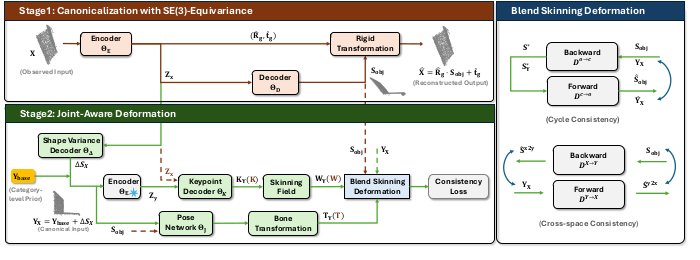
SCAPO canonicalizes a single RGB-D / 3D observation with an SE(3)-equivariant vector-neuron autoencoder, then uses joint-aware blend skinning to learn parts, joint parameters, and articulation states through self-supervision.
2.1 Guide to the paper’s figures and tables
Figure / table
Purpose
Overview reading tips
Figure 1
Arbitrary pose to canonical shape, parts, and joints
Outputs extend beyond one global pose
Figure 2
Canonicalization and joint-aware deformation
Geometry / articulation disentanglement
Table 1
Synthetic HOI4D / Shape2Motion results
Self-supervised versus supervised gaps
Table 2
Real joint / part mAP
Synthetic-to-real transfer
Table 3
Regularization ablations
Shape variance, alignment, and boundaries
Original figure excerpt: global pose, canonical shape, part segmentation, and joint parameters from one arbitrarily posed observation. Source: project / CVF Open Access. Image copyright belongs to the authors and publisher; reproduced here for paper analysis.
3. Problem setting
Input: one RGB-D / point cloud observation from a known category, with unseen instance / articulation.
Output: canonical geometry, rigid parts, part poses, joint pivots, axes, and states.
Synthetic self-supervision needs no GT labels, category CAD, or motion sequences. Real Table 2 uses segmentation / joint supervision but no pose supervision; separate these settings.
4. Method overview
SE(3)-equivariant autoencoding aligns global poses into a shared canonical space.
A learned canonical template and instance residual separate shared geometry from shape variation.
Joint-aware blend skinning models motion, with keypoint-predicted bone anchors.
Cycle reconstruction and cross-space alignment supervise learning.
Joint directions, pivot proximity, and boundary regularization stabilize interpretation.
Real scans: basket, laptop, suitcase, drawer, scissors.
Synthetic mean segmentation IoU is 84.98% and joint direction error 3.89. Real joint mAP improves over comparisons under Table 2’s segmentation / joint supervision without pose supervision.
6. Quick assessment
Value: explicit joint structure from single-frame unlabeled articulated modeling.
Strength: jointly learns canonical geometry, parts, and articulation for structured robot understanding.
Limitation: occlusion, missing parts, and unknown topology leave ambiguities.
Recommended for: self-supervised category-level pose, SE(3) equivariance, canonicalization, and manipulation.
Available src/paper-notes/scapo/deep.md
In-depth paper notes
Support reproduction, comparison, related-work writing, and identifying opportunities for further research.
Deep Reading Notes: SCAPO: Self-Supervised Category-Level Articulated Pose Estimation from a Single 3D Observation
Assessment: shape, global pose, parts, and joints share a cycle-reconstructable canonical representation, yielding an interpretable structural space beyond joint angles alone.
2. Positioning in one sentence
SE(3)-equivariant canonicalization maps one 3D observation to a shared shape; blend skinning infers parts / joints through observed↔canonical cycles.
2.1 Guide to the paper’s figures and tables
Figure / table
Deep-dive questions
Figure 1
Does the input, canonicalization, part, and joint data flow close?
Figure 2
How autoencoding connects to deformation.
Table 1
Joint improvements in segmentation, direction, pivot, and part pose.
Table 2
Transfer to real scans without pose supervision.
Table 3
Geometric roles of regularizers.
Figure 3
Whether real segmentation noise concentrates at boundaries.
Original figure excerpt: canonical geometry, rigid parts, and joint parameters from arbitrary input poses. Source: project / CVF Open Access. Image copyright belongs to the authors and publisher; reproduced here for paper analysis.
3. Problem setting and task boundaries
An object has P rigid parts; input is one point cloud with global pose and articulation.
Each part has an SE(3) transform, connected parts share joint pivots, and joint types constrain rotation / translation.
Targets include a shared frame, soft parts, part poses, and joint attributes rather than just global 6D pose.
Synthetic self-supervision uses no GT labels, supplied category template, or multiframe cues. Real Table 2 supplies segmentation / joint supervision without pose supervision; real results are not fully unlabeled training.
4. Research context
PartMobility uses motion sequences, UPPD implicit fields, EAP latent part transforms, and OP-Align single-cloud canonical reconstruction.
Earlier methods lack explicit pivots / axes or struggle to separate shape variation and articulation.
Equivariant vector neurons separate global pose from invariant shape; blend skinning explains part motion.
5. Research motivation
Single observations cannot reveal motion directly, requiring shape, part, and kinematic consistency.
Fixed canonical templates can confuse instance shape differences with articulation.
Without geometry constraints, pivots drift from surfaces and axes retain sign ambiguity.
Learned templates / residuals, cycles, and structural regularizers address this.
6. Method details
6.1 SE(3)-equivariant canonicalization
Vector neurons produce features that transform with input rotations.
Encoder-decoder predicts global transforms to canonicalize instances.
Direction alignment constrains axes with local principal geometry;
Joint proximity keeps pivots near surfaces / joint structures;
Boundary attraction favors plausible part boundaries.
7. Experimental analysis
7.1 Data and metrics
Synthetic: five HOI4D / Shape2Motion articulated categories;
Real: five RGB-D scan categories without mesh GT, combining depth and instance masks;
Metrics: segmentation IoU, joint direction / pivot errors, part rotation / translation, and real joint / part mAP.
7.2 Main results
Synthetic means: IoU 84.98%, direction 3.89°, pivot 0.075, part rotation 5.78°, translation 0.086.
OP-Align reports IoU 82.24, direction 4.60, pivot 0.104, rotation 6.73; most structural metrics improve.
Real Table 2 labels segmentation mIoU at 75% / 50% as 91.89% / 98.29%, with joint mAP 62.51 / 89.59 / 95.91. Ours uses segmentation / joint labels without pose labels; these are not fully unlabeled real adaptation results.
7.3 Ablations
Removing shape variance drops IoU 84.98→80.15 and raises direction error 3.89→10.63, supporting template / residual separation;
Removing direction alignment raises direction error to about 8.54 and worsens pivots;
Removing proximity raises pivot error to 0.137, supporting geometry constraints;
Heavy occlusion / missing parts still cause joint errors and segmentation drift.
8. Critical analysis
Strength: interpretable structural outputs with low supervision requirements in the self-supervised setting.
Limitations: point cloud quality and shared category kinematics; unknown topology, soft objects, and nonrigid deformation remain outside scope.
Ambiguity: different articulation states can expose similar surfaces; cycles may select one plausible explanation.
Deployment: mask errors, depth holes, and occlusion jointly damage canonicalization, segmentation, and joints.
9. Implications for my research
Canonicalization can unify object and articulation pose;
Instance residuals also suggest shared-category-plus-local-differences models for static pose;
Pivot / axis regularizers could transfer to articulated furniture, tools, and manipulated objects.
10. Open questions
How discover unknown part counts and articulation graphs from one observation?
How explicitly represent multimodal joints and symmetries?
How combine RGB semantics, touch, and active manipulation for hidden parts?
11. Further analysis: structured self-supervision
11.1 Inputs, outputs, and learning signals
SCAPO infers structure from one articulated RGB-D / 3D observation. Synthetic self-supervision requires no supplied templates, motion sequences, or joint labels; real Table 2 uses segmentation / joint labels without pose supervision. Vector-neuron canonicalization factors out global pose, then blend skinning generates articulated observations. Outputs include canonical geometry, rigid parts, pivots, axes, and states.
11.2 Data splits
Synthetic EAP-style categories are laptop, safe, oven, washer, eyeglasses from HOI4D / Shape2Motion. Real categories are basket, laptop, suitcase, drawer, scissors, without mesh GT, testing dependence on precise CAD.
11.3 Exact main results
Synthetic mean
Segmentation IoU
Joint direction error
Pivot error
Part rotation
Part translation
SCAPO
84.98%
3.89°
0.075
5.78°
0.086
OP-Align
82.24%
4.60°
0.104
6.73°
0.115
Real segmentation mIoU under the table’s 75% / 50% thresholds is 91.89% / 98.29%; joint mAP at 5°5cm, 10°10cm, 15°15cm is 62.51 / 89.59 / 95.91. OP-Align gives 90.02% / 97.18% and 61.37 / 87.72 / 92.73. Gains span segmentation and joint geometry as well as poses, under segmentation / joint supervision without pose supervision.
11.4 Causal reading of ablations
Removed module
Seg. IoU
Joint direction
Pivot
Full SCAPO
84.98
3.89°
0.075
Shape variance removed
80.15
10.63°
0.175
Direction alignment removed
—
8.54°
0.086
Proximity removed
—
—
0.137
Residual decoding captures instance differences beyond shared shape; removing it harms parts and joints. Direction alignment mainly reduces axis error, proximity pivot drift. Module-specific metrics explain gains better than total mAP alone.
11.5 Authors’ claims and my analysis
Authors’ claims
My assessment
One observation recovers shape / articulation
Synthetic / real results support it given shared category structure and observable joint evidence.
Canonicalization disentangles shape and motion
Equivariance + cycles are convincing; unknown graphs and multimodal articulation need testing.
Self-supervision reduces annotation costs
Supported by unlabeled synthetic training. Real scans lack mesh GT but Table 2 still uses segmentation / joint labels; RGB-D, masks, and category data remain priors.
12. Reproduction and extensions
Record vector-neuron transforms, canonical frames, skinning temperatures, cycle / cross-space weights, and joint keypoint counts. Hidden joints warrant posteriors rather than one axis; robotic systems could connect pivots / axes to grasps and joint limits for executable motion.