Confronting Ambiguity in 6D Object Pose Estimation via Score-Based Diffusion on SE(3)
The method learns p(R,t|I) directly, defining score diffusion on SE(3) rather than independently diffusing rotation and translation. A surrogate Stein score avoids expensive Jacobians. On T-LESS, the SE(3) model achieves MSPD / R@5 of 93.16 / 86.94. Sampling runs at 20 FPS with 100 steps and 250 FPS with 5 steps.
single RGB object cropvisible-object segmentation mask in the T-LESS protocol
Requirements
ground-truth pose labels for trainingground-truth bounding boxes and visible masks in the T-LESS evaluationknown test-object identities represented during trainingiterative reverse diffusionno CAD model or symmetry annotations
Full paper metadataAuthors, affiliations, research area, datasets, metrics, method tags, and reading statusExpandCollapse
Authors
Tsu-Ching Hsiao, Hao-Wei Chen, Hsuan-Kung Yang, Chun-Yi Lee
ground-truth pose labels for trainingground-truth bounding boxes and visible masks in the T-LESS evaluationknown test-object identities represented during trainingiterative reverse diffusionno CAD model or symmetry annotations
Reading Notes
Overview / Deep Dive
Available src/paper-notes/se3-diffusion-pose-cvpr2024/coarse.md
Paper overview notes
Quickly assess the paper's scope, problem setting, core method, experimental findings, and whether to read it in depth.
Overview Notes: SE(3) Score Diffusion
1. Basic information
Title: Confronting Ambiguity in 6D Object Pose Estimation via Score-Based Diffusion on SE(3)
Authors: Tsu-Ching Hsiao, Hao-Wei Chen, Hsuan-Kung Yang, Chun-Yi Lee
Affiliation: Elsa Lab, National Tsing Hua University
Rather than forcing single-image pose into one R,t, this work learns a conditional score on the rigid-motion group SE(3) and samples plausible poses through reverse diffusion. A surrogate Stein score addresses the expensive true score and deviating denoising direction caused by the SE(3) Jacobian.
3. Guide to figures and tables
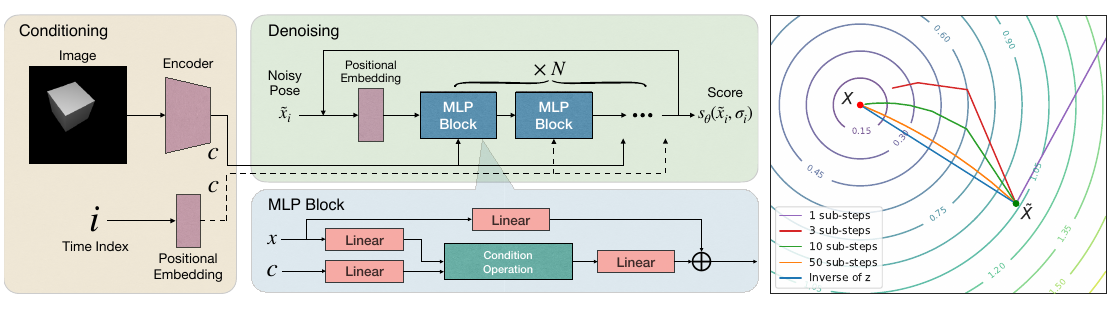
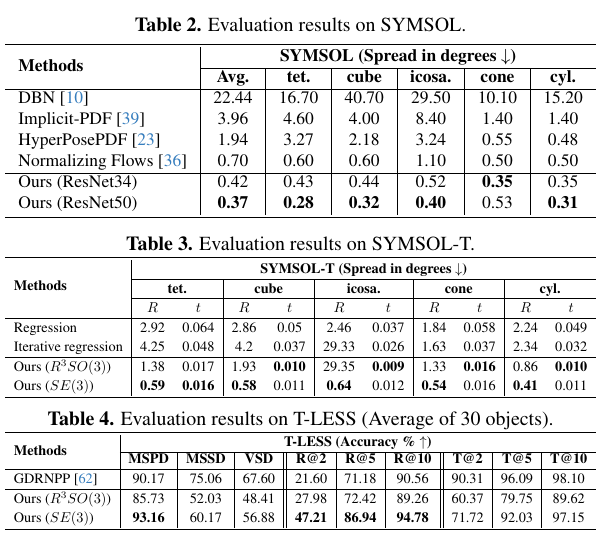
Original Figure 2 method diagram: RGB is encoded once into condition \(c\); pose and noise time receive positional embeddings, and an MLP score network iteratively updates noisy poses in the Lie algebra. At right, more substeps bring curved-space denoising trajectories closer to the true inverse transform. Source: published CVPR 2024 paper. Image copyright belongs to the authors and IEEE/CVF; reproduced here for paper analysis.Original Tables 2–4: mean angular spread is 0.37° on SYMSOL; joint SE(3) substantially improves icosahedron rotation multimodality on SYMSOL-T; T-LESS MSPD / R@5 are 93.16 / 86.94. Source: published CVPR 2024 paper. Table copyright belongs to the authors and IEEE/CVF; reproduced here for paper analysis.
4. Problem setting
Input: one RGB object crop; the T-LESS protocol also supplies ground-truth bounding boxes and visible-object masks.
Output: pose samples from conditional distribution p(X∣I), with X=(R,T)∈SE(3).
Supervision: RGB and GT poses, without 3D CAD or symmetry annotations.
Data: SYMSOL, the paper’s new SYMSOL-T, and 30 real T-LESS objects.
Goal: cover ambiguity from symmetry, occlusion, self-occlusion, and perspective, rather than average it into one pose.
5. Method overview
Perturb GT poses with a Gaussian perturbation kernel on the Lie group.
Extract image condition c once through ResNet, avoiding image-feature recomputation at every step.
Feed noisy poses, noise levels, and image conditions to an MLP score network in the corresponding Lie algebra.
Gradually generate pose samples through reverse Geodesic Random Walk.
For SO(3) and R3SO(3), the Stein score simplifies to −z/σ2. The same Jacobian symmetry does not hold on SE(3); the authors use this quantity as a surrogate target and smaller substeps to approximate the inverse transform.
Available src/paper-notes/se3-diffusion-pose-cvpr2024/deep.md
In-depth paper notes
Support reproduction, comparison, related-work writing, and identifying opportunities for further research.
Deep Reading Notes: Confronting Ambiguity via Score Diffusion on SE(3)
1. Key assessment
Single-RGB 6DoF pose is not always a function I↦(R,t). Symmetric objects, occlusion, and self-occlusion can associate one image with several equivalent or nearly equivalent poses. Single-valued regression on this one-to-many problem tends to:
Average across modes;
Depend on manually specified symmetry annotations;
Ignore ambiguity induced dynamically by current visibility.
The paper directly learns:
X∼p(X∣I),X=(R,T)∈SE(3).
Beyond rotation distributions on SO(3) alone, the method attempts joint rotation and translation. T-LESS shows strong rotation posteriors and visibility-conditioned symmetry, but translation trails CAD-based GDRNPP substantially. This is primarily research into ambiguity-aware pose posteriors, with a complete deployment pipeline still pending.
2. Why distinguish SE(3) from R3SO(3)?
Both parameterizations contain R,t, but their group operations differ.
Independent product:
(R2,T2)(R1,T1)=(R2R1,T2+T1).
Rigid-motion group:
(R2,T2)(R1,T1)=(R2R1,T2+R2T1).
In SE(3), rotation acts on translation, matching rigid composition; R3SO(3) diffuses them independently. Perspective couples rotation with image-space translation / depth, motivating the authors’ joint SE(3) distribution.
SYMSOL-T specifically tests this: random translations are added to SYMSOL’s five symmetric shapes so viewpoint ambiguity involves R,t jointly.
3. Lie-group score matching
On group G, perturb GT pose X with Gaussian Lie-algebra noise z:
X~=XExp(z),z∼N(0,Σ).
The network learns the perturbation distribution’s Stein score:
sθ(X~,σ)≈∇X~logpσ(X~∣X).
Reverse sampling uses Geodesic Random Walk:
X~i+1=X~iExp(ϵisθ(X~i,σi)+2ϵizi).
Exp / Log keep every update on the group, rather than adding to a 4×4 transform as an ordinary Euclidean vector.
4. Surrogate Stein score
On SO(3), the left / right Jacobians satisfy:
Jl(z)=Jr⊤(z),Jl−1(z)=Jr−⊤(z),
Together with Jl(z)z=z, this simplifies the score to:
∇X~logpσ(X~∣X)=−σ21z.
R3SO(3) supports this simplification independently for each component. However, the SE(3) Jacobian has a rotation–translation coupling block Q(ρ,ϕ) and lacks the same symmetry. The true score vector need not follow the geodesic inverse direction from X~ to X.
Instead of an expensive Jacobian / autodiff score, the authors use:
s~X(X~,σ)=−σ21z
as a surrogate target. Large steps introduce curved-space approximation errors; subdividing them into smaller substeps progressively approaches the correct inverse transform. This engineering approximation does not make the true SE(3) score identical to the Euclidean Gaussian score.
Original Figure 2 graphical excerpt: MLP blocks fuse image and time conditions; the SE(2) example at right shows surrogate directions approaching the true inverse with more integration substeps. Source: published CVPR 2024 paper. Image copyright belongs to the authors and IEEE/CVF; reproduced here for paper analysis.
5. Conditional network
The network separates:
Conditioning: ResNet encodes RGB once into c;
Denoising: pose / noise-level positional embeddings and multiple MLP blocks.
Periodic functions retain periodic derivatives, an inductive bias better suited to rotation manifolds.
6. SYMSOL and SYMSOL-T
Original Tables 2–4. SYMSOL evaluates rotation density; SYMSOL-T reports rotation spread and translation distance; T-LESS reports symmetry-aware BOP recalls and threshold accuracies. Source: published CVPR 2024 paper. Table copyright belongs to the authors and IEEE/CVF; reproduced here for paper analysis.
SYMSOL’s five shapes are tetrahedron, cube, icosahedron, cone, and cylinder: the first 3 have discrete symmetries and the last 2 continuous symmetries:
Method
Mean rotation spread
Implicit-PDF
3.96°
HyperPosePDF
1.94°
Normalizing Flows
0.70°
Proposed ResNet34
0.42°
Proposed ResNet50
0.37°
The icosahedron is particularly informative on SYMSOL-T:
R3SO(3): rotation 29.35°;
SE(3): rotation 0.64°.
Independent diffusion misses perspective-induced coupling, while the joint group model recovers multimodal rotations. Some independent-model translation errors are lower because it avoids interference between R,t. The joint model therefore favors consistent rigid distributions rather than improving every individual metric.
7. Multimodal visualizations
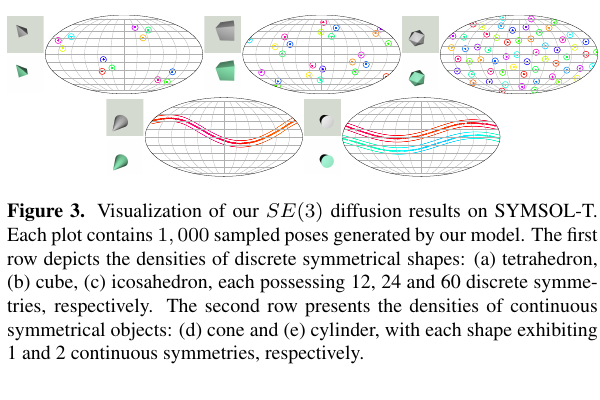
Original Figure 3: 1,000 samples per plot. Tetrahedron, cube, and icosahedron form 12, 24, and 60 discrete modes; cone and cylinder follow one or two continuous symmetry orbits. Source: published CVPR 2024 paper. Image copyright belongs to the authors and IEEE/CVF; reproduced here for paper analysis.
This extends beyond Gaussian uncertainty: discrete symmetries form separated modes, while continuous symmetries form manifold bands. For pose systems, this better reflects the topology than a single covariance.
8. T-LESS: visibility-induced dynamic ambiguity
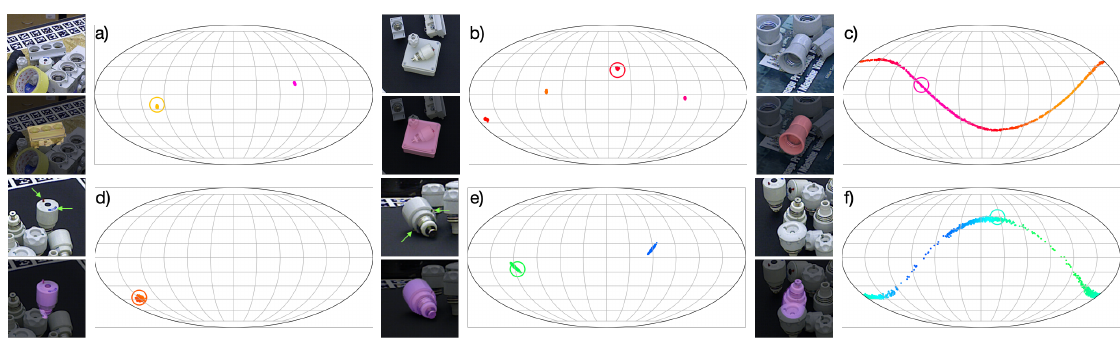
Original Figure 4 graphical excerpt: discrete / continuous symmetries appear above. Below, object 4 changes from unimodal to bimodal or continuous posteriors depending on whether its top feature or bottom holes are visible. Source: published CVPR 2024 paper. Image copyright belongs to the authors and IEEE/CVF; reproduced here for paper analysis.
Object 4 has a manually annotated continuous symmetry, but visibility determines its actual posterior:
Visible top feature: unambiguous, one mode;
Occluded top with two visible bottom holes: two discrete modes;
Occluded holes too: approximately continuous symmetry.
Fixed object-level symmetry annotations cannot express these image-conditioned changes; the generative posterior is the paper’s strongest conceptual contribution.
Quantitative results:
Method
MSPD
MSSD
VSD
R@2
R@5
R@10
T@2
GDRNPP
90.17
75.06
67.60
21.60
71.18
90.56
90.31
R3SO(3) diffusion
85.73
52.03
48.41
27.98
72.42
89.26
60.37
SE(3) diffusion
93.16
60.17
56.88
47.21
86.94
94.78
71.72
SE(3) improves rotation markedly, while translation / surface metrics trail GDRNPP. The authors attribute GDRNPP’s better depth to 3D model geometry; this method uses no CAD.
9. Speed and step trade-offs
T-LESS, ResNet34, 224×224, RTX 2080 Ti:
steps
FPS
MSPD
MSSD
VSD
100
20
93.16
60.17
56.88
50
38
93.00
59.96
56.64
10
161
92.79
60.35
57.08
5
250
92.40
59.30
56.15
10 steps barely reduce accuracy, supporting substantial step reduction with the surrogate score and conditioning network. FPS per sample differs from FPS for a complete image posterior: drawing 1,000 samples to approximate the distribution still increases total cost linearly.
10. Experimental protocol boundaries
T-LESS uses:
30 objects known during training;
GT bounding boxes;
visible-part segmentation masks;
A single model across all 30 objects;
Strong image augmentation and Dynamic Zoom-In.
These tables exclude detection, segmentation, and novel-object generalization errors. The claim of avoiding 3D models / symmetry annotations holds, with more ideal frontend conditions than deployment.
11. Limitations and reproduction checks
Weak T-LESS translation: missing CAD / depth geometry remains a central bottleneck.
GT poses are required for training; this is supervised learning.
Calibration, NLL, and coverage are not evaluated; main results primarily measure sample accuracy.
Real experiments use GT boxes / masks; deployment needs a frontend and tests of posterior stability under segmentation noise.
Sample counts, final single-pose aggregation, and random seeds affect reported accuracy.
The surrogate score is approximate; empirically effective step reduction has no guarantee across all group distributions.
The main text provides no official code link; reproduce Lie-group conventions, Exp / Log, left / right multiplication, and unit scales carefully.
12. Overall assessment
The paper elevates symmetry from a static object property to image-conditioned posterior topology. T-LESS object 4’s visibility-dependent modes are more persuasive than a single AR value.
Rotation and ambiguity modeling are strong; translation, real frontends, and posterior calibration remain incomplete. As a methodological baseline for ambiguity-aware pose estimation, it suggests retaining multimodal samples for visibility checks, collision tests, or task costs before selecting one pose for reliable grasping.