SE(3)-PoseFlow: Estimating 6D Pose Distributions for Uncertainty-Aware Robotic Manipulation
SE(3)-PoseFlow encodes RGB-D with DINOv2 + PointNet++, conditions SE(3) rectified flow through DiT* masked cross-attention, and directly samples multimodal poses. DBSCAN, Chamfer distance, or neural SDFs select a pose. REAL275 10°5 cm is 89.1%, and YCB-V / LM-O is 68.2% / 53.7%. Multiple hypotheses raise occluded-cup grasp success from 6/10 to 9/10, with costs from 50 samples, mesh reranking, and interpreting samples in Bayesian terms.
object-centric RGB croppartial depth point cloudpreceding object detector / mask
Requirements
RGB-D image and camera calibrationobject detector or segmentation masktraining data with pose labelsobject mesh or dense point cloud for model-based re-rankingmultiple sampled hypotheses
Full paper metadataAuthors, affiliations, research area, datasets, metrics, method tags, and reading statusExpandCollapse
RGB-D image and camera calibrationobject detector or segmentation masktraining data with pose labelsobject mesh or dense point cloud for model-based re-rankingmultiple sampled hypotheses
Reading Notes
Overview / Deep Dive
Available src/paper-notes/se3-poseflow-icra2026/coarse.md
Paper overview notes
Quickly assess the paper's scope, problem setting, core method, experimental findings, and whether to read it in depth.
Overview: SE(3)-PoseFlow
One-sentence summary
SE(3)-PoseFlow samples pose hypotheses from RGB-D using rectified flow on the SE(3) manifold. Retaining multimodal uncertainty from symmetry, occlusion, and partial visibility lets active perception and grasp planning use it directly.
Method overview
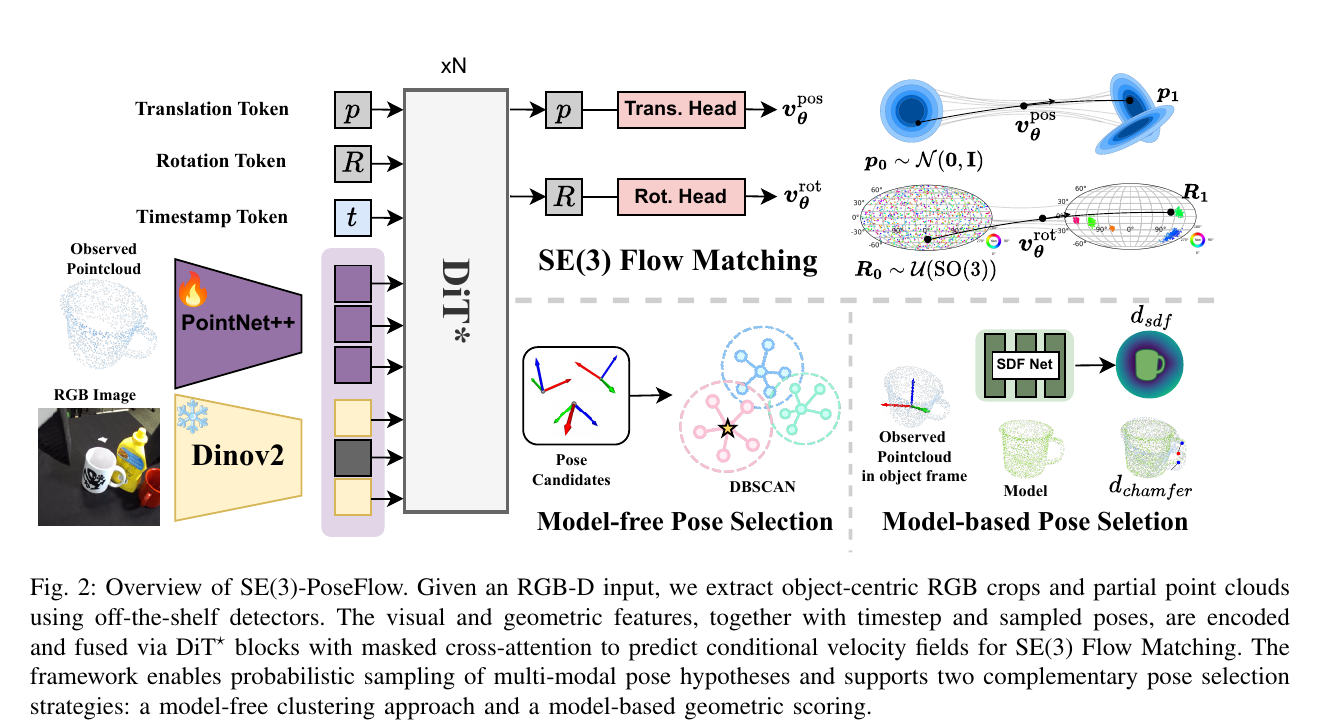
Inputs are detected / segmented object-centric RGB crops and partial point clouds. Frozen DINOv2 extracts visual features; PointNet++ extracts geometry. Translation, rotation, and time tokens interact with observations through segmentation-masked DiT* cross-attention to predict conditional translation velocities in R3 and rotation velocities on SO(3).
Training linearly interpolates translation from a Gaussian prior to GT and geodesically interpolates rotation from uniform SO(3) to GT, fitting the corresponding velocities. Inference integrates random poses to t=1, producing multiple hypotheses; tracking initializes near the preceding frame’s pose.
Original Figure 2: DINOv2 / PointNet++ condition \(SE(3)\) flow through DiT*. Samples can be selected with DBSCAN, Chamfer, or neural SDF. Source: original paper. Image copyright belongs to the authors; reproduced here for academic analysis.
Pose selection
The paper provides two postprocessing options:
Model-free: DBSCAN with a joint SE(3) distance; take the largest cluster’s Karcher mean;
Model-based: one-sided Chamfer from observed points to transformed object models, or learned neural-SDF scores.
Model-based selection is more accurate but needs meshes / dense object clouds, with object-specific training for SDF. Distinguish the probabilistic estimator’s requirements from those of its final single-pose output.
Key results
REAL275 5°2 cm / 5°5 cm / 10°2 cm / 10°5 cm: 48.8 / 56.3 / 76.3 / 89.1%. The two strictest metrics slightly trail GenPose; the latter two improve.
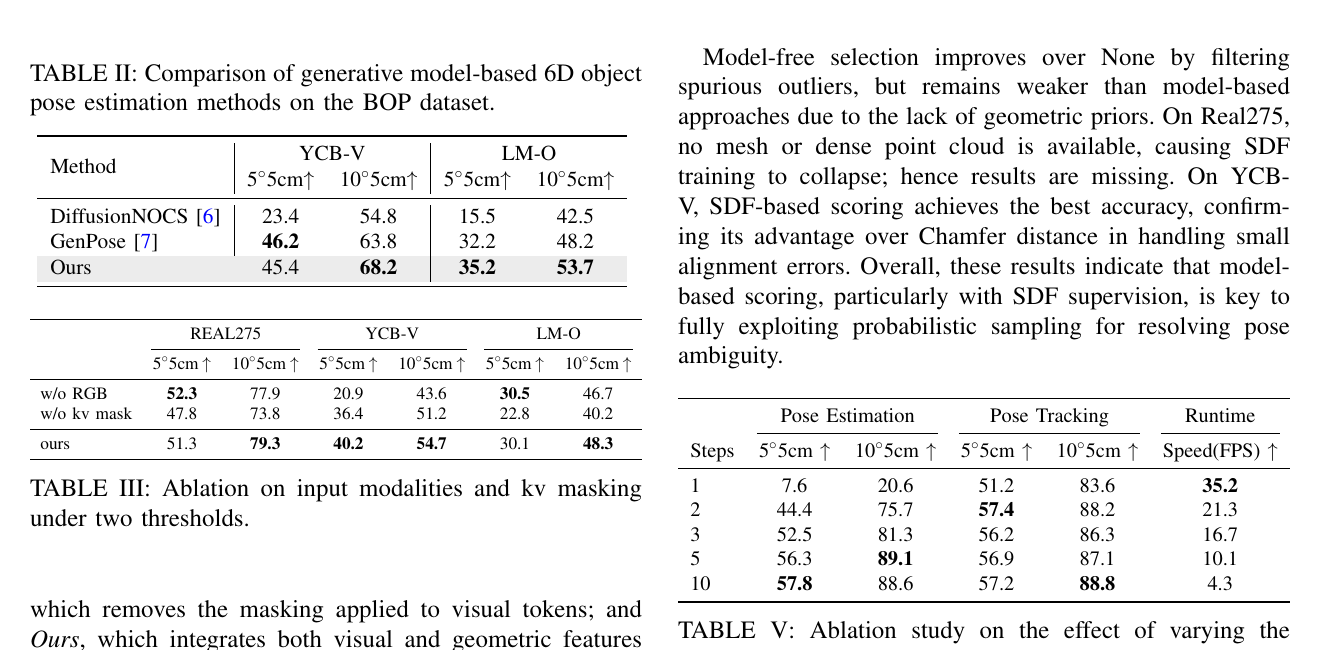
YCB-V 5°5 cm / 10°5 cm: 45.4 / 68.2%; LM-O: 35.2 / 53.7%. Both 10°5 cm results exceed DiffusionNOCS and GenPose.
At 5 ODE steps, REAL275 pose estimation reaches 56.3 / 89.1%, about 10.1 FPS. One-step tracking already reaches 51.2 / 83.6%, at 35.2 FPS.
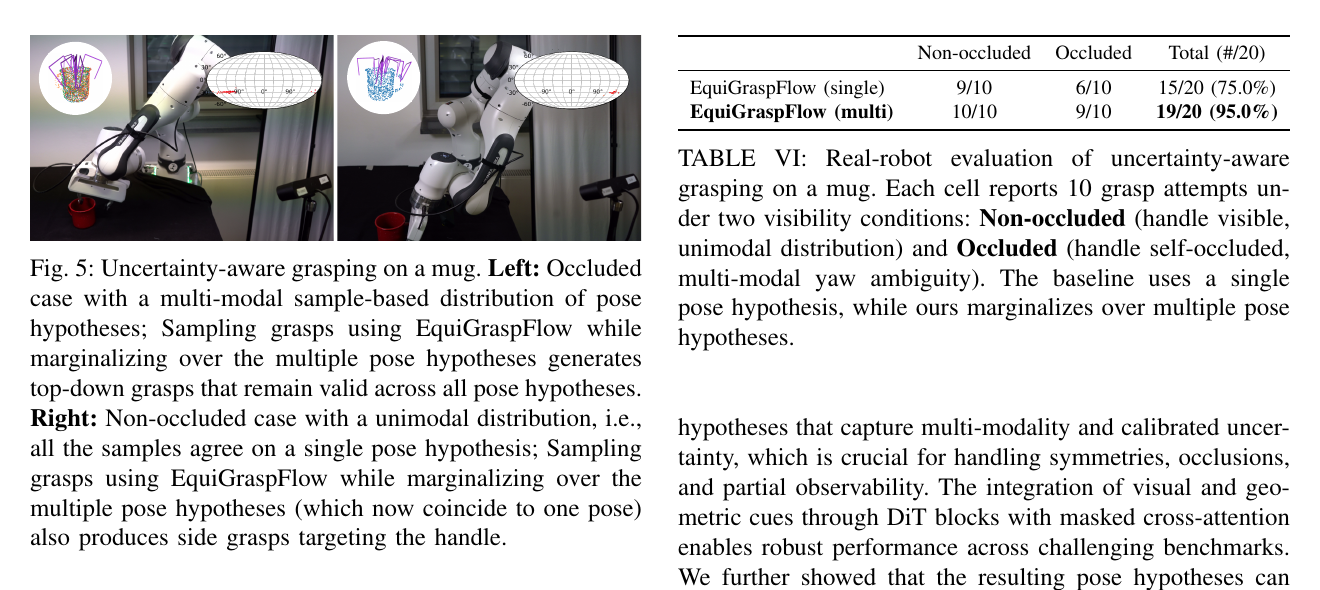
20 mug-grasping attempts: single-pose EquiGraspFlow succeeds 15/20; marginalizing velocity fields over multiple hypotheses gives 19/20. With an occluded handle, success rises from 6/10 to 9/10.
Original Figure 5 and Table VI: a self-occluded handle creates multimodal yaw; marginalizing hypotheses favors top grasps valid across plausible poses. Source: original paper. Image copyright belongs to the authors; reproduced here for academic analysis.
Important boundaries
Uncertainty is mainly expressed by samples and their covariance, without systematic calibration, NLL, or coverage evaluation. Accurate final poses still depend on masks, RGB-D, training domains, and geometric reranking. REAL275 lacks meshes for SDF, and cross-category generalization varies. The project page stated Code Coming Soon when these notes were compiled.
Reading assessment
The strongest contribution is showing that hypotheses should remain available beyond pose selection: they can guide next-best views and grasp generators toward solutions valid across plausible poses. The downstream 19/20 gain demonstrates the value of multimodal modeling for safe manipulation more directly than a leaderboard score alone.
Available src/paper-notes/se3-poseflow-icra2026/deep.md
In-depth paper notes
Support reproduction, comparison, related-work writing, and identifying opportunities for further research.
Problem: symmetry, occlusion, and partial observations can make several 6D poses consistent with RGB-D. Deterministic single-pose regressors are often overconfident and cannot pass this ambiguity to downstream robot decisions.
Answer: learn conditional rectified flow on the manifold parameterized as SE(3)=SO(3)×R3, sample full-pose hypotheses from random initializations, then obtain representative poses through model-free clustering or geometry-aware scoring.
My assessment: a complete demonstration of distribution-first pose estimation, with strongest evidence from active perception and grasping. Standard uncertainty metrics still do not establish sample calibration or per-mode quality.
2. Inputs and frontend
RGB-D inputs assume a detector / segmenter has supplied object regions. The paper uses Mask R-CNN, CNOS, or SAM2 mask tracking across settings:
Crop object-centric RGB using the mask;
Backproject depth into a partial point cloud;
Subtract the point-cloud mean to reduce the influence of camera-frame absolute translation during training;
Encode RGB with a frozen DINOv2 ViT;
Encode point clouds with a PointNet++ trained from scratch;
Project both streams into a 256D feature space.
Translation, rotation, and Fourier-time tokens enter DiT*. Instead of original DiT self-attention, masked cross-attention lets pose tokens query visual / geometric tokens while segmentation-derived binary masks exclude backgrounds. Complexity falls from O(n2) for all-token self-attention to O(n).
Original Figure 2: translation / rotation use separate pose tokens and output heads. Below are model-free DBSCAN and model-based SDF / Chamfer selection. Source: original paper. Image copyright belongs to the authors; reproduced here for academic analysis.
3. SE(3) Rectified Flow
The target conditional distribution is p(R,p∣O,I), with R∈SO(3), p∈R3, partial point cloud O, and RGB I.
Training constructs paths from random initial pose (R0,p0) to ground truth (R1,p1):
pt=(1−t)p0+tp1,Rt=R0exp(tlog(R0⊤R1)).
Translation follows a Euclidean straight line and rotation an SO(3) geodesic, with target velocities:
p˙t=1−tp1−pt,r˙t=1−t1log(Rt⊤R1).
Two network heads predict vθpos and vθrot. The loss regresses velocities:
LFM=E[λℓpos+ℓrot],
Experiments set λ=10 to compensate for differing translation / rotation scale sensitivities.
Compared with diffusion, rectified flow offers simple paths and target velocities with good results after few ODE steps. Explicit Lie-algebra log / exp preserve manifold geometry, avoiding Euclidean Gaussian perturbation of rotation as a three-vector.
4. From samples to a representative pose
Inference integrates random samples to t=1, obtaining {Ti}. These can form one mode or several along symmetry / occlusion ambiguities.
4.1 Model-free selection
DBSCAN distances combine rotation geodesic angles and translation:
d(T1,T2)=(ϵRθ(R1,R2))2+(ϵt∥t1−t2∥)2.
Take the largest cluster and compute a Karcher mean using se(3). This CAD-free option suits category-level / model-free settings, although the largest sample mode may not best match observed geometry.
4.2 Chamfer selection
Transform object model M into each candidate pose and compute one-sided nearest distances from observed points P to the model. No training is needed, but point density, occlusion, and depth noise matter. REAL275 lacks high-quality meshes / dense clouds, so the paper uses this weaker geometric score.
4.3 Neural SDF selection
Compute learned-SDF residuals for normalized observations in object coordinates. Continuous global surface feedback is smoother than discrete Chamfer for small misalignments, but each object needs high-quality meshes / dense points for training; sparse supervision can collapse. This benefits YCB-V / LM-O while limiting model-free generality.
One method passage retains the top 20% for model-based selection, while the experimental comparison uses the top 40%. Follow each table’s protocol rather than treating both as one fixed hyperparameter.
5. Tracking
Pose estimation starts from random SE(3) samples; tracking initializes from the preceding prediction and integrates the learned field for refinement. Experiments initialize the first frame with perturbed GT, up to 20° rotation and 5 cm translation, then reuse preceding predictions.
Thus, 35.2 FPS one-step tracking is local refinement near a correct initialization. It does not measure full detector-to-pose recovery. Complete sequence metrics for post-occlusion relocalization, long-term drift, and mode switching remain absent.
6. Benchmark settings
REAL275: NOCS real test, 6 categories, substantial within-category variation, category-level;
LM-O: 8 weakly textured objects, heavy occlusion, instance-level.
Metrics are α∘β cm threshold accuracies. For discrete symmetries, rotation error is the minimum geodesic error over the symmetry set. The paper samples 50 poses per object and compares NOCS, DualPoseNet, SPD, DiffusionNOCS, and GenPose.
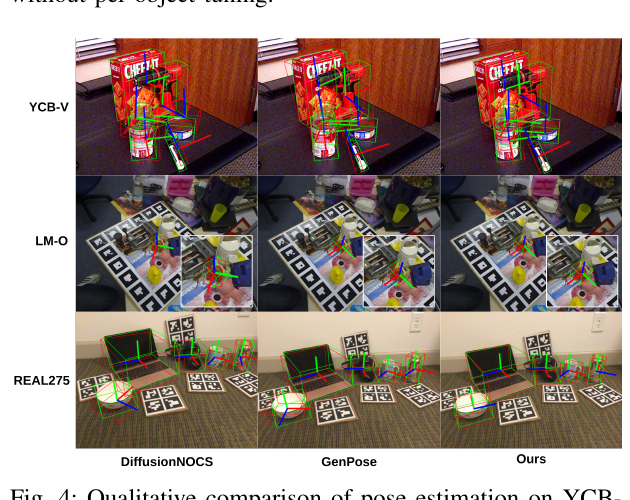
Original Figure 4: qualitative YCB-V, LM-O, and REAL275 results. This excerpt contains the result figure and original caption, rather than a homepage screenshot. Source: original paper. Image copyright belongs to the authors; reproduced here for academic analysis.
7. Quantitative benchmark results
7.1 REAL275
Method
5°2 cm
5°5 cm
10°2 cm
10°5 cm
DiffusionNOCS
–
35.0
66.6
77.1
GenPose
52.1
60.9
72.4
84.0
SE(3)-PoseFlow
48.8
56.3
76.3
89.1
Broader rotation thresholds improve, while the two strictest metrics trail GenPose. The authors attribute this to REAL275’s missing meshes / dense clouds, leaving noisy partial-point Chamfer reranking; GenPose’s learned energy better fits this dataset. Claims of SOTA at every threshold would overstate the results.
7.2 YCB-V and LM-O
Original Tables II, III, and V: YCB-V / LM-O comparisons, RGB / mask ablations, and ODE-step accuracy / speed trade-offs. Source: original paper. Image copyright belongs to the authors; reproduced here for academic analysis.
YCB-V 5°5 cm / 10°5 cm scores are 45.4 / 68.2; LM-O scores 35.2 / 53.7. The strict YCB-V result slightly trails GenPose 46.2, while 10°5 cm improves by 4.4. Both LM-O metrics lead. Strong SDF geometry priors matter, so flow matching alone cannot explain these gains.
8. Interpreting ablations
8.1 RGB, point clouds, and masks
Without pose selection:
REAL275: point-cloud-only 5°5 cm is 52.3 versus the full model’s 51.3. Many symmetric / weakly textured objects limit RGB’s benefit.
YCB-V: point-cloud-only 20.9 versus full-model 40.2; texture cues matter greatly.
Removing key / value masks degrades all three datasets, supporting background-token suppression.
RGB benefits depend strongly on texture distributions; RGB-D does not uniformly beat depth alone.
8.2 Pose selection
REAL275 5°5 / 10°5:
none 51.3 / 79.3;
model-free 52.5 / 88.2;
Chamfer 56.3 / 89.1.
YCB-V:
none 40.2 / 54.7;
model-free 42.5 / 65.6;
Chamfer 43.1 / 67.5;
SDF 45.4 / 68.2.
Samples provide multimodal representations, while reranking accounts for much of final single-pose leaderboard accuracy.
One-step tracking already reaches 10°5 cm 83.6, versus 88.8 at 10 steps; near-correct starts need only local field corrections.
9. Active perception
A Franka Panda wrist-mounted ZED Mini samples viewpoints on an object-centric sphere. For each view, pose hypotheses give rotation covariance in the SO(3) tangent space; select the view with the lowest expected rotational covariance trace.
This is a sampling approximation to next-best view. Robot demonstrations reveal ambiguous directions by moving around objects, but no large-sample success table comparable to grasping is provided. They demonstrate feasibility, without establishing broad superiority over strong active-view baselines.
10. Grasping with multiple hypotheses
EquiGraspFlow generates a grasp velocity field per pose hypothesis. Instead of selecting one pose, the authors average at the velocity level across K hypotheses:
vˉ(M,t)≈K1k=1∑Kvθ(M~k,t).
A visible mug handle gives a unimodal pose distribution and handle-side grasps. Self-occlusion creates multimodal yaw, and averaging suppresses orientation-dependent side-grasp modes; top grasps remain valid across plausible yaws.
Original Figure 5 and Table VI: single-hypothesis success is 15/20 versus 19/20 with multi-hypothesis marginalization; under occlusion, 6/10 rises to 9/10. Source: original paper. Image copyright belongs to the authors; reproduced here for academic analysis.
Only one mug is tested, with 10 attempts per condition. Persuasive but limited in scale, these results do not establish stability across multiple objects, clutter collisions, or different grasp generators.
11. Limitations and unanswered questions
Missing calibration: no NLL, ECE, coverage, or mode recall; whether sample covariance reflects true error probabilities is unknown.
Frontend dependencies: detector, mask, and depth errors systematically affect distributions.
Geometric reranking: best instance-level results require meshes / dense clouds and SDF training.
Uneven category generalization: the authors explicitly acknowledge that transfer is not seamless across all categories.
Cross-modal gap: image and point-cloud tokens resist unified representations; the paper suggests point maps.
No Bayesian sample-use principle: weighting, updates, and temporal posteriors remain unresolved.
Limited tracking evaluation: previous-frame initialization, without long-sequence relocalization or multimodal transitions.
Test mask perturbations, depth dropout, symmetry-mode recall, and relocalization.
Expand grasping to multiple objects / grasp types and report collision / planning failures.
13. Methodological takeaways
SE(3)-PoseFlow’s main lesson is to make multiple solutions available downstream, beyond replacing diffusion with flow. Pose pipelines often return one canonical pose after symmetry handling; retaining plausible alternatives can be safer for robotic manipulation than aggressively selecting one estimate. Calibrated SE(3) posteriors, sequential Bayesian updates, and task-conditioned hypothesis weighting are valuable next steps.