SecondPose: SE(3)-Consistent Dual-Stream Feature Fusion for Category-Level Pose Estimation
SecondPose fuses DINOv2 category semantics with hierarchical PPF instance geometry pointwise into an approximately SE(3)-consistent representation, then separately regresses rotation, translation, and size. REAL275 IoU75 / 5°2cm is 49.7 / 56.2, and HouseCat6D IoU25/50 is 83.7/66.1. Removing semantics lowers strict 5°2cm to 51.1.
RGB-D object cropback-projected point cloudDINOv2 semantic patch featureshierarchical point-pair features
Requirements
Mask R-CNN object segmentationvalid depth and camera intrinsicspretrained DINOv2known category vocabulary2,048 point samples and 300-point geometric subset
Full paper metadataAuthors, affiliations, research area, datasets, metrics, method tags, and reading statusExpandCollapse
Authors
Yamei Chen, Yan Di, Guangyao Zhai, Fabian Manhardt, Chenyangguang Zhang, Ruida Zhang, Federico Tombari, Nassir Navab, Benjamin Busam
Affiliations
Technical University of Munich / Munich Center for Machine Learning / Google / Tsinghua University / 3dwe.ai
Mask R-CNN object segmentationvalid depth and camera intrinsicspretrained DINOv2known category vocabulary2,048 point samples and 300-point geometric subset
Reading Notes
Overview / Deep Dive
Available src/paper-notes/secondpose-cvpr2024/coarse.md
Paper overview notes
Quickly assess the paper's scope, problem setting, core method, experimental findings, and whether to read it in depth.
Overview Notes: SecondPose
1. Basic information
Title: SecondPose: SE(3)-Consistent Dual-Stream Feature Fusion for Category-Level Pose Estimation
Authors: Yamei Chen, Yan Di, Guangyao Zhai, Fabian Manhardt, Chenyangguang Zhang, Ruida Zhang, Federico Tombari, Nassir Navab, Benjamin Busam
Affiliations: Technical University of Munich; Munich Center for Machine Learning; Google; Tsinghua University; 3dwe.ai
SecondPose replaces category mean shapes with pointwise fusion of DINOv2 cross-instance semantic correspondences and hierarchical Point Pair Features spanning local to global geometry. The resulting approximately SE(3)-consistent representation directly regresses category-level rotation, translation, and metric size from RGB-D.
3. Guide to figures and tables
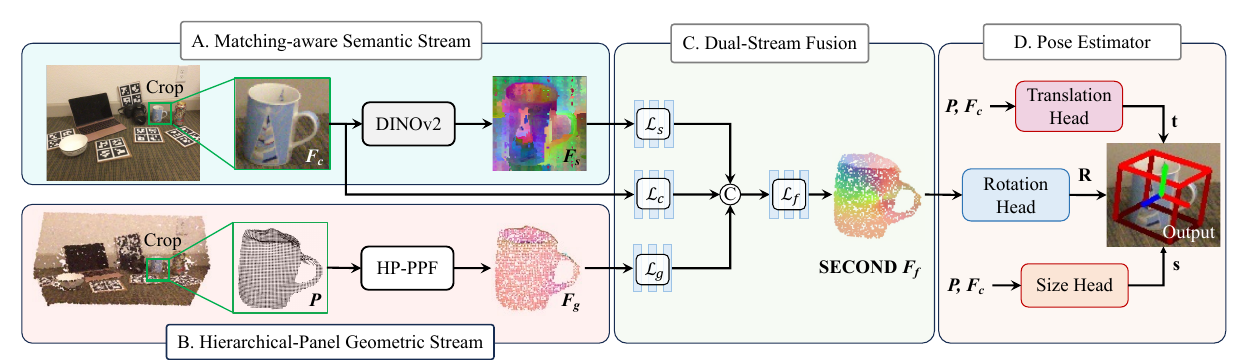
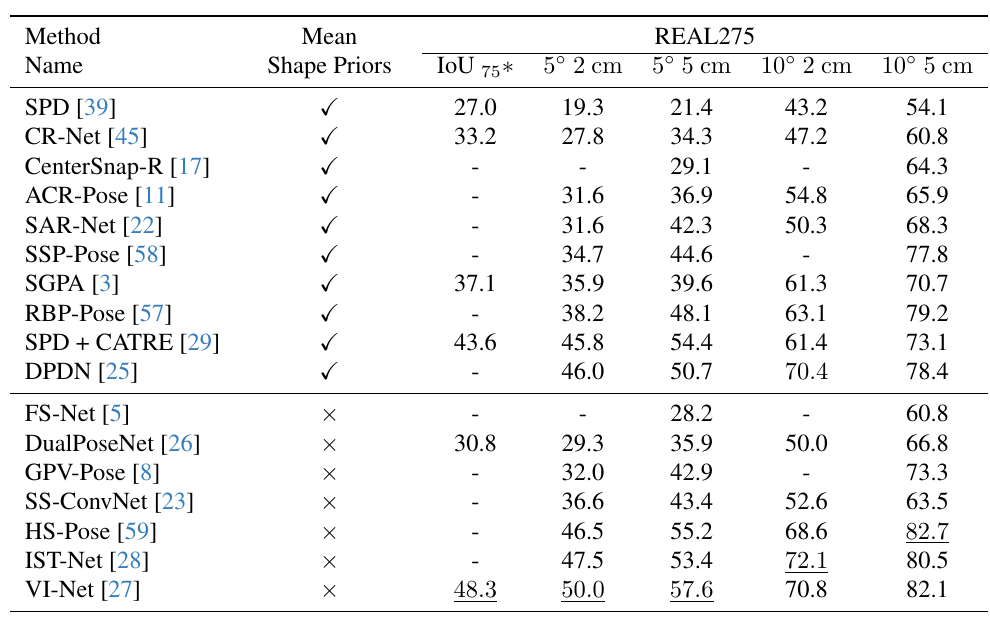
Original Figure 2 method diagram: DINOv2 encodes RGB crops into a semantic stream, HP-PPF encodes point-cloud geometry, and dedicated / shared layers fuse these with RGB point features into SECOND features, followed by rotation, translation, and size heads. Source: published CVPR 2024 paper. Image copyright belongs to the authors and IEEE/CVF; reproduced here for paper analysis.Baseline portion of original Table 1; this crop omits the SecondPose row. Its IoU75 49.7, 5°2cm 56.2, 5°5cm 63.6, 10°2cm 74.7, and 10°5cm 86.0 can be verified in original Table 3 row A0, included in the deep notes. Strict pose metrics substantially exceed VI-Net. Source: published CVPR 2024 paper. Table copyright belongs to the authors and IEEE/CVF; reproduced here for paper analysis.
4. Problem setting
Input: RGB-D, object masks / crops, and camera intrinsics.
Output: category-level 9DoF pose: rotation R, translation t, and metric size s.
Training / testing: known categories with unseen test instances; no instance CAD or category mean shape is required.
Data: NOCS-REAL275 / CAMERA25 and the more complex HouseCat6D.
Frontend: Mask R-CNN segmentation; depth backprojection gives object point clouds.
5. Method overview
DINOv2 layer-11 token features supply cross-instance part semantics, with weaker local geometry.
For points pi,pj, PPF comprises distance d and three normal angles α,β,θ, invariant under a shared SE(3) transform.
Hierarchically average and concatenate support panels from near to far, going beyond fixed KNN to form HP-PPF.
Align DINOv2, HP-PPF, and RGB / radial features pointwise and project them to a spherical feature map for dual-stream fusion.
Reuse a VI-Net-style estimator: regress rotation separately, with lightweight PointNet++ predicting translation and size.
Without semantics, 5°2cm falls from 56.2 to 51.1; without geometry to 55.1; without both to 49.9.
Replacing hierarchical panels with 10-NN yields 5°2cm 55.4, a 0.8 drop.
Occluding 1/4 of the bounding box yields IoU75 46.7 versus 49.7, a drop of 3.0.
Full model: about 9 FPS; excluding DINOv2: 10 FPS.
7. Quick assessment
Highlight: semantic and geometric features are first made stable under SE(3) transforms at the point level, going beyond simple concatenation.
Strongest evidence: removing semantics costs 5.1 on strict 5°2cm, supporting DINOv2’s role in orientation. HouseCat6D IoU50 +9.7 also supports complex materials and shapes.
Limitations: depth, Mask R-CNN, and DINOv2 dependencies; semantic mismatches in DINOv2 remain a bottleneck.
Recommended for: category-level RGB-D pose, foundation features, PPF, SE(3)-invariant representations, and semantic–geometric fusion.
Available src/paper-notes/secondpose-cvpr2024/deep.md
In-depth paper notes
Support reproduction, comparison, related-work writing, and identifying opportunities for further research.
Deep Reading Notes: SecondPose
1. Key assessment
Category-level pose needs both shared cross-instance semantics, such as a mug’s front / top, and each instance’s particular geometry. Mean-shape methods compress instances into one template and distort cameras, chairs, or household objects with substantial structural variation; DINOv2 semantics alone lack precise metric 3D geometry.
SecondPose uses two streams:
Semantic stream: DINOv2 provides cross-instance and cross-view semantic correspondences;
Fusion: pointwise alignment forms an approximately consistent representation under input-coordinate transforms.
Strict REAL275 5°2cm improves from VI-Net’s 50.0 to 56.2, falling to 51.1 without semantics. The largest gain comes from foundation semantic priors, beyond replacing point descriptors.
2. Task and system boundaries
Input pipeline:
Obtain masks / boxes with Mask R-CNN;
Extract DINOv2 patch features from RGB crops;
Backproject depth with camera intrinsics into object point clouds;
Attach RGB, radial distance, semantic, and geometric features to each point.
Output is category-level 9DoF:
(R,t,s),R∈SO(3),t∈R3,s∈R3.
Categories are known during training, with unseen test instances. No test-instance CAD or category mean shape is required; trained categories, usable depth, and foreground segmentation remain prerequisites.
3. DINOv2 as a semantic orientation prior
The authors use DINOv2’s layer-11 token facet. Deeper features capture category and overall part semantics more strongly than shallow patches: mug handles, camera lenses, and shoe tips can define canonical front / left / top directions.
DINOv2 features are not mathematically rotation-invariant. The paper describes empirical consistency across semantic instance matching and some viewpoint changes. Simply concatenating DINOv2 and xyz has two problems:
RGB-only DINOv2 lacks metric local geometry;
Deep features favor global structure and smooth out details.
A second geometric stream therefore supplies local structure.
4. Hierarchical-Panel Point Pair Features
For point-cloud points pi,pj and normals ni,nj, the basic PPF is:
Applying the same rigid transform to both points and normals preserves these distances and angles, making the descriptor SE(3)-invariant.
One local KNN panel is sensitive to normal noise and misses global structure. SecondPose sorts points by distance to each center and divides them into near-to-far support panels:
Si,m={pj∣km−1<ri,j≤km},
Average PPF within each panel, then concatenate across scales:
fgi=fli,1⊕fli,2⊕⋯⊕fli,l.
Near panels describe edges, curvature, and local parts; far panels describe overall dimensions and part relationships. Against fixed 10-NN, 5°2cm improves from 55.4 to 56.2, a modest but consistent gain.
5. Dual-stream fusion and pose heads
Original Figure 2 method diagram. DINOv2 and HP-PPF features align with point samples; stream-specific modules \(L_s,L_g,L_c\) process semantics, geometry, and color. After concatenation, shared \(L_f\) produces the SECOND representation. Source: published CVPR 2024 paper. Image copyright belongs to the authors and IEEE/CVF; reproduced here for paper analysis.
SecondPose uses VI-Net as its pose estimator, projecting pointwise features and point clouds to spherical feature maps. It seeks to learn:
Φ:Rn×3×Rn×C→SO(3),
while satisfying:
Φ(RxP,ψRx(F))=RxΦ(P,F).
If fused features are approximately invariant:
ψRx(F)≈F,
then the network only needs to learn an equivariant mapping from point-cloud rotation to output rotation, without also compensating for view-dependent feature drift. The paper calls this SE(3) consistency, with no strict group-equivariance proof.
Rotation and translation-size networks train separately; the latter uses lightweight PointNet++ and L1 losses. The implementation samples 2,048 points, then 300 of these for PPF, estimating normals with 10-NN.
6. REAL275 main results
Baseline portion of original Table 1. Mean-shape-prior methods appear above and prior-free methods below. The crop omits SecondPose; its full results can be verified in row A0 of original Table 3 below. SecondPose uses a semantic prior rather than an explicit shape prior. Source: published CVPR 2024 paper. Table copyright belongs to the authors and IEEE/CVF; reproduced here for paper analysis.
Method
IoU75
5°2cm
5°5cm
10°2cm
10°5cm
DPDN
—
46.0
50.7
70.4
78.4
HS-Pose
—
46.5
55.2
68.6
82.7
IST-Net
—
47.5
53.4
72.1
80.5
VI-Net
48.3
50.0
57.6
70.8
82.1
SecondPose
49.7
56.2
63.6
74.7
86.0
The abstract’s “12.4% leap” is relative 5°2cm improvement over VI-Net; the absolute improvement is 6.2 points. Prefer absolute points when reading tables to avoid inflating the apparent gain.
7. REAL275 qualitative results and representation contributions
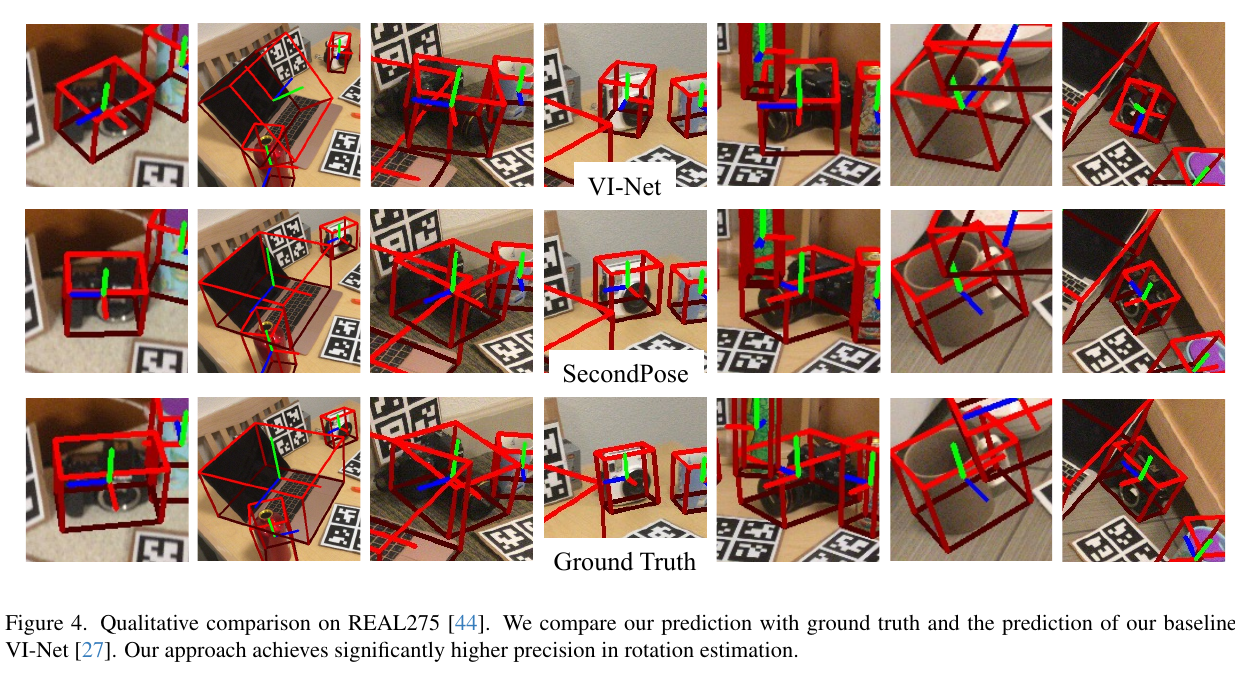
Original Figure 4: VI-Net, SecondPose, and GT occupy the first, second, and third rows. For cameras, laptops, mugs, and other categories with substantial instance variation, SecondPose's rotation axes and 3D boxes better match GT. Source: published CVPR 2024 paper. Image copyright belongs to the authors and IEEE/CVF; reproduced here for paper analysis.
Semantic / geometric ablations:
Configuration
IoU75
5°2cm
5°5cm
Full
49.7
56.2
63.6
Without semantics
48.0
51.1
58.9
Without geometry
49.5
55.1
62.3
Without both
48.5
49.9
57.4
Semantics contribute most to strict pose; geometry alone adds +1.1, while combining both beats removing both by 6.3. The geometric stream primarily grounds semantics in metric 3D, rather than independently identifying category orientation.
Removing each PPF component yields 5°2cm 54.7–55.1, all below 56.2. Both normal angles and point distances matter; retaining only the easiest distance term loses information.
8. HouseCat6D
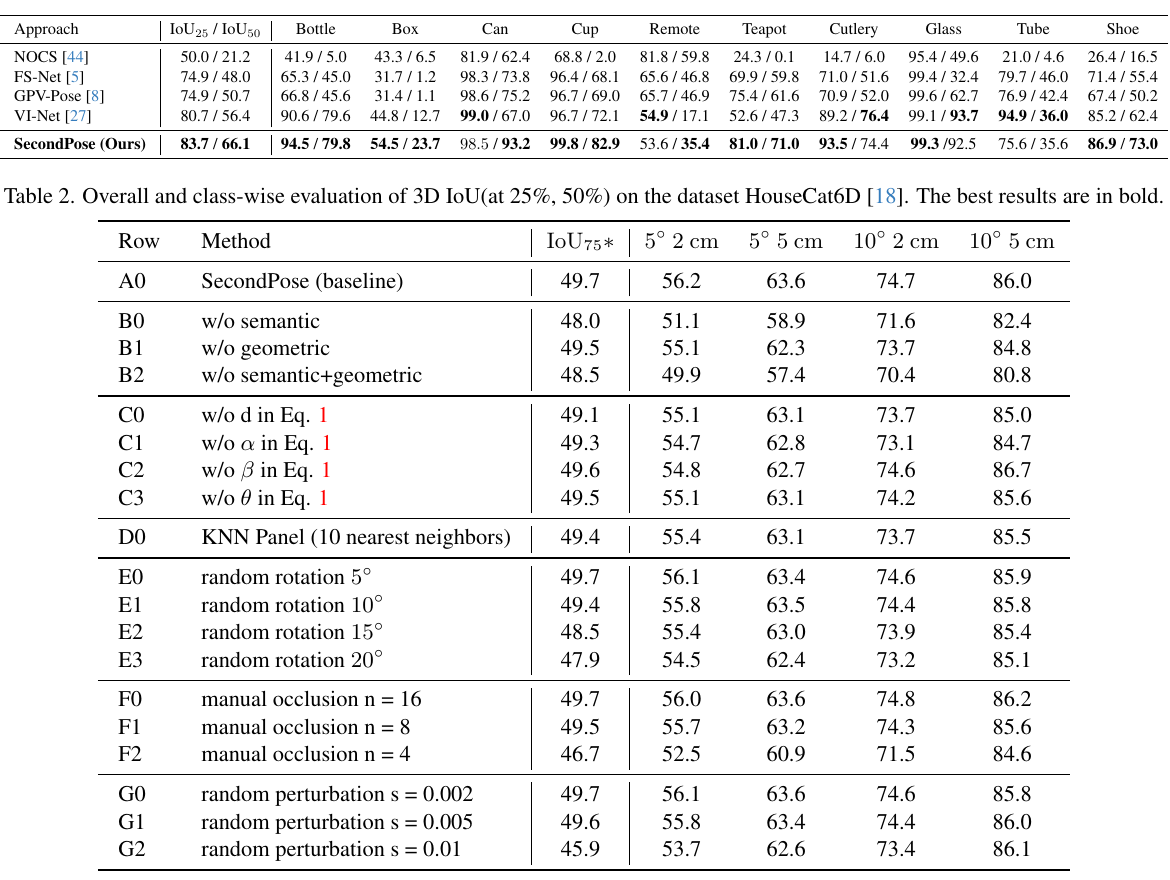
Original Tables 2 and 3: HouseCat6D overall / per-class IoU25 and IoU50 appear above; semantic, geometric, panel, rotation, occlusion, and point-perturbation ablations below. Source: published CVPR 2024 paper. Table copyright belongs to the authors and IEEE/CVF; reproduced here for paper analysis.
Method
Overall IoU25
Overall IoU50
NOCS
50.0
21.2
FS-Net
74.9
48.0
GPV-Pose
74.9
50.7
VI-Net
80.7
56.4
SecondPose
83.7
66.1
IoU50 rises from VI-Net’s 12.7 to 23.7 for boxes, 67.0 to 93.2 for cans, and 47.3 to 71.0 for teapots. However, tubes decline from 36.0 to 35.6 and glasses from 93.7 to 92.5; gains are not universal. Transparent / reflective HouseCat6D objects may also have incomplete depth, warranting separate depth-quality evaluation.
Manual occluders covering 1/16, 1/8, 1/4 of the box: IoU75 49.7 / 49.5 / 46.7.
Point perturbation s=0.002,0.005,0.01: IoU75 49.7 / 49.6 / 45.9.
Small perturbations barely matter; stronger point-cloud noise damages IoU75 more than 1/4 occlusion. HP-PPF depends on normals and pair geometry, so coordinate noise contaminates several angular terms together.
10. Training and efficiency
NOCS training mix: 25% REAL275 real + 75% CAMERA25 synthetic;
Batch 48, one RTX 3090, 40 epochs;
DINOv2 crop: 210×210;
point cloud: 2,048 points;
HP-PPF: 300 sampled points, 10-NN normals;
Inference: full model 9 FPS; excluding DINOv2 10 FPS.
DINOv2 contributes only about a 1 FPS difference; point-cloud geometry, spherical projection, and pose heads account for most latency. Whether 9 FPS includes Mask R-CNN is unspecified, so deployment comparisons should account for segmentation separately.
11. Limitations and reproduction checks
Depth and camera intrinsics are essential; monocular foundation features alone are insufficient.
Geometry cannot fully recover incorrect DINOv2 part semantics, a limitation the authors explicitly acknowledge.
PPF is sensitive to noisy normals; transparent / reflective depth can corrupt features.
SE(3) consistency is an approximate representation property, without a strict network-equivariance theorem.
Known-category protocols do not establish open-vocabulary behavior; DINOv2 does not directly generalize the model to unseen categories.
Evaluate Mask R-CNN, box crops, and object-depth segmentation errors in a complete pipeline.
REAL275’s six and HouseCat6D’s ten categories remain limited.
12. Overall assessment
SecondPose illustrates a useful division of labor for foundation features in category-level pose: DINOv2 supplies cross-instance semantic orientation, structured PPF supplies metric local geometry, and point alignment combines them into a pose-consistent representation.
It substantially improves strict pose metrics and HouseCat6D IoU50; ablations separate semantic, geometric, and panel contributions. The costs are continued RGB-D, segmentation, and known-category dependencies. Future work should extend semantics to open categories while making geometry robust to missing and noisy depth.