SE(3)-Equivariance with Geometric and Topological Guidance for Category-Level Object Pose Estimation
SEGPose combines SE(3)-equivariant feature prediction with geometric and topological guidance, using local point cloud structures and global connectivity to strengthen category-level pose estimation. It also evaluates transfer to real robotic grasping.
SEGPose combines geometry, topology, and SE(3) equivariance for point-cloud-only category-level pose. Topology-guided reconstruction and an equivariant pose head improve generalization across complex shapes and real robot scenes.
2.1 Guide to the paper’s figures and tables
Figure / table
Purpose
Overview reading tips
Figure 1
Geometry-only methods versus SEGPose
Separate the roles of topology and SE(3) guidance
Figure 2
Reconstruction, feature extraction, and pose heads
Connect losses with NOCS alignment
Table 1
CAMERA25 / REAL275 results
Focus on depth-only comparisons
Table 2
REAL275 module / loss ablations
Separate topology, SE(3), reconstruction, and augmentation
Tables 3 / 4
Wild6D and UR3 grasping
Ask whether benchmark gains transfer to real actions
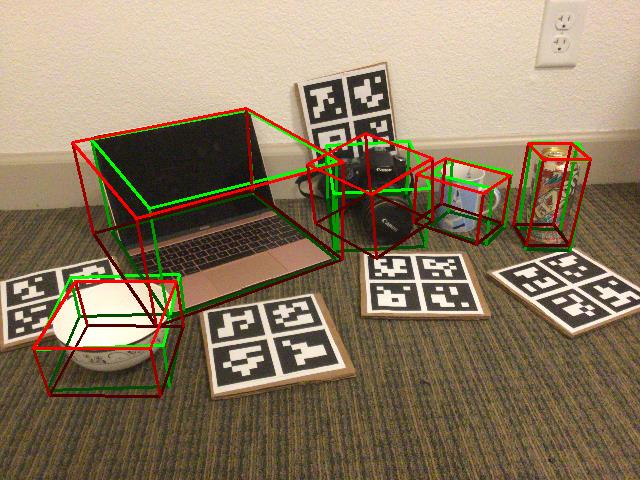
Original qualitative pose excerpt: red and green 3D boxes overlay a real scene. This crop does not show network architecture, topological features, or equivariant modules. Source: CVF Open Access. Image copyright belongs to the authors and publisher; reproduced here for paper analysis.
3. Problem setting
Input: category-level object point clouds / depth; estimate unseen instances’ poses and sizes.
RGB serves frontend segmentation only; the core pose network uses depth point clouds, supporting low-light operation.
Tests cover CAMERA25, REAL275, Wild6D, and real UR3 grasping.
4. Method overview
Extract geometric and topological / graph features from point clouds.
Use constrained feature extraction and 3D reconstruction to recover more complete category geometry.
Refine reconstruction and pose through NOCS point-cloud alignment.
Use an SE(3)-equivariant feature-prediction network to transform outputs consistently with inputs.
5. Experimental overview
REAL275 and CAMERA25 cover bottle, bowl, camera, can, laptop, and mug.
REAL275 10 degree 2 cm mAP is 73.9; 10 degree 5 cm is 87.1.
Wild6D depth-only 10 degree 5 cm mAP reaches 48.1. Robot grasping under external disturbances, task F, succeeds at 84.4%; this is not the six-task average.
6. Quick assessment
Value: extends category-level point-cloud pose beyond geometric distances to topology and group equivariance.
Strengths: limited RGB dependence, explicit structural priors, and real grasping validation.
Limitations: category NOCS / point-cloud priors are needed; topology remains sensitive to severe missing data.
Recommended for: depth-only category-level pose, equivariance, topological point clouds, and robotic grasping.
Available src/paper-notes/segpose-2026/deep.md
In-depth paper notes
Support reproduction, comparison, related-work writing, and identifying opportunities for further research.
Deep Reading Notes: SE(3)-Equivariance with Geometric and Topological Guidance for Category-Level Object Pose Estimation
Assessment: SEGPose combines three often separate factors: local point geometry, topology between points, and SE(3) equivariance under input changes.
2. Positioning in one sentence
Topology-guided reconstruction recovers category structure, while an SE(3)-equivariant pose head makes predictions transform consistently with input rotation / translation. Together they improve depth-only category-level pose.
2.1 Guide to the paper’s figures and tables
Figure / table
Deep-dive questions
Figure 1
Where do topology and SE(3) guidance enter the pipeline?
Figure 2
How does reconstructed geometry align with category NOCS?
Table 1
Do depth-only methods exceed RGB-D on CAMERA25 / REAL275?
Table 2
What is lost by removing topology, SE(3), reconstruction, or augmentation?
Table 3
Does generalization hold across Wild6D scenes?
Table 4
Do six grasping-task success rates agree with pose metrics?
Original qualitative pose excerpt: red and green 3D boxes overlay a real scene. It shows pose alignment, without geometric / topological features or SE(3)-equivariant architecture. Source: CVF Open Access. Image copyright belongs to the authors and publisher; reproduced here for paper analysis.
3. Problem setting and task boundaries
Category-level pose starts from object-mask-filtered point clouds, typically sampled to 1024 points.
Outputs are rotation, translation, and scale corresponding to NOCS; evaluation uses IoU and joint rotation / translation thresholds.
RGB supplies segmentation only. The paper intentionally studies depth-only pose without RGB texture dependence in low light.
Training / evaluation assume category NOCS point clouds / models, distinct from model-free novel-object pose.
4. Research context
NOCS, GPV-Pose, HS-Pose, and related methods already use point geometry and voting / alignment, but usually overlook graph / topology properties.
Point clouds should transform with structured SE(3) equivariance; ordinary features can make pose predictions unstable across changing views.
SEGPose adds topology-aware reconstruction and SE(3)-equivariant feature prediction to depth-based pose.
5. Research motivation
Point connectivity complements individual distances and local normals, especially for shared category structure.
Moving cameras and objects require consistent responses to input rotation / translation.
Geometry-only reconstruction is sensitive to occlusion, interference, and shape variation.
Topology-guided reconstruction maps observations into more complete category structures, followed by NOCS pose alignment.
6. Method details
6.1 Topology-guided reconstruction
Geometric descriptors and topological / graph features encode point adjacency, connectivity, and structural relationships.
Constrained feature extraction predicts topology-related features; 3D reconstruction stabilizes point representations.
Align reconstructions to category-specific NOCS point clouds, measuring quality with Density Chamfer Distance.
6.2 SE(3)-equivariant pose head
An SE(3)-equivariant feature-prediction network makes features and poses transform with rigidly transformed inputs.
Pose heads predict rotation components and combine translation / size for final category-level poses.
Equivariance losses constrain predictions across augmented views, beyond approximate equivariance learned through augmentation alone.
6.3 Losses and augmentation
Point / category topology, feature alignment, reconstruction, and SDF / equivariance-related losses.
Random cropping, resizing, and occlusion simulate real missing data and point-count changes.
NOCS alignment bridges reconstruction and pose, correcting inconsistencies without extra pose branches.
7. Experimental analysis
7.1 Data and metrics
CAMERA25 inserts synthetic objects into real scenes; REAL275 contains six real test scenes, both covering bottle, bowl, camera, can, laptop, and mug.
Wild6D tests five categories in real environments for cross-scene generalization.
Metrics include IoU50 / IoU75, 5° 2 cm, 5° 5 cm, 10° 2 cm, 10° 5 cm, and overall mAP.
REAL275 IoU50 / IoU75: 83.1 / 78.3; 5° 2 cm, 5° 5 cm, 10° 2 cm, 10° 5 cm: 51.8, 61.1, 73.9, 87.1.
Wild6D depth-only IoU50 72.2 and 10° 5 cm 48.1 exceed compared depth-based methods.
UR3 success rates for single grasp, occluded grasp, handover, pouring, stacking, and external disturbance are 88.9, 82.2, 75.6, 71.1, 64.4, 84.4%. Original Table 4’s 84.4 is task F, not the six-task average.
7.3 Ablations
Removing topology and SE(3) modules drops REAL275 10° 5 cm to 79.2, versus 87.1 with both.
Topology-guided reconstruction, NOCS alignment, and reconstruction losses each benefit geometry and pose.
Removing SE(3)-equivariance loss weakens pose consistency under dynamic views.
8. Critical analysis
Strengths: depth-only inputs and real grasping define an explicit application scope; topology plus equivariance has a plausible structural motivation.
Limitations: category NOCS and reconstruction priors still need preparation; open categories without shared topology require redesign.
Metric versus task: grippers, friction, and collisions affect grasp success; it cannot be equated to pose mAP.
Robustness: extreme occlusion / missing parts can also leave topology unsupported; uncertainty deserves further study.
9. Implications for my research
Topological persistence, part graphs, and local connectivity can supply extra category-level pose supervision.
SE(3)-equivariant features could combine with NOCS, canonical point clouds, and object-centric Gaussians.
Robot tests should separate pose accuracy, occlusion, manipulation type, and recovery rather than reporting one success rate.
10. Open questions
How discover topology with unknown categories and no NOCS?
How handle symmetry-equivalent poses and topological ambiguity?
How can active perception and robot actions reveal hidden topology?
11. Further analysis: joint evidence for SE(3) equivariance and topology priors
11.1 Setting and implementation
SEGPose primarily takes point clouds, with RGB for instance segmentation only, without RGB-D feature fusion. Settings: 1024 points, batch size 24, one RTX 3090, initial learning rate 10−4, cosine schedule; loss weights λ1=8,λ2=1,λ3=4,λ4=0.1,λ5=2 and β1=0.5,β2=1.
Three complementary paths:
Geometric / topological guidance builds local geometric and topological features to reconstruct category structure;
Reconstruction and NOCS alignment map observations to canonical space;
SE(3)-equivariant feature prediction follows the group action under global input rotation / translation, then NOCS alignment recovers pose.
11.2 CAMERA25 / REAL275 main results
Dataset
IoU50
IoU75
5°2cm
5°5cm
10°2cm
10°5cm
FPS
CAMERA25
93.7
90.5
76.3
82.9
82.7
91.2
—
REAL275
83.1
78.3
51.8
61.1
73.9
87.1
45.8
These are depth-only results. The authors acknowledge stronger RGB-D SpotPose on some metrics. Advantages lie in simpler inputs, higher speed, and joint structure / pose modeling, without beating RGB-D on every metric.
UR3 tasks are single-object grasping, occluded grasping, handover, pouring, stacking, and external disturbance; success rates are 88.9 / 82.2 / 75.6 / 71.1 / 64.4 / 84.4. The last 84.4 belongs to external-disturbance task F, not an average. These robot results demonstrate applications, with a different meaning from mAP.
Removing reconstruction / topology terms lowers 10°5cm from full-model 87.1 to about 79.2, consistent with the motivation.
SE(3) equivariance improves dynamic pose changes
Removing equivariant guidance / loss lowers pose metrics; further breakdown by rotation magnitude and point density is needed.
Depth-only operation remains practical
45.8 FPS and UR3 results support deployment potential, conditional on masks, point quality, and category NOCS.
12. Failures and transferable designs
Severe missing parts can leave topology unsupported; symmetric categories allow multiple equivalent NOCS poses; Mask R-CNN misses harm both reconstruction and pose. Future work could propagate persistent-topology confidence to pose heads, output equivalent pose sets, and use robot grasp success / reobservation for online calibration.