Object Pose Estimation · 2026 · ICRA / IEEE RA-L · CCF B
Simultaneous Extrinsic Contact and In-Hand Pose Estimation via Distributed Tactile Sensing
TacGraph combines dual-GelSight tactile geometry, in-grasp displacement, and wrench estimates in a factor graph. Geometric consistency, nonpenetration, contact kinematics, and force balance jointly estimate in-grasp rest pose, external contact points, and forces. Tactile-only contact-point error drops from ICP's 17.53 mm to 3.72 mm, with 23/40 successful open-loop insertions at 3 mm clearance. Known object / environment meshes, elastic nonslipping grasps, and single-point contact are assumed.
known rigid object meshknown static environment meshtrained tactile depth / displacement / wrench modelselastic grasp without slipsingle point contact without torque
Reading Notes
Overview / Deep Dive
Available src/paper-notes/simultaneous-contact-inhand-pose-icra2026/coarse.md
Paper overview notes
Quickly assess the paper's scope, problem setting, core method, experimental findings, and whether to read it in depth.
Overview: TacGraph
One-sentence summary
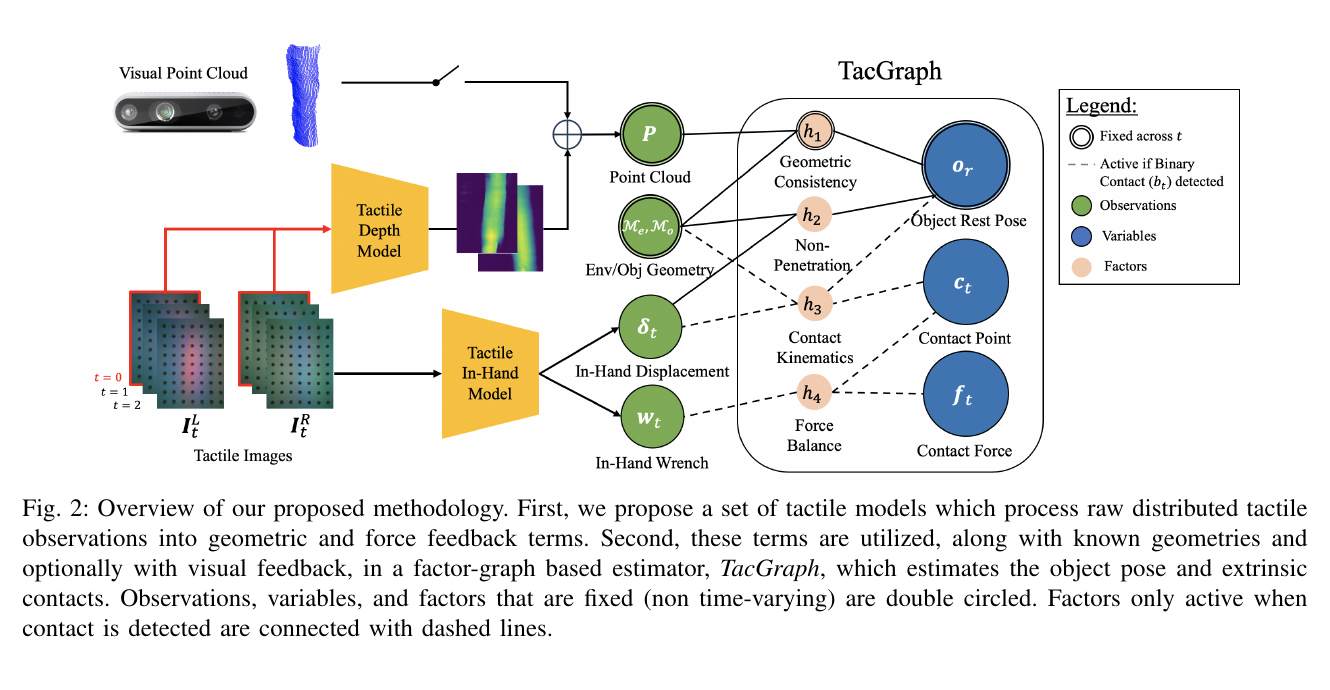
TacGraph combines bilateral tactile geometry, in-hand displacement, and wrench predictions with known object / environment geometry. A factor graph jointly estimates object pose, external contact, and force, using contact physics to constrain mutually ambiguous unknowns.
Research question
Insertion, tool use, and assembly need precise in-gripper poses and external contact locations / forces. Local tactile patches admit several poses, while vision suffers occlusion and depth noise. Can visual / tactile evidence and quasi-static constraints jointly recover pose and extrinsic contact?
Method overview
GelSight Mini sensors on both fingers feed three object-agnostic networks:
Initial tactile depths become local points;
Relative in-hand displacements reference the initial grasp;
Predicted 6D gripper wrenches trigger external-contact detection through magnitude thresholds.
Variables are one shared object rest pose plus time-varying contact points / forces. Current poses combine the rest pose with tactile displacement. Four factors check:
Whether tactile and optional visual points lie on object surfaces;
Original Figure 2: tactile depth, in-hand displacement, and wrenches feed geometric consistency, non-penetration, contact-kinematics, and force-balance factors. Source: TacGraph paper. Image copyright belongs to the authors; reproduced here for academic analysis.
Key results
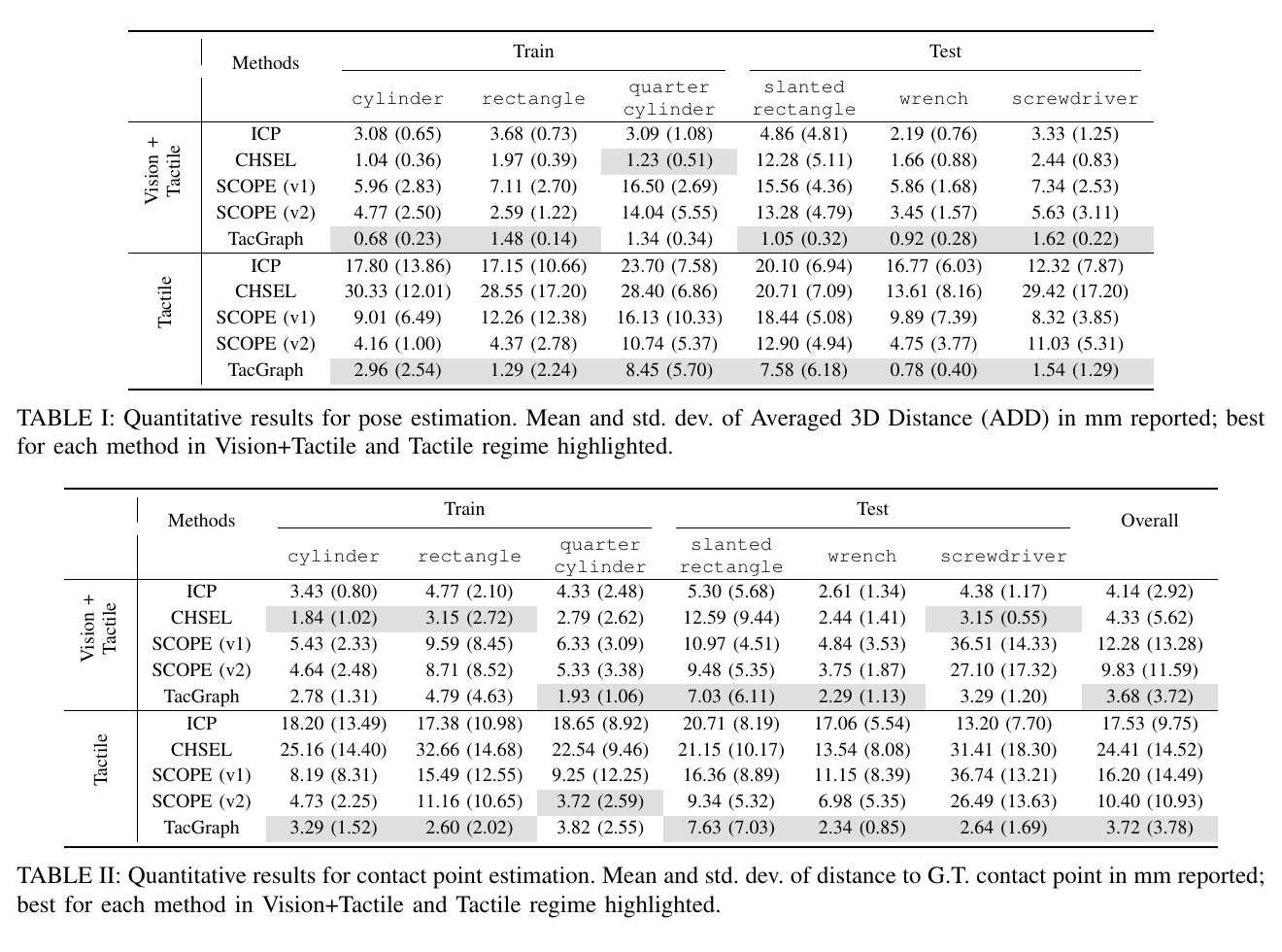
Vision + Tactile ADD is lowest in most of six train / test geometries: 0.68, 1.48, 1.34, 1.05, 0.92, 1.62 mm.
Tactile-only contact-point error is 3.72 ± 3.78 mm, versus ICP 17.53, CHSEL 24.41, SCOPE v1 / v2 16.20 / 10.40 mm.
Force error is about 0.61 ± 0.36 N. Shared learned wrench models prevent attributing this alone to factor-graph superiority.
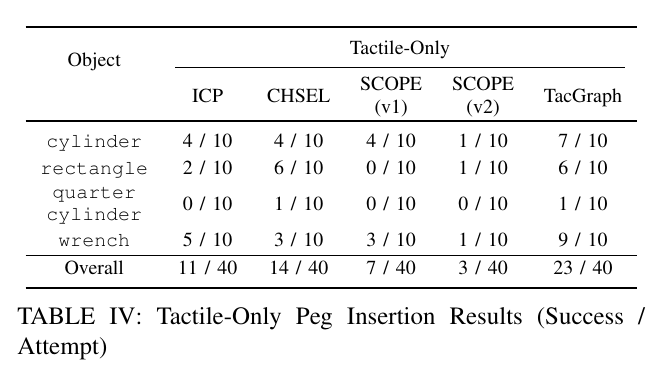
Tactile-only open-loop insertion with 3 mm clearance succeeds 23/40, versus ICP 11/40, CHSEL 14/40, SCOPE v1 7/40 and v2 3/40.
Original Tables I–II: pose and contact-point errors with visual-tactile / tactile-only sensing. This crop omits force Table III; force results in the text come separately from that original table. Source: TacGraph paper. Image copyright belongs to the authors; reproduced here for academic analysis.
Assumptions and limitations
Known rigid-object and static-environment meshes are required. Elastic grasps must return to one rest pose after forces disappear; slip breaks this model. Contacts are single points without contact torque. Local optimization needs initialized pose particles, such as ICP, with more particles for strong symmetries. Quarter-cylinder insertion succeeds only 1/10, exposing sensitivity to noisy GelSight normal-direction depth.
Reading assessment
The transferable idea is joint variable design: pose constrains feasible contacts, and contacts reject wrong poses. Physics-consistent inference connects vision and touch beyond feature concatenation. Open-world / CAD-free manipulation still needs reconstruction, slip detection, and multiple-contact models.
Available src/paper-notes/simultaneous-contact-inhand-pose-icra2026/deep.md
In-depth paper notes
Support reproduction, comparison, related-work writing, and identifying opportunities for further research.
Problem: local touch cannot uniquely resolve in-hand poses / external contacts, and vision may be occluded. Pose, contact location, and force must jointly satisfy rigid geometry and quasi-static mechanics.
Answer: bilateral GelSight predicts surfaces, in-hand displacements, and wrenches; geometric consistency, non-penetration, contact kinematics, and force balance jointly solve rest pose, contact points, and forces.
Assessment: contact becomes a constraint rather than a disturbance. Precision depends on known meshes, point contacts, elastic no-slip grasps, and good initialization, limiting arbitrary in-hand generalization.
2. Task and state variables
Known inputs:
Object triangle mesh Mo;
Static-environment mesh Me;
Gripper / camera calibration;
Bilateral GelSight Mini images;
Optional external RGB-D points.
At each time, recover pose ot, contact ct, and force ft. Instead of independently optimizing every full pose, a network measures relative grasp deformation, introducing one time-invariant rest pose or:
ot=gtδtor,
Here gt is gripper pose and δt tactile in-hand displacement. Removing external force should restore or. This reduces temporal freedoms while excluding permanent slip.
3. From tactile images to optimization observations
Three object-agnostic convolutional models are trained.
3.1 Tactile depth
Initial bilateral RGB predicts heights and tactile points PT in the gripper frame. Optional visual points PV merge into P. Known fixtures under random grasps provide rendered training labels.
3.2 In-hand displacement
Initial / current tactile pairs regress δt∈SE(3). Fixed fixtures and small gripper motions provide known relative-transform labels. Errors in tactile-deformation-to-rigid-displacement prediction propagate into every pose.
3.3 In-hand wrench
A third network predicts gripper wrench wt∈R6 and contact boolean bt through a weighted-norm threshold. Environment-mounted ATI Gamma F/T supplies training GT, without participating in TacGraph inference.
Original Figure 2: optional vision, three tactile intermediates, and known geometry constrain rest pose, contact points, and forces. Source: TacGraph paper. Image copyright belongs to the authors; reproduced here for academic analysis.
4. Four factors
MAP becomes nonlinear least squares with Gaussian factor covariances, solved through GTSAM / iSAM2.
4.1 Geometric consistency h1
Transform observed points to object coordinates and measure signed distances to Mo. Initial tactile / visual points should approach the surface. This constrains rest pose; δt propagates current poses.
4.2 Non-penetration h2
Sample object surfaces, transform to environment coordinates, evaluate SDF(⋅∣Me), and penalize negative interior distances:
h2=min(0,SDF(otp∣Me)).
This rejects locally plausible poses that penetrate tables / fixtures.
4.3 Contact kinematics h3
Contacts lie on both surfaces, so ct has near-zero signed distance to both meshes. Infeasible simultaneous contact rejects candidate poses.
4.4 Force balance h4
Contact Jacobian J(ot−1ct) maps force to grasp-frame wrench, matched to prediction wt:
h4=J(ot−1ct)ft−wt.
Torque couples contact locations and forces; pose / geometry further disambiguate similar force readings. h3,h4 activate only when bt=1.
5. Multiple initialized particles
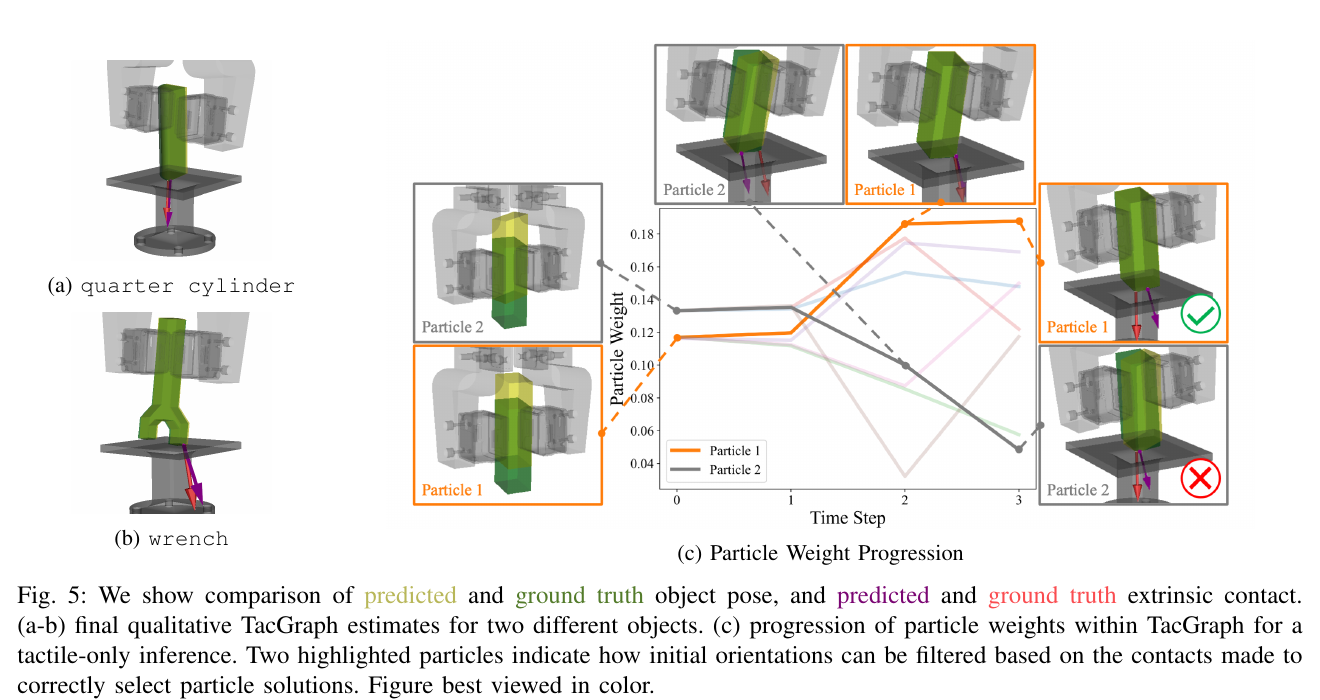
Local nonlinear optimization starts with K rest-pose particles from ICP / grasp-direction heuristics. Each maintains an independent graph; total factor cost H selects the best. Most objects need only 1–2 initializations, but experiments uniformly use 10 for symmetry / local minima.
Original Figure 5: subsequent contacts give initially plausible particles different physical costs, identifying the correct local solution. Source: TacGraph paper. Image copyright belongs to the authors; reproduced here for academic analysis.
TacGraph uses multiple local MAP initializations and cost-based selection, without a strict global posterior. Plotted weights reflect e−H rather than establishing normalized, calibrated pose uncertainty.
6. Experiments and ground truth
Hardware: KUKA LBR iiwa Med R820, WSG-50, one GelSight Mini per finger, optional RealSense D435. Object / environment ATI sensors supply training / evaluation GT only.
Pose / contact tests use 3 fixed angled pokes. Object-specific fixtures provide pose GT with roughly 1 mm tolerance; ADD uses 1000 mesh points. Environment F/T infers contact GT by sampling surfaces and matching c×f to measured torque. Thus contact GT itself inverts a point-contact model rather than independently tracking contact precisely.
7. Pose, contacts, and forces
Original Tables I–II: pose and contact-point errors, with best values shaded per sensing setting. This crop omits force Table III; the text's force results come separately from that table. Source: TacGraph paper. Image copyright belongs to the authors; reproduced here for academic analysis.
7.1 Vision + Tactile pose
TacGraph ADD spans 0.68–1.62 mm across six geometries, versus ICP 2.19–4.86 mm and CHSEL 12.28 mm on slanted rectangles. Vision already helps ICP; contact constraints still guide physically feasible solutions.
7.2 Tactile-only pose
Tactile-only cylinder / rectangle / quarter cylinder / slanted rectangle / wrench / screwdriver errors are 2.96 / 1.29 / 8.45 / 7.58 / 0.78 / 1.54 mm. Curvature and weak normal sensitivity make quarter cylinders / slanted rectangles substantially harder; precision varies by object.
7.3 Contact point
Overall contact-point errors:
Method
Vision + Tactile (mm)
Tactile-only (mm)
ICP
4.14 ± 2.92
17.53 ± 9.75
CHSEL
4.33 ± 5.62
24.41 ± 14.52
SCOPE v1
12.28 ± 13.28
16.20 ± 14.49
SCOPE v2
9.83 ± 11.59
10.40 ± 10.93
TacGraph
3.68 ± 3.72
3.72 ± 3.78
These better support joint estimation than pose means alone: removing vision lets baseline contacts drift with wrong poses, while h3+h4 anchor contacts to surfaces and wrenches.
7.4 Contact force
TacGraph gives 0.61 ± 0.36 N in both sensing settings; others about 0.61–0.68 N. Shared force models mean differences mainly follow contact-location / torque consistency, without establishing independent force-estimator superiority at 0.61 N.
8. Open-loop peg insertion
Per-object fixtures have 3 mm clearance. After exploratory contacts and rest-pose estimation, insertion proceeds open-loop; force above 5 N stops / releases. Each method has 10 attempts per object, 40 total.
Original Table IV: TacGraph succeeds 23/40, above four comparison systems, but quarter cylinders only 1/10. Source: TacGraph paper. Image copyright belongs to the authors; reproduced here for academic analysis.
Per-object successes: cylinder 7/10, rectangle 6/10, quarter cylinder 1/10, wrench 9/10, total 23/40. ICP gives 11/40, CHSEL 14/40, SCOPE v1 7/40, v2 3/40. Estimates affect task success, but execution remains open-loop after estimation, without coupled feedback control or information-seeking poke selection.
9. Failures and assumptions
Known geometry: accurate Mo,Me are essential; CAD errors contaminate all factors.
Elastic rest pose: forces must leave no permanent displacement; slip makes historical data inconsistent with one or.
Point contact without torque: face, edge, or simultaneous contacts break the ct,ft representation.
Quasi-static: impacts / significant inertia are absent from force balance.
Local optimization: symmetry needs particle coverage, trading computation for robustness.
Tactile normal quality: noisy quarter-cylinder depths damage pose and insertion.
Code at compilation: the official project provided videos / paper, without an implementation repository.
10. Reproduction checklist
Specify sensor, gripper, object, environment, and robot-base frames.
Reproduce all three networks’ fixtures, data scales, losses, and calibration.
Record every factor covariance, which sets relative evidence / physics weights.
Report particles, ICP seeds, and failed initializations per object.
Separate learned wrench errors, joint contact localization, and final task success.
Test mesh errors, slip, double contacts, face contacts, and impacts.
Use contact uncertainty to correct closed-loop insertion beyond executing one final pose.
11. Methodological takeaways
TacGraph turns interpretable intermediates into physical constraints: points enable geometry consistency, displacement compresses state, and wrenches enforce force balance. This makes conflicts easier to diagnose than large fused-feature networks. Reconstruction, slip detection, and multiple-contact factors are needed to extend precision-fixture demonstrations toward open-world manipulation.