U-COPE: Taking a Further Step to Universal 9D Category-level Object Pose Estimation
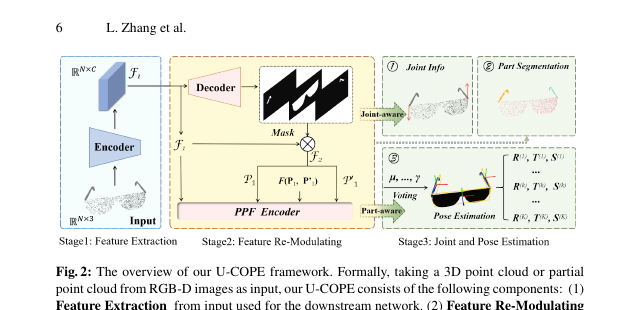
U-COPE treats rigid objects as articulated objects with K=1. PointNet++, part-mask feature remodulation, and within-part PPF voting jointly predict joints, segmentation, and per-part 9D poses. CAMERA25 3D75+5° is 57.3. ArtImage uses 20K point pairs by default at around 1.4–2.1 s; real ReArtMix / RobotArm results are qualitative only.
cropped partial point cloudRGB-D projected to point cloud
Requirements
known object categorypredefined part count and joint topologyobject-level crop or detectionvalid depth and camera intrinsicspart / joint / per-part pose supervision20,000 point pairs by default
Full paper metadataAuthors, affiliations, research area, datasets, metrics, method tags, and reading statusExpandCollapse
Authors
Li Zhang, Weiqing Meng, Yan Zhong, Bin Kong, Mingliang Xu, Jianming Du, Xue Wang, Rujing Wang, Liu Liu
Affiliations
Hefei Institutes of Physical Science, Chinese Academy of Sciences / University of Science and Technology of China / Anhui University / Peking University / Astribot / Hefei University of Technology
known object categorypredefined part count and joint topologyobject-level crop or detectionvalid depth and camera intrinsicspart / joint / per-part pose supervision20,000 point pairs by default
Reading Notes
Overview / Deep Dive
Available src/paper-notes/u-cope-eccv2024/coarse.md
Paper overview notes
Quickly assess the paper's scope, problem setting, core method, experimental findings, and whether to read it in depth.
Overview Notes: U-COPE
1. Basic information
Title: U-COPE: Taking a Further Step to Universal 9D Category-level Object Pose Estimation
Authors: Li Zhang, Weiqing Meng, Yan Zhong, Bin Kong, Mingliang Xu, Jianming Du, Xue Wang, Rujing Wang, Liu Liu
Affiliations: Hefei Institutes of Physical Science, Chinese Academy of Sciences; University of Science and Technology of China; Anhui University; Peking University; Astribot; Hefei University of Technology
U-COPE treats rigid objects as the special articulated case K=1 and general articulated objects as K rigid parts with K−1 joints. From a cropped partial cloud of 2,048 points, it jointly predicts part masks and joint pivots / directions, then lets within-part point-pair features vote for center, orientation, and scale parameters, yielding per-part 9D category poses for unseen instances.
3. Guide to figures and tables
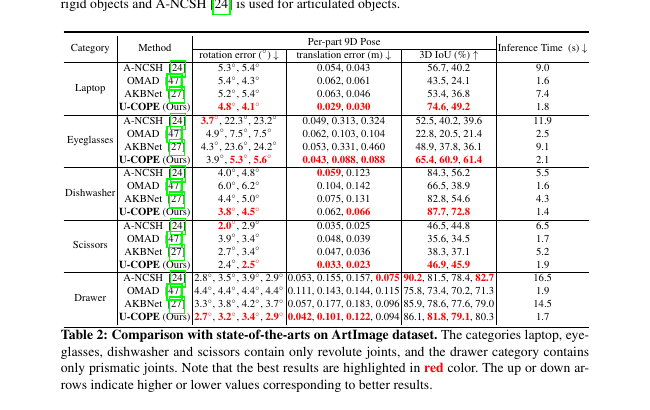
Original Figure 2: a part-mask decoder remodulates PointNet++ features, which work with a PPF encoder in joint, part-segmentation, and per-part 9D pose branches. Rigid objects disable the joint / part branches. Source: published ECVA paper. Image copyright belongs to the authors and Springer Nature; reproduced here for paper analysis.Original Table 2: per-part rotation / translation / 3D IoU and whole-object inference time for laptop, eyeglasses, dishwasher, scissors, and drawer. U-COPE does not outperform A-NCSH on every drawer IoU. Source: published ECVA paper. Table copyright belongs to the authors and Springer Nature; reproduced here for paper analysis.
4. Problem setting
Input: a single-object partial point cloud already cropped from a scene; RGB-D is first cropped and back-projected into a cloud.
Objects: unseen instances of known categories; no test CAD model is required.
Unified formulation: K=1 for rigid objects and K≥2 for articulated objects.
Outputs: joint pivots / axes, per-point part segmentation, and each part’s rotation, translation, and amodal 3D size.
This is category-level 9D pose, rather than BOP-style known-CAD SE(3) or simultaneous detection from a full RGB-D scene.
5. Method overview
PointNet++ extracts point features from 2,048 points.
A decoder predicts K part masks; their Hadamard product with the original features produces part-conditioned features.
The joint branch uses a heatmap to locate joint-neighborhood points, offsets to recover pivots, and regression for joint directions.
A PPF encoder encodes within-part point pairs to avoid geometric contamination across parts.
Translation uses center-parameter voting; rotation uses orientation voting for two object axes.
Scale uses voting for log residuals relative to category-average size.
Joint / part awareness scores filter points unrelated to a joint and cross-part pairs during inference.
Drawer: U-COPE improves rotation, while A-NCSH has higher 3D IoU on some parts; it cannot be called best on every metric.
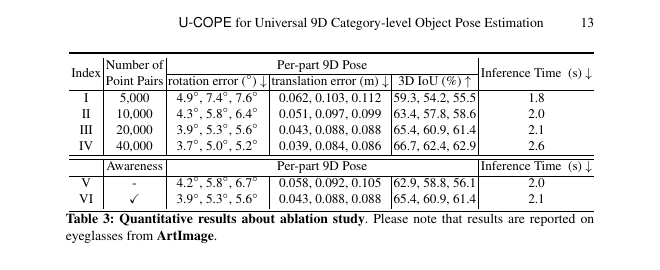
The default is 20,000 point pairs, with about 2.1 s inference for eyeglasses; 40,000 pairs are slightly more accurate but take 2.6 s.
ReArtMix and RobotArm provide only qualitative real-world generalization figures, without a common quantitative table.
7. Quick assessment
Strengths: one formulation covers rigid / articulated objects; per-part pose, joints, and segmentation constrain one another; voting is more interpretable than direct regression.
Limitations: requires a precropped object cloud and known part count / topology; main results use synthetic CAMERA25 / ArtImage; real experiments are qualitative; latency is around 1–2 seconds.
Suggested readers: researchers in category-level 9D pose, articulated objects, point-pair features, part segmentation, and parameter voting.
Available src/paper-notes/u-cope-eccv2024/deep.md
In-depth paper notes
Support reproduction, comparison, related-work writing, and identifying opportunities for further research.
Deep Reading Notes: U-COPE
1. Key assessment
“Universal” in U-COPE means a unified rigid and articulated category-level pose formulation, rather than open vocabulary, arbitrary topology, or arbitrary sensors. Its central abstraction is:
object={K rigid parts,K−1 joints},
A rigid object is simply the degenerate K=1 case. The network can therefore jointly output:
Joint pivots and directions;
K-way part segmentation;
R(k),t(k),s(k) for each part.
This abstraction reduces the need for two separate pipelines but still requires category-specific part counts, joint relationships, and training supervision. A more precise description is a shared architecture across predefined rigid / articulated categories.
2. Inputs and supervision boundaries
The problem takes P∈RN×3 as input; test-object CAD is unknown, but the category is known. If the original input is RGB-D:
Obtain the object region through cropping / detection;
Back-project depth using intrinsics;
Sample a 2,048-point object cloud.
The model does not detect objects in a full RGB-D image. CAMERA25 AP also uses detection boxes provided in prior work. Training supervision includes:
per-point part labels;
joint pivot / direction;
Each part’s rotation / translation / 3D size;
Known category topology and part count.
“Unseen instance” means only that the test shape was absent from training, rather than an unknown category or joint structure.
3. Network: segment parts before within-part PPF
Original Figure 2. Shared point features \(F_1\) predict part masks and are multiplied by each mask to obtain part-conditioned \(F_2\); the PPF encoder ultimately predicts pose-voting parameters for within-part point pairs. Source: published ECVA paper. Image copyright belongs to the authors and Springer Nature; reproduced here for paper analysis.
PointNet++ outputs F1∈RN×C. The decoder produces mk∈RN×1, followed by:
F2(k)=F1⊙mk.
Feature remodulation serves two purposes:
Part segmentation explicitly restricts each pose branch’s support region;
PPF no longer incorrectly combines points from two moving parts into a rigid pair.
It also creates cascading risks: incorrect mask boundaries or too few points on an occluded part affect downstream joints and poses. The paper explicitly acknowledges incomplete / noisy part clouds caused by inaccurate segmentation.
4. Joint prediction
A joint ϕ=(q,u) is represented by a pivot line and axis direction. Each point predicts:
Heatmap Hi: probability of being a joint-neighborhood candidate;
Offset Oi: pointing toward the joint line;
Direction u^i;
Joint-awareness score: whether the point belongs to a part connected to this joint.
The pivot loss does not require a unique endpoint; it measures the perpendicular distance from a predicted point to the GT joint axis:
Lpvt=∥(p^−q)×u∥2,Ldir=∥u^−u∥2.
This better matches revolute / prismatic axis geometry. Inference aggregates only points whose awareness and heatmap both exceed 0.5. For a rigid object with K=1, the entire joint branch is disabled.
5. 9D pose voting
The authors replace direct R,t,s regression with point-pair parameters:
Pair-relative distances / angles generate center candidates for voting;
Orientation uses SO(3)-invariant angular parameters for right / up axes; two object axes determine rotation;
Scale regresses a log residual relative to the category-average box sˉ:
γ=logs−logsˉ,s^=exp(γtotal)⊙sˉ.
A part-awareness classifier retains only point pairs from the same part. PPF is therefore not inherently articulated-object aware: learned segmentation / awareness decomposes the object back into local rigid parts.
6. CAMERA25: rigid-object results of the unified framework
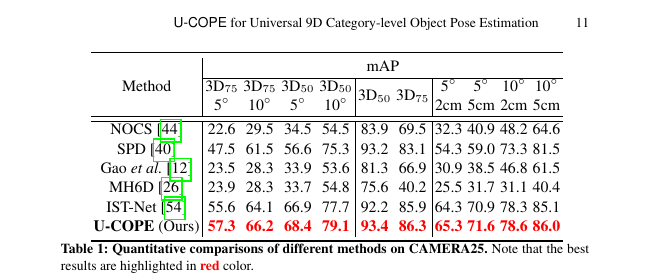
Original Table 1. CAMERA25 is a synthetic NOCS benchmark. U-COPE gains 0.4–1.7 points over IST-Net on the five metrics selected below, while two other joint-threshold metrics in the full table decline. Comparing only with the older NOCS baseline exaggerates the gain. Source: published ECVA paper. Table copyright belongs to the authors and Springer Nature; reproduced here for paper analysis.
Method
3D75+5°
3D50
3D75
5°2cm
10°5cm
NOCS
22.6
83.9
69.5
32.3
64.6
IST-Net
55.6
92.2
85.9
64.3
85.1
U-COPE
57.3
93.4
86.3
65.3
86.0
Against the strong nearby baseline IST-Net, U-COPE improves modestly on the five listed metrics. In the full table, however, 3D75+10° is 66.2 versus 66.9 and 3D50+5° is 68.4 versus 69.9, both regressions. The paper emphasizes large gains such as +34.7 over NOCS, which is a less fair measure of the actual advance in 2024.
7. ArtImage: per-part results and speed
Original Table 2. Each comma-separated value corresponds to one part; the best number cannot be treated as a single error for the whole category. Source: published ECVA paper. Table copyright belongs to the authors and Springer Nature; reproduced here for paper analysis.
U-COPE generally leads on rotation and translation, but drawer IoU for parts 1 / 3 / 4 is 86.1 / 79.1 / 80.3, versus A-NCSH’s 90.2 / 78.4 / 82.7: lower on parts 1 and 4, higher on part 3, so part-level outcomes are mixed. Whole-object inference takes 1.4–2.1 s, far from real time.
8. Point-pair count and awareness ablations
Original Table 3, ArtImage eyeglasses. Accuracy keeps improving from 5K→40K pairs, while time rises from 1.8 s to 2.6 s; the authors use 20K by default. Source: published ECVA paper. Table copyright belongs to the authors and Springer Nature; reproduced here for paper analysis.
Point pairs
Rotation (3 parts)
IoU (3 parts)
Time
5K
4.9 / 7.4 / 7.6
59.3 / 54.2 / 55.5
1.8 s
20K
3.9 / 5.3 / 5.6
65.4 / 60.9 / 61.4
2.1 s
40K
3.7 / 5.0 / 5.2
66.7 / 62.4 / 62.9
2.6 s
20K trades speed for accuracy rather than reaching saturation. Adding joint / part awareness improves third-part rotation from 6.7→5.6 and IoU from 56.1→61.4, supporting cross-part pairs as a major noise source.
9. Limits of the real-world generalization evidence
ReArtMix and RobotArm show only qualitative overlays, without:
The main SOTA evidence therefore remains synthetic CAMERA25 / ArtImage. The paper shows that the model can work on some real examples, which does not establish reliable sim-to-real transfer.
10. Limitations
Upstream object-crop / depth errors are not included;
Categories, part counts, and joint topology are predefined;
Unseen instances are not unseen categories;
Part-segmentation errors contaminate all downstream branches;
PPF sampling of 20K pairs causes second-scale inference;
Rigid / articulated objects use separate datasets, without a unified mixed-scene evaluation;
ReArtMix / RobotArm evidence is qualitative;
Symmetry handling and equivalent rotations are insufficiently explained;
Dynamic video, temporal consistency, and multiple sensors are not validated;
No dedicated public code was verified.
11. Reproduction checklist
Fix object crops, depth back-projection, and 2,048-point sampling;
Record K, part order, joint graph, and canonical frames for each category;
Reproduce part-mask and joint-heatmap / offset / direction supervision;
Train pose parameters only on within-part pairs;
Report accuracy and latency separately for 5K / 10K / 20K / 40K pairs;
Use identical detection boxes and metric implementations on CAMERA25;
Report ArtImage results in part order rather than only category averages;
Add quantitative real-data metrics;
Include detection, cloud preprocessing, and network time in end-to-end timing;
Test robustness to segmentation corruption, missing depth, and unknown topology.
12. Overall assessment
U-COPE’s most useful contribution is its task abstraction: rigid objects become single-part articulated objects, while part segmentation, joints, and pose jointly constrain point-pair voting. CAMERA25 gains over IST-Net on the selected metrics and clear improvements for moving parts on ArtImage demonstrate the feasibility of this unified structure.
“Universal” cannot extend to open categories or unknown topology. U-COPE relies on cropped clouds and predefined part / joint semantics; real-world generalization is qualitative, and 20K pairs take about 2 s. This is a valuable unified-modeling paper, rather than a real-time system with general deployment capabilities.