Uncertainty-Aware Knowledge Distillation for Compact and Efficient 6DoF Pose Estimation
The method estimates epistemic uncertainty from 2D keypoint variance across 4–6 independent teachers, reducing distillation mass for unstable teacher points in unbalanced optimal transport. PFKD reuses the transport plan to align corresponding keypoint feature receptive fields, compressing WDRNet / SPNv2 to 2.3–3.8M parameters while improving LINEMOD and SPEED+ pose results.
The paper estimates epistemic uncertainty from the variance of 2D keypoint predictions across 4–6 independently trained teachers, reducing unstable teacher points’ mass in unbalanced optimal transport. The same OT plan aligns teacher / student receptive-field features at corresponding keypoints, compressing WDRNet or SPNv2 to 2.3–3.8M parameters.
3. Guide to figures and tables
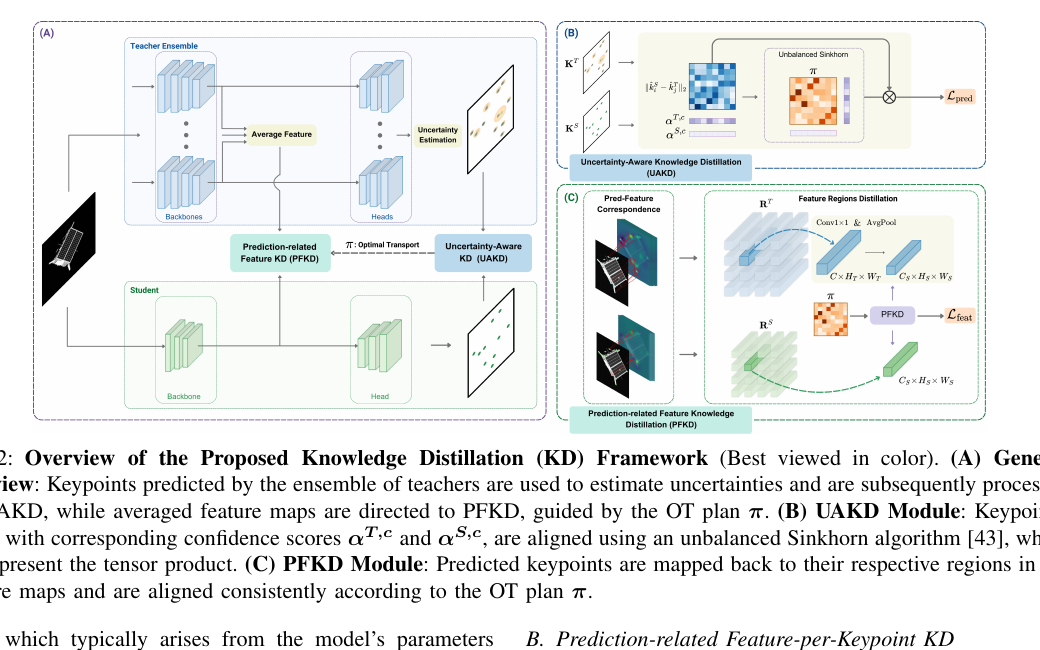
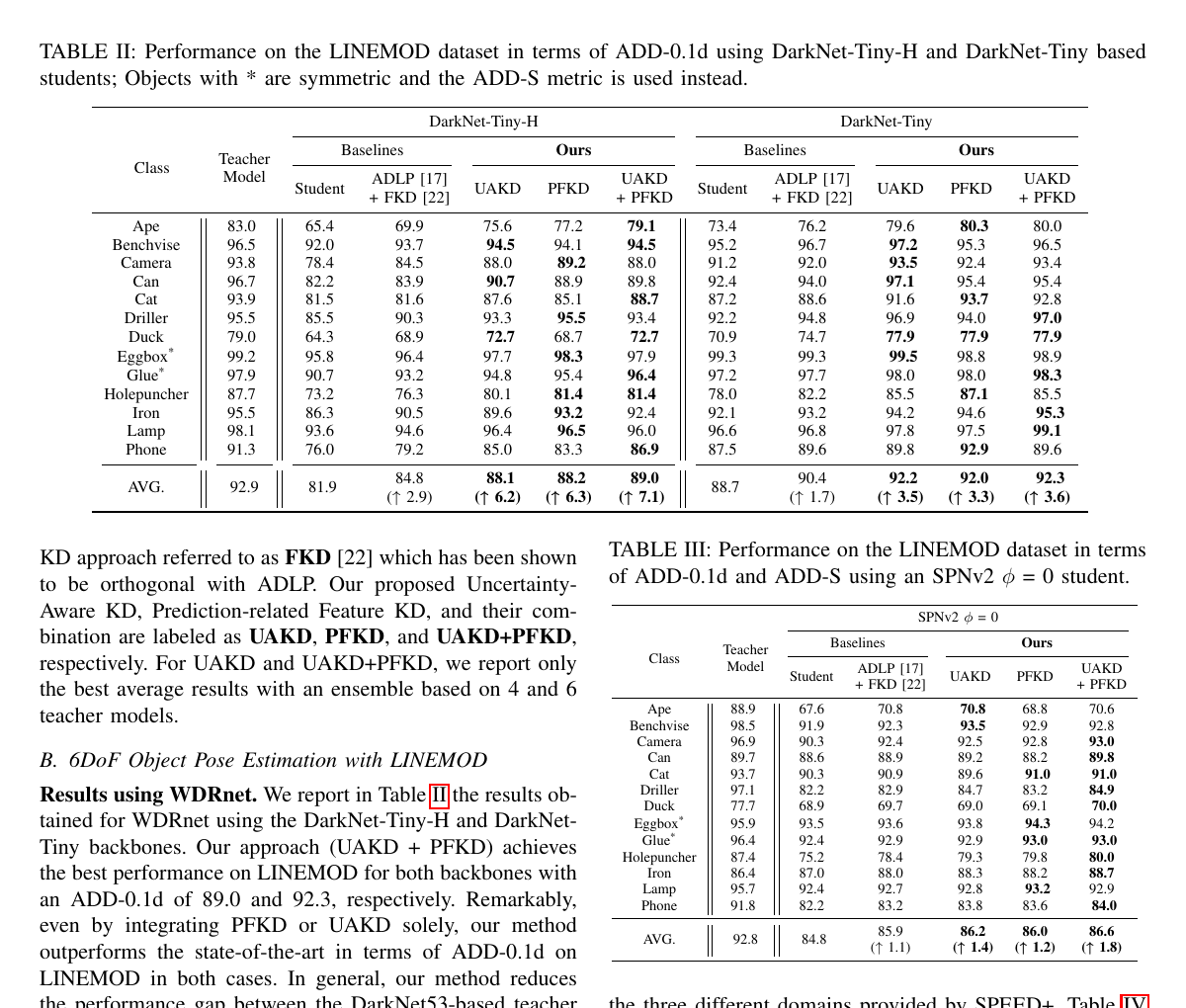
Original Figure 2: a teacher ensemble produces keypoint means, variances, and averaged features. UAKD weights keypoint OT by uncertainty; PFKD reuses the transport plan to align corresponding feature regions. Source: authors' public manuscript. Image copyright belongs to the authors and IEEE; reproduced here for paper analysis.Original Tables II–III: DarkNet-Tiny-H student baseline / UAKD+PFKD is 81.9 / 89.0 ADD(-S)-0.1d; DarkNet-Tiny gives 88.7 / 92.3, and SPNv2 φ=0 gives 84.8 / 86.6. Source: authors' public manuscript. Table copyright belongs to the authors and IEEE; reproduced here for paper analysis.
Base networks: WDRNet or SPNv2 predict 2D keypoints, followed by PnP to recover R,t.
Training: both large teachers and small students retain GT keypoint losses, with additional prediction / feature distillation.
Uncertainty: ensemble keypoint-coordinate variance models parameter uncertainty, rather than single-model confidence or final pose covariance.
Inference: only the student is deployed; 4–6 teachers generate distillation targets during training.
5. Method overview
Independently initialize and train 4–6 teachers to obtain each keypoint’s 2D mean and variance.
Sum x,y variances and map them through tanh to ui∈[0,1]; teacher confidence is 1−ui.
For WDRNet, blend uncertainty confidence and keypoint-existence scores with λ=0.5.
UAKD uses unbalanced Sinkhorn to find an OT plan between teacher / student keypoint sets that may differ in size; uncertain teacher points carry less mass.
Map each keypoint back to its actual receptive field in backbone features using prediction-head kernels and strides.
PFKD reuses the UAKD OT plan for weighted mean-square alignment of corresponding feature regions, keeping prediction-level and feature-level distillation consistent.
WDRNet DarkNet-Tiny: 8.5M / 18.84 GFLOPs; 88.7→92.3, versus a 92.9 teacher.
SPNv2 EfficientDet-D6→D0: 57.8M→3.8M and 288.27→12.1 GFLOPs (95.8% fewer FLOPs; the paper’s text summarizes this as about 96.6%); 84.8→86.6, versus a 92.8 teacher.
Teacher ensembling alone without uncertainty improves DarkNet-Tiny-H / Tiny by only 0.2 / 0.5, so averaging teachers does not explain the main gains.
7. Quick assessment
Highlight: prediction and feature distillation share OT correspondences, with validation on two pose backbones and two datasets.
Avoid overinterpretation: uncertainty estimates teacher keypoint epistemic variance only during training; it does not enter PnP or produce test-time pose confidence intervals.
Main limitations: training 4–6 teachers is costly; only parameters and FLOPs are reported, without real-device latency / FPS / memory; no public code entry point.
Suggested readers: researchers in keypoint + PnP pose, model compression, optimal transport, uncertainty-aware distillation, and spacecraft pose.
Available src/paper-notes/uncertainty-kd-pose-iros2025/deep.md
In-depth paper notes
Support reproduction, comparison, related-work writing, and identifying opportunities for further research.
Deep Reading Notes: Uncertainty-Aware KD
1. Key assessment
This paper questions a common knowledge-distillation assumption: teachers are not equally reliable at every 2D keypoint. Occlusion, weak local texture, or degenerate views may make certain predictions vary substantially with initialization; weighting them like stable points can reinforce incorrect knowledge in the student.
The authors couple two mechanisms:
UAKD converts teacher keypoint variance into confidence mass in OT;
PFKD aligns corresponding receptive fields along UAKD’s keypoint transport plan, rather than independently matching whole feature maps.
The clearest contribution is using the same correspondences to constrain outputs and features. All three LINEMOD students outperform undistilled students and ADLP+FKD, yet the lighter SPNv2 student still trails its teacher by 6.2 points, so distillation does not eliminate the capacity gap.
2. Base pose pipelines and task boundaries
The paper compresses existing two-stage RGB pose estimators, rather than proposing a new PnP solver or pose head:
A network predicts object 2D keypoints from one RGB image;
Known 3D keypoints / bounding-box corners correspond to the 2D predictions;
PnP recovers object rotation and translation relative to the camera.
Two base networks:
WDRNet: DarkNet + FPN outputs local 2D keypoint clusters at multiple scales, with keypoint-existence scores;
SPNv2: an EfficientDet + BiFPN multitask network; only its 2D keypoint-heatmap head is distilled here.
Student training retains GT keypoint losses. KD supplies additional supervision rather than label-free compression; known-object 3D keypoints, camera intrinsics, and other PnP priors remain required.
3. Estimating teacher uncertainty
Only epistemic uncertainty is estimated: train E=4 or 6 teachers with identical architectures and different initializations. For an input image and keypoint i, collect E 2D predictions:
{k^iTj}j=1E.
Compute the means and variances of x,y separately, use the ensemble mean as the teacher target, and define:
σi2=σx,i2+σy,i2,ui=tanh(σi2).
Teacher uncertainty confidence is:
αT,c=1−u.
If WDRNet also provides existence probability αT,e:
αT=λαT,c+(1−λ)αT,e,
The default is λ=0.5. Multiplication was also tried but performed worse empirically; specific numbers are not given.
Three boundaries matter:
Variance depends on initialization, training randomness, and predicted-coordinate scale;
tanh lacks temperature or scale calibration, so input resolution and coordinate normalization change saturation behavior;
This does not model image-noise aleatoric uncertainty or pose covariance.
If ensemble members predict different numbers of keypoints, majority voting retains alignable points, with uncertainty set to 1 for the rest. This branch is not evaluated separately.
4. UAKD: unbalanced optimal transport
Original Figure 2. Upper right: UAKD aligns teacher / student keypoint distributions. Lower right: PFKD maps points back to feature receptive fields and distills along the same \(\pi\). Source: authors' public manuscript. Image copyright belongs to the authors and IEEE; reproduced here for paper analysis.
With N teacher points and M student points, OT allows N=M. Its cost is 2D Euclidean distance:
Lpred=πmini=1∑Mj=1∑Nπij∥k^iS−k^jT∥2.
Student / teacher confidence controls the row / column marginal masses of π, solved with unbalanced Sinkhorn. Uncertain teacher points have smaller αjT, reducing mass transferred to the student.
The unbalanced formulation matters: strict mass conservation would force unreliable teacher points to distribute all their mass. Sensitivity to Sinkhorn regularization, the unbalanced penalty, and iteration count is not systematically reported, posing a reproduction risk.
5. PFKD: from keypoints to receptive fields
Ordinary feature KD often aligns entire teacher / student maps independently of prediction-level correspondence. PFKD uses the keypoint head’s convolutional structure to map predicted coordinates back to features:
Multiply output coordinates by spatial scale δ and convert to integers for region centers;
Derive region size from the receptive field determined by each head layer’s kernel κl and stride sl;
Align teacher channels to student channels with a 1×1 convolution;
Align spatial dimensions with average pooling.
For teacher region RiT and student region RjS, UAKD’s πij weights feature MSE. Ensemble teacher feature regions are first averaged across models.
Finally:
Ldistill=γpLpred+γfLfeat,γp=5,γf=0.1.
PFKD shares output and feature correspondences, at the cost of assuming a clear spatial mapping in the keypoint head. Backtracking convolutional receptive fields may not apply directly to transformer tokens, global attention, or deformable sampling.
6. Model size: efficiency evidence and gaps
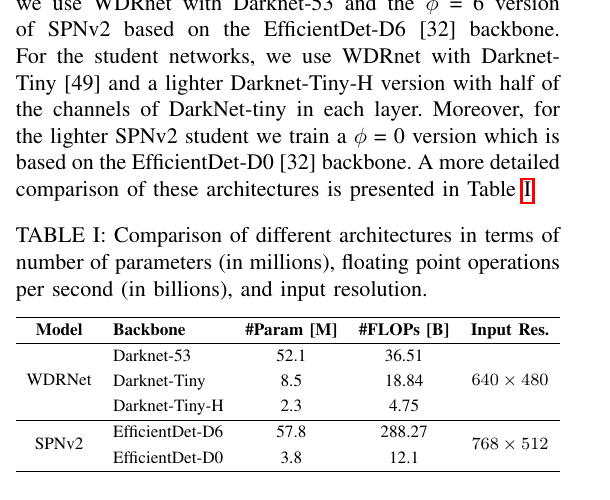
Original Table I: teacher / student backbone parameters, FLOPs, and input resolutions. No measured GPU, CPU, or edge-device latency is reported. Source: authors' public manuscript. Table copyright belongs to the authors and IEEE; reproduced here for paper analysis.
Model
Backbone
Parameters
FLOPs
Input
WDRNet teacher
DarkNet-53
52.1M
36.51B
640×480
WDRNet student
DarkNet-Tiny
8.5M
18.84B
640×480
WDRNet tiny-H
DarkNet-Tiny-H
2.3M
4.75B
640×480
SPNv2 teacher
EfficientDet-D6
57.8M
288.27B
768×512
SPNv2 student
EfficientDet-D0
3.8M
12.1B
768×512
Parameter / FLOP reductions are clear, but real-time / efficient-inference claims lack latency, FPS, peak-memory, or energy evidence. Distillation needs 4–6 full teachers and averaged feature regions, increasing training resources substantially; deployment retains only the student.
7. Main LINEMOD results
Original Tables II–III. Starred objects use ADD-S and the others ADD; the mean is not a strictly uniform symmetry-aware BOP AR. Source: authors' public manuscript. Table copyright belongs to the authors and IEEE; reproduced here for paper analysis.
Mean ADD(-S)-0.1d:
Student
Teacher
Student
ADLP+FKD
UAKD
PFKD
UAKD+PFKD
DarkNet-Tiny-H
92.9
81.9
84.8
88.1
88.2
89.0
DarkNet-Tiny
92.9
88.7
90.4
92.2
92.0
92.3
SPNv2 φ=0
92.8
84.8
85.9
86.2
86.0
86.6
Observations:
Weaker Tiny-H gains more in absolute terms: +7.1, yet still trails its teacher by 3.9;
DarkNet-Tiny nearly matches its teacher: 92.3 versus 92.9;
SPNv2 has the largest remaining student–teacher gap, 6.2 after distillation;
UAKD / PFKD individually exceed the ADLP+FKD mean, supporting both designs;
The combination exceeds the best individual component by only 0.8 / 0.1 / 0.4: complementary, but not linearly additive.
Students exceeding teachers on individual classes may reflect distillation regularization and class variation. No multiseed variance is given, so differences of 0.1–0.5 require caution.
8. SPEED+ cross-domain results
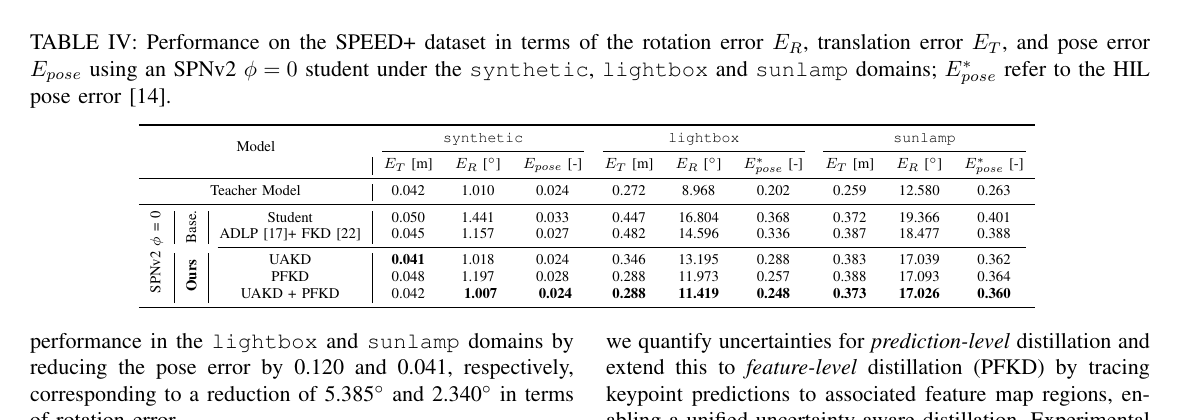
Original Table IV: translation, rotation, and pose errors for synthetic, lightbox, and sunlamp domains; lightbox / sunlamp are hardware-in-the-loop domains. Source: authors' public manuscript. Table copyright belongs to the authors and IEEE; reproduced here for paper analysis.
SPNv2 φ=0:
Method
Synthetic pose
Lightbox HIL pose
Sunlamp HIL pose
Teacher
0.024
0.202
0.263
Student
0.033
0.368
0.401
ADLP+FKD
0.027
0.336
0.388
UAKD
0.024
0.288
0.362
PFKD
0.028
0.257
0.364
UAKD+PFKD
0.024
0.248
0.360
The combination matches the teacher on synthetic data and improves over the student by 0.120 / 0.041 on lightbox / sunlamp, yet trails the teacher by 0.046 / 0.097. PFKD alone gives 0.257 on lightbox, near the combined 0.248, suggesting feature alignment is particularly helpful for synthetic-to-real lighting transfer.
9. Additional analysis
The authors separate ensemble-averaging gains from uncertainty weighting:
Ensemble alone without uncertainty (λ=0): Tiny-H +0.2, Tiny +0.5;
Full UAKD: +6.2 / +3.5, respectively.
This supports weighted distillation as the main source of improvement rather than simply more accurate teacher ensembling.
The λ curve peaks at 0.5, equally weighting uncertainty confidence and WDRNet existence scores. A single curve without calibration metrics, keypoint-level correlations, or pose-error stratification still does not establish ui as a well-calibrated probability.
10. Limitations and reproduction risks
Uncertainty-guided PnP and other compression techniques are future work. Current boundaries:
Uncertainty does not reach PnP; deployment outputs no pose uncertainty;
The ensemble estimates only epistemic variance, without accounting for training costs of 4–6 teachers;
tanh(variance), coordinate scale, ensemble seeds, and member count directly affect weights;
No public code; OT / receptive-field details must be reconstructed from formulas;
Only LINEMOD and single-spacecraft SPEED+ are tested, without harder-occlusion LM-O, YCB-V, or T-LESS;
No detection / crop frontend explanation or end-to-end latency;
LINEMOD uses only ADD(-S)-0.1d, without stricter thresholds, AUC, or BOP AR;
Decimal-scale differences lack multiseed means / variances.
11. Reproduction checklist
Fix every teacher’s data, augmentation, and training configuration, varying only initialization;
State whether keypoint coordinates are pixels or normalized values;
Record the choice of ensemble size 4 / 6 and keypoint majority voting;
Check variance→tanh and existence-score weighting with λ=0.5;
Reproduce unbalanced Sinkhorn entropy regularization, mass penalties, and iteration counts;
Derive feature receptive fields correctly from head kernels / strides;
Distinguish teacher-feature averaging from ensemble-mean keypoints;
Compare all KD baselines with identical PnP and detectors;
Report parameters, FLOPs, GPU / CPU / edge latency, peak memory, and training costs together.
12. Overall assessment
The method trades training cost for compact deployment: teacher disagreement filters keypoint-level knowledge, while prediction and feature distillation share one OT plan. Three student results suggest some cross-architecture applicability. However, uncertainty-aware pose is easily overinterpreted: uncertainty is currently a training-time teacher epistemic signal, while final PnP and deployment remain deterministic.