Reading Notes
Overview / Deep Dive
Available src/paper-notes/unified-detection-pose-iccv2025/coarse.md
Paper overview notes
Quickly assess the paper's scope, problem setting, core method, experimental findings, and whether to read it in depth.
Overview Notes: Unified Category-Level Object Detection and Pose Estimation from RGB Images using 3D Prototypes
1. Basic information
- Year / venue: 2025 / ICCV; reading mode: coarse.
- Task: RGB-only category-level multi-object detection, 6D pose, and 9D pose refinement.
- Original paper: ICCV Open Access.
2. Positioning in one sentence
This work combines detection and single-object pose estimation around neural-mesh 3D prototypes, using shared 2D–3D feature matching to locate objects, estimate poses, and then estimate scale / deformation.
2.1 Guide to the paper’s figures and tables
| Figure / table | What to examine |
|---|---|
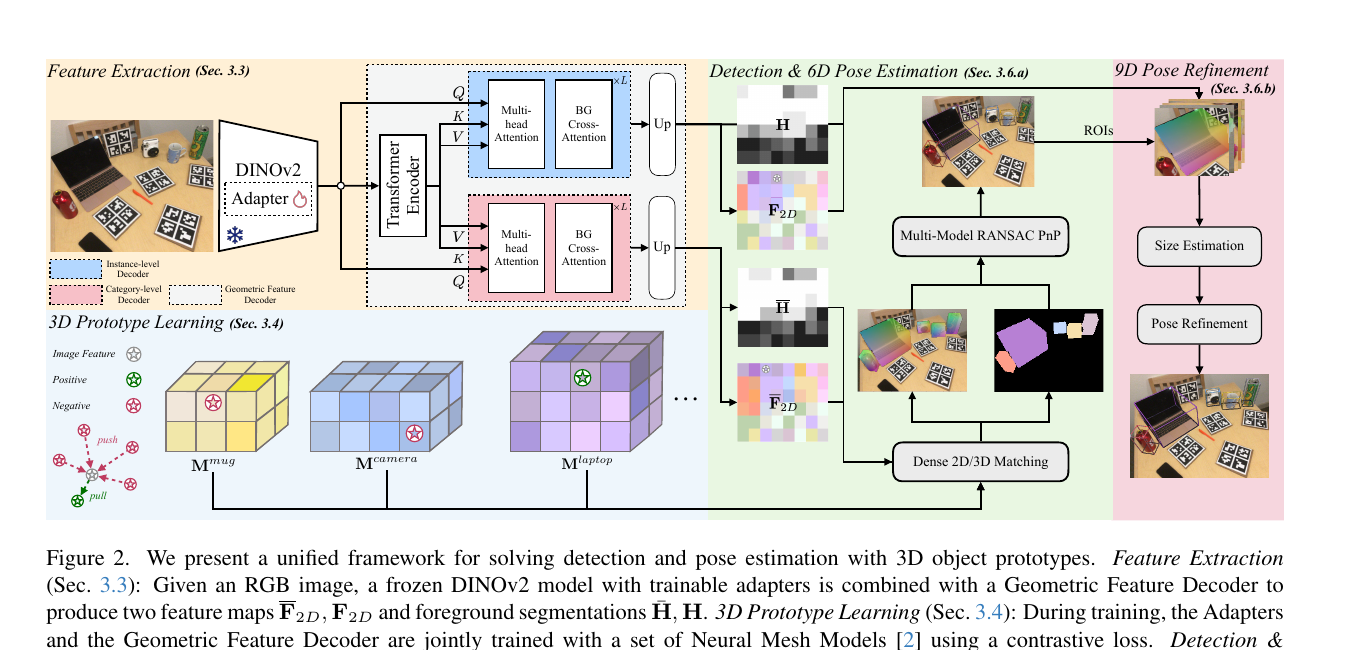
| Figure 2 | Unified DINOv2 features, 3D prototype learning, multi-model RANSAC, and 9D refinement. |
3. Method overview
- Frozen DINOv2 with trainable adapters and a geometric decoder outputs instance-level / category-level feature maps and foreground information.
- Each category’s neural-mesh prototype stores vertices and learned features; dense 2D–3D matches feed multi-model RANSAC-PnP to discover multiple objects and their 6D poses together.
- Deformation / scale is then optimized for each instance to obtain 9D pose. RGB-only operation is a key benefit, with independent-detector errors no longer fixed as an unrecoverable prerequisite.
4. Experimental overview
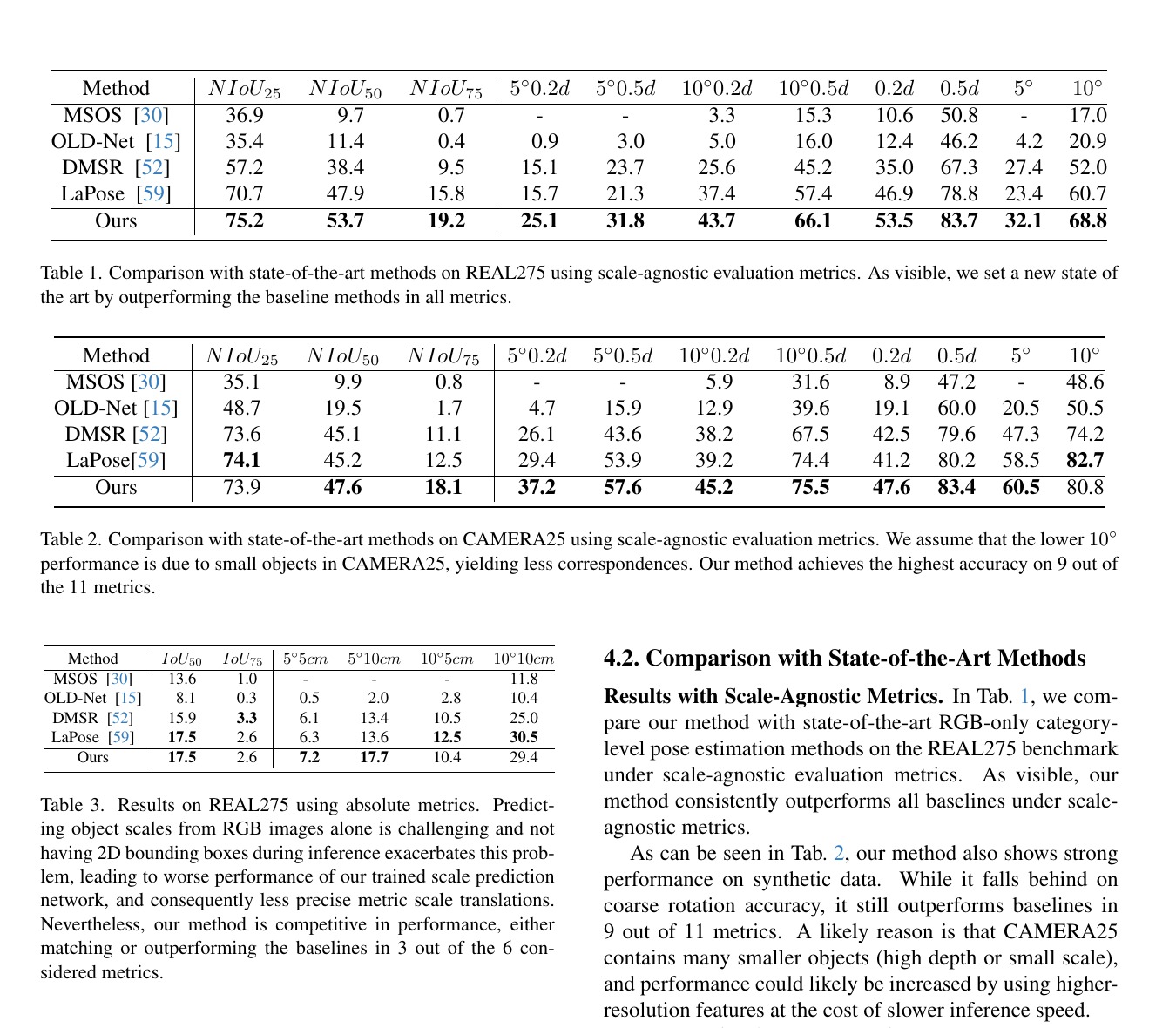
- Datasets: REAL275 and CAMERA25, using category-level scale-agnostic metrics.
- Authors’ claim: mean scale-agnostic performance on REAL275 exceeds the previous SOTA by 22.9%, with greater robustness than a single-stage baseline.
- My assessment: sharing a 3D representation between detection and pose is a strong design; prototype construction, intrinsics, RANSAC multi-instance complexity, and 9D refinement cost still need code-level assessment.
5. Strengths, risks, and insights
- Strength: estimate category-level poses of multiple objects directly from RGB, reducing error propagation between two separate models.
- Risk: categories must still have predefined 3D prototypes; this is not category-agnostic.
- Insight: matchable 3D prototypes can jointly express detection, orientation, and size for category-level pose, rather than assigning each to a separate head.