Unsupervised Learning of Category-Level 3D Pose from Object-Centric Videos
Coarse SfM meshes and DINOv2 surface features align same-category object videos into a canonical frame without pose labels. Learned neural-mesh pixel–vertex correspondences then support single-image rotation estimation by render-and-compare. CO3D alignment Acc30 is 77.0; single-image PASCAL3D+ / ObjectNet3D Acc30 is 69.2 / 52.4, at around 0.22 s per sample.
unlabeled object-centric RGB videos for trainingsingle object-centered RGB image at inference
Requirements
category-specific full-view object videosoff-the-shelf SfM and coarse watertight meshes during trainingfiltered CO3D videos with sufficient viewpoint coveragecategory-level neural mesh and differentiable rendererobject-centered test crops
Full paper metadataAuthors, affiliations, research area, datasets, metrics, method tags, and reading statusExpandCollapse
Authors
Leonhard Sommer, Artur Jesslen, Eddy Ilg, Adam Kortylewski
category-specific full-view object videosoff-the-shelf SfM and coarse watertight meshes during trainingfiltered CO3D videos with sufficient viewpoint coveragecategory-level neural mesh and differentiable rendererobject-centered test crops
Reading Notes
Overview / Deep Dive
Available src/paper-notes/unsupervised-category-pose-cvpr2024/coarse.md
Paper overview notes
Quickly assess the paper's scope, problem setting, core method, experimental findings, and whether to read it in depth.
Overview Notes: Unsupervised Category-Level 3D Pose
1. Basic information
Title: Unsupervised Learning of Category-Level 3D Pose from Object-Centric Videos
Authors: Leonhard Sommer, Artur Jesslen, Eddy Ilg, Adam Kortylewski
Affiliations: University of Freiburg; Saarland University
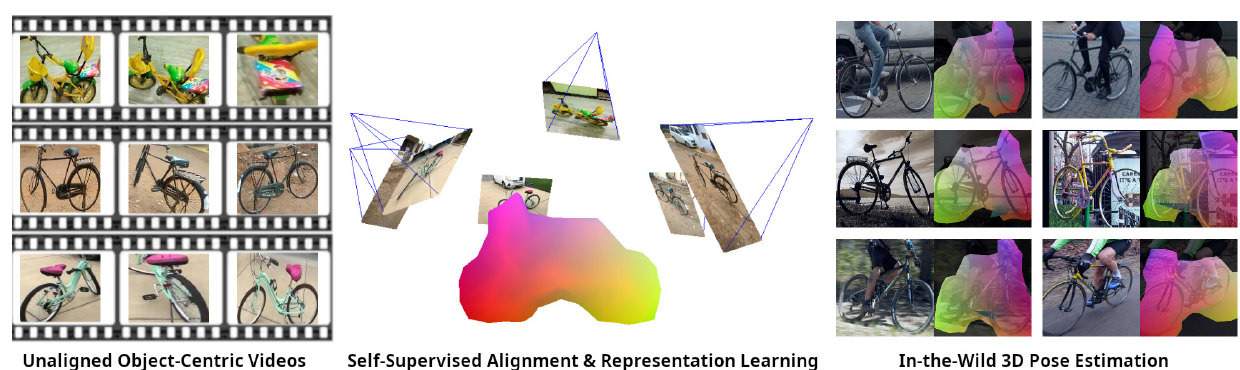
Using unlabeled object-centric videos from one category, this work combines coarse SfM reconstruction, DINOv2 surface features, and 3D cyclic consistency to align instances in a canonical frame. It then learns neural-mesh pixel–vertex correspondences for category-level 3D orientation from a single test RGB image.
3. Guide to figures and tables
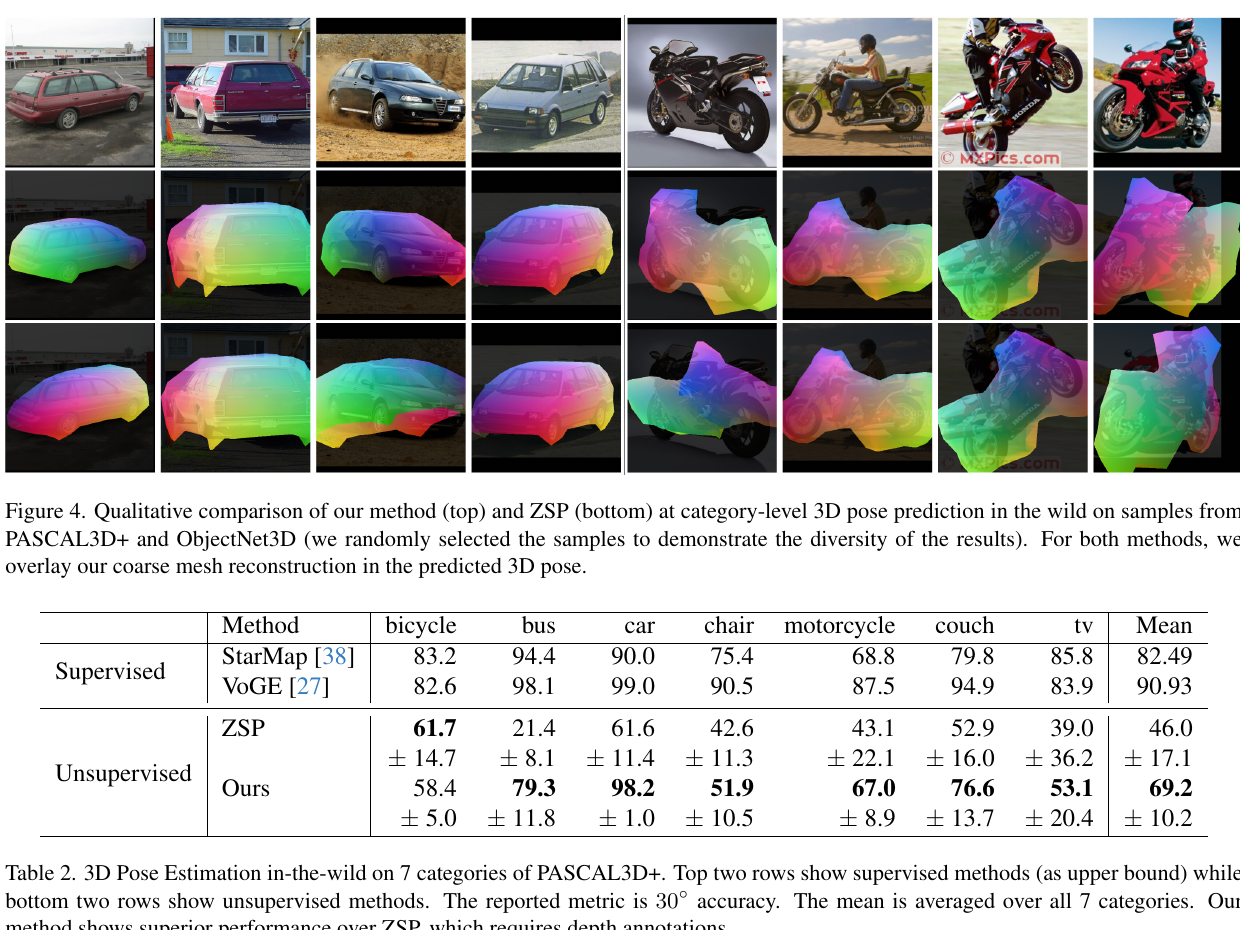
Method diagram from original Figure 1: unaligned object videos on the left; self-supervised appearance / geometry alignment and a category template in the middle; single-image 2D–3D correspondence and 3D pose on the right. Source: published CVPR 2024 paper. Image copyright belongs to the authors and IEEE/CVF; reproduced here for paper analysis.Original Figure 4 and Table 2: on seven PASCAL3D+ categories, the unsupervised model achieves 69.2 Acc30, above ZSP's 46.0 with reference depth / CAD / pose annotations, but below supervised VoGE's 90.93. Source: published CVPR 2024 paper. Image / table copyright belongs to the authors and IEEE/CVF; reproduced here for paper analysis.
4. What unsupervised means here
No manual pose labels, category CAD, or RGB-D as method supervision.
Training uses casually captured object-centric RGB videos.
Off-the-shelf Structure-from-Motion still provides relative camera poses and coarse clouds, cleaned into watertight meshes.
CO3D supplies SfM camera / cloud estimates; GT poses are used only to evaluate alignment, not for training.
Testing needs only one object-centered RGB image, without depth or CAD.
5. Method overview
SfM reconstructs a coarse mesh per video; projecting DINOv2 patches onto visible vertices yields an instance neural mesh.
Choose a random reference video and construct cross-mesh correspondences with geometric and DINOv2 appearance nearest neighbors.
Weight correspondences by 3D cyclical-distance reliability; RANSAC + Umeyama estimates rotation, translation, and scale to align category videos to a canonical frame.
Learn a category neural mesh after alignment, with frozen DINOv2 + 3 ResNet blocks predicting template-vertex features per pixel.
Initialize inference by template matching over predefined poses, then optimize pose using a differentiable renderer.
6. Experiments at a glance
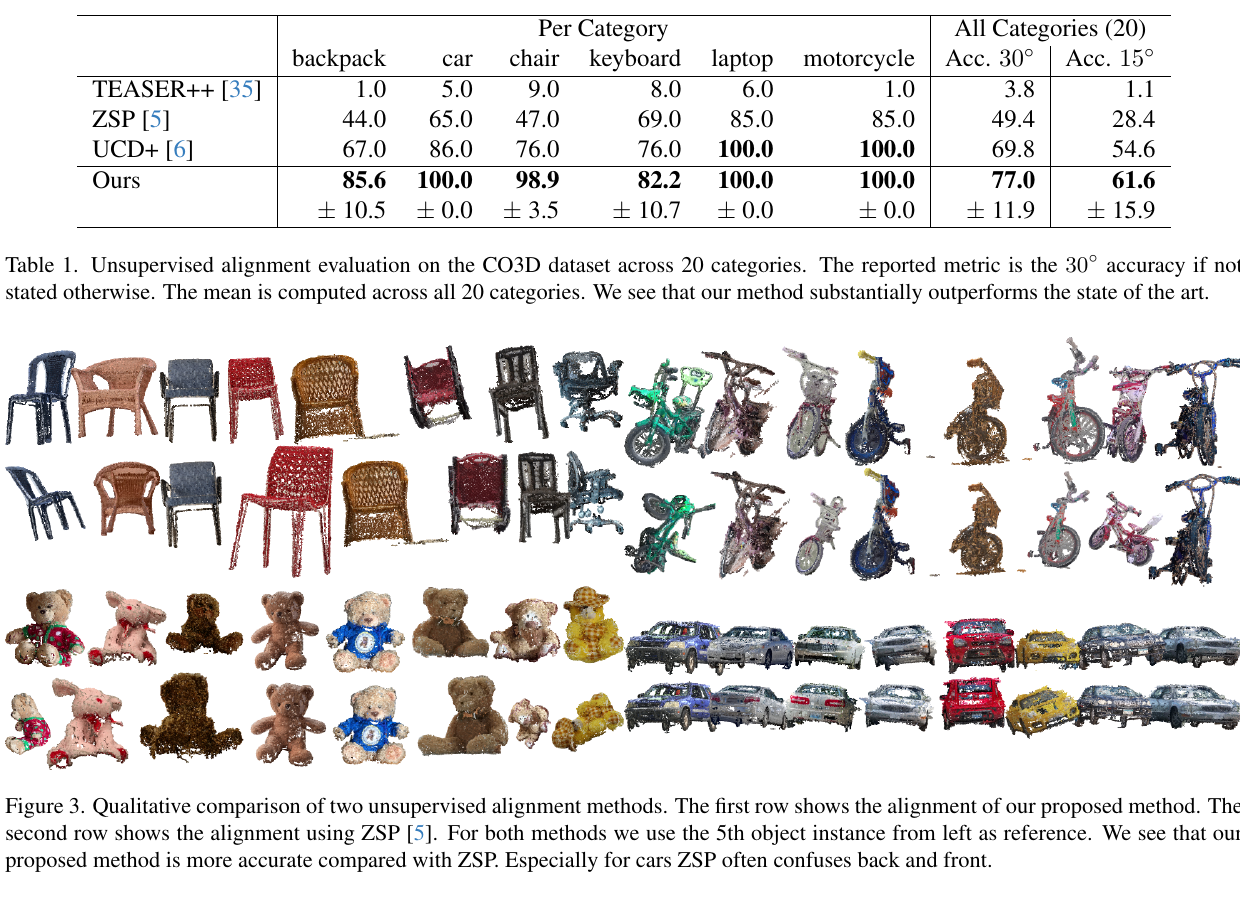
Unsupervised alignment on 20 CO3D categories: Acc30 77.0, Acc15 61.6, versus UCD+‘s 69.8 / 54.6.
Seven PASCAL3D+ categories: Acc30 69.2, versus ZSP 46.0 and supervised VoGE 90.93.
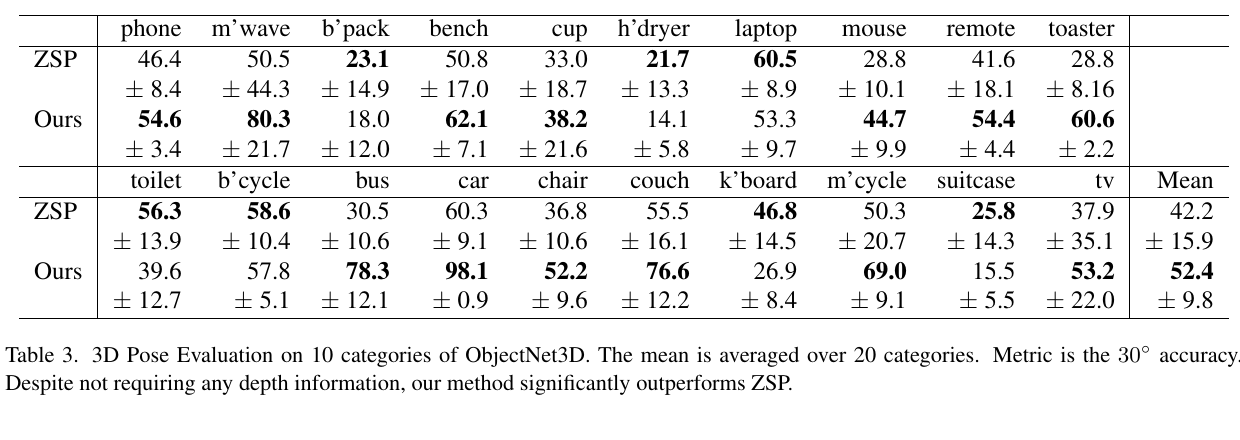
Twenty ObjectNet3D categories: Acc30 52.4, versus ZSP 42.2.
Direct rotation regression gives PASCAL3D+ / ObjectNet3D Acc15 of 25.8 / 16.4, versus 41.3 / 25.5 for neural meshes + render-and-compare.
Inference takes about 0.22 s / sample, versus about 10.92 s for ZSP.
Alignment hyperparameters α=0.2,τ=100; the corresponding ablation peaks at 75.2 Acc30.
7. Quick assessment
Highlight: turn readily captured videos into a canonical category frame, then distill multiview knowledge into a 3D template for single-image inference.
Strongest evidence: CO3D alignment improves Acc30 by +7.2, and PASCAL3D+ improves over ZSP by 23.2.
Limitations: requires full-circuit videos suitable for SfM reconstruction; large within-category topology variation defeats rigid templates and correspondences.
Suggested readers: researchers in low-label category pose, object-centric video, self-supervised canonicalization, DINOv2 correspondences, and neural-mesh render-and-compare.
Available src/paper-notes/unsupervised-category-pose-cvpr2024/deep.md
In-depth paper notes
Support reproduction, comparison, related-work writing, and identifying opportunities for further research.
Deep Reading Notes: Unsupervised Category-Level 3D Pose from Object-Centric Videos
1. Key assessment
The paper addresses missing canonical frames, beyond training a regressor without pose labels. Each video in a category has its own SfM coordinates; without aligning them, a model cannot know which direction means bicycle forward across videos.
The authors divide the problem into:
Instance neural-mesh alignment: combine geometry, DINOv2 appearance, and 3D cycle consistency to align coarse category reconstructions in a canonical frame;
Category neural-mesh learning: learn viewpoint-invariant surface embeddings in that frame;
Single-image pose fitting: initialize with template matching at test time, then optimize rotation through render-and-compare.
The main boundary is that unsupervised does not remove geometric tools. Training still needs SfM, full-circuit videos, coarse meshes, and differentiable rendering, while avoiding manual poses, category CAD, and depth sensors.
2. Data flow and supervision sources
Method region of original Figure 1. Multiview training videos provide SfM geometry and viewpoint coverage; after alignment, this knowledge enters a category neural mesh and single-image correspondence network. Source: published CVPR 2024 paper. Image copyright belongs to the authors and IEEE/CVF; reproduced here for paper analysis.
Training material:
Multiple object-centric RGB videos within one category;
Relative camera poses and coarse clouds per video from off-the-shelf SfM;
Cloud cleaning and watertight-mesh reconstruction;
Image patch features from frozen DINOv2.
Not used:
Manual pose labels;
Category or instance CAD;
RGB-D camera;
PASCAL3D+ / ObjectNet3D pose labels for training.
CO3D GT alignment follows the ZSP evaluation protocol and only measures Acc30 / Acc15. Rule-based filtering of failed SfM and poor viewpoint coverage remains necessary, so data selection is an important engineering prior.
3. Neural-mesh representation
A neural mesh is written as:
S={V,F},V={vi∈R3},F={{fik∈RD}k=1∣Fi∣}.
Each vertex may store several features because DINOv2 appearance varies by viewpoint. In the first training stage, mesh vertices project into each frame’s DINOv2 map and aggregate visible patch features at the vertex, retaining view-dependent appearance better than a simple average.
The second-stage category neural mesh learns viewpoint-invariant vertex features: the same canonical surface location should map to the same vertex prototype from any view, enabling stable single-image 2D–3D correspondences.
4. Self-supervised cross-instance alignment
Given source neural mesh S=(V,F) and reference Sˉ=(Vˉ,Fˉ), estimate similarity transform T containing rotation, translation, and scale. The basic objective combines:
TminDgeo(V,Vˉ)+Dapp(S,Sˉ).
The geometry term uses bidirectional Chamfer-like nearest-neighbor distances; the appearance term finds cross-mesh matches through DINOv2 feature nearest neighbors. Geometry alone suffers from topology variation and symmetry, while appearance alone suffers from patch ambiguity and reconstruction noise.
4.1 3D cyclic distance
If source vertex vi has feature nearest neighbor vˉj, and matching back from vˉj returns source vertex vi′:
dcycle(vi,fi)=∥vi−vi′∥2.
Returning to the starting point indicates more reliable correspondence. A softmax temperature τ converts cycle distances to weights so stable matches dominate Umeyama fitting, rather than forcing erroneous topologies into one-to-one matches.
The final distance is:
L(S,Sˉ)=(1−α)Dgeo\*+αDapp\*.
With α=0.2,τ=100, geometry has about four times the appearance weight, while more correspondences contribute. RANSAC randomly samples four source vertices and their feature correspondences, then fits a similarity transform with Umeyama.
5. From aligned videos to single-image pose
Aligned videos share one canonical frame. The model learns vMF compatibility between image features fi and template-vertex features fr, with background prototype β. Training classifies both foreground vertices and background.
Implementation:
DINOv2 ViT-S/14, 21M parameters;
A 448×448 input yields 32×32×384 features;
Freeze DINOv2 and add three ResNet blocks in stage two;
Final dense features are 64×64×128;
Adam, 10 epochs;
Less than one hour per category on RTX 2080.
Inference enumerates predefined camera poses, chooses initialization by render-and-compare joint likelihood, then updates pose iteratively through differentiable rendering. Foreground pixels may be explained by background features to reduce clutter interference.
6. CO3D alignment results
Original Table 1 and Figure 3: top, mean alignment accuracy over 20 categories; bottom, instance-mesh alignment against ZSP, whose typical error is front–back car confusion. Source: published CVPR 2024 paper. Image / table copyright belongs to the authors and IEEE/CVF; reproduced here for paper analysis.
Method
Acc30
Acc15
TEASER++
3.8
1.1
ZSP
49.4
28.4
UCD+
69.8
54.6
This method
77.0
61.6
Five reference videos are sampled per category; reported means and standard deviations vary across references. Acc30 standard deviation is 11.9, so the canonical frame still depends substantially on reference choice. Laptop and motorcycle reaching 100% does not mean all 20 categories saturate; the six displayed categories are only a subset.
7. In-the-wild single-image results
Original Figure 4 and Table 2: colored coarse meshes overlay PASCAL3D+ / ObjectNet3D images at predicted rotations; seven-category mean PASCAL3D+ Acc30 is 69.2. Source: published CVPR 2024 paper. Image / table copyright belongs to the authors and IEEE/CVF; reproduced here for paper analysis.
Seven PASCAL3D+ categories:
Method
Supervision
Acc30
StarMap
pose labels
82.49
VoGE
pose labels
90.93
ZSP
reference depth / CAD / pose
46.0
This method
No manual pose supervision
69.2
Bicycle scores 58.4, slightly below ZSP’s 61.7, while bus reaches 79.3 versus 21.4 and car 98.2 versus 61.6. Means hide category differences: stable-topology, well-represented car / couch categories perform better, while variable categories such as chair are harder.
Twenty ObjectNet3D categories:
Main body of original Table 3: twenty-category mean ObjectNet3D Acc30 is 52.4 versus ZSP's 42.2. Toilet, backpack, hairdryer, and some other categories do not favor this method, indicating remaining video-count and topology bottlenecks. Source: published CVPR 2024 paper. Table copyright belongs to the authors and IEEE/CVF; reproduced here for paper analysis.
Dataset
ZSP Acc30
This method Acc30
This method Acc15
PASCAL3D+
46.0
69.2
41.3
ObjectNet3D
42.2
52.4
25.5
Inference takes 0.22 s / sample versus ZSP’s 10.92 s. Learned category templates replace multireference image matching, but 0.22 s still includes initialization and differentiable pose optimization rather than one regression pass.
8. Why not direct rotation regression?
The paper compares direct 6D rotation-representation regression with the same backbone:
Data
Direct regression Acc30 / Acc15
Neural mesh Acc30 / Acc15
PASCAL3D+
66.0 / 25.8
69.2 / 41.3
ObjectNet3D
44.5 / 16.4
52.4 / 25.5
Larger Acc15 than Acc30 gains suggest explicit surface correspondences and render-and-compare particularly help fine angles. Direct regression can collapse symmetry and within-category variation into average directions.
9. Data filtering and reproducibility
CO3D contains about 1.5M frames, 50 categories, and 19k scenes, but not every original video is suitable:
Too little viewpoint change causes SfM failure;
Cameras do not circle the object center;
Views are too close to capture whole-object geometry.
The target is 50 videos per category, but remote has only 17, mouse 15, TV 16, and toilet 7. Uneven category data is directly linked to lower ObjectNet3D scores. Filtering, mesh cleaning, reference videos, and object centering may matter more for reproduction than network hyperparameters.
10. Limitations
Rigid category templates struggle with large topology changes such as chairs or deformable objects.
Near-360° videos and usable SfM are required; transparent, reflective, and weak-texture objects are hard to reconstruct.
Random references define canonical orientation, allowing semantic-direction drift across a category.
Testing assumes object-centered crops, without evaluating detection / segmentation.
Still below fully supervised methods, especially on strict Acc15.
The main paper provides no official code link, increasing reproduction cost relative to open-source methods.
11. Overall assessment
The useful principle is align training-data frames before learning pose. Many unsupervised-pose approaches design equivariance losses without addressing incompatible canonical frames across videos; this work explicitly bridges them using SfM geometry, DINOv2 appearance, and cycle consistency.
Acquisition and reconstruction costs remain, but ordinary RGB videos replace expensive manual pose annotations and CAD. This is practical for new categories with available full-circuit videos but difficult pose labeling. Single-image training, large topology variations, or unreliable SfM still call for weaker supervision or generative 3D priors.