Reading Notes
Overview / Deep Dive
Paper overview notes
Quickly assess the paper's scope, problem setting, core method, experimental findings, and whether to read it in depth.
Overview Notes: You Only Estimate Once
1. Basic information
- Full title: You Only Estimate Once: Unified, One-Stage, Real-Time Category-Level Articulated Object 6D Pose Estimation for Robotic Grasping
- Abbreviation: YOEO
- Venue: ICRA 2025
- Paper: arXiv:2506.05719
- Project: YOEO
2. Positioning in one sentence
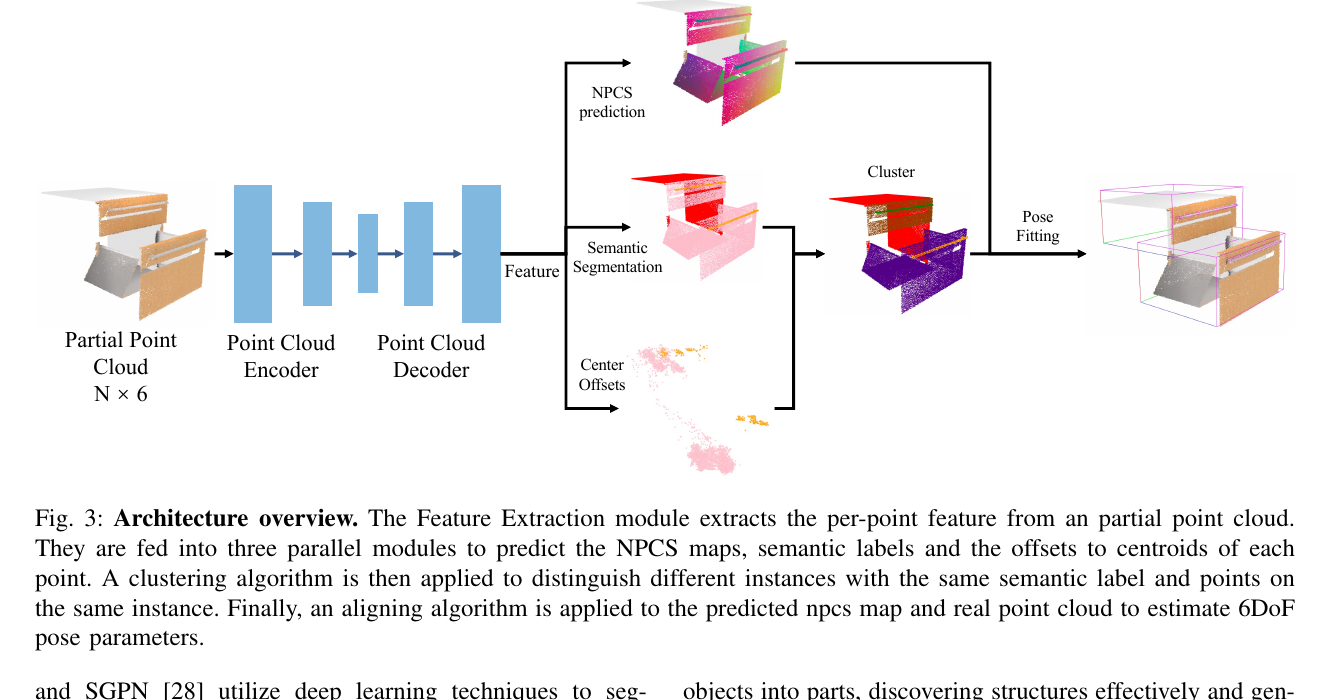
One RandLA-Net-style point-cloud network jointly predicts part semantics, centroid offsets, and NPCS. Clustering separates same-category part instances; RANSAC + Umeyama then recovers each movable part’s rotation, translation, and scale.
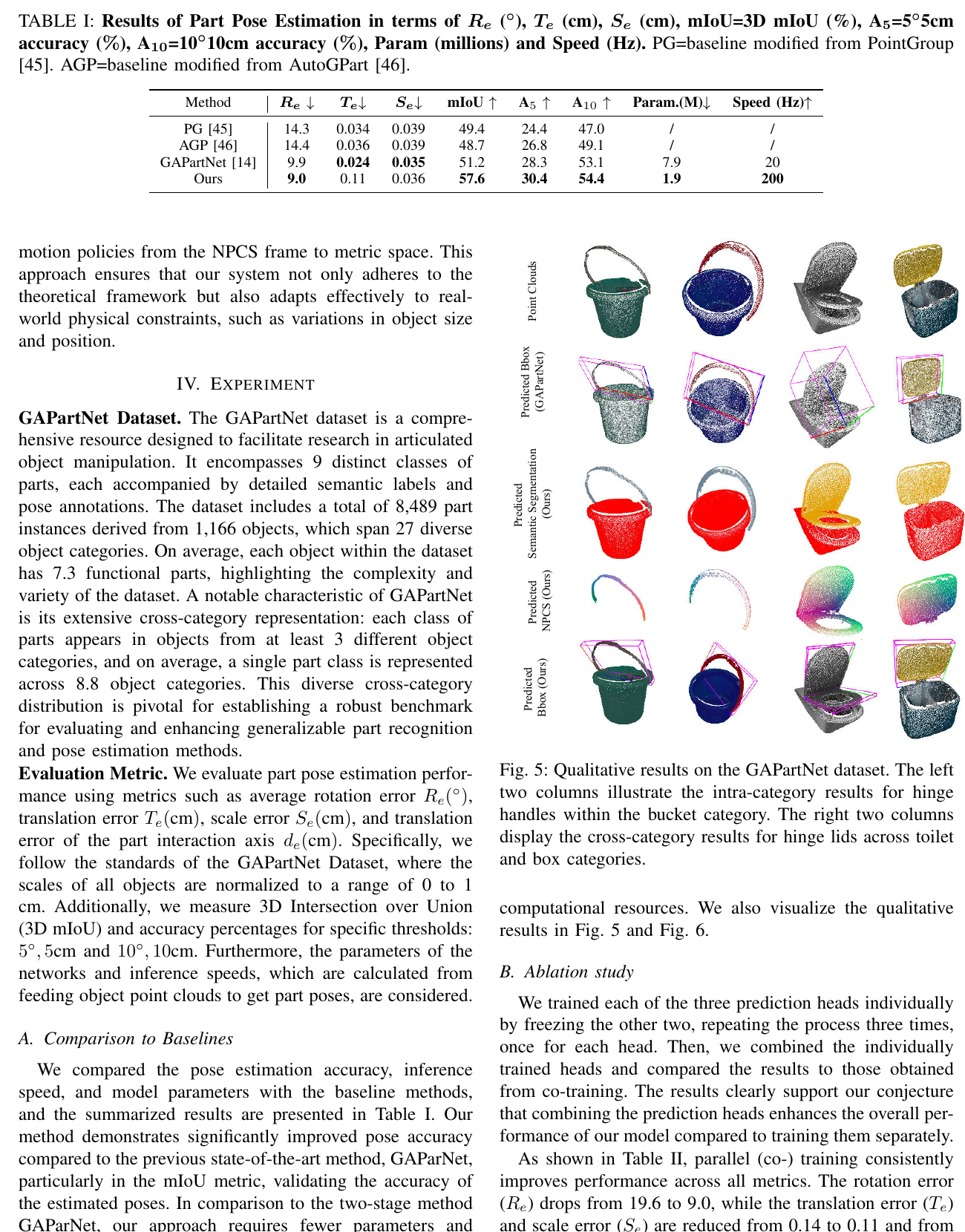
2.1 Guide to the paper’s figures and tables
3. Task setting
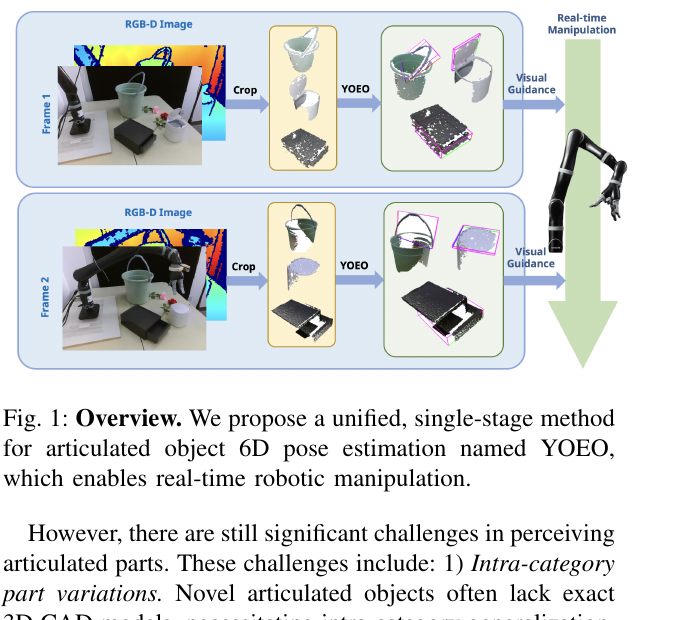
- Input: a single-frame partial cloud already cropped to an object; raw scenes additionally need object detection / selection and depth back-projection.
- Output: each functional part’s category, instance mask, 6D pose, and scale.
- Dataset: GAPartNet, with 1166 objects, 8489 part instances, 27 object categories, and 9 part classes.
- Target: manipulation of unseen articulated-object instances, beyond whole-object rigid pose.
4. Method pipeline
- A cloud network predicts per-point part semantics.
- Each point regresses an offset to its part-instance center.
- Offset voting / clustering separates multiple instances of the same part class.
- Each point predicts its canonical NPCS coordinate.
- RANSAC rejects erroneous correspondences.
- Umeyama aligns NPCS with metric observations to recover pose and scale.
5. Key results
Joint parallel versus independent training:
| Setting | Rotation error ↓ | Translation error ↓ | Scale error ↓ | mIoU ↑ |
|---|---|---|---|---|
| Independent | 19.6 | 0.14 | 0.041 | 52.3 |
| Parallel | 9.0 | 0.11 | 0.036 | 57.6 |
Real Kinova manipulation succeeds in 20/30 trials for GAPartNet and 22/30 for YOEO. The authors report 200 Hz from object-cloud input to part-pose output, covering the stated estimation path rather than only backbone inference; raw RGB-D acquisition, object selection, and robot control still need separate accounting.
6. Coarse reading conclusion
YOEO predicts part location, class, instance membership, and canonical coordinates in one cloud-network pass, then solves pose by geometric registration. It suits grasping handles, pulling drawers, and opening lids; small parts and missing depth on reflective metal remain major failure sources.