You Only Pose Once: A Minimalist's Detection Transformer for Monocular RGB Category-Level 9D Multi-Object Pose Estimation
YOPO outputs categories, 2D boxes, centers, depth, rotation, and anisotropic scale directly from DETR object queries. Translation is conditioned on boxes, and pose error enters Hungarian matching. A fine-tuned model reaches REAL275 IoU50 79.6 and 10°10 cm 54.1. Its benefit is end-to-end RGB-only estimation; fine-grained accuracy still trails strong RGB-D systems.
Authors / affiliation: Hakjin Lee, Junghoon Seo, Jaehoon Sim; PIT IN Co. AI Robot Team.
Task: jointly detect multiple objects in one RGB image and estimate category, rotation, translation, and anisotropic scale for unseen instances of known categories.
2. Positioning in one sentence
YOPO extends DETR set prediction to category-level 9DoF pose: each object query directly predicts a 2D box, rotation, translation, and scale, without CAD, masks, pseudo-depth, or per-object postprocessing.
3. Method overview
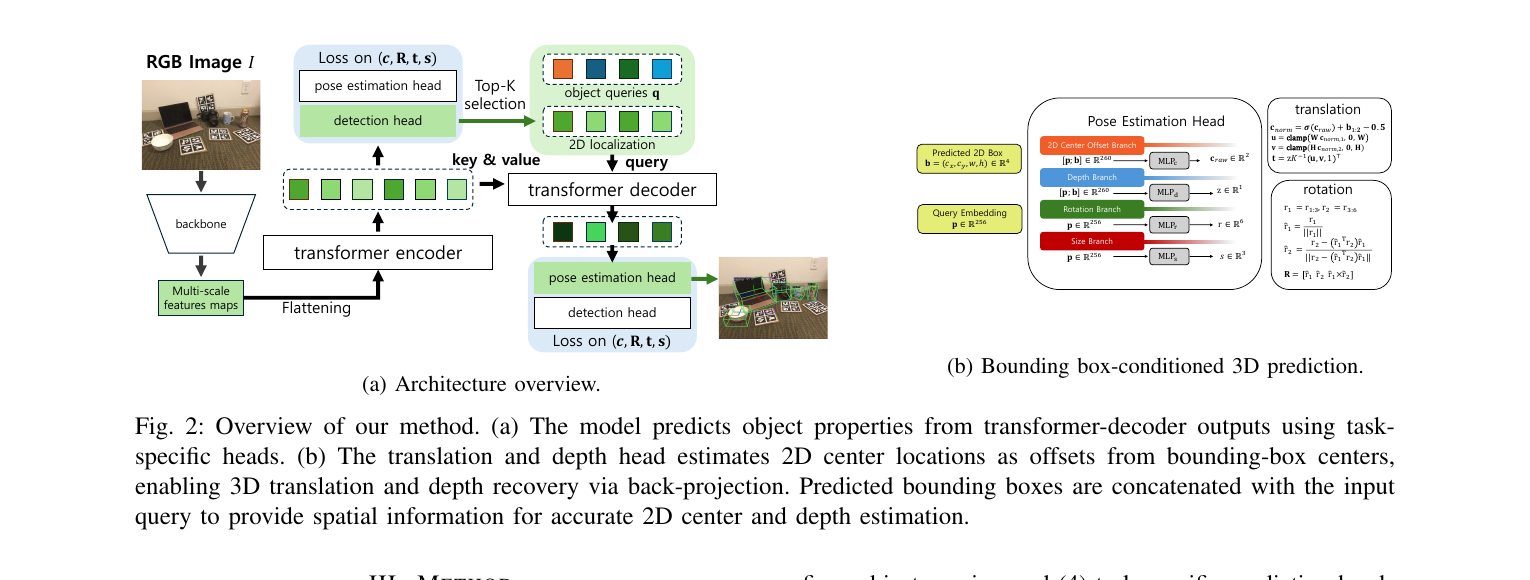
Built on DINO / DETR, YOPO shares object queries between detection heads and four lightweight pose branches:
2D geometric-center offset relative to the detected box;
Object-center depth;
6D continuous rotation representation;
Three-axis metric scale.
Center-offset and depth branches concatenate predicted boxes, providing image-scale / position context. Intrinsics backproject center and depth into 3D translation. Training adds translation distance and symmetry-aware rotation geodesics to classification / box Hungarian costs, reducing correct-2D but incorrect-3D query assignments.
Original Figure 2: shared queries drive detection and four pose branches. Box-conditioned translation and 6D-aware matching are central changes. Source: YOPO paper. Image copyright belongs to the authors; reproduced here for academic analysis.
4. Experiments at a glance
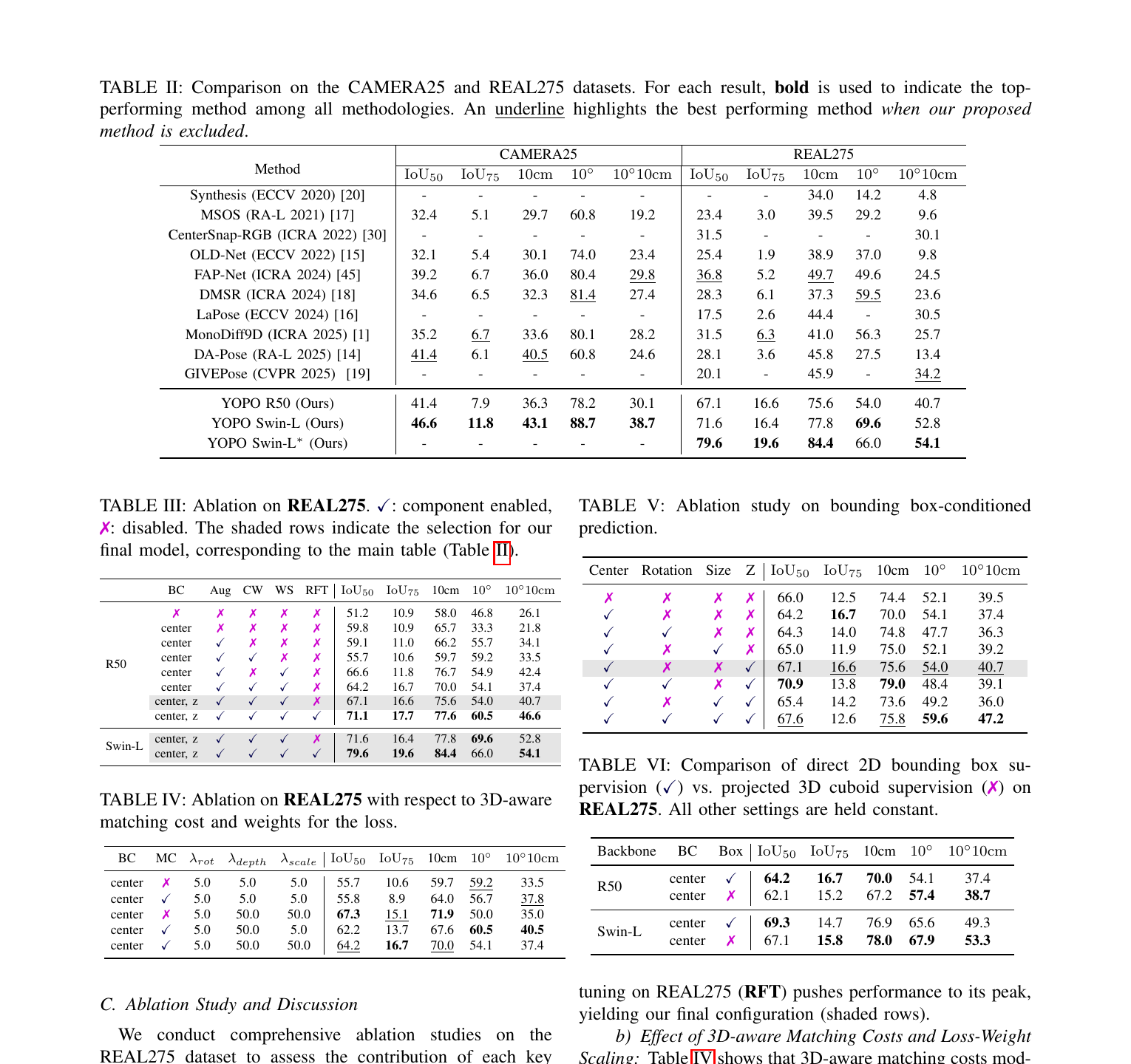
CAMERA25: Swin-L reaches IoU50 / IoU75 / 10°10 cm of 46.6 / 11.8 / 38.7.
Speed: about 49.7 ms (20 FPS) total for R50 and 124.5 ms for Swin-L. The pose head takes about 9.1 ms, leaving backbone / transformer processing as the main bottleneck.
Gains over RGB-only baselines are large, but IoU75 and strict angle–distance thresholds show unresolved monocular depth / scale ambiguity.
Original Tables II–VI: CAMERA25 / REAL275 results plus component, matching / loss, box-conditioning, and 2D-box-supervision ablations. This excerpt excludes HouseCat6D and runtime. The base model already uses joint CAMERA25 and REAL275 training; YOPO* adds REAL275 fine-tuning and must be distinguished. Source: YOPO paper. Image copyright belongs to the authors; reproduced here for academic analysis.
5. Quick assessment
Value: a direct detector-like approach to RGB-only category-level multi-object 9DoF pose that reduces error propagation across external modules.
Common misreading: training still requires category-level 9D labels and intrinsics. The base model jointly trains on CAMERA25 and REAL275; YOPO* adds real-data fine-tuning. Neither uses CAMERA25 synthetic data alone.
Suitable settings: a simple-input, multi-object robotic frontend with moderate geometric precision requirements. Millimeter-depth assembly still favors RGB-D / geometric refinement.
Available src/paper-notes/yopo-icra2026/deep.md
In-depth paper notes
Support reproduction, comparison, related-work writing, and identifying opportunities for further research.
Question: must category-level 9DoF pose use a long detection / segmentation → crop → pseudo-depth or shape prior → single-object pose pipeline?
Answer: binding 9DoF parameters to detection-transformer queries and including 3D pose in assignment lets one set-prediction network detect and estimate all scene instances jointly.
My assessment: YOPO provides a strong, simple, scalable RGB-only baseline. It does not remove monocular ambiguity; good query features, parameterization, and assignment substantially close the gap to complex cascades.
2. Positioning in one sentence
YOPO implements category-level detection-as-pose: DINO queries predict c,R,t,s together, box-conditioned translation reconnects image geometry to 3D, and 6D-aware Hungarian costs assign the right supervision to the right query.
2.1 Guide to figures and tables
Figure / table
What to look for
Figure 1
No CAD / masks / pseudo-depth refers to inputs and external modules, not absence of 9D labels.
Figure 2
Shared detection / four-MLP pose queries; translation is not a bare 3D-vector regression.
Tables II / VII
CAMERA25, REAL275, and HouseCat6D differ in training domains and category counts; one best number cannot summarize them.
Inference Time & Bottleneck Analysis
R50 / Swin-L timing appears in the text; the lightweight pose head leaves backbone / transformer bottlenecks.
Tables III–VI
Component, 6D-aware matching / loss, box-conditioned center / depth, and 2D-box-supervision ablations.
Original Figure 2: DINO features / queries feed detection and pose heads; separate branches regress center offset, depth, rotation, and scale. Training assignment also considers 6D pose. Source: YOPO paper. Image copyright belongs to the authors; reproduced here for academic analysis.
3. Problem setting
Given monocular RGB I and intrinsics K, the model predicts an unordered set
{(cj,Rj,tj,sj)}j=1M,
Here cj denotes category, Rj∈SO(3), tj∈R3, and sj∈R>03 gives metric size along three canonical axes. Test instances are unseen members of training categories with different dimensions, making the complete state 9DoF.
The minimalist formulation has specific boundaries:
No CAD, instance masks, depth, or pseudo-depth at inference.
No detection-then-per-object-crop cascade; all queries predict in parallel on one image.
Training still needs category, 9D pose, and intrinsics. Projecting annotated 3D cuboids can supply 2D boxes without separate manual box annotation.
Generalization remains within fixed training categories rather than arbitrary open-vocabulary objects.
4. From DETR to 9DoF pose
4.1 Shared object queries
A DINO-style detector extracts multiscale backbone features and maintains object queries in its encoder / decoder. Four pose MLPs extend ordinary class / box outputs. Detection and pose share query context instead of exchanging crops between two models.
This offers two engineering benefits:
Multi-object compute does not grow nearly linearly with instance count, avoiding per-box pose-network execution.
Joint supervision lets each query represent both image location and the instance’s 3D state.
4.2 Rotation and scale
Continuous 6D rotation predictions are orthogonalized into rotation matrices, avoiding Euler discontinuities and quaternion double coverage. The scale head regresses sx,sy,sz, yielding a projectable oriented 3D box as well as center pose.
4.3 box-conditioned translation
Direct global-query regression of tx,ty,tz is difficult because pixel position, apparent size, and real dimensions are coupled. Translation is decomposed into:
2D offset of the projected 3D center relative to the predicted box center;
Depth along the camera optical axis;
Backprojection through intrinsics K to obtain t.
Both center and depth branches concatenate predicted boxes, supplying low-cost image scale, aspect ratio, and position context. Conditioning both improves main metrics over center-only; the authors choose it as a balanced default. Other branch combinations can still score higher on individual metrics, so it is not uniformly optimal.
4.4 6D-aware Hungarian matching
DETR assigns a fixed number of queries one-to-one to GT instances. Class / 2D-box costs alone can confuse overlapping neighbors with similar 2D projections but different rotations / translations, creating contradictory pose supervision.
YOPO adds Hungarian costs for:
Euclidean predicted-to-GT translation distance;
Symmetry-aware rotation geodesic distance.
Symmetry matters because bottles and bowls may be invariant to axial rotation, making some angles unobservable. Matching costs and final loss weights are scaled separately. Ablations show they require joint tuning, with gains dependent on metrics and configuration rather than universal superiority of changing both.
5. Main results
Original Tables II–VI: CAMERA25 / REAL275 results and component, matching / loss, box-conditioning, and 2D-box-supervision ablations. This excerpt contains neither HouseCat6D nor speed results. The base model jointly trains on CAMERA25 and REAL275; the starred version adds REAL275 fine-tuning, requiring separate training-stage comparisons. Source: YOPO paper. Image copyright belongs to the authors; reproduced here for academic analysis.
5.1 CAMERA25 and REAL275
After joint CAMERA25 and REAL275 training, without additional real-data fine-tuning, Swin-L reaches the following on CAMERA25:
IoU50 / IoU75: 46.6 / 11.8
10 cm: 43.1
10°: 88.7
10°10 cm: 38.7
The same model achieves on REAL275:
IoU50 / IoU75: 71.6 / 16.4
10 cm: 77.8
10°: 69.6 (the project page’s reproduction table reports 67.6; use the relevant checkpoint / PDF version to resolve this version discrepancy)
10°10 cm: 52.8
Additional REAL275 fine-tuning of the jointly trained base model gives YOPO* 79.6 IoU50 and 54.1 at 10°10 cm. The star denotes an extra fine-tuning stage; the base already uses REAL275, so neither result demonstrates 79.6 from CAMERA25 synthetic data alone. The site summary retains the fine-tuning condition.
R50 reaches 67.1 IoU50 and 40.7 at 10°10 cm on REAL275, showing gains are not solely from Swin-L size. YOPO clearly improves overlap and combined-threshold results over the listed RGB-only baselines.
5.2 Relationship to RGB-D methods
Closing much of the gap is more accurate than universally surpassing RGB-D. Strong IoU50 coexists with only about 16–20% IoU75 and room on strict rotation–translation thresholds. Strong RGB-D systems such as SpotPose retain finer geometric accuracy. Category priors and apparent-size statistics estimate metric depth / size effectively near the training distribution without fundamentally changing monocular observability.
5.3 HouseCat6D
HouseCat6D adds categories, complex real backgrounds, and within-category shape changes. YOPO remains competitive but trails RGB-D systems more substantially. The unified architecture scales, while category / scene shifts remain a major RGB-only risk.
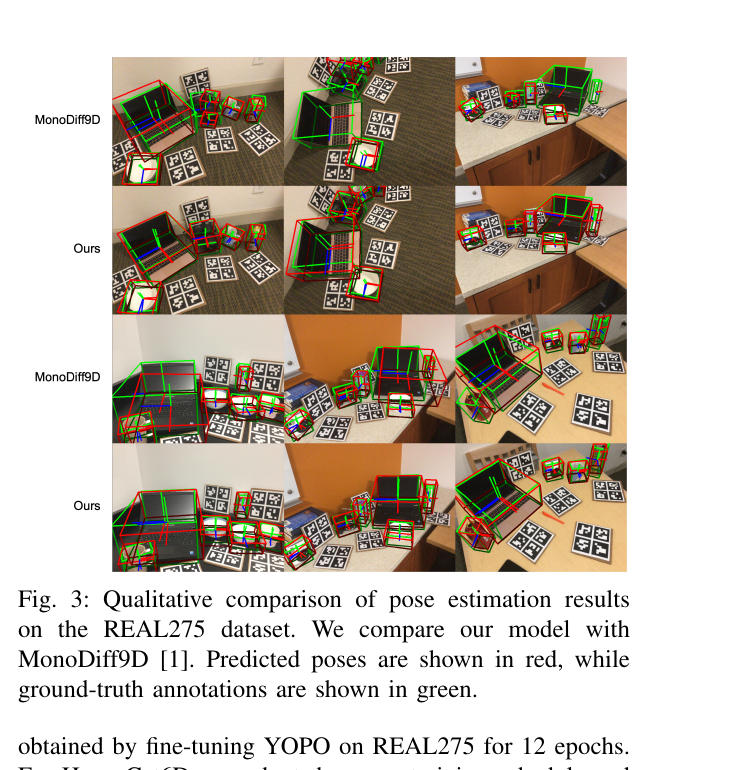
Original Figure 3: REAL275 qualitative results, with predictions in red and GT in green. YOPO predicts multiple objects jointly, though occlusion and similar appearance still cause local errors. Source: YOPO paper. Image copyright belongs to the authors; reproduced here for academic analysis.
6. Speed and posing once
On A6000, the paper reports:
Backbone
Total latency
Approximate frame rate
ResNet-50
49.7 ms
About 20 FPS
Swin-L
124.5 ms
About 8 FPS
The pose head takes about 9.1 ms; backbone / transformer processing dominates. The title describes one stage / forward pass rather than universally high frame rates. R50 needs optimization for 30–60 Hz control, while parallel processing becomes advantageous with many scene objects.
7. Authors’ claims and my assessment
Authors’ claims
My assessment
End-to-end RGB-only 9DoF without CAD, masks, or pseudo-depth
The inference pipeline meets this claim; training needs 9D labels, fixed categories, and intrinsics. No extra data means no additional geometric assets / auxiliary modules.
SOTA on three benchmarks
Holds within the paper’s RGB-only comparisons; RGB-D modalities and real-data fine-tuning conditions require separate comparison groups.
Minimalist architecture
Pose extensions are lightweight MLPs, parameterization, and matching costs; the DINO / Swin-L detector itself remains large.
Real-time robotic perception
R50 at about 20 FPS is useful; Swin-L is about 8 FPS, excluding subsequent grasp planning.
8. Reproduction considerations
Follow official NOCS / HouseCat6D preprocessing and frames, checking axis order, size units, and symmetric categories.
Distinguish YOPO Swin-L from YOPO* Swin-L; the latter loads the former and continues fine-tuning on NOCS real.
Boxes projected from 3D cuboids still need truncation, image-boundary, and invisible-corner handling.
Hungarian translation / symmetry-rotation costs and training losses use different weight hyperparameters.
Intrinsics must match resized / cropped images, or even correct box-conditioned centers yield wrong backprojected translations.
Report backbone, resolution, GPU, instance count, and loading / NMS scope. DETR avoids conventional NMS but still has preprocessing and output-handling costs.
9. Limitations and research implications
Monocular scale–depth coupling: category priors learn statistics but can systematically bias instances outside training-size distributions.
Fixed categories: queries handle multiple instances, but training defines the vocabulary; open-vocabulary discovery is a natural extension.
Detection / pose gradient conflicts: shared queries may face competing 2D AP and precise 3D objectives; uncertainty weighting or staged freezing could help.
No explicit geometric verification: one-pass prediction is convenient; precision-critical systems could add lightweight RGB-D / render-and-compare refinement and use YOPO as initialization.
Strong research baseline: methods claiming auxiliary depth / CAD / masks are necessary should compare with unified detectors like YOPO and justify their extra complexity.
YOPO shows that module boundaries and assignment explain substantial performance loss previously attributed to unavoidable cascade complexity. Incorporating 3D state into query training makes a simple RGB-only approach competitive without resolving category-level 9DoF pose in general.