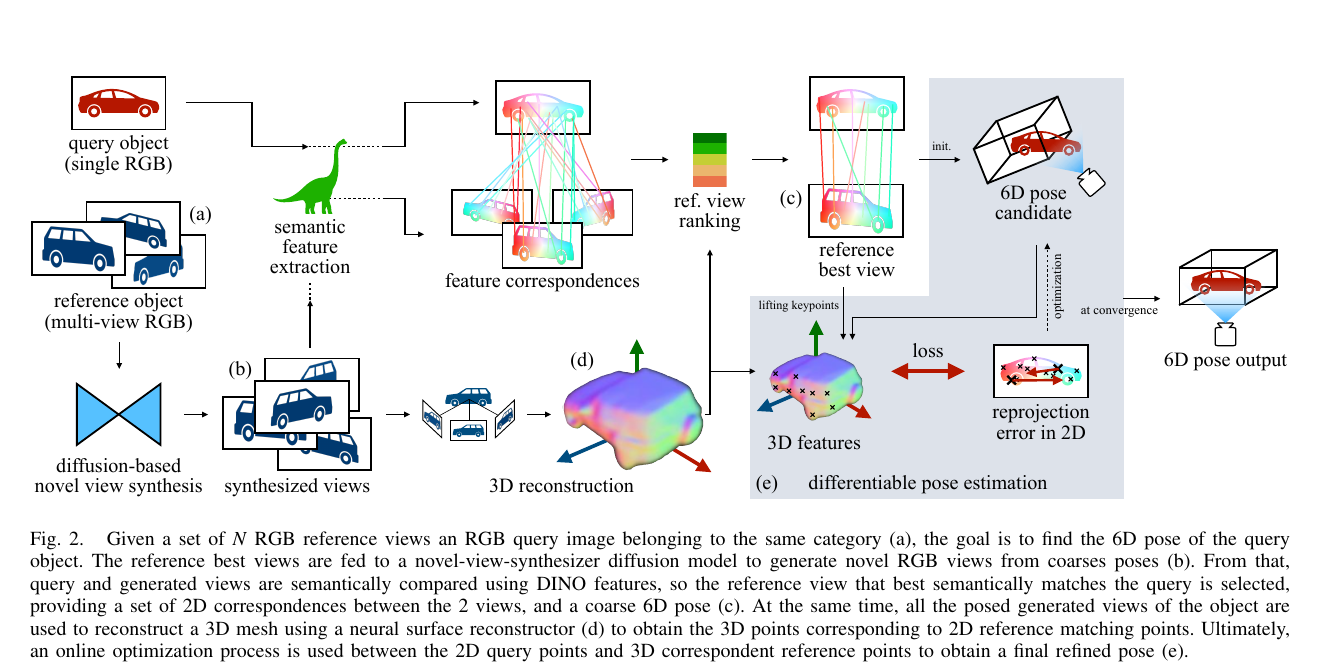
Zero123-6D augments sparse category references using pretrained novel-view diffusion. DINO semantic matching selects a reference view, NeUS reconstructs category geometry, and 2D–3D correspondence with differentiable reprojection refines the query’s RGB-only category-level pose online.
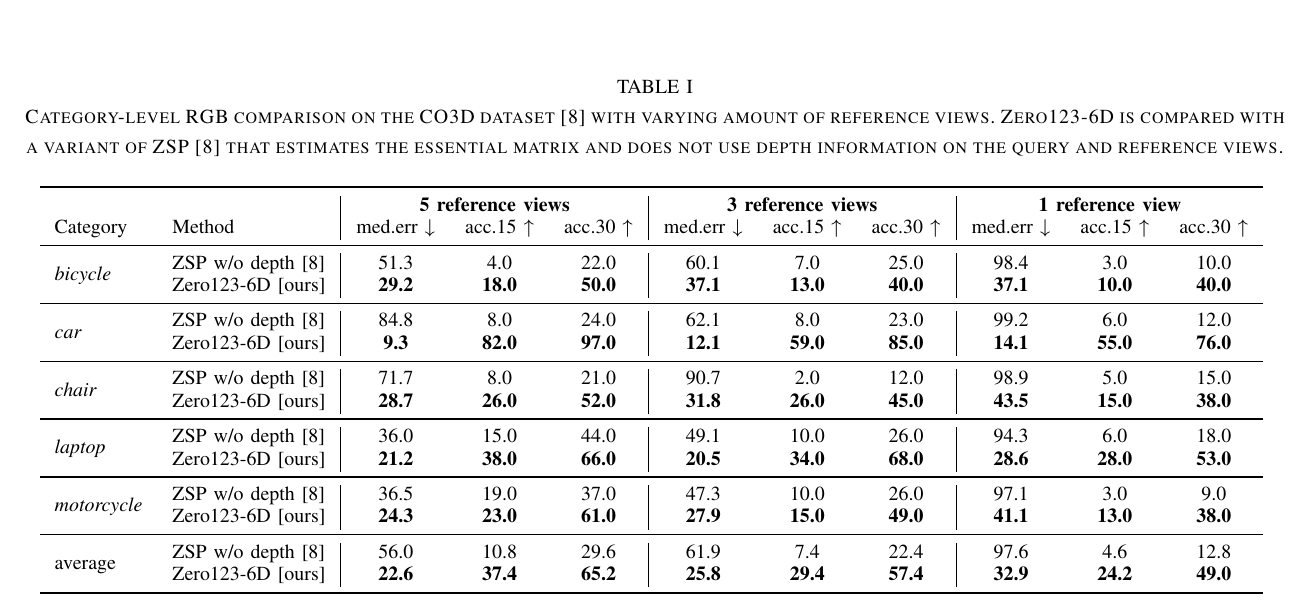
Original Figure 2: novel-view synthesis expands references, DINO provides coarse pose, and NeUS supplies 2D–3D points for online optimization. Source: authors' public manuscript. Image copyright belongs to the authors and IEEE; reproduced here for paper analysis.Original Table I: 5, 3, and 1 original reference images; generated views compensate for sparse angular coverage. Source: authors' public manuscript. Table copyright belongs to the authors and IEEE; reproduced here for paper analysis.
Method and experiments
Only 1 / 3 / 5 posed RGB reference images per category.
EscherNet generates views; views and camera poses train a category-level NeUS model offline.
DINO matches the query with real / generated references; the best view’s camera pose initializes query pose.
NeUS depth lifts matched pixels to 3D; online optimization runs up to 1000 steps with early stopping, taking about 2–4 s.
Available src/paper-notes/zero123-6d-iros2024/deep.md
In-depth paper notes
Support reproduction, comparison, related-work writing, and identifying opportunities for further research.
Deep Reading Notes: Zero123-6D
1. Key assessment
Zero123-6D uses novel-view synthesis to augment reference coverage rather than directly generate poses. Generated views fill angular gaps, DINO matches semantics across instances, and NeUS geometry lifts 2D matches into 2D–3D correspondences for optimization.
Zero-shot means models such as EscherNet and DINO need no target-category retraining. Each reference set still needs offline NeUS reconstruction and known reference camera poses, so this is not single-image pose without object / category preparation.
2. Task setting
Input:
N RGB images with camera poses of one reference instance in a category;
A query RGB image of a different instance;
No query / reference depth required.
Output is the query’s 6D pose in the reference category frame. CO3D experiments cover bicycle, car, chair, laptop, and motorcycle with 1 / 3 / 5 reference views.
Cross-instance category matching must handle changes in shape, proportions, and texture. The method relies on DINO semantic correspondence rather than conventional local texture features.
3. Method pipeline
Original Figure 2: generated views enlarge matching candidates and combine with real references to reconstruct NeUS category geometry. Source: authors' public manuscript. Image copyright belongs to the authors and IEEE; reproduced here for paper analysis.
3.1 Novel-view synthesis
EscherNet synthesizes views conditioned on reference RGB, camera poses, and target spherical-camera poses. Azimuth, elevation, and radius expand sparse real views into denser angular coverage.
Generated views serve two purposes:
Increase the likelihood of a reference close to the query viewpoint;
Supply fuller multiview appearance and implicit depth for NeUS.
Diffusion may alter details or geometry, especially across different category instances; more views do not guarantee more reliable correspondence.
3.2 Best-view matching and coarse pose
DINO extracts query / reference features for semantic correspondence and similarity. The best reference’s known camera pose supplies the coarse query pose.
This turns pose search into discrete viewpoint retrieval. Dense coverage helps initialization, but a semantically similar yet geometrically incorrect generated reference can trap refinement in a local optimum.
3.3 NeUS and online refinement
Real / generated references with poses reconstruct NeUS. Depth rendered at matched best-view pixels is backprojected into reference 3D points. Query pose is optimized so those points reproject near DINO query matches.
Optimization runs up to 1000 iterations with loss-based early stopping, taking about 2–4 s on RTX 3090. One-time offline reconstruction is excluded from per-query runtime.
4. CO3D results
Original Table I: ZSP without depth uses an essential matrix; generated references and implicit geometry reduce Zero123-6D rotation errors. Source: authors' public manuscript. Table copyright belongs to the authors and IEEE; reproduced here for paper analysis.
Average results:
Original references
Method
Median rotation error↓
acc15↑
acc30↑
5
ZSP w/o depth
56.0
10.8
29.6
5
Zero123-6D
22.6
37.4
65.2
3
ZSP w/o depth
61.9
7.4
22.4
3
Zero123-6D
25.8
29.4
57.4
1
ZSP w/o depth
97.6
4.6
12.8
1
Zero123-6D
32.9
24.2
49.0
With just 1 real reference, generated references lower average median rotation error from 97.6° to 32.9°. Cars benefit strongly: 9.3° with 5 references and 14.1° with 1; greater chair shape variation leaves 43.5° with 1 reference.
The paper also compares depth-enabled ZSP: reliable real query / reference depth can make ZSP stronger. Zero123-6D removes depth while retaining competitive performance. Ablations show generated views already improve best-view selection, with NeUS 2D–3D refinement adding gains.
5. Critical analysis
Strengths: a clear use of pretrained generation to improve pose-reference coverage; RGB-only; strong gains with 1 view.
Limits: reference-set-specific offline NeUS; 2–4 s online optimization; known reference poses; unquantified diffusion / NeUS geometry hallucination.
Task boundary: cross-instance pose within known categories, rather than open-category pose or absolute instance pose from a single reference.
Fairness: distinguish sensor requirements when comparing depth methods, and separate online runtime from offline reconstruction.
6. Reproduction checklist
Fix EscherNet version, target-view grid, and generation seeds;
Save DINO matching scores for generated views and inspect selection of hallucinated views;
Record NeUS training time, scale, and coordinate frame;
Specify correspondence count, outlier filtering, optimization learning rate, and early stopping;
Report category-wise reference-count sensitivity and symmetry;
Evaluate translation, scale, and generated-geometry errors in addition to rotation.
7. Overall assessment
Zero123-6D shows novel-view generation can augment pose-reference data, especially with one real view. Promising next steps are geometric confidence for generated views and a deployable replacement for 2–4 s optimization.