PACA: Perspective-Aware Cross-Attention Representation for Zero-Shot Scene Rearrangement
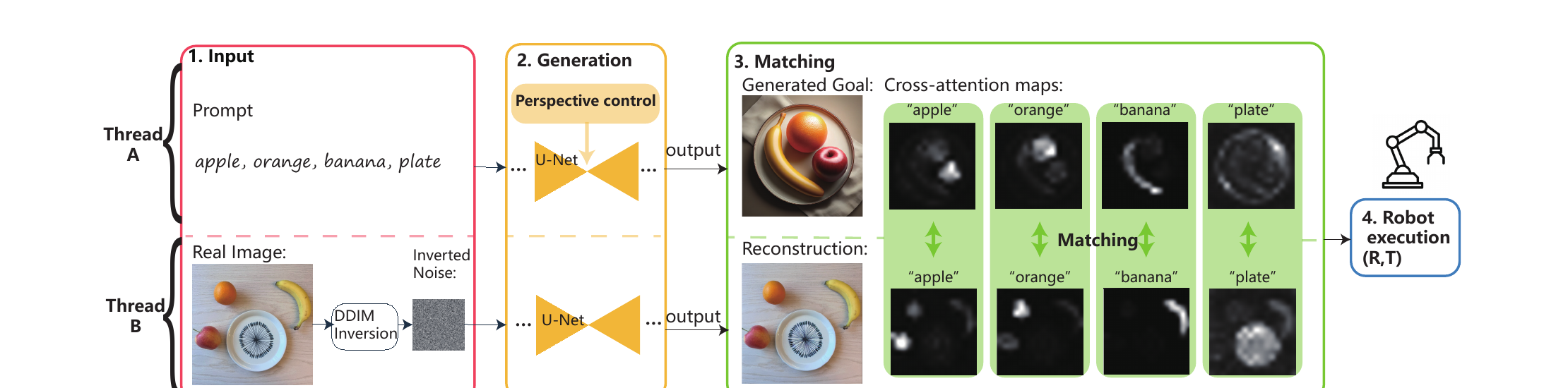
PACA unifies Stable Diffusion generation, object-region extraction, and feature encoding into word-conditioned cross-attention representations. Targets are generated directly; real RGB undergoes DDIM inversion / reconstruction before object representations are read along the same denoising timeline. ICP, Marigold relative depth, and RGB-D alignment compute rearrangement transforms. Mean matching accuracy on 450 real–generated pairs is 86.72% versus DALL·E-Bot's 51.35%. Across 60 real robot trials, mean success in 3-DoF / 6-DoF settings is 68.73% / 65.56%. The text explicitly defines object transforms as (x,y,z,θ), and success measures relative layouts rather than pose ground truth. This is a generative-goal robotic extension, not a full SE(3) object-pose benchmark.
category-word text promptwrist-mounted RGB-D image of the real sceneStable Diffusion generated goal imageword-specific diffusion cross-attention mapsMarigold relative depth and RealSense metric depth
Requirements
pretrained Stable Diffusion and ControlNetDDIM inversion and access to U-Net cross-attention mapscategory words for every object to be rearrangedvisible perspective line cues for the Hough-transform control branchRGB-D camera and calibrated robot workspaceICP and monocular-depth scale/shift alignmenttop-down vacuum-graspable tabletop objects
Full paper metadataAuthors, affiliations, research area, datasets, metrics, method tags, and reading statusExpandCollapse
Authors
Shutong Jin, Ruiyu Wang, Kuangyi Chen, Florian T. Pokorny
Affiliations
KTH Royal Institute of Technology / Graz University of Technology
pretrained Stable Diffusion and ControlNetDDIM inversion and access to U-Net cross-attention mapscategory words for every object to be rearrangedvisible perspective line cues for the Hough-transform control branchRGB-D camera and calibrated robot workspaceICP and monocular-depth scale/shift alignmenttop-down vacuum-graspable tabletop objects
Reading Notes
Overview / Deep Dive
Available src/paper-notes/paca-wacv2025/coarse.md
Paper overview notes
Quickly assess the paper's scope, problem setting, core method, experimental findings, and whether to read it in depth.
Paper Reading Notes (Coarse): PACA: Perspective-Aware Cross-Attention Representation for Zero-Shot Scene Rearrangement
1. Basic information
Abbreviation: PACA
Authors: Shutong Jin, Ruiyu Wang, Kuangyi Chen, Florian T. Pokorny
Affiliations: KTH Royal Institute of Technology, Graz University of Technology
Stable Diffusion generates human-preferred tabletop goals while supplying object-level cross-attention representations. Real RGB-D scenes undergo DDIM inversion / reconstruction to obtain the same representation for real-to-generated object matching. ICP and monocular-depth alignment then recover object transformations for robotic rearrangement.
This site includes PACA as an extended system in its annual object-pose collection: pose transformations mediate robot actions, but BOP-style 6D pose benchmarking is not its main task. The main text explicitly defines transformations as:
T=(x,y,z,θ),
Only 3D translation and one planar rotation angle are included. The paper’s 6-DoF terminology also combines:
A 6-DoF robot arm;
Oblique camera observations and perspective-controlled goals;
System-level comparison with conventional top-down 3-DoF rearrangement.
Thus PACA’s 65.56% 6-DoF success rate must not be read as complete SE(3) object-pose accuracy.
2.1 Key results
Over 450 real–generated image pairs, PACA averages 86.72% matching accuracy versus 51.35% for the multistage DALL·E-Bot baseline;
PACA matching accuracy is 83.75% for Dining, 88.63% for Fruit, and 87.78% for Office;
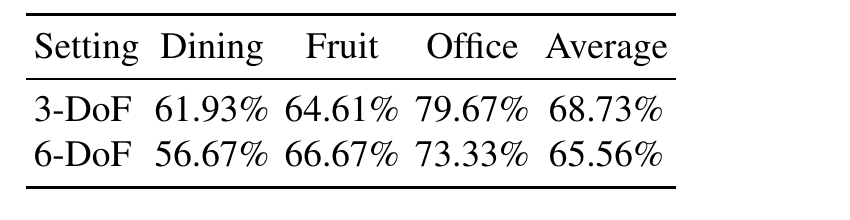
In 60 real-robot trials, average task success is 68.73% / 65.56% for 3-DoF / 6-DoF settings;
A user study with 43 participants and 559 ratings gives mean goal satisfaction of 3.85, 4.42, and 3.49 out of 5 across the three scenes;
Main 6-DoF bottlenecks are monocular goal-depth errors and grasp / place positioning, rather than inaccuracy after recovering full three-axis rotation.
2.2 Guide to figures and tables
Figure / table
Question
Initial assessment
Figure 2
How do textual goals and real scenes share a representation?
Generate goals directly; invert and reconstruct real images; extract object representations from Stable Diffusion cross-attention on both sides
Table 3
Does a joint representation beat segmentation followed by CLIP encoding?
Large gains in all three scenes, averaging 51.35%→86.72%
Figure 5
Does the system execute on a robot?
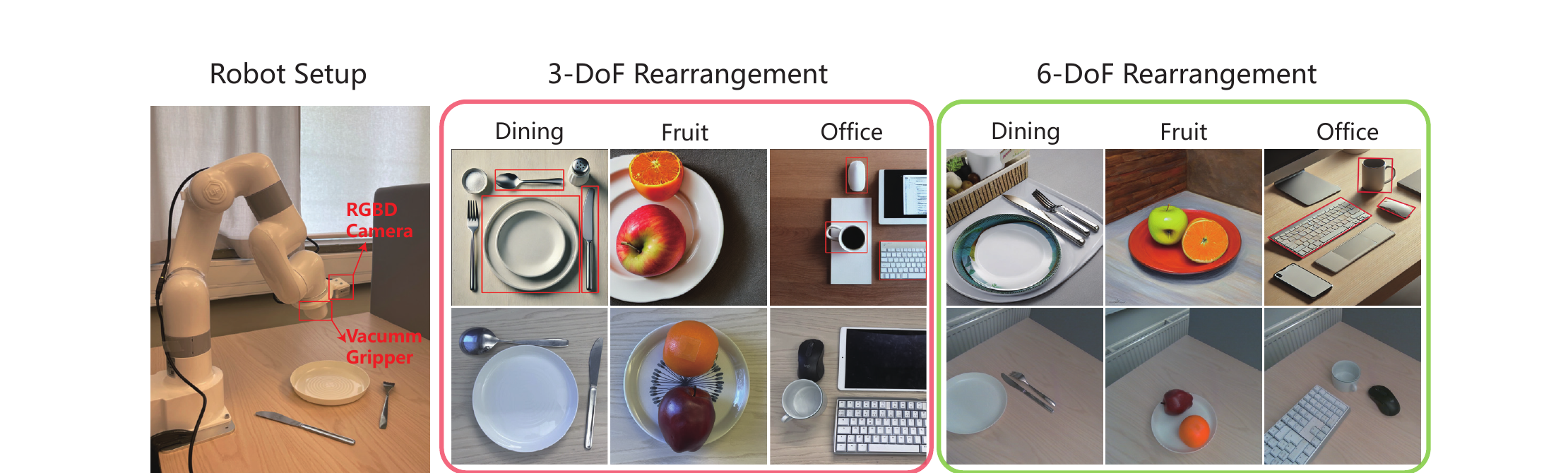
Lite 6, wrist RGB-D, and vacuum suction demonstrate top-down / oblique Dining, Fruit, and Office goals
Table 4
How reliable is execution?
About two-thirds mean success, best on Office; 6-DoF slightly trails 3-DoF
Original Figure 2: Thread A generates goals from text, while Thread B inverts and reconstructs real RGB with DDIM. Both form object representations from the same diffusion U-Net cross-attention maps, followed by matching and robot execution. Source: CVF Open Access. Image copyright belongs to the authors and publisher; reproduced here for paper analysis.
3. Research problem
3.1 Why generate goal images?
Tabletop organization has no unique answer: cutlery may surround a plate, fruit may go inside it, and office supplies have other relationships. Collecting ideal-layout demonstrations across objects, scenes, and preferences is costly. Web-scale models such as Stable Diffusion already learn common scene structures from internet images.
PACA therefore asks users only to list object categories, for example:
apple, orange, plate
The model generates a goal, and the robot tries to reproduce its relative layout on the real table.
3.2 Problems with conventional multistage pipelines
Methods such as DALL·E-Bot typically:
Generate a goal image;
Segment target objects with Mask R-CNN;
Crop object patches;
Encode patches with CLIP;
Match them to real objects;
Compute actions.
Generation may distort, duplicate, or add unrequested objects. Incorrect segmentation leaves CLIP encoding wrong patches and errors accumulate. PACA reuses internal word–image cross-attention to combine generation, segmentation, and feature encoding.
3.3 Why control perspective?
Earlier image-goal rearrangement often uses a fixed top-down camera, called the 3-DoF setting. If the real camera is oblique but the generated goal is top-down, matching corresponding object regions becomes difficult.
PACA extracts real-scene lines with the Hough Line Transform and uses them as ControlNet conditions for Stable Diffusion goals with similar perspective. This controls image perspective / camera-view compatibility rather than directly regressing complete camera extrinsics.
4. Method pipeline
4.1 Inputs
User category prompt P;
Current real RGB-D scene Xreal;
Pretrained Stable Diffusion, ControlNet, Marigold, and related models;
Robot and wrist-camera execution system.
Zero-shot means no PACA retraining for Dining, Fruit, or Office rearrangement; large pretrained models are still required.
4.2 Thread A: goal generation
The 3-DoF top-down setting uses Stable Diffusion directly:
xgoal=StableDiffusion(P,s,βcfg),
Random seed s reproduces goals; classifier-free guidance is fixed at 7.5.
The 6-DoF setting first extracts real-image Hough lines:
Ch=HoughTransform(xreal),
Then conditions ControlNet:
xgoal=ControlNet(Ch,P,s,βcfg).
4.3 Thread B: real-image reconstruction
Real RGB is resized to 512×512 and encoded into Stable Diffusion latents. DDIM inversion maps clean latents to deterministic noise, followed by reconstruction with CFG=0. Real and goal images thus pass through the same U-Net, exposing comparable cross-attention maps throughout denoising.
4.4 Joint cross-attention representation
PACA observes coarse object regions emerging before texture and local details. It extracts two attention types for each object word w:
Conceptual embedding:t≈T/2 represents object regions for segmentation;
Perceptual embedding:t≈1 contains finer features for matching.
There are 50 denoising steps; the two maps are binarized at 0.3 / 0.9 and added:
R(w)=Step(M(w,T/2),0.3)+Step(M(w,1),0.9).
This is closer to an object-level combination of semantic regions and strongly activated feature regions than a conventional dense descriptor tensor.
4.5 Matching, depth, and execution
For each word w, find the best transform between goal / real representations. The pipeline then uses:
ICP to align object representations;
Marigold to estimate monocular goal depth;
RealSense RGB-D for real metric depth;
Scale / shift fitting to align Marigold depth with real depth;
Region geometric centers as top-down vacuum grasp points.
Execution transforms are T=(x,y,z,θ): translation and yaw for tabletop scenes, without reported independent roll / pitch estimates or errors.
5. Experimental setup
5.1 Hardware
UFactory Lite 6 robot arm;
wrist-mounted Intel RealSense D405 RGB-D camera;
vacuum gripper;
top-down grasp;
Representation-region geometric centers as grasp points.
5.2 Three tasks
Scene
Objects
Dining
knife, fork, spoon, plate
Fruit
apple, orange, plate
Office
keyboard, mouse, mug
These are static tabletop objects accessible by top-down suction. Stacking, heavy occlusion, articulation, side grasps, and precise grasp orientations are not evaluated.
5.3 Baselines
SG-Bot: scene-graph-generated goals;
DALL·E-Bot: Mask R-CNN goal segmentation followed by CLIP matching;
Parallel: a hand-designed baseline arranging objects horizontally;
Two human users for goal-layout satisfaction comparisons.
6. Experimental evidence by level
6.1 Do people like the goals?
43 participants provide 559 ratings on a 1–5 scale:
Method
Dining
Fruit
Office
Human 1
3.41
4.63
3.55
Human 2
4.34
1.89
3.67
PACA
3.85
4.42
3.49
Parallel
3.05
2.26
1.95
SG-Bot
1.68
—
—
PACA and the two human arrangers score within similar ranges, but this does not establish a human ceiling: the two humans differ markedly, and SG-Bot does not apply to Fruit / Office.
6.2 Are category prompts better?
Stable Diffusion generates 2,000 images per scene, 6,000 total. Category-list prompts score higher on Inception Score and CLIP Score than exact-count / top-down descriptions. For example, Dining:
fork, knife, spoon, plate, table: IS 4.08±0.21, CLIP 31.19;
A fork, a knife, a plate, and a spoon, top-down: IS 3.54±0.24, CLIP 30.33.
The authors attribute this to web captions resembling category descriptions. The trade-off is weaker control of exact counts and spatial relationships.
6.3 Does the joint representation improve matching?
Original Table 3: 150 real–generated pairs per scene, 450 total. Combining generation, segmentation, and feature encoding through cross-attention gives PACA 86.72% average matching accuracy versus DALL·E-Bot's 51.35%. Source: CVF Open Access. Image copyright belongs to the authors and publisher; reproduced here for paper analysis.
Method
Dining
Fruit
Office
Average
DALL·E-Bot
42.83%
42.57%
68.66%
51.35%
PACA
83.75%
88.63%
87.78%
86.72%
This is the clearest quantitative evidence: joint representation reduces sequential amplification from generated distortion to wrong segmentation crops and CLIP encodings. The metric measures successful object association, not rotation / translation error.
6.4 Robot execution
Three scenes, 10 random initializations per setting, and two settings give 60 trials. Without GT pose trajectories, success means final relative object positions agree with the generated goal, allowing slight absolute-position differences.
Original Table 4: average execution success is 68.73% / 65.56% in 3-DoF / 6-DoF settings. This evaluates reproduction of relative layouts, not standard SE(3) object-pose accuracy. Source: CVF Open Access. Image copyright belongs to the authors and publisher; reproduced here for paper analysis.
Setting
Dining
Fruit
Office
Average
3-DoF
61.93%
64.61%
79.67%
68.73%
6-DoF
56.67%
66.67%
73.33%
65.56%
The paper mainly attributes lower 6-DoF success to generated-goal depth errors, which propagate to grasp and placement positions.
7. Strengths
Combining generation, segmentation, and encoding aligns the problem definition with the experiments.
Cross-attention connects prompt words, goal images, and real images naturally for category-level association.
Perspective control addresses an actual image-goal bottleneck beyond visual goal quality.
Separate tests of satisfaction, prompt design, matching, and execution form a relatively complete evidence chain.
Pretrained models and geometry avoid collecting training demonstrations for the three scenes.
Validation uses real robots alongside visual outputs.
8. Limitations and risks
Explicit (x,y,z,θ) transformations are not full SE(3); no rotation / translation errors, ADD(-S), or BOP AR are provided.
6-DoF refers jointly to robot, camera view, and scene setting, inviting confusion with three-axis object rotation.
Success uses human / rule-based relative-layout judgments without GT, allowing absolute-position deviations.
Stable Diffusion can distort, add, or omit objects; category prompts poorly constrain exact counts / relations.
Hough-based perspective control depends on stable scene lines and does not guarantee recovery of real extrinsics.
Relative Marigold depth needs scale / shift alignment; errors are a major 6-DoF failure source.
Geometric centers need not be centers of mass or feasible grasp points; top-down suction limits object types.
Evaluation covers only three small tabletop scenarios and 60 executions.
Same-category counts and instance identity remain weakly controlled.
No verifiable official code link is provided in the paper, making reproduction harder than training-free may imply.
9. Is a deep reading worthwhile?
Recommended for language-driven rearrangement, diffusion attention, open-category matching, and generated robot goals. For standard 6D pose leaderboards, treat it as extended reading.
The most useful lessons are:
Interpreting different diffusion timesteps as region and feature information;
Bridging real and generated images through one pretrained model;
Quantifying error accumulation in modular systems;
Taking matching into robot execution, beyond a visual demonstration;
Distinguishing variable-viewpoint 6-DoF systems from complete SE(3) object-pose estimators.
10. Coarse-reading assessment
PACA is a systems paper connecting generated goals, object representation, relative layout, and robot actions. Its strongest result is matching accuracy increasing from 51.35% to 86.72% on 450 pairs, showing that direct diffusion cross-attention can reduce sequential segmentation / encoding errors.
Real execution establishes feasibility, but average success remains around 66%–69% without full object-pose GT. Read PACA as a representative integration of transformations into generative robotics; 65.56% is not 6D pose accuracy.
Available src/paper-notes/paca-wacv2025/deep.md
In-depth paper notes
Support reproduction, comparison, related-work writing, and identifying opportunities for further research.
Paper Reading Notes (Deep): PACA: Perspective-Aware Cross-Attention Representation for Zero-Shot Scene Rearrangement
1. Basic information
Abbreviation: PACA
Authors: Shutong Jin, Ruiyu Wang, Kuangyi Chen, Florian T. Pokorny
Affiliations: KTH Royal Institute of Technology, Graz University of Technology
PACA turns Stable Diffusion generation into an object-level perception interface. Goal generation exposes cross-attention for prompt words; real-image DDIM inversion / reconstruction exposes comparable attention. Middle denoising maps provide regions and late maps provide finer features. Their combination supports real–generated object matching, relative transformations, and robot execution.
The evidence has four levels:
Goal quality: 43 participants and 559 ratings place PACA’s three scene averages near those of two human arrangers;
Prompt design: among 2,000 images per scene, 6,000 total, category-list prompts beat exact-count and top-down descriptions on IS / CLIP score;
Object matching: on 450 real–generated pairs, joint cross-attention averages 86.72%, versus 51.35% for DALL·E-Bot’s Mask R-CNN + CLIP pipeline;
Robot execution: three scenes, two settings, and 60 real trials yield 68.73% / 65.56% average success for 3-DoF / 6-DoF.
For an object-pose collection, four boundaries must remain explicit:
The main text parameterizes transformations as (x,y,z,θ), without full roll / pitch / yaw;
6-DoF mainly describes oblique observations, perspective-controlled goals, and the robot system; it does not imply standard SE(3) object-pose output;
The clearest quantitative gain is object matching, rather than rotation / translation accuracy.
PACA belongs among extended systems that integrate transformations into generative robotics, rather than BOP / ADD(-S) 6D pose methods.
2.1 Evidence matrix
Experiment
Sample
Metric
Supports
Does not establish
User study
43 people, 559 ratings
Satisfaction, 1–5
Human-preferred goals in small everyday scenes
Geometric executability, correct counts, or all-user preference generalization
Prompt comparison
6,000 generated images
IS, CLIP score
Less distortion and better text agreement for category prompts in this SD setup
More controllable precise spatial relationships
Matching
450 image pairs
Object matching accuracy
Fewer matching errors with a joint representation
More accurate numerical object transformations
Robot execution
60 trials
Relative-layout success
A real system completing about two-thirds of tasks
Industrial-precision SE(3) pose, grasping, or placement
3. Problem setting: generate goals and recover transforms
3.1 Scene rearrangement
Let the initial real scene be X and the human-preferred goal be X∗. An embodied agent transforms scene objects to approach X∗:
X{Ti}X∗.
Conventional approaches learn desirable layouts from training data. Dining, Fruit, and Office have different relationships and user preferences; fixed simulated patterns may also produce a reality gap.
PACA uses a web-scale generator for image goals and converts them into object actions. This replaces learning the goal distribution with three interface challenges:
Do generated objects follow the prompt?
Can generated and real objects be matched?
Can a 2D goal supply metric transformations for the robot?
3.2 Why multistage errors accumulate
Let G,S,E,M denote the generator, segmenter, encoder, and matcher, respectively. The conventional path is:
If G distorts, duplicates, or adds objects, S produces repeated / misplaced crops, and E compresses wrong crops into features; lost image information cannot be recovered. Errors alter downstream input distributions rather than merely adding independently.
PACA directly uses internal prompt-word / spatial-token cross-attention as segmentation and feature information, reducing model interfaces.
3.3 What zero-shot means
Training-free / zero-shot means no new network training or robot demonstrations for the three rearrangement scenes. The system still depends on:
Web-scale Stable Diffusion image–text training;
ControlNet conditional generation;
Marigold monocular-depth priors;
DDIM inversion;
ICP geometry optimization;
RealSense RGB-D and robot calibration.
Zero-shot concerns task adaptation; learned priors, calibration, and a manually constructed pipeline remain necessary.
4. What PACA means by 6-DoF
4.1 Three DoF contexts
3-DoF top-down setting: near-overhead goal and real views, mainly planar translation / rotation;
6-DoF setting: oblique real-camera perspectives, requiring view-compatible goals and depth;
6-DoF robot arm: UFactory Lite 6 has six joint degrees of freedom.
None automatically implies object pose with three-axis SO(3) rotation plus 3D translation.
4.2 Object transformations in the main text
Section 4.5 explicitly gives:
T=(x,y,z,θ).
This is 3D translation and one rotation scalar. With top-down suction and tabletop placement, θ is planar orientation / yaw. No three independent rotational degrees in R∈SO(3) or mechanism for flipping arbitrary sideways objects into full target poses is reported.
Figure 2 labels execution (R,T) and the conclusion mentions 6-DoF operations, but these broad labels do not override the specific method parameterization. This site uses the most explicit mathematical definition for task scope.
4.3 Evaluation is not a pose benchmark
Success means final relative positions agree with the generated goal, allowing slight absolute-position variations. The paper provides no:
translation error (cm / mm);
rotation error (degree);
ADD / ADD-S;
VSD / MSSD / MSPD;
6D ground-truth object pose;
per-object transformation residual.
Thus Table 4’s 65.56% is task success, not 6D pose accuracy.
5. Overall PACA architecture
Original Figure 2: Thread A generates goals and reads word-specific cross-attention. Thread B inverts / reconstructs real images for the same representation. Matching supplies object transforms for execution. Source: CVF Open Access. Image copyright belongs to the authors and publisher; reproduced here for paper analysis.
Four stages:
Input a prompt and real RGB-D;
Generate a perspective-compatible goal and object representations;
Invert / reconstruct real RGB, extracting matching real representations;
Execute grasping and placement through depth, ICP, and robot geometry.
This combines foundation models, attention maps, geometric alignment, and scripted grasping rather than an end-to-end policy.
6. Thread A: prompt-to-goal generation
6.1 3-DoF top-down generation
Prompt P lists object categories; random seed s reproduces the goal:
xgoal=StableDiffusion(P,s,βcfg),
Classifier-free guidance is fixed at:
βcfg=7.5.
The authors favor category lists over exact one-to-one counts and articles:
fork, knife, spoon, plate, table
Instead of:
A fork, a knife, a plate, and a spoon, top-down
Experiments show higher IS / CLIP scores for the former under this Stable Diffusion distribution.
6.2 From top-down to perspective-controlled goals
A key image-goal challenge is viewpoint mismatch: an oblique wrist camera versus a generated top-down view. Inspired by perspective lines in drawing, PACA extracts Hough lines from real RGB:
Ch=HoughTransform(xreal).
These line conditions control generation:
xgoal=ControlNet(Ch,P,s,βcfg).
Table edges, wall corners, and furniture contours supply perspective cues, making generated viewpoints closer to the real scene.
6.3 This does not explicitly recover camera pose
Although the text describes aligning goal / real extrinsic matrices with Hough lines, the implementation conditions image generation without reporting:
camera intrinsics;
Numerical real / goal extrinsics;
reprojection error;
line-to-vanishing-point calibration;
camera pose ground truth.
A more precise interpretation is perspective appearance conditioning rather than geometric calibration. Views may still mismatch without stable lines, when lines come from objects rather than the environment, or when ControlNet ignores conditions.
7. Thread B: real images in diffusion representation space
7.1 Inputs and latents
Real RGB xreal is resized to 512×512 and encoded by Stable Diffusion E into clean latent:
z0real=E(xreal).
Ordinary generation starts from noise. To read real-image cross-attention on the same denoising timeline, first find a noise latent reconstructing the image.
7.2 DDIM inversion
Deterministic DDIM inversion maps z0real from t=1 to t=T, yielding noise zTreal. Standard denoising then reconstructs the real image with CFG 0, reducing prompt-induced content changes.
This supplies:
A hidden process using the same U-Net / timesteps as goal generation;
Cross-attention between prompt words and real image regions.
Inversion builds an attention-readable reconstruction trajectory rather than generating a different semantic scene from real RGB.
7.3 Possible errors
Inversion / reconstruction is not strictly lossless;
Stable Diffusion latents may poorly represent tiny industrial objects or nonnatural scenes;
Real objects absent from the prompt lack word-specific representations;
Synonyms, compound words, and tokenization affect attention;
CFG=0 removes text-guidance strength without guaranteeing pixel-identical reconstruction.
8. Joint cross-attention representation
8.1 Cross-attention definition
The paper uses:
M=Softmax(dQKT),
where:
Q=WQϕz(zt),K=WKp,V=WVp,
p=ψ(P) is the prompt embedding; M(w,t) is the spatial attention map for word w at timestep t. Maps are upsampled / represented at 512×512, with activations in 0–1.
8.2 Information levels during lossy denoising
The authors compare denoising to progressive decoding: large shapes / regions emerge at high noise, followed by texture and local features. Figure 4’s plate / fork example shows:
Middle-step attention covering whole silhouettes;
Late attention focusing on discriminative fork heads and plate patterns.
They define:
Conceptual embedding (region):t≈T/2;
Perceptual embedding (feature):t≈1.
Total denoising steps:
T=50.
8.3 Constructing the representation
Threshold the two attention maps separately:
R(w)=Step(M(w,T/2),τ1)+Step(M(w,1),τ2),
where:
τ1=0.3,τ2=0.9.
The lower region threshold retains full object regions; the higher feature threshold retains strongest late discriminative activations while reducing matching computation.
8.4 Segmentation and feature encoding as functional roles
The two terms of R(w) play segmentation-like and feature-like roles. This is not:
A segmentation mask trained with pixel GT;
A conventional CLIP embedding with high-dimensional appearance vectors;
A dense descriptor trained with explicit correspondence supervision;
A panoptic representation with instance IDs.
It is thresholded word-conditioned attention support. Generation and representation are naturally synchronized, but depend on tokens, thresholds, and attention interpretability.
9. Object matching and transformation estimation
9.1 Matching objective
For each word w, PACA solves between real / goal representations:
Topt(w)=argTminRgoal(w)−T(Rreal(w))2.
ICP estimates relative alignment, initialized from real representations. These mainly encode 2D regions / feature support; depth is still needed for robot actions.
9.2 Goal depth
Generated RGB lacks metric depth. Marigold estimates Dest, then real RGB-D depth Dreal fits scale / shift parameters:
L(ϑ)=∥Dest(ϑ)−Dreal∥22.
ϑ denotes depth scaling / shifting, distinct from object yaw θ. Aligning relative monocular goal depth to real depth approximates placement z, but generated sizes, perspectives, and hallucinated shapes still affect it.
9.3 Final object transformations
The main text parameterizes:
T=(x,y,z,θ).
This provides 3D placement and planar orientation. Sideways cutlery, tilted cups, or objects needing flipping lack a full execution mechanism in this representation and top-down suction strategy.
10. Robot execution
10.1 Platform
UFactory Lite 6;
wrist-mounted Intel RealSense D405 RGB-D camera;
vacuum gripper;
Before grasping, the camera is above the table;
Representation geometric centers are grasp points;
Grasping is top-down.
The robot has 6 joint degrees of freedom, while its tabletop grasp / place strategy remains highly structured.
10.2 Scenes
Scene
Objects
Main relationships
Dining
Knives, forks, spoons, plate
Cutlery around a plate
Fruit
Apples, oranges, plate
Fruit on / near a plate
Office
Keyboards, mice, mug
Relative office-supply arrangements
These reuse DALL·E-Bot’s everyday tabletop setting for baseline comparison. Small object counts and regular workspaces do not represent open-world tidying.
Original Figure 5: left, Lite 6 with wrist RGB-D and vacuum suction; middle / right, top-down 3-DoF and perspective-varying 6-DoF settings. Generated goals occupy the first row, final robot arrangements the second. Source: CVF Open Access. Image copyright belongs to the authors and publisher; reproduced here for paper analysis.
10.3 Handling generated extra objects
Stable Diffusion may add unrequested objects. Because PACA builds representations only for prompt words, extra objects lack word maps and do not enter execution. This reduces matching to extras but does not fix missing objects or wrong same-category counts: a category token does not naturally give two apples stable individual IDs.
11. Experiment I: goal satisfaction
11.1 Protocol
43 subjects;
559 ratings;
Ratings from 1 (very bad) to 5 (very good);
Human 1, Human 2, PACA, Parallel, and SG-Bot;
Dining / Fruit / Office scenes.
11.2 Results
Method
Dining
Fruit
Office
Human 1
3.41
4.63
3.55
Human 2
4.34
1.89
3.67
PACA
3.85
4.42
3.49
Parallel
3.05
2.26
1.95
SG-Bot
1.68
—
—
PACA approaches Human 1 on Fruit and lies between / near the two humans on Dining / Office. Human 2 scores only 1.89 on Fruit, highlighting subjective ideal layouts rather than one uniquely correct GT.
SG-Bot lacks applicable trained models / simulated objects for Fruit / Office. Missing entries cannot serve as numerical evidence of PACA outperforming it.
11.3 Evaluation boundaries
Satisfaction evaluates visual layouts without measuring:
Grasp feasibility;
Collisions;
Object stability;
Realistic physical sizes;
Robot reachability;
Consistency with individual user preferences.
12. Experiment II: prompt forms
12.1 Protocol
Generate 2,000 images per scene, 6,000 total. Compare categorical versus specific one-to-one descriptions using:
Inception Score, used by the authors to reflect distortion / generation quality;
CLIP Score: image–prompt alignment.
12.2 Complete numerical results
Scene
Prompt
IS
CLIP
Dining
fork, knife, spoon, plate, table
4.08±0.21
31.19
Dining
A fork, a knife, a plate, and a spoon, top-down
3.54±0.24
30.33
Fruit
apple, orange, plate
3.53±0.19
21.54
Fruit
Two apples, and an orange, top-down
2.99±0.15
19.80
Office
keyboard, mouse, mug
3.81±0.20
20.54
Office
A keyboard, a mouse, and a mug, top-down
3.55±0.21
20.32
The authors suggest LAION-5B captions more often describe categories than exact inventories, making categorical prompts more familiar to Stable Diffusion.
12.3 A clear trade-off
Category prompts improve overall image quality while reducing:
exact object count;
one-to-one identity;
precise spatial relation;
user personalization.
The conclusion lists object-count / spatial-relationship control as future work. Higher IS / CLIP scores should not obscure weaker control.
Original Table 3: PACA reaches 83.75%, 88.63%, and 87.78% on Dining, Fruit, and Office, averaging 86.72%; DALL·E-Bot averages 51.35%. These are object-matching results, not transformation errors. Source: CVF Open Access. Image copyright belongs to the authors and publisher; reproduced here for paper analysis.
Method
Dining
Fruit
Office
Average
DALL·E-Bot
42.83%
42.57%
68.66%
51.35%
PACA
83.75%
88.63%
87.78%
86.72%
Absolute gains:
Dining: +40.92 percentage points;
Fruit: +46.06 points;
Office: +19.12 points;
Average: +35.37 points.
The relative average improvement is about 68.9%, but percentage-point differences are clearer here.
13.2 Why is the Office baseline higher?
Table 3 provides no rigorous attribution. Larger keyboard / mouse / mug appearance differences and stronger Mask R-CNN / CLIP familiarity are plausible explanations, not validated conclusions.
13.3 Persuasive evidence with limits on extrapolation
The experiment directly targets multistage error accumulation and improves all three scenes, but does not ablate:
Changing segmentation alone;
Changing CLIP features alone;
conceptual map only;
perceptual map only;
threshold sensitivity;
timestep sensitivity;
SD version / layer aggregation.
It validates the joint design as a whole without isolating every internal contribution.
14. Experiment IV: real-robot execution
14.1 Protocol
3 scenes;
3-DoF and 6-DoF settings;
10 random object initializations per scene per setting;
3×2×10=60 trials total;
No object-pose ground truth;
Success: relative positions align with the goal, allowing slight absolute-position variation.
Original Table 4: mean PACA task success is 68.73% / 65.56% for 3-DoF / 6-DoF. Lower 6-DoF success is mainly attributed to monocular goal-depth error. Source: CVF Open Access. Image copyright belongs to the authors and publisher; reproduced here for paper analysis.
Setting
Dining
Fruit
Office
Average
3-DoF
61.93%
64.61%
79.67%
68.73%
6-DoF
56.67%
66.67%
73.33%
65.56%
14.2 Interpreting differences
The 3.17-percentage-point average drop is modest;
Dining / Office decline in 6-DoF, while Fruit improves;
The paper mainly attributes 6-DoF failures to generated-goal depth errors;
60 trials is a small sample without confidence intervals;
Percentages are not simple multiples of 10 trials, suggesting object-level / multiple-criterion averaging. The text does not break this down, so exact success counts must not be inferred.
14.3 Possible failure propagation
Prompt count / relationship errors ↓Generated-object distortion or viewpoint mismatch ↓Cross-attention region / feature displacement ↓Real–goal matching or ICP error ↓Marigold depth scale / shift error ↓Geometric center is not a feasible grasp point / center of mass ↓Suction, movement, or placement failure
Table 4 gives only final success, without stage contributions. Future work should log stage-specific failure labels.
15. Strengths
15.1 One model bridges real and generated domains
Real and goal appearances differ substantially. Instead of requiring an external segmenter / encoder to fit both, PACA obtains word-conditioned attention from the same U-Net during generation and reconstruction, creating a shared interface.
15.2 Strong semantic context
Prompts identify apples, oranges, or plates. Category words can ignore instance appearance differences across real / generated domains more readily than color histograms, local keypoints, or templates.
15.3 Fewer module interfaces
A joint representation does not make the whole system simple: foundation and geometry modules remain. It does remove the key sequence of generic segmentation, patch cropping, and encoding for generated images.
15.4 Real execution
Beyond attention visualizations and matching benchmarks, robot execution exposes actual limits in depth, grasp centers, and goal control.
16. Limitations and unresolved questions
16.1 Incomplete pose definition
The central inclusion boundary: (x,y,z,θ) is not complete SE(3), with no pose GT / error metric. Do not rank PACA alongside standard 6D methods such as FoundationPose, MegaPose, or GDR-Net.
16.2 Imprecise goal constraints
Category prompts improve quality without reliably controlling:
Object counts;
Left / right, front / back, and contact relationships;
object identity;
Reachability and collisions;
Physical stability;
Personal preferences.
The paper suggests energy-based models for better goal control.
16.3 Perspective control is a weak geometric condition
Hough lines encode only 2D structure, without guaranteeing matching extrinsics, object scales, or principal points. Curved tables, line-free backgrounds, clutter, narrow fields of view, and occluded lines may cause failures.
16.4 Depth is a bottleneck
Marigold gives relative depth; global affine scale / shift fitting assumes it can be aligned with real depth. Different generated shapes / scales leave local metric errors that one alignment cannot correct.
16.5 Weak grasp planning
Geometric centers serve as vacuum grasp points, but:
They can fall in holes or nonsuctionable regions;
They are not centers of mass;
Surface normals / suction seals are unchecked;
Collision / reachability scores are absent;
Transparent, flexible, porous, or heavy objects are not handled.
The conclusion also notes missing grasp-critical information such as center of mass.
16.6 Multiple instances
Word attention aggregates by category. Two apples or identical utensils may form multiple connected regions without stable instance indexing / one-to-one assignment. Generated count changes further complicate this.
16.7 Scale and statistics
3 scenes;
450 image pairs;
60 robot trials;
No diversity of robots / cameras;
No confidence intervals;
No stage-specific failure counts;
No standard pose benchmark.
The results establish feasibility rather than reliability at scale.
16.8 Reproduction materials
No verifiable official code link appears in the main text / CVF page. Training-free reproduction still requires SD / ControlNet layer extraction, DDIM inversion, attention aggregation, thresholds, ICP, depth alignment, camera–robot calibration, and manipulation integration.
17. Reproduction checklist
17.1 Perception / generation
Fix Stable Diffusion version, scheduler, and 50 denoising steps;
CFG 7.5 for goal generation;
CFG 0 for real reconstruction;
Save random seeds;
Fix 512×512 real-RGB preprocessing;
Record U-Net layers, heads, and attention aggregation;
region timestep T/2, feature timestep 1;
thresholds 0.3 / 0.9;
Specify tokenization of plurals, compounds, and synonyms;
Record ICP source / target points, distance thresholds, and iterations;
Fix Marigold version;
Specify pixels used for scale / shift fitting;
Handle missing depth, reflection, and occlusion;
Convert image coordinates to camera / robot frames;
Verify units and coordinate directions.
17.3 Robot
Calibrate Lite 6 and D405 extrinsics;
vacuum tool center point;
top-down approach / retract height;
workspace safety margin;
Check that grasp centers have valid masked depth;
Check placement collisions;
Plan failure recovery;
Save prompts, seeds, goals, attention maps, depth, ICP transforms, and execution logs for every trial.
17.4 Better evaluation
Alongside task success, add:
Matching precision / recall and Hungarian assignment;
mask IoU;
camera-view / vanishing-point error;
Depth AbsRel / RMSE where synthetic or calibrated GT is available;
planar translation / yaw error;
Complete SE(3) error if roll / pitch are added;
Separate grasp, placement, and layout success;
stage-wise failure taxonomy;
Confidence intervals over multiple random seeds.
18. Potential improvements
These extensions arise from the limitations and are not completed paper contributions.
18.1 Explicit camera conditioning beyond Hough lines
Condition viewpoints directly on calibrated intrinsics / extrinsics, depth edges, or scene geometry, rather than indirectly through image lines. Camera parameters could condition ControlNet / adapters, evaluated by reprojection consistency.
18.2 Scene graphs before images
Language or energy models could generate verifiable graphs: nodes contain categories / counts; edges encode left-of, inside, near, aligned, and similar relations. Check counts and physical constraints before image generation.
18.3 Instance-aware attention decomposition
Create instance proposals from same-category connected regions, then enforce one-to-one matches with geometry, depth, and assignment, avoiding mixed apples / forks in one token map.
18.4 Depth-aware representations
The paper also suggests integrating depth estimation into representation construction. Align attention with metric real RGB-D clouds for 3D support; use generated multiview / depth uncertainty for goals rather than treating monocular depth as certain.
18.5 Complete SE(3) and grasp-aware goals
To enter the core 6D pose collection, the method would need:
Outputs R∈SO(3) and t∈R3;
Sideways / flipped object handling;
Symmetry-aware pose metrics;
Goal grasp surfaces, center of mass, stable support, and collision constraints;
Multiview / 3D goal representations beyond one image.
19. Relationship to the object-pose research map
PACA can be located as:
Language prompt ↓Stable Diffusion goal generation and object cross-attention ↓Real RGB-D DDIM inversion / reconstruction ↓Real–goal object matching ↓ICP and depth alignment recover (x,y,z,θ) ↓Robot grasp / place and relative-layout evaluation
Overlap with core 6D pose research:
Object-level correspondence;
Relative transformation;
RGB-D and geometric alignment;
Transformations used in robot actions.
Differences:
Goals come from generation rather than real references / CAD;
Main output is a rearranged scene;
Rotation is only θ;
No pose GT or standard metric.
Extended inclusion can demonstrate downstream pose value while preserving the integrity of standard pose-paper statistics.
20. Deep-reading assessment
PACA offers a useful foundation-model interface: diffusion cross-attention forms comparable object representations in goal generation and real reconstruction, reducing segmentation–crop–encoder errors. 86.72% versus 51.35% over 450 pairs is its strongest direct evidence.
Robot execution establishes more than attention visualization, but 68.73% / 65.56% task success also reveals bottlenecks in generated counts / relations, monocular depth, grasp centers, and small-sample reliability.
The most precise assessment is:
PACA is a zero-shot image-goal rearrangement pipeline using perspective-conditioned generation and joint cross-attention for object matching and (x,y,z,θ) transformations. Real-robot relative-layout success is about two-thirds. It is not a complete SE(3) object-pose estimator and does not report standard 6D pose accuracy.
Future work should incorporate camera geometry, instance counts, metric depth, full rotation, grasp affordances, and stage-specific uncertainty into representation and evaluation, rather than broadening 6-DoF terminology.