论文精读笔记:SurgiPose
1. 核心判断
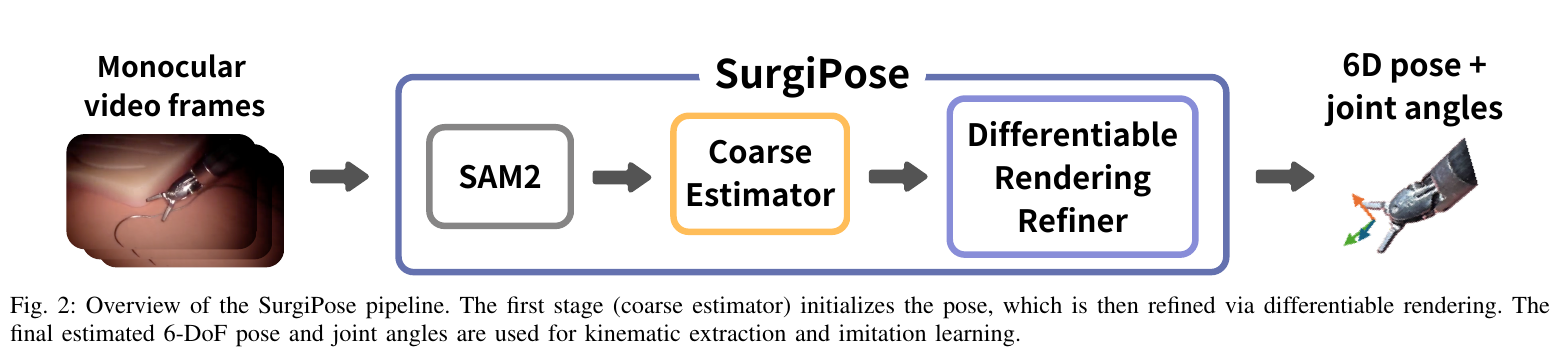
SurgiPose 试图补上“只有手术视频、没有同步机器人状态”到“可用于 imitation learning 的动作轨迹”之间的缺口。其链路是:
monocular video → mask / crop → { T C E , t , q t } t = 1 T → Δ actions → ACT policy . \text{monocular video}
\rightarrow
\text{mask / crop}
\rightarrow
\{T_{CE,t},\mathbf q_t\}_{t=1}^{T}
\rightarrow
\Delta \text{actions}
\rightarrow
\text{ACT policy}. monocular video → mask / crop → { T C E , t , q t } t = 1 T → Δ actions → ACT policy . 它不是从视频直接生成 action,而是先借助已知器械 URDF 和一个离线训练的关节条件 3D Gaussian model,以 render-and-compare 恢复每帧 end-effector 6D pose 与关节角,再把相邻帧状态转成 relative actions。
论文最有价值的实验不是“渲染结果看起来贴合”,而是同一批 220 / 224 条示范分别用 ground-truth 和 video-estimated kinematics 训练策略。估计监督的策略能完成任务,说明 1 cm 量级轨迹误差没有完全破坏学习;但 70% 对 100%、60% 对 80% 的差距同样真实,不能简单概括成无损替代。
2. 输入、输出和隐藏先验
原论文 Figure 2:首帧由 coarse estimator 全局初始化,后续由 differentiable rendering refiner 恢复 6D pose + joint angles。来源:作者公开稿 ;图片版权归论文作者及 IEEE 所有,本站仅作论文解读展示。
直接输入
monocular endoscopic video frames;
camera intrinsics;
目标器械 URDF / 几何结构;
能渲染该器械 articulation 的预训练 3D Gaussian model;
SAM2 segmentation。
输出状态
T C E , t ∈ S E ( 3 ) , q t = [ q p i t c h , q j a w 1 , q j a w 2 ] ⊤ . T_{CE,t}\in SE(3),
\qquad
\mathbf q_t=[q_{\mathrm{pitch}},q_{\mathrm{jaw1}},q_{\mathrm{jaw2}}]^\top. T C E , t ∈ S E ( 3 ) , q t = [ q pitch , q jaw1 , q jaw2 ] ⊤ . 论文只建模 end-effector 部分的三个关节自由度,不恢复整条 PSM 的所有 joint states。绝对位姿是在 camera frame 中表达。
需要警惕的“hardware-free”
方法测试时不读取 robot encoder、stereo depth 或 motion capture,因此对已有单目视频有吸引力。但它不是零先验:
需要准确 camera intrinsics;
需要工具 URDF;
每种工具要在 MuJoCo 中生成合成数据并训练渲染模型;
需要首帧两侧 jaws 可见;
需要视频中器械持续可见;
需要 SAM2 mask 足够稳定。
因此更准确的说法是“不需要同步 robot telemetry 的 model-based video kinematics recovery”,而不是任意视频上的无模型 motion capture。
3. 首帧 324 个候选如何产生
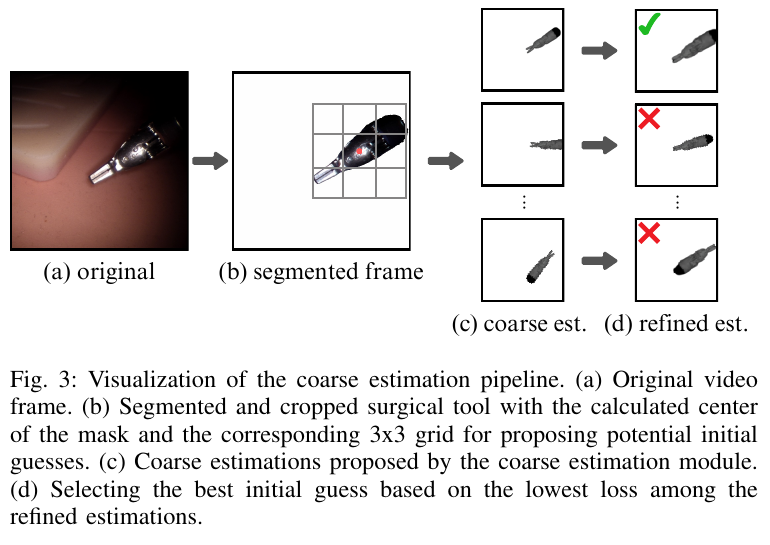
原论文 Figure 3:SAM2 mask center 决定 3×3 image-plane grid;每个位置枚举 36 个绕视轴角度,所有候选先经可微渲染优化,再按 pixel-averaged loss 选最优初值。来源:作者公开稿 ;图片版权归论文作者及 IEEE 所有,本站仅作论文解读展示。
作者把“initial guess”明确定义为视频第一帧的工具 pose。步骤为:
对 SAM2 mask 求中心;
以中心为中点、平行 image plane 建立 3×3 grid;
每个 grid point 生成 36 个 z z z [ 0 , 2 π ) [0,2\pi) [ 0 , 2 π )
得到 9 × 36 = 324 9\times36=324 9 × 36 = 324
每个候选都用 differentiable renderer refinement;
计算 pixel-averaged rendering loss,选择最低者作为 T C E i n i t i a l T_{CE}^{initial} T C E ini t ia l
使用 pixel average 而不是像素 loss 总和,是为了避免“离相机更近、投影像素更多”的候选仅因面积大而受惩罚 / 获益。
该 coarse space 明确没有采样:
绕 image x x x
绕 image y y y
depth。
作者假定 refiner 能恢复这些变量。优点是候选数可控;风险是单目 depth 本来就是最弱方向,若初始 depth 偏差超出 optimization basin,324 个候选也无法解决。论文没有报告:
coarse-only 与 coarse + refiner 的 pose error 消融;
324 候选对单初值 / 随机候选的成功率;
网格尺度和初始 depth 的来源;
候选数量—精度—耗时曲线;
第一帧每个候选的 refinement iterations。
4. 关节条件 3D Gaussian 工具模型
作者把 dVRK large needle driver 的 URDF 放入 MuJoCo,生成:
500 个 canonical tool poses,关节保持 neutral;
10,000 个 pose-conditioned configurations,三个关节从无 self-collision 的状态随机采样;
每个 configuration 从 12 个随机 camera viewpoints 渲染,随机 azimuth、elevation 和 distance;
标签包括关节角、camera extrinsics、camera intrinsics、depth / point clouds 与 rendered images。
按正文直接理解,共有 500 + 10,000 = 10,500 500+10{,}000=10{,}500 500 + 10 , 000 = 10 , 500
训练遵循三阶段 articulated Gaussian 模型流程:
学 canonical 3D Gaussian representation,重建静态工具;
加 deformation field,表达不同 jaw / pitch configuration 引起的形变;
联合优化 canonical model 与 deformation field。
作者基于公开 3D Gaussian Splatting 实现,在 RTX 4090 上训练 20,000 iterations,并缩短 URDF shaft,让 Gaussian capacity 更集中在像素面积远小于 shaft 的 jaws。
这说明 SurgiPose 的可微表示不是直接 rasterize CAD silhouette,而是一个从合成多视角外观 / 深度学出的 articulated radiance representation。它可能比硬 mesh 更能拟合器械外观,但也引入:
synthetic-to-real appearance gap;
每个新工具重新生成数据 / 训练的成本;
deformation field 是否物理对应真实关节的可辨识性;
3DGS opacity / scale 造成投影“缩小工具”以降低 loss 的风险。
5. Pose 与 joint 的联合可微优化
测试时渲染图 I r e n I_{\mathrm{ren}} I ren I o b s I_{\mathrm{obs}} I obs
L c o m b i n e d = α ( 1 − S S I M ( I r e n , I o b s ) ) + ( 1 − α ) ∥ I r e n − I o b s ∥ 2 2 , α = 0.8. \mathcal L_{\mathrm{combined}}
=
\alpha\left(1-\mathrm{SSIM}(I_{\mathrm{ren}},I_{\mathrm{obs}})\right)
+(1-\alpha)\|I_{\mathrm{ren}}-I_{\mathrm{obs}}\|_2^2,
\qquad
\alpha=0.8. L combined = α ( 1 − SSIM ( I ren , I obs ) ) + ( 1 − α ) ∥ I ren − I obs ∥ 2 2 , α = 0.8. SSIM 提供结构 / 局部外观相似性,MSE 保留逐像素约束。与上一篇 dVRK silhouette-calibration 论文不同,SurgiPose 依赖 articulated 3D Gaussian rendered appearance,不只是二值 mask。
优化参数:
rotation learning rate α R = 0.3 \alpha_R=0.3 α R = 0.3
translation learning rate β = 3 × 10 − 4 \beta=3\times10^{-4} β = 3 × 1 0 − 4
translation gradient clamp [ − 0.02 , 0.02 ] [-0.02,0.02] [ − 0.02 , 0.02 ]
joint learning rate γ = 10 − 3 \gamma=10^{-3} γ = 1 0 − 3
learning-rate reduction factor 0.5;
plateau patience 20 epochs;
连续 10 iterations 的 loss change 小于 10 − 7 10^{-7} 1 0 − 7
joint angles clamp 到 [ q min , q max ] [\mathbf q_{\min},\mathbf q_{\max}] [ q m i n , q m a x ]
论文给出的 rotation 更新近似为:
R u p d a t e d = R c u r r e n t ( I + α R ∇ R ) , R_{\mathrm{updated}}
=
R_{\mathrm{current}}\left(I+\alpha_R\nabla R\right), R updated = R current ( I + α R ∇ R ) , 然后强制回到合法 homogeneous transform。正文没有说明具体如何投影回 S O ( 3 ) SO(3) S O ( 3 )
joint update 为:
q u p d a t e d = clamp ( q c u r r e n t − γ ∇ q L , q min , q max ) . \mathbf q_{\mathrm{updated}}
=
\operatorname{clamp}\left(
\mathbf q_{\mathrm{current}}
-\gamma\nabla_{\mathbf q}\mathcal L,
\mathbf q_{\min},
\mathbf q_{\max}
\right). q updated = clamp ( q current − γ ∇ q L , q m i n , q m a x ) . 约束只能防止超出机械限位,不能消除单目投影中 pose 与 articulation 互相补偿的歧义。
6. 时序追踪策略
第一帧完成 coarse + refinement 后,后续每帧:
使用上一帧 refined pose 作为 initialization;
同时优化 pose 和 joints;
每帧最多 10 iterations;
plateau 时 early stop。
它本质上是 frame-to-frame warm-start optimization,没有显式:
velocity / acceleration motion model;
Kalman / particle filter;
optical flow;
temporal consistency loss;
re-detection / lost-state recovery;
occlusion memory。
所以只要工具连续可见、相邻帧运动小,它可以平滑跟随;一旦遮挡、出画或 mask 跳变,错误会传给下一帧。论文也明确把 continuous visibility 和第一帧双 jaw 可见列为限制。
“最多 10 iterations”不能自动等同于 real-time:文中没有 pose extraction 的 seconds/frame、fps、序列长度或 GPU memory。只有 3DGS model training 和 policy training 的硬件 / 时长信息。
7. 从绝对状态到可学习 action
实验使用 dVRK Si:
PSM + large needle driver;
ECM endoscope 固定,提供全局 camera frame;
wrist camera 装在 needle driver 上,为 policy 提供局部视觉;
pink suture pad 作背景;
tissue-lifting 用白色 2D pad;
needle-pickup 用 surgical needle。
SurgiPose 只用 endoscopic monocular video 恢复 kinematics。Wrist camera image 不进入 pose estimator ,但在训练和执行 ACT policy 时作为额外视觉输入。
动作采用 SRT 的 hybrid-relative representation:
translation delta 在 endoscope frame 表达;
rotation delta 在 current end-effector frame 表达;
jaw action 单独输出。
相对动作能减弱 da Vinci encoder 绝对状态误差对 policy supervision 的影响。这里存在一个容易忽略的事实:policy 最终不是盲目“回放估计轨迹”,而是图像条件的闭环策略;尤其 needle task 中,作者观察到两种 policy 都利用 wrist camera 做视觉对准。因而 policy success 不只是轨迹标签精度,也受视觉 encoder、ACT action chunking 和 wrist-camera feedback 影响。
8. 数据规模和评价设计
主数据:
tissue lifting:220 demonstrations;
needle pickup:224 demonstrations;
每条同时保存 video 与 ground-truth kinematics;
同一视频经 SurgiPose 得到 estimated kinematics。
对每个任务训练两类 policy:
图像 + ground-truth relative actions;
相同图像 + estimated relative actions。
这样控制了示范内容差异,能较直接测试“替换动作标签”的代价。但论文没有说明 train / validation split、是否所有 444 条示范都用于训练、训练 seeds、action horizon、ACT hyperparameters 和 augmentation。
每类 policy 每项任务只执行 10 trials。成功率的一个样本就是 10 个百分点,因此 100% / 70% 或 80% / 60% 都有很大的二项采样不确定性;论文没有 confidence interval 或多随机种子。
9. 轨迹误差结果
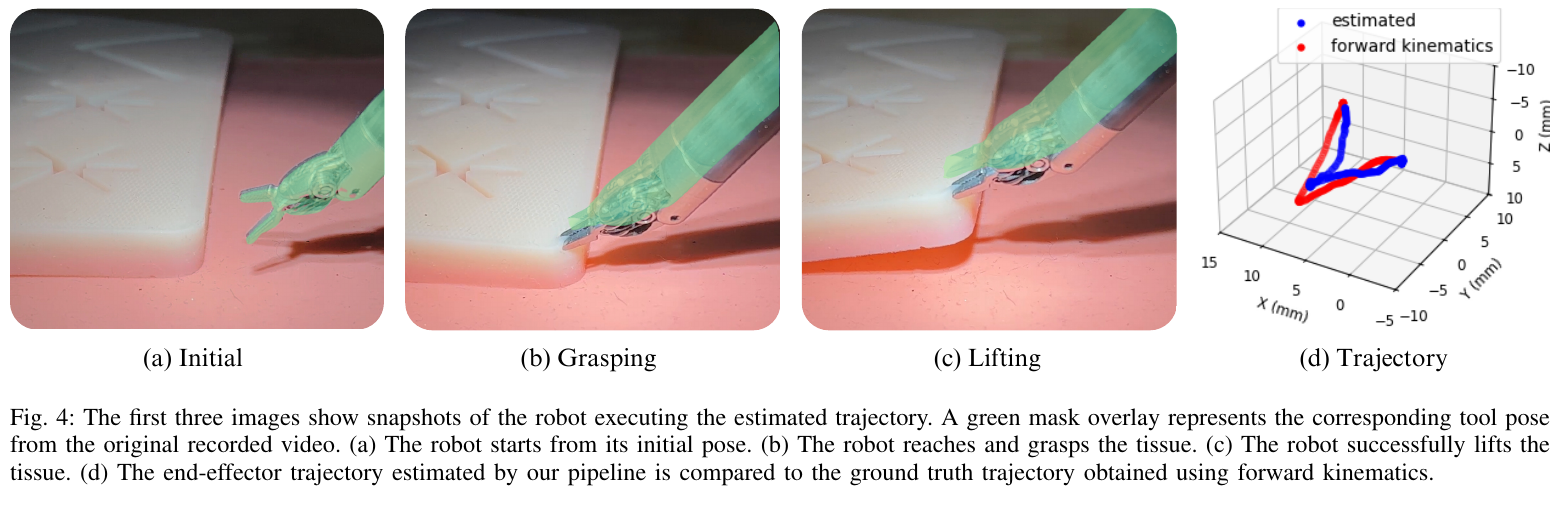
原论文 Figure 4:机器人从初始、抓取到抬起阶段回放估计轨迹,绿色 overlay 来自原示范视频的估计工具 pose;右侧蓝色估计轨迹与红色 forward-kinematics trajectory 大体一致,但深度存在偏差。来源:作者公开稿 ;图片版权归论文作者及 IEEE 所有,本站仅作论文解读展示。
定义:
A D E = 1 T ∑ t = 1 T ∥ p ^ t − p t ∥ , F D E = ∥ p ^ T − p T ∥ . \mathrm{ADE}
=
\frac1T\sum_{t=1}^{T}
\|\hat{\mathbf p}_t-\mathbf p_t\|,
\qquad
\mathrm{FDE}
=
\|\hat{\mathbf p}_T-\mathbf p_T\|. ADE = T 1 t = 1 ∑ T ∥ p ^ t − p t ∥ , FDE = ∥ p ^ T − p T ∥. 结果:
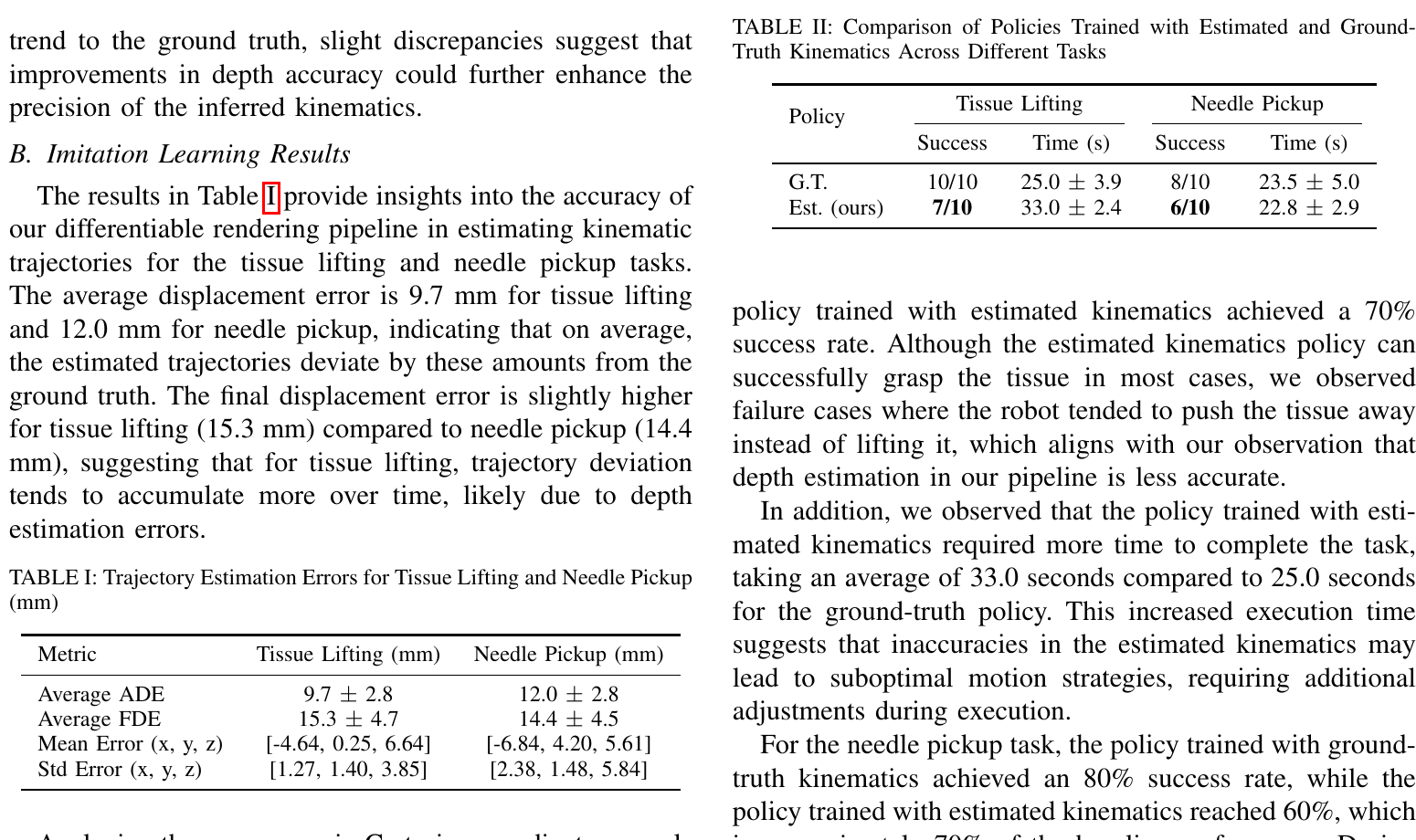
Metric Tissue lifting Needle pickup ADE ↓ 9.7 ± 2.8 mm 12.0 ± 2.8 mm FDE ↓ 15.3 ± 4.7 mm 14.4 ± 4.5 mm Mean ( x , y , z ) (x,y,z) ( x , y , z ) [ − 4.64 , 0.25 , 6.64 ] [-4.64,0.25,6.64] [ − 4.64 , 0.25 , 6.64 ] [ − 6.84 , 4.20 , 5.61 ] [-6.84,4.20,5.61] [ − 6.84 , 4.20 , 5.61 ] Std ( x , y , z ) (x,y,z) ( x , y , z ) [ 1.27 , 1.40 , 3.85 ] [1.27,1.40,3.85] [ 1.27 , 1.40 , 3.85 ] [ 2.38 , 1.48 , 5.84 ] [2.38,1.48,5.84] [ 2.38 , 1.48 , 5.84 ]
两点解读:
Needle pickup 的平均轨迹误差更大,但 tissue lifting 的 final error 略大,提示不同任务的累计误差形态不同。
两任务的 z z z
作者给出一个值得重视的失败机制:可微渲染可能偏向把投影工具变小来降低视觉 discrepancy,相当于把工具估得离相机更远。它不是普通零均值噪声,而可能是 loss / representation 引入的系统性 depth bias。
表中 ground truth 来自 robot forward kinematics。dVRK 本身存在 cable-driven encoder error,因此它不是外部 motion-capture 真值;论文用 hybrid-relative action 正是为了减轻这类误差。页面将其称为“记录的 ground-truth kinematics / 论文真值”,不把它提升为物理绝对真值。
10. 模仿学习结果没有“无损”
原论文 Table I 与 Table II。Estimated policy 可以完成两项任务,但 tissue lifting 成功率下降 30 个百分点且耗时增加 8 秒;needle pickup 下降 20 个百分点。每格仅 10 trials,没有置信区间。来源:作者公开稿 ;表格版权归论文作者及 IEEE 所有,本站仅作论文解读展示。
Policy supervision Tissue lifting Needle pickup Ground-truth kinematics 10/10;25.0 ± 3.9 s 8/10;23.5 ± 5.0 s Estimated kinematics 7/10;33.0 ± 2.4 s 6/10;22.8 ± 2.9 s
Tissue lifting
estimated supervision 的绝对成功率下降 30 points;
成功 trial 平均多用 8.0 s;
常见失败是把 tissue 推远而不是提起,与 depth 偏差一致;
失败 trial 被排除在平均耗时之外,因此 33.0 s 不是所有 10 次的统一平均。
Needle pickup
ground-truth policy 本身也只有 80%,说明任务和训练集存在明显上限;
estimated policy 为 60%,绝对下降 20 points;
两者都使用 wrist view 进行视觉对中,执行表现并非单纯 open-loop replay;
训练示范主要是成功轨迹,没有 recovery demonstrations,偏差累积后 policy 不会恢复。
“Comparable”可以支持“估计监督有实用信号、不是完全失效”,但不能支持统计等价。样本只有 10 trials、没有 seed variation,甚至无法判断差距是否稳定。
11. 跨数据集结果的证据等级
SurgRIPE
SurgRIPE 使用 keydot marker 得到 absolute tool pose,再从图像中 inpaint marker;它没有 ground-truth joint angles。SurgiPose 只展示随机帧 silhouette overlay,正文明确称为 qualitative assessment。即使 absolute pose GT 存在,论文也没有报告 translation / rotation error。
Ex vivo cholecystectomy
自采 ex vivo 数据包含 kinematics,工具改为 ProGrasp forceps。Figure 6 展示:
蓝色 estimated 与红色 recorded trajectory 的图像投影;
三帧 segmented tool 与 rendered silhouette overlay。
仍没有 ADE / FDE / joint-angle error。不同工具需要对应 geometry / URDF 和 articulated Gaussian model,这不是对任意新工具的 zero-shot generalization。论文也没有说明 ProGrasp 的 synthetic training 数量与是否完全沿用 large needle driver 超参数。
因此可以说“流程能在第二种工具和 ex vivo 视觉域运行”,不能说“跨工具定量泛化已验证”。
12. “互联网规模手术学习”还缺什么
论文的动机指向 online surgical videos,但主实验数据来自同步采集的 dVRK Si:
相机固定;
相机内参已知;
工具型号已知;
URDF 已知;
首帧姿态相对受控;
图像和 robot kinematics 同步,只是在估计分支中不用 kinematics。
真实公开视频还会遇到:
视频压缩、缩放与未知 / 变化 intrinsics;
镜头运动、zoom 和 crop;
多工具、换工具、器械只露出一部分;
烟雾、血液、组织遮挡与强高光;
未知 surgical robot model;
时间编辑、镜头切换和非连续轨迹;
无法确定 metric scale;
右 / 左工具和同形对称歧义。
所以当前结果是“受控单目示范恢复的 proof of feasibility”,而不是已经完成 internet-scale harvesting。
13. 复现状态
可获得依赖
dVRK URDF / model repository;
SAM2;
MuJoCo;
3D Gaussian Splatting 基础实现;
ACT、EfficientNet-B3 等公开方法。
论文提供的参数
500 canonical + 10,000 articulated configurations;
每配置 12 views;
3DGS training 20,000 iterations,RTX 4090;
SSIM weight 0.8;
rotation lr 0.3;
translation lr 3 × 10 − 4 3\times10^{-4} 3 × 1 0 − 4
translation gradient clamp [ − 0.02 , 0.02 ] [-0.02,0.02] [ − 0.02 , 0.02 ]
joint lr 10 − 3 10^{-3} 1 0 − 3
LR reduction factor 0.5,patience 20;
loss-change early-stop threshold 10 − 7 10^{-7} 1 0 − 7
later-frame maximum 10 iterations;
policy training 约 20 h / RTX 4090。
仍缺
SurgiPose method repository 与 trained checkpoints;
MuJoCo scene、rendering ranges 与 dataset split;
exact articulated 3DGS / deformation implementation;
3×3 grid spacing、initial depth 和 crop normalization;
first-frame candidate refinement steps;
SAM2 prompt / tracking strategy;
S O ( 3 ) SO(3) S O ( 3 ) pose extraction runtime;
ACT config、train split、random seeds;
220 / 224 demonstrations 与 ex vivo data;
per-frame rotation error / joint-angle error;
failure detection 和 reinitialization。
截至 2026-07-31,作者主页提供论文入口,但未找到公开的 SurgiPose 方法代码、数据或预训练模型。不能把其引用的 dVRK model / 3DGS 基础仓库记作“方法已开源”。
14. 局限
每个工具依赖 URDF 与专门训练的 articulated Gaussian model;
首帧仅枚举平面位置与绕视轴旋转,没有 coarse depth / x , y x,y x , y
324 候选和首帧 refinement 的耗时未报告;
后续 10 iterations 也没有 fps;
无显式 temporal loss、motion model、遮挡恢复或 re-detection;
要求 continuous visibility;
首帧要求两个 jaws 可见;
依赖 SAM2 first-frame segmentation;
单目 depth 存在系统性正偏差;
ground-truth kinematics 来自 forward kinematics,不是外部测量;
只报告 translation trajectory error,缺 rotation / joint-angle error;
主方法没有与其他 monocular articulated pose trackers 做定量对比;
imitation policy 每项仅 10 trials;
estimated supervision 成功率低 20–30 points;
SurgRIPE / ex vivo 泛化只有定性图;
“online videos” 没有真实互联网数据实验;
方法代码和训练数据未公开。
15. 最终评价
SurgiPose 把 6D pose 研究从“每帧姿态误差”推进到一个更有意义的问题:恢复出的运动学是否足以监督机器人 policy。324 候选首帧初始化、关节条件 3DGS 和上一帧 warm start 组成了清楚的 model-based video pipeline;1 cm 左右 ADE 仍能训练出可执行 tissue / needle policies,是值得记录的正结果。
但证据不支持“estimated kinematics 与 ground truth 等价”。成功率仍有 20–30 个百分点差距,单目 depth bias 会直接变成推远组织的动作失败,且跨工具 / 跨数据只做定性展示。更准确的定位是:在已知 dVRK 工具、固定相机和连续可见的受控数据上,SurgiPose证明了“从 RGB 恢复的近似运动学可以成为 imitation learning supervision”;离真正自动采集互联网手术示范,还需要相机自标定、遮挡重定位、metric-depth 约束、跨工具模型和大规模外部真值评测。