1. 核心判断
论文:CVF Open Access
项目:Intrinsic 3PT
核心判断:3PT 的系统意义大于单一 pose head:它把 detection、segmentation、pose hypothesis、render matching 和 scoring 设计成统一 object-centric Transformer,避免传统 zero-shot pipeline 由多个冻结模型拼接而成。
2. 一句话定位
object 3D model 在推理时作为条件输入,2D/3D towers 在 RGB 场景中共同建立物体表示,并用连续 refinement 输出检测、mask 和 6DoF pose。
2.1 论文图表导读
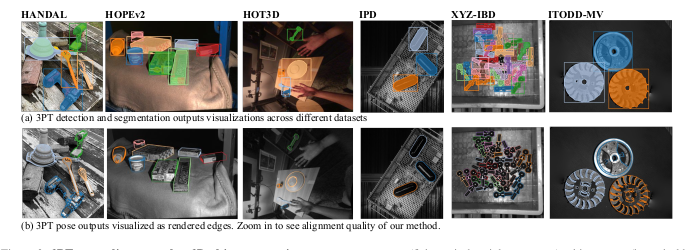
图表 精读问题 Figure 1 3PT 是否真的同时理解 detection、segmentation 和 pose? Figure 2 跨 fisheye、industrial、consumer camera 的 zero-shot 能否保持? Figure 3 BOP-H3、BOP-Industrial、BOP-Classic 的 AP 变化来自哪一个 tower? Figure 4 AR glasses、bin picking、DIMM insertion 的 pose 是否足以支持动作? Table 1 3PT-D detection 与 3PT(D+R) pose 的增益如何分解? Table 2 / ablation multi-view、orientation templates、vocabulary scale 与 refinement 的贡献是什么?
原论文图表中的相关区域:3PT 以 object 3D model 和单 / 多视角图像为输入,统一输出 detection、segmentation 与 6D pose。来源:项目页 / CVF Open Access 。图片版权归论文作者及出版方所有,本站仅作论文解读展示。
3. 问题设定与任务边界
zero-shot 物体感知要求测试物体只在 inference 时以 3D model 形式出现,不能为每个目标训练新模型。
单 RGB 模式不使用 depth;multi-view RGB 模式利用相机标定和多视角信息进一步改善 pose。
detection 与 pose 在野外必须同时处理未知 object count、false positives 和遮挡,因此论文采用 AP / AP-mm 而非只报告已知目标数量下的 AR。
3PT 是 model-based at inference,不等同于 CAD-free;它的优势是免 object-specific training、免 depth 和统一感知接口。
4. 研究脉络
传统 pipeline 先检测,再用 CNOS / DINO / GroundingDINO / SAM 得到 mask,再用 matching、ICP、render-and-compare 得到 pose。
这种 ensemble pipeline 的接口固定、误差难传递,且 generic foundation model 对 industrial object 的 3D understanding 不足。
3PT 训练专门的 2D / 3D object-centric towers,并让它们在同一个 object representation 上做 detection、segmentation 和 pose。
5. 研究动机
真实工业物体不断变化,per-object training 和手工 CAD onboarding 成本高。
depth 在 fisheye、反光、透明和工业相机上可能不可用或不稳定,RGB-only 更容易部署。
detection、segmentation 和 pose 共享 object identity 与 geometry,拆开训练会丢掉互相帮助的信号。
通过大规模 3D-model-conditioned synthetic training,学习从 object model 到真实图像的跨域对齐。
6. 方法详解
6.1 Two-tower object perception
Object Encoder 处理输入 3D model,在多视角 orientation templates 下生成 object embeddings。
Image tower 处理原始 RGB,输出 object candidates、pixel features 和 detection evidence。
3PT-D 融合 object / image evidence,完成 zero-shot detection 与 mask;object representation 还携带 orientation 信息供 pose 阶段复用。
6.2 Pose hypothesis generation
通过 2D detections 和多视角 images 建立 object evidence,预测多个 coarse orientation / translation hypotheses。
multi-view 模式将多个 calibrated views 的 2D detections 转成 3D hypotheses,并保留 top-K rotations。
通过 hypothesis fusion、SE(3) distance filtering 和 confidence 保持多解,避免单次初始化错误锁死。
6.3 Render-and-compare refinement
对每个 pose hypothesis 渲染 object model,获得 rendered RGB / feature map。
以 3D model point 投影和真实 image feature 建立 reciprocal correspondence,优化 pose update。
3PT-R 输出 segmentation、pose confidence 和 refined pose;每轮过滤底部 hypotheses,再进行后续 refinement。
训练包括 segmentation loss、classification loss 和 matching loss;matching 让真实—渲染对应 feature 相似、非对应 feature 分离。
7. 数据与训练
训练约 900,000 unique synthetic images,使用超过 100,000 mesh files,平均每图约 110 个 annotated instances,增广前约 100M unique object instances。
场景包含 clutter、紧密堆叠、浮空物体、随机背景和不同 camera / lighting。
训练 hypotheses 由 GT pose 扰动产生;3PT-R 同时学习 segmentation、hypothesis score 与 feature matching。
BOP 评测涵盖 13 datasets:BOP-H3(HOPE、HOT3D、HANDAL 等)、BOP-Industrial(ITODD、IPD、XYZ-IBD 等)和 BOP-Classic。
8. 实验分析
8.1 主结果
detection:在 12/13 benchmarks 上达到新高;BOP-H3 相对提升 13.3 AP,BOP-Industrial 提升 23.6 AP,BOP-Classic 提升 4.6 AP。
single-view RGB pose:BOP-H3 平均 AP 提升 12.3,BOP-Classic 平均提升 5.4;在 T-LESS 上 zero-shot multi-view RGB 的 AR 为 90.0,超过 supervised / seen MV-RGB baseline 4.2。
industrial mm-level pose:BOP-Industrial 平均 AP-mm 为 80.6,较此前最佳提升 29.1;只用 RGB 也超过多个 zero-shot RGB-D 方法。
排名:论文报告在 BOP Challenge 2025 的 11 个 tracks 中 7 个排名第一。
8.2 真实应用
AR glasses multi-view pose tracking、long-range cluttered bin-picking、sub-mm DIMM insertion 三类案例展示了从 pose 到动作的闭环潜力。
论文报告工业 bin picking 中超过 100 次成功尝试;这类结果比单一 benchmark AP 更能说明系统可部署性,但仍受特定硬件与动作流程影响。
8.3 消融
3D model vocabulary 从 35k 增到 110k 带来约 5.1 AP 提升,说明大规模 object diversity 是 zero-shot 的核心。
multi-view、orientation templates、classification / scoring 和 refinement 都有独立收益。
与 generic foundation ensemble 相比,原生 3D-conditioned training 在 BOP-H3 和工业数据上更稳定。
9. 批判性分析
优势 :统一接口、任务覆盖完整、工业评测强,且明确把 AP 与 AP-mm 用于未知 object count 的真实检测场景。系统成本 :训练数据、3D model vocabulary 和多 tower architecture 都较重;推理时仍需准备 3D model。泛化边界 :zero-shot 依赖 object model 的质量;未建模的透明、严重反光、细薄结构仍可能造成渲染与真实 feature mismatch。指标边界 :BOP AP-mm 不能完全覆盖抓取姿态可执行性、碰撞、时间稳定性和 recovery。
10. 对我的研究的启发
物体位姿估计可以和检测、分割共享 object-centric representation,而不是把 pose 作为最后孤立 head。
训练数据的 3D model vocabulary 规模与类别长尾应作为独立变量统计。
多解 pose hypothesis + feature refinement 是连接 zero-shot 泛化与可靠工业部署的有效结构。
11. 待解决问题
如何在没有完整 3D model、只有少量 reference view 时保留 3PT 的统一 perception 能力?
如何把 transparent / deformable / articulated object 纳入 3D model-conditioned representation?
如何把 pose confidence 转成机器人动作的安全边界、重试和主动观测策略?
12. 精读补充:3PT 的统一感知与规模效应
12.1 Main Table 1 的精确数字
任务 BOP-H3 BOP-Industrial BOP-Classic 平均 / 关键结论 3PT-D detection AP 55.1 57.9 57.9 相对此前最好分别 +13.3、+23.6、+4.6 3PT(D+R) single-view RGB pose AP 58.7 — 66.0 H3 +12.3,Classic +5.4 3PT(D+R) industrial MV-RGB AP-mm — 80.6 — 相对最佳 +29.1
细分数据集上,BOP-H3 的 single-view RGB pose 为 H3D 55.3、HOPEv2 55.1、HANDAL 65.7;BOP-Classic 为 LMO 64.2、T-LESS 77.5、TUD-L 71.8、IC-BIN 37.1、ITODD 64.4、HB 79.6、YCB-V 67.5。T-LESS 的 zero-shot multi-view RGB AR 为 90.0,比 supervised / seen MV-RGB 方法高 4.2。
12.2 3D vocabulary 与 hypothesis 的消融
论文表明 3D model vocabulary 从 35k 增到 110k,平均 AP 提升 5.1;110k CAD、300k training iterations 的 mean AP 为 56.4,相比 35k / 100k 的 49.7 提升 6.7。multi-view refinement 的工业 AP-mm 从 FRTPose 68.3 提升到 3PT full 80.6,其中仅加入 refinement 已到 78.3,说明多视角 feature alignment 是主要增益来源。
Single-view BOP-H3 上,Co-Op 1 hypothesis 为 46.4,加入 refinement 为 47.8;3PT 的 K=1 为 55.1,K=5 为 58.7。也就是说,多 hypothesis 不只是冗余输出,它给 refinement 留出了从不同 orientation basin 中选择的空间。
12.3 训练与系统边界
论文在不同分析处报告了约 900k unique synthetic images / >100k mesh files,以及扩大训练时使用 76.8M images、110k unique 3D object models;这两个数字对应不同的训练 / scaling 描述,不应合并写成单一数据集大小。平均每张图约 110 个 annotated instances,增广前约 100M object instances。
3PT 的 inference 仍需要 object 3D model。bin picking 中 50 个物体约 1.6 s(已知 object class),未知 class 的 per-object image tower 是主要瓶颈;论文展示了超过 100 次真实 bin-clearing 和 96/96 DIMM insertion,但这些是特定硬件 / 动作流程下的应用结果。
12.4 作者声称与我的分析
作者声称 我的判断 统一 2D/3D object representation 带来 zero-shot detection + pose BOP-H3 / Industrial / Classic 三组 AP 和工业应用共同支持。 只用 RGB 也能达到 mm-level industrial pose 80.6 AP-mm 与 RGB-D baseline 的比较支持,但依赖 calibrated multi-view 与 object mesh。 scale 是 zero-shot 泛化核心 vocabulary 35k→110k 的 +5.1 AP 是清晰证据;还需类别长尾与 mesh quality 审计。
13. 研究复现清单
固定 3D model orientation templates、hypothesis 数 K、refinement iterations、BOP AP / AP-mm 阈值、object class 是否已知和 multi-view camera calibration。把 detection、segmentation、coarse pose、rendered feature alignment、final pose 与机器人成功率分别记录;只有这样才能判断失败来自 object proposal,还是来自真正的 SE(3) refinement。