论文精读笔记:FAFA
1. 核心判断
FAFA 处理的是一个比普通室内 pose 更苛刻、但也更窄的设定:水下近红外 depth 常失效,真实 6D 标注昂贵,因此只依靠 RGB、已知 UUV CAD、synthetic GT 和无标签 target-real images。
它把 sim-to-real 分成两个阶段:
先改变训练输入的频谱 :保留 synthetic phase / geometry,混入 real amplitude / style;再改变 refinement 网络的约束 :teacher–student 不只对齐最终 pose 或 flow,还对齐 photometric warp、rendered mask 与 feature space。
ROV6D 的 91.39 mean 接近 labeled upper bound 92.43,是论文最强结果;DeepURL 的 73.46 虽超过 PFC 68.72,却仍距 92.68 的 upper bound 很远。因而它证明多层自监督有效,但不支持“无标签适配已普遍替代真实标注”的结论。
2. 精确任务边界
给定:
一个已知 UUV 的 3D CAD;
带 pose GT 的 synthetic RGB;
一组目标水域无标签 real RGB;
camera intrinsics;
外部 coarse pose estimator 的初值 P 0 P_0 P 0
目标是从真实 underwater RGB refinement 出准确 S E ( 3 ) SE(3) S E ( 3 ) instance-level、model-based、monocular pose refinement ,不是:
从整图完成 detection + pose 的端到端系统;
无初值的 absolute pose;
未见对象 / 类别级 pose;
无目标域样本的 domain-generalization。
论文在预训练阶段的 FFT augmentation 已读取 random target-real images 的 amplitude。因此 OURS (LB) 虽然没有 self-supervised teacher–student fine-tuning,也不是严格意义的 synthetic-only baseline;表中 Real Data 明确标为 Unlabeled。
3. FFT augmentation:目标风格先进入 synthetic pretraining
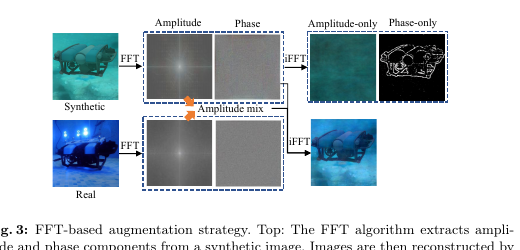
原论文 Figure 3。作者将 phase 解释为较稳定的轮廓 / 结构,将 amplitude 解释为域相关外观;最终图像保留 synthetic phase,并混合或丢弃 amplitude。来源:ECVA 正式论文 ;图片版权归论文作者及 Springer Nature 所有,本站仅作论文解读展示。
对图像 x x x
F A ( x ) = R ( x ) 2 + I ( x ) 2 , F P ( x ) = arctan I ( x ) R ( x ) . \mathcal F^A(x)=\sqrt{R(x)^2+I(x)^2},\qquad
\mathcal F^P(x)=\arctan\frac{I(x)}{R(x)}. F A ( x ) = R ( x ) 2 + I ( x ) 2 , F P ( x ) = arctan R ( x ) I ( x ) . 给定 synthetic x s x^s x s x r x^r x r
F ^ A ( x s , x r ) = { ( 1 − α ) F A ( x s ) + α F A ( x r ) , δ < δ 0 1 , otherwise , \hat{\mathcal F}^A(x^s,x^r)=
\begin{cases}
(1-\alpha)\mathcal F^A(x^s)+\alpha\mathcal F^A(x^r),
&\delta<\delta_0\\
1,&\text{otherwise},
\end{cases} F ^ A ( x s , x r ) = { ( 1 − α ) F A ( x s ) + α F A ( x r ) , 1 , δ < δ 0 otherwise , 其中 α ∼ U ( 0 , β ) \alpha\sim U(0,\beta) α ∼ U ( 0 , β ) δ 0 = 0.5 , β = 1 \delta_0=0.5,\beta=1 δ 0 = 0.5 , β = 1
x s → r = F − 1 [ F ^ A ( x s , x r ) e − j F P ( x s ) ] . x^{s\rightarrow r}=
\mathcal F^{-1}
\left[
\hat{\mathcal F}^A(x^s,x^r)e^{-j\mathcal F^P(x^s)}
\right]. x s → r = F − 1 [ F ^ A ( x s , x r ) e − j F P ( x s ) ] . amplitude mix 注入 target-water 的色偏、照度和模糊风格;amplitude dropout 迫使网络更依赖 phase / contour。它是一种低成本 domain randomization,但“phase 是 domain-invariant geometry、amplitude 是 style”只是近似:强散射、局部遮挡与 caustics 同样会改变 phase;全局 amplitude mixing 也不能模拟空间非均匀水体。
4. Flow–pose 迭代 refinement
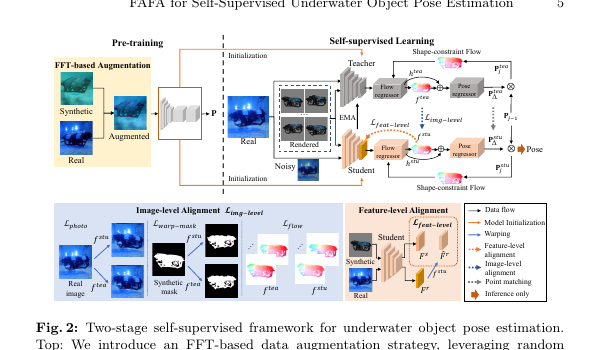
原论文 Figure 2。网络由 feature encoder、RAFT 风格 flow regressor 和 pose regressor 构成;pose 生成 shape-constraint flow,flow 又更新 relative pose,形成可微迭代。来源:ECVA 正式论文 ;图片版权归论文作者及 Springer Nature 所有,本站仅作论文解读展示。
从 coarse P 0 P_0 P 0 N = 4 N=4 N = 4 P j = [ R j ∣ t j ] P_j=[R_j|t_j] P j = [ R j ∣ t j ] p i p_i p i
λ i [ u i 1 ] = K ( R j p i + t j ) . \lambda_i
\begin{bmatrix}u_i\\1\end{bmatrix}
=K(R_jp_i+t_j). λ i [ u i 1 ] = K ( R j p i + t j ) . 相对于 P 0 P_0 P 0 R Δ , t Δ R_\Delta,t_\Delta R Δ , t Δ
teacher 用 8 iterations,student 用 4;teacher 权重是 student 的 EMA,factor 0.999。clean input 的 teacher flow 只有通过 forward / backward geometric-consistency 筛选后才作为 pseudo-label。这个门控能去掉部分水下纹理造成的错误 flow,但论文未报告有效 pseudo-flow 像素比例、threshold sensitivity 或不同浑浊度下的保留率。
5. 多层自监督目标
Image-level:
L img = γ 1 L flow + γ 2 L photo + L warp-mask . \mathcal L_{\text{img}}=
\gamma_1\mathcal L_{\text{flow}}+
\gamma_2\mathcal L_{\text{photo}}+
\mathcal L_{\text{warp-mask}}. L img = γ 1 L flow + γ 2 L photo + L warp-mask .
L flow \mathcal L_{\text{flow}} L flow L photo \mathcal L_{\text{photo}} L photo L warp-mask \mathcal L_{\text{warp-mask}} L warp-mask
Feature-level:
real feature 按 student flow warp;
与 synthetic feature 做加权 dissimilarity;
目标是在低照、色偏、模糊下使用比 raw photometric error 更稳的 latent metric。
Pose-level:
teacher pose 作为 pseudo-pose;
model-point matching loss L pose \mathcal L_{\text{pose}} L pose
总损失:
L self = γ 3 L pose + γ 4 L img + L feat , \mathcal L_{\text{self}}=
\gamma_3\mathcal L_{\text{pose}}+
\gamma_4\mathcal L_{\text{img}}+
\mathcal L_{\text{feat}}, L self = γ 3 L pose + γ 4 L img + L feat , 其中 γ 1 = γ 2 = 0.1 , γ 3 = γ 4 = 10 \gamma_1=\gamma_2=0.1,\gamma_3=\gamma_4=10 γ 1 = γ 2 = 0.1 , γ 3 = γ 4 = 10
6. 数据与评测协议
ROV6D
对象:BlueROV,按论文协议视为 symmetric,使用 ADD-S。
synthetic:PBR。
target-real:Pool-Basic 取 1,000 images 自监督。
test:Pool-Occluded。
未使用:小规模、低能见度的开放湖 Maoming subset。
该 split 专门验证由基础池景适配到遮挡池景,但不能证明 pool→open-water 泛化。
DeepURL
对象:Aqua2,使用 ADD。
作者另用 BlenderProc 生成 30,000 PBR synthetic images。
随机 1,000 real images 自监督,其余 real 评测,训练 / 测试不重叠。
无自监督 baselines 使用 UE4 + CycleGAN target style;PFC 与 FAFA 使用 PBR + 同一组 1,000 unlabeled real。
DeepURL Table 2 的 synthetic source 并不统一。FAFA 与 PFC 的比较较公平;与 DeepURL / GDRN / DeepIM / SCFlow 的绝对值还混入 PBR 与 UE4+CycleGAN 差异。
7. 主结果
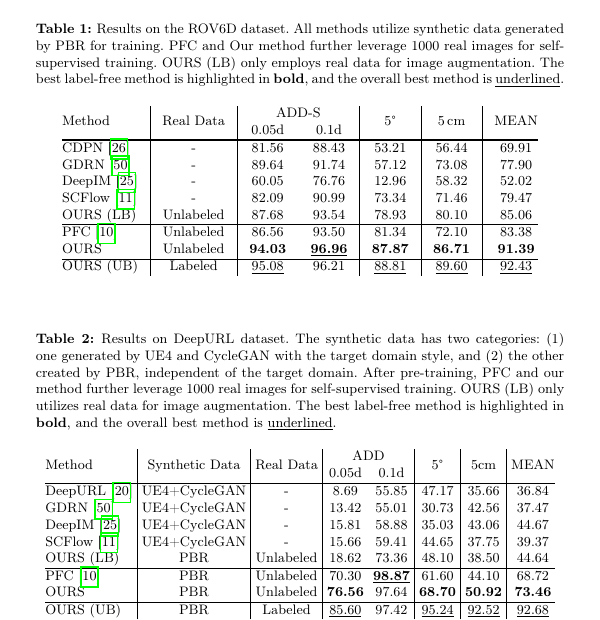
原论文 Table 1–2 合并展示。LB 只使用 real images 做 FFT augmentation;OURS 再使用 1,000 real images 自监督;UB 使用相同 real images 的 pose labels。来源:ECVA 正式论文 ;表格版权归论文作者及 Springer Nature 所有,本站将两张原表组合用于跨数据集阅读。
ROV6D
方法 Real supervision ADD-S 0.05d ADD-S 0.1d 5° 5cm Mean OURS (LB) unlabeled,FFT only 87.68 93.54 78.93 80.10 85.06 PFC unlabeled 86.56 93.50 81.34 72.10 83.38 OURS unlabeled 94.03 96.96 87.87 86.71 91.39 OURS (UB) labeled 95.08 96.21 88.81 89.60 92.43
OURS 比 PFC mean +8.01 points,主要来自 5cm +14.61 和 5° +6.53。其 0.1d 比 UB 高 0.75,但 0.05d、rotation、translation 和 mean 仍低;单个宽 threshold 胜出不等于无标签模型超过监督上界。
DeepURL
方法 Real supervision ADD 0.05d ADD 0.1d 5° 5cm Mean OURS (LB) unlabeled,FFT only 18.62 73.36 48.10 38.50 44.64 PFC unlabeled 70.30 98.87 61.60 44.10 68.72 OURS unlabeled 76.56 97.64 68.70 50.92 73.46 OURS (UB) labeled 85.60 97.42 95.24 92.52 92.68
OURS 比 PFC mean +4.74 points;5cm 的 44.10→50.92 是 +6.82 points,论文所述 15.46% 指相对提升。PFC 在较宽 ADD 0.1d 上反而高 1.23。更关键的是 self-supervised 与 UB 在 5° / 5cm 上仍差 26.54 / 41.60,说明 Aqua2 的精确 rotation / translation 远未解决。
8. 消融:两阶段各自贡献
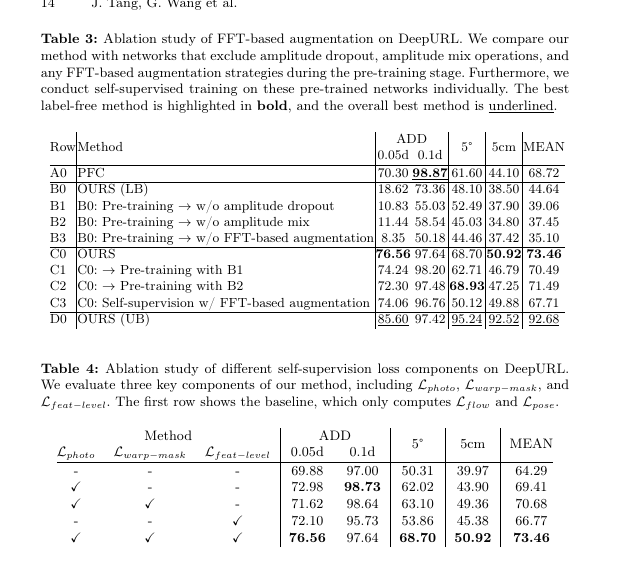
原论文 Table 3–4。上表拆分 amplitude mix / dropout 及其与自监督的组合;下表拆分 photometric、warped-mask 与 feature consistency。来源:ECVA 正式论文 ;表格版权归论文作者及 Springer Nature 所有,本站仅作论文解读展示。
FFT pretraining:
配置 Mean 无 FFT augmentation 35.10 只有 amplitude mix 39.06 只有 amplitude dropout 37.45 mix + dropout,LB 44.64 full pretrain + self-supervision 73.46 self-supervision 时继续 FFT 67.71
mix 与 dropout 有互补性;但进入 target self-supervision 后继续扰动 real images 会破坏真实分布,mean 降 5.75。
Self-supervised losses:
Photo Warp mask Feature Mean — — — 64.29 ✓ — — 69.41 ✓ ✓ — 70.68 — — ✓ 66.77 ✓ ✓ ✓ 73.46
Photo 是最大单项增益;feature-only 也有效,但三层联合最好。论文所述 photo 对 5° 提升 23.28% 是 50.31→62.02 的相对增幅,绝对是 +11.71 points。
9. 工程设置
PyTorch,单张 RTX 3090;
AdamW,batch size 16;
OneCycle,maximum learning rate 4 × 10 − 4 4\times10^{-4} 4 × 1 0 − 4
crop 由初始 pose 决定,resize 到 256×256;
N = 4 N=4 N = 4 teacher / student iterations = 8 / 4;
EMA = 0.999;
self-supervision 冻结 BatchNorm。
论文没有给出:
coarse estimator + 4-view rendering + 12 次 teacher/student iterations 的延迟;
每帧 GPU memory;
是否满足真实 UUV control loop 的实时需求;
初值扰动范围或对初值误差的 success basin。
因此不能从“使用 flow refinement”推断其在线可部署性。
10. 局限与风险
对象太少 :两套数据分别只有 BlueROV 与 Aqua2,难以判断跨几何类别泛化。仍需 target data :新水域需 1,000 real images,且 FFT pretraining 已使用目标域 style。依赖 coarse pose :初值质量决定 CAD render 与真实图像是否有足够 overlap;正文未给系统 sensitivity。无开放水域主结果 :ROV6D Maoming 因数据少被排除,主实验只覆盖 pool。对称约定宽松 :BlueROV 按 symmetric ADD-S 评估会弱化 orientation ambiguity,需同时看 5°。伪 flow / pose 偏差 :teacher 与 student 同源,EMA 只能平滑,不能自动纠正系统性错误。外观假设近似 :频率的 phase / amplitude 不能严格等同 geometry / style。protocol 不完全统一 :DeepURL 中 PBR 与 UE4+CycleGAN baselines 混列。无 runtime :无法评估真实机器人闭环。代码状态 :论文和 ECCV 页写明代码将公开;截至本站核验时,GitHub 仓库只有 README 与两个提交,未包含训练 / 推理实现,故元数据不标记为已开源。
11. 复现检查表
固定 BlueROV / Aqua2 CAD、intrinsics、坐标系和 symmetry;
严格保存 1,000 unlabeled-real IDs 与 evaluation split;
生成与论文一致的 30,000 DeepURL PBR images;
分离 FFT-only LB、teacher–student self-supervision 与 real-label UB;
记录 δ 0 = 0.5 , β = 1 \delta_0=0.5,\beta=1 δ 0 = 0.5 , β = 1
coarse estimator 与 P 0 P_0 P 0
N = 4 N=4 N = 4 EMA 0.999、BN frozen;
复现 flow consistency filtering threshold 和有效像素比例;
分别报告 ADD(-S)、5°、5cm,不用 mean 掩盖精确姿态差距;
计入 detection / coarse pose / rendering / refinement 的端到端速度;
增加 open-water 与跨水体 domain shift 测试。
12. 最终评价
FAFA 的方法设计与水下约束是吻合的:不强求不可得的 depth,而把 CAD projection 转成 shape-constrained flow;不只靠 noisy pseudo-pose,而以 image、mask、feature 和 model points 多级约束它;FFT augmentation 又让 target style 在正式自监督前就进入网络。
最强证据是 ROV6D mean 83.38→91.39、DeepURL 68.72→73.46,以及完整 loss 消融 64.29→73.46。最重要的边界则是:只验证两个已知 UUV、需要初值和 1,000 张目标域真实图、未评开放湖、未给 runtime、代码仓库尚无实现。它是一条有说服力的 underwater pose refinement / adaptation 路线,而不是通用水下 6D pose 系统。