论文精读笔记:Finding NeMO: A Geometry-Aware Representation of Template Views for Few-Shot Perception
1. 基本信息
- 作者 / 机构:Sebastian Jung、Leonard Klüpfel、Rudolph Triebel、Maximilian Durner;German Aerospace Center (DLR)。
- 年份 / 会议:2026 / 3DV Oral。
- 论文页 · arXiv PDF · 代码。
- 阅读模式:精读。
2. 一句话定位
NeMO 以少量 template RGB 建一个可查询、带 object coordinate system 的 Neural Memory Object;这把“每个新物体都反复与全部 templates 匹配”的代价前移到 onboarding,使同一个 dense decoder 可以服务未见对象的 detection、segmentation 和 6DoF pose。
2.1 论文图表导读
| 图表 | 阅读重点 |
|---|
| Figure 2 | template feature 如何在 encoder 中变为 NeMO point memory,以及 decoder 如何以 query image 读取它 |
| Figure 4–5 | model-free detection / pose 与 object surface 的定性结果;区分“框更准”和“pose 更准” |
| Table 1–6 | 不同检测来源、model-free/model-based 设置、BOP AP/AR 与 template-point 数量的 trade-off |
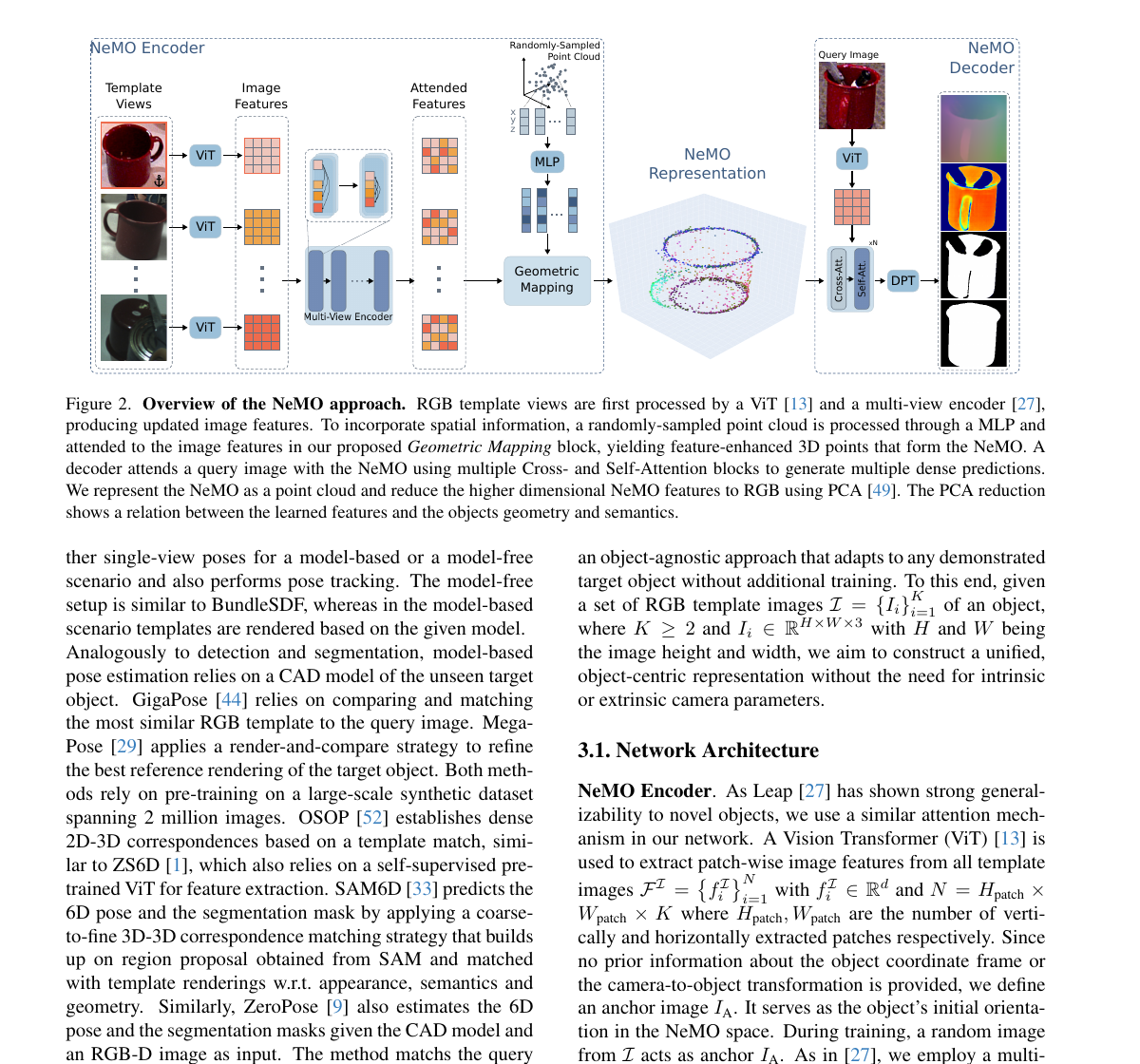 原论文 Figure 2:template views 经 ViT 与 multi-view encoder 构成 NeMO,query image 再从 NeMO 解出 dense predictions。来源:arXiv PDF。图片版权归论文作者及出版方所有,本站仅作论文解读展示。
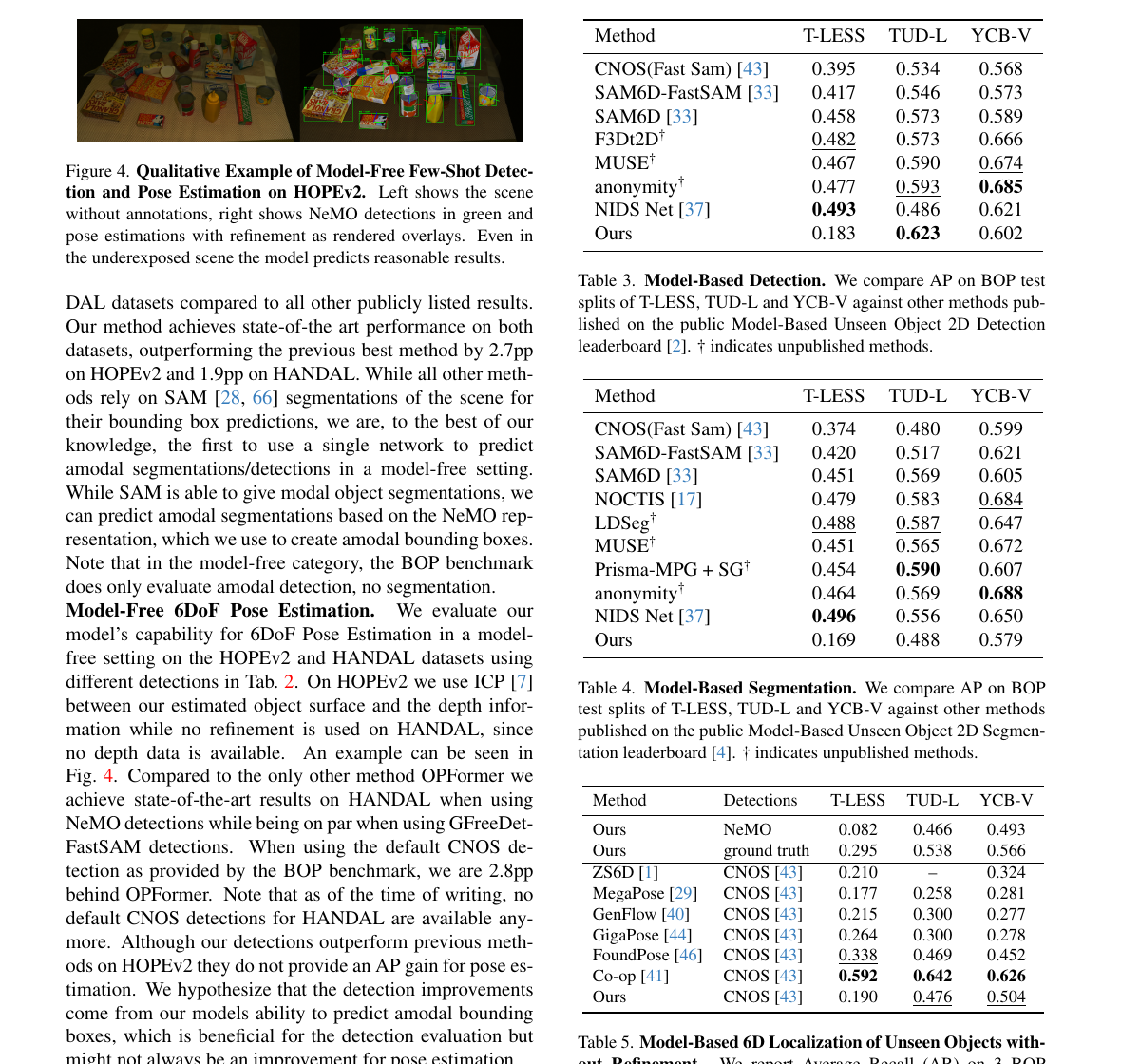 原论文 Figure 4 所在实验页局部:model-free few-shot detection 与 pose overlay。来源:arXiv PDF。图片版权归论文作者及出版方所有,本站仅作论文解读展示。
3. 问题设定与任务边界
- 任务:对训练未见对象进行 model-free 或 model-based few-shot perception;model-free 没有 CAD,model-based 只在推理时提供 CAD render。
- 输入:若干对象 template RGB(论文默认实验常取 32 张)和 query RGB;模型可接收 object crop,HOPEv2 pose 的额外 ICP 使用 depth。
- 输出:amodal detection、modal/amodal segmentation、object surface point map、camera-to-object pose 与 confidence。
- 不需要:为目标物体 fine-tuning,或目标的已知 camera intrinsics / extrinsics 来建立 NeMO coordinate system。
- 仍依赖:template view 覆盖、前端 detection / crop,以及在某些 protocol 中的 depth-based refinement。因而它不是完全无先验的 open-world pose。
4. 方法详解
4.1 Pipeline
- ViT 从每张 template 提取 patch feature,multi-view encoder 将不同视角的信息 cross-attend 融合。
- 从 [−1,1]3 采样初始 points,经 MLP 得到 point feature;Geometric Mapping Block 让 point 与 image feature 交互,形成 feature-enhanced 3D points,即 NeMO。
- query image 经 ViT 后与 NeMO 交替 cross-attention / self-attention;DPT decoder 输出 2D–3D point map、confidence、modal/amodal mask 等 dense maps。
- pose 由 point map / surface correspondence 推出;如果 protocol 允许,ICP 用 depth 再 refine。
4.2 关键模块
| 模块 | 输入 | 输出 | 作用 |
|---|
| Multi-view encoder | template patch features | attended template feature | 聚合少样本视角,避免逐 view 独立匹配 |
| Geometric mapping | template feature + sampled 3D points | NeMO point memory | 让 memory 同时携带几何和语义而非纯 image token |
| NeMO decoder | query feature + NeMO | dense predictions | 将同一 object memory 复用至多个感知任务 |
| Confidence-aware losses | predicted maps / GT | calibrated confidence | 压低 background 或不可靠 pixel 的对应影响 |
4.3 训练与工程复杂度
- 在 Objaverse、GSO、OmniObject3D 的 11,077 个对象渲染数据上训练;BOP test objects 没有进入训练或 target fine-tuning。
- 论文使用 DINOv2 ViT、DPT regression head、AdamW;400k steps,16×A100 约 10 天。这里的 training expense 是模型获得通用 object memory 的主要代价。
- 推理可把 template attention 的昂贵部分提前保存为 NeMO;但 object onboarding 的 view 数、memory size 与实际场景的 coverage 仍决定工程体验。
5. 实验分析
| 设定 | 指标 / 结果 | 我的解读 |
|---|
| model-free detection | HOPEv2 / HANDAL AP = 0.411 / 0.273 | 论文称相对前一最佳高 2.7 / 1.9 pp;说明 amodal object memory 对 detection 有价值 |
| model-free 6DoF,NeMO detection | HOPEv2 / HANDAL AP = 0.302 / 0.235 | 以自己的 detection 做 pose 不一定最优,前端 detection AP 不等价于 pose AP |
| model-based 6D,无 refinement | T-LESS / TUD-L / YCB-V AR = 0.190 / 0.476 / 0.504 | 对 textureless / symmetric 的 T-LESS 明显吃亏;TUD-L、YCB-V 有竞争力 |
| point 数消融 | YCB-V 6D AP:200 points 0.290,500 points 0.380,1000 points 0.383 | 表征容量存在饱和,不能只靠增加 sampled points |
5.1 作者声称与我的判断
| 作者声称 | 证据 | 我的判断 |
|---|
| 新对象可无 fine-tuning onboarding | 训练 / 测试对象分离、few-shot BOP tests | 支持充分,但对象仍需 multiple templates |
| 一个 representation 覆盖多个任务 | detection、segmentation、surface、pose 的多表报告 | 支持,但各任务不是统一最优;共享 decoder 有取舍 |
| 对 cluttered scene 可靠 | HOPEv2 / HANDAL 定量与图示 | 有一定支持;T-LESS 明确暴露 symmetry/textureless 失败 |
6. 批判性分析
优点:将 object-specific information 外置为 NeMO,模型不必随对象数增长;任务联合输出使 pose 可以借助 segmentation / point map;BOP model-free 与 model-based 双协议覆盖较完整。
局限:需要 object template coverage;对称、弱纹理与同类 clutter 仍显著困难;训练成本远高于“few-shot”这个推理阶段标签;论文报告的 AP/AR 受 detector、ICP 是否可用影响,应严格同 protocol 比较。
对研究的启发:可为每个 template correspondence 学一个 confidence 或 visibility field,再把它作为 weighted PnP / refinement 的输入;object memory 还可以存 uncertainty 来避免把 amodal detection 的优势误传为 pose confidence。
