论文精读笔记:FoundPose
1. 核心判断
FoundPose 的贡献可以概括成一句话:DINOv2 的中间层 patch descriptors 已经具备足够强的 real-render correspondence,使“模板检索 → 2D–3D correspondence → PnP”这条经典路线重新成为 unseen-object pose 的强方法,而且不必为 pose 任务训练网络。
这里真正重要的是“中间层”。最后层更偏语义,在无纹理或对称对象上,不同侧面可能得到相似特征;浅层位置性强但跨域语义弱。作者发现 ViT-L/14 registers 第 18 层在 positional 与 semantic information 之间平衡最好。该层让渲染模板与真实图像中的同一对象侧面保持可匹配,从而把 foundation model 从“全局相似度”推进到可用于 PnP 的局部 2D–3D correspondence。
FoundPose 本体及其 featuremetric refinement 都无需 pose-specific training;但论文最高的 59.6 AR 配置还接了 MegaPose refiner,后者在 200 万余合成图上训练。阅读结果表时必须把 training-free 本体与混合系统分开。
2. 任务、输入与对象 onboarding
给定:
- 查询 RGB image;
- camera intrinsics;
- 带 object identity 的 segmentation mask;
- texture-mapped 3D model。
目标是估计 model-to-camera R,t。默认 mask 来自 CNOS;对象 mask 识别和 pose 使用同一 CAD inventory,因此并非在完全未知身份的开放世界中检测。
BOP 2023 unseen-object protocol 要求每对象 onboarding 不超过 5 分钟、单 GPU。FoundPose在该预算内为每对象:
- 均匀采样 SO(3),渲染 800 个 RGB-D templates;
- 提取 patch descriptors;
- 用 rendered depth 将 descriptor 绑定到 CAD surface point;
- 建立 per-object bag-of-words index。
这不是训练,但仍有对象级预计算、存储和渲染成本。
3. 从模板到 2D–3D correspondence
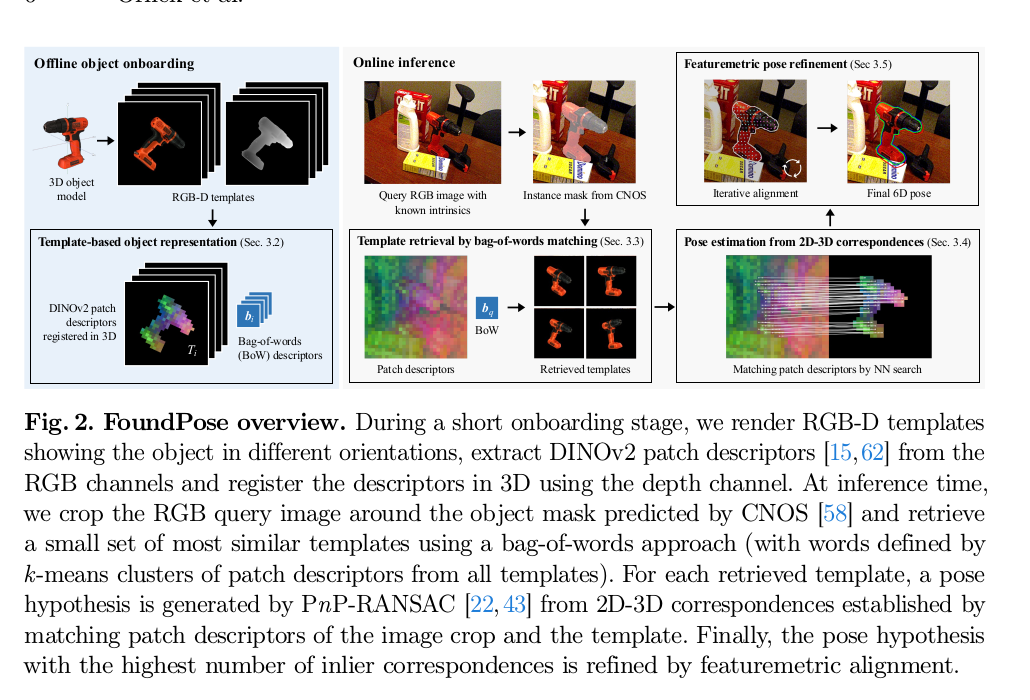 原论文 Figure 2。检索不是最终 pose:它只把 exhaustive all-template matching 缩小到 5 个候选,随后每个候选独立建立 correspondence 并由 PnP-RANSAC 验证空间一致性。来源:ECVA 正式论文;图片版权归论文作者及 Springer Nature 所有,本站仅作论文解读展示。
3.1 Template representation
模板和查询 crop 均为 420×420,object longer side 占 δ=0.6。DINOv2 patch size 为 14,因此每幅图产生 30×30 grid。
对模板 patch j:
- 第 18 层 raw descriptor 经全模板 PCA 投影到 256D;
- 只有 patch center 在 mask 内才有效;
- rendered depth + intrinsics 给出对应 CAD point xj;
- template 记为 Tt={(pj,xj)}。
这一步把纯 2D foundation feature 转成 model-space 3D descriptor bank。
3.2 Bag-of-words retrieval
每对象将全部模板 patch descriptors 聚成 2,048 个 visual words。模板词频使用类似 TF-IDF 的权重:
bi=ntni,tlogniN,
并把 patch soft-assign 到 3 个最近词,σ=10。查询与模板 BoW 用 cosine similarity 排序,保留 top 5。
BoW 对遮挡的鲁棒性来自可见 parts 仍贡献一部分 words;后续 PnP-RANSAC则隐式完成 spatial verification。直接对每个 query-template pair 做 patch kNN 需要 0.64 s / query,BoW retrieval 只需约 0.0008 s。
3.3 Perspective crop
直接矩形 crop 会因对象偏离主点而产生与模板不同的 perspective distortion。作者构造 optical axis 指向 mask box center 的 virtual pinhole camera,再 warp 为与模板相同的尺寸和 object occupancy。这是容易被忽略、但对 PnP correspondence 很实用的几何预处理。
4. PnP 与免训练 featuremetric refinement
对每个 retrieved template,查询 patch descriptor匹配模板最近邻,得到:
Ct={(ui,xi)},
其中 ui 是 query patch center,xi 是模板 patch 绑定的 CAD point。EPnP 每次用最小 4 对 correspondence,RANSAC最多 400 iterations、10 px 阈值;5 个模板各自产生 pose,以 inlier 数最高者作为 coarse pose。
14×14 patch center 是粗采样,匹配点的真实投影可能不在 patch center。featuremetric refinement 用最多 30 次 L-M 优化:
R,tmini∑ρ(pi−Fq(π(Rxi+t))),
在 query DINO feature map 上 bilinear sampling,以 Barron robust loss(α=−5,c=0.5)减少错误对应影响。它不需要专门训练 refinement network,但仍是局部优化,错误 coarse basin 无法保证纠正。
5. 定性证据
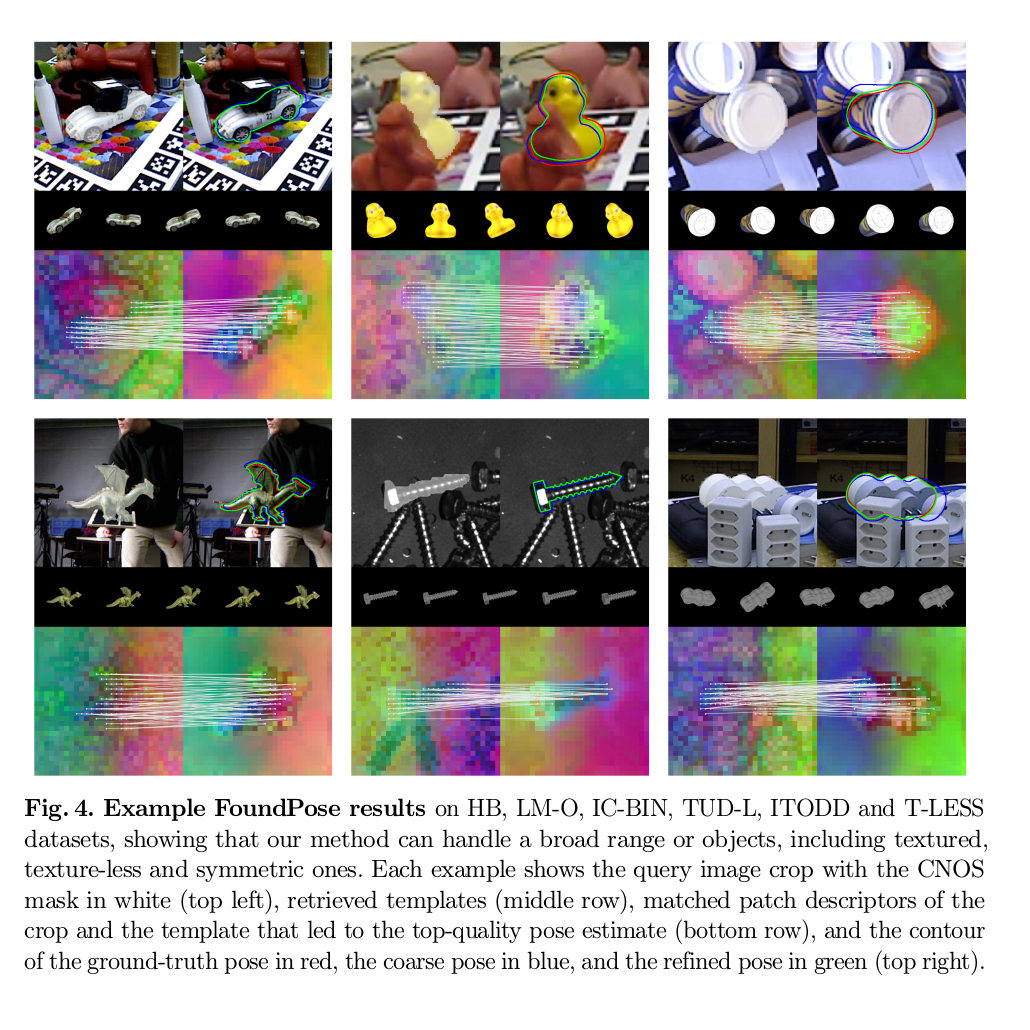 原论文 Figure 4:每例依次显示 query + CNOS mask、retrieved templates、patch correspondences,以及 GT / coarse / refined contours。来源:ECVA 正式论文;图片版权归论文作者及 Springer Nature 所有,本站仅作论文解读展示。
图覆盖 HB、LM-O、IC-BIN、TUD-L、ITODD 与 T-LESS,包含 clutter、occlusion、texture-less 和 symmetry。它证明真实—渲染之间存在可用 patch matches,但属于作者挑选案例;定性图没有系统展示失败率,仍需以 BOP AR 判断。
6. BOP 主结果与 training-free 边界
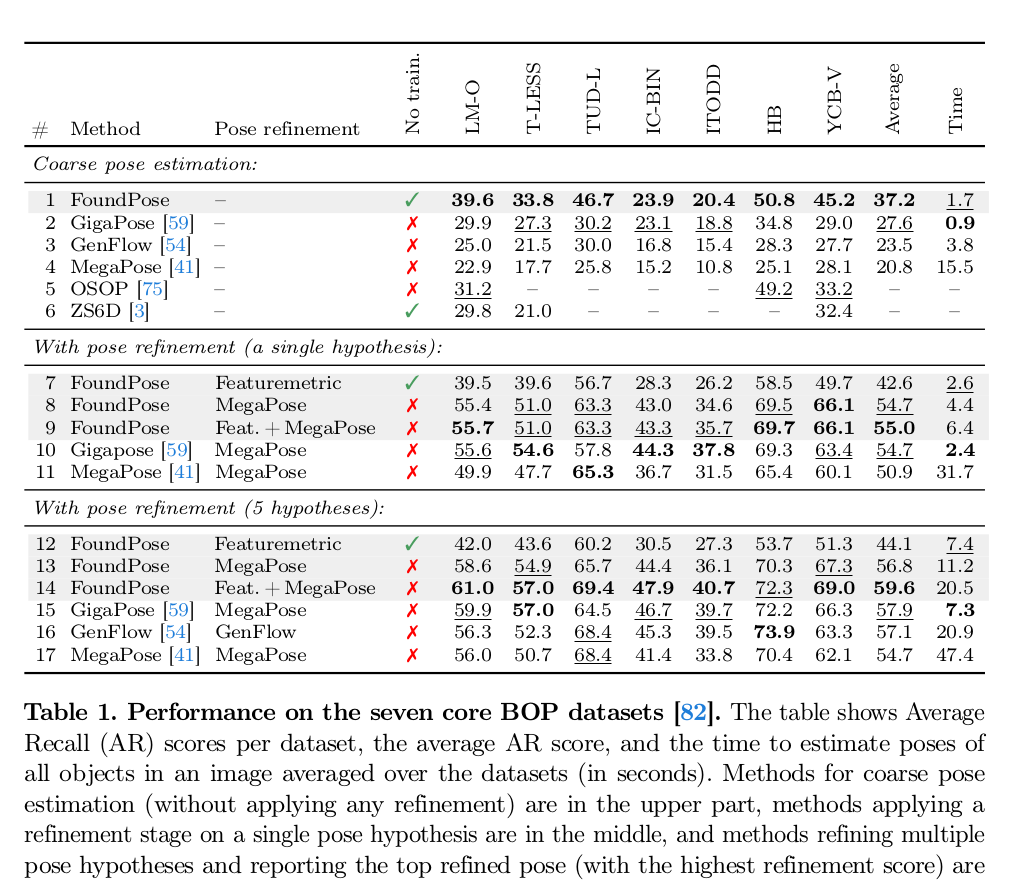 原论文 Table 1。绿色勾只表示该行整体不做 task-specific training;接入 MegaPose refinement 的行没有勾,因为 MegaPose refiner本身有大规模合成训练。来源:ECVA 正式论文;表格版权归论文作者及 Springer Nature 所有,本站仅作论文解读展示。
七个 BOP 数据集共 108 个对象,指标为:
AR=(ARVSD+ARMSSD+ARMSPD)/3.
| 配置 | Task-specific train | Hypotheses | Mean AR | s / image |
|---|
| FoundPose coarse | 否 | 1 | 37.2 | 1.7 |
| + featuremetric | 否 | 1 | 42.6 | 2.6 |
| + MegaPose refiner | 是 | 1 | 54.7 | 4.4 |
| + featuremetric + MegaPose | 是 | 1 | 55.0 | 6.4 |
| featuremetric, 5 hypotheses | 否 | 5 | 44.1 | 7.4 |
| featuremetric + MegaPose, 5 hypotheses | 是 | 5 | 59.6 | 20.5 |
coarse FoundPose 比 GigaPose / GenFlow / MegaPose coarse 高 9.6 / 13.7 / 16.4 AR。单假设 featuremetric 再增 5.4;但单独 refine 5 hypotheses只到 44.1,说明重复局部优化的边际收益不大。
最强 59.6 AR 是“FoundPose proposal + FoundPose featuremetric + trained MegaPose render-and-compare”的组合,不应归因于 frozen DINOv2 alone。
时间包含约 0.3 s CNOS;硬件也不完全一致:GigaPose 0.9 s 用 V100 48 GB,FoundPose用 P100 16 GB。FoundPose coarse 更准确但不是实时。
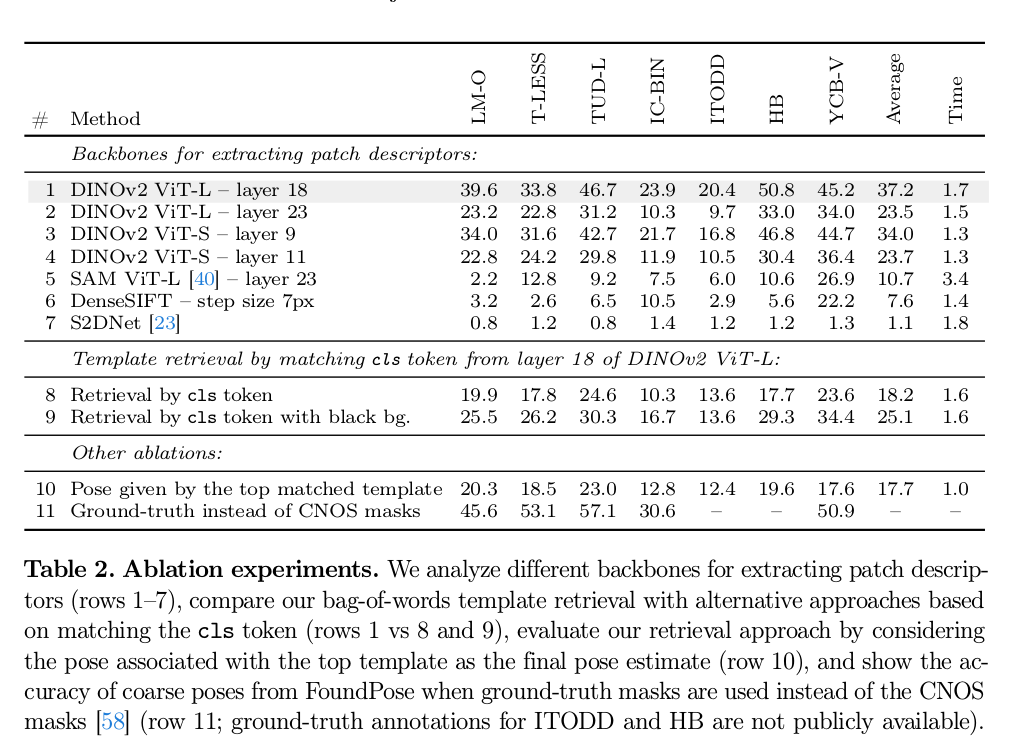 原论文 Table 2。layer 18 相对 last layer 的巨大差距验证了 positional information;GT mask 行则量化了 segmentation 上限。来源:ECVA 正式论文;表格版权归论文作者及 Springer Nature 所有,本站仅作论文解读展示。
- DINOv2 ViT-L layer 18:37.2 AR;
- 同模型 layer 23:23.5,下降 13.7;
- ViT-S intermediate layer 9:34.0 / 1.3 s;
- SAM ViT-L:10.7;
- DenseSIFT:7.6;
- S2DNet:1.1。
BoW 37.2 vs cls-token retrieval 18.2;将 background 置黑后 cls token 25.1,仍明显落后。top-template pose 直接作为输出只有 17.7,证明 retrieval 不能替代 PnP。
GT mask 相对 CNOS 在可核验数据集提高 6–19 AR。对象表示默认约:
800×(300 patches×256×4 B+8 kB BoW)≈234 MB.
使用 400 templates、128D PCA、1,024 words 可降到 59 MB,AR 损失不足 1。
8. 限制与复现风险
- 依赖 texture-mapped 3D model;CAD texture 错误会影响 template feature;
- 依赖 CNOS mask 与正确 object identity;
- intrinsics 与 virtual-camera warp 必须一致;
- 1.7–2.6 s / image,不适合高帧率闭环;
- 每对象 234 MB 对大 inventory 显著;
- featuremetric objective 有局部极值;
- 中间层位置编码可能依赖 crop、padding 和背景约定;
- BOP 只测已给 instance count 的 localization,开放场景 detector errors 没有完全纳入;
- 高精度配置依赖 trained MegaPose,不能称整个 pipeline training-free。
- 官方代码仓库目前发布的是 coarse pose pipeline,不含论文中的 featuremetric refinement;复现 42.6 / 59.6 AR 配置时不能只依赖仓库默认实现。
9. 复现检查表
- 每对象 800 views、约 25° spacing、420×420、δ=0.6;
- DINOv2 ViT-L/14 registers layer 18、14×14 patches、256D PCA;
- 只保留 template mask 内 patch centers,并准确反投影到 CAD;
- 2,048 per-object k-means words,soft top-3、σ=10;
- virtual-camera perspective crop,而非普通 resize;
- top-5 templates,EPnP-RANSAC 400 iterations、10 px;
- L-M 30 iterations,Barron α=−5,c=0.5;
- 统一 CNOS masks 数量 n / 5n;
- 分开报告 coarse、featuremetric 与 MegaPose refinement;
- 记录 onboarding time、per-object memory、CNOS time 和 pose time。
10. 最终评价
FoundPose 最有价值的结论是:foundation model 的中间层可以直接支持几何一致的 real-render correspondences,而不只做语义检索。它让经典的 BoW、nearest-neighbor、PnP-RANSAC 和 L-M 在 unseen-object pose 上重新达到强竞争力,且方法每一步都可以诊断。
37.2 AR 的 training-free coarse 和 42.6 AR 的免训练 refinement 是论文最干净的贡献;59.6 AR 则是与 trained MegaPose refiner 的系统组合。把两组结果区分后,FoundPose 仍是 2024 年 RGB-only unseen-object pose 最值得精读的基础特征路线之一。
