论文精读笔记:GenFlow
1. 核心判断
GenFlow 的出发点是:novel-object pose refinement 若直接回归 pose delta,虽然能跨对象训练,却没有充分利用测试 CAD 的 3D shape 与 camera projection;若只训练通用 optical flow,再接外部 PnP,又会让 flow objective 与 pose objective 脱节。
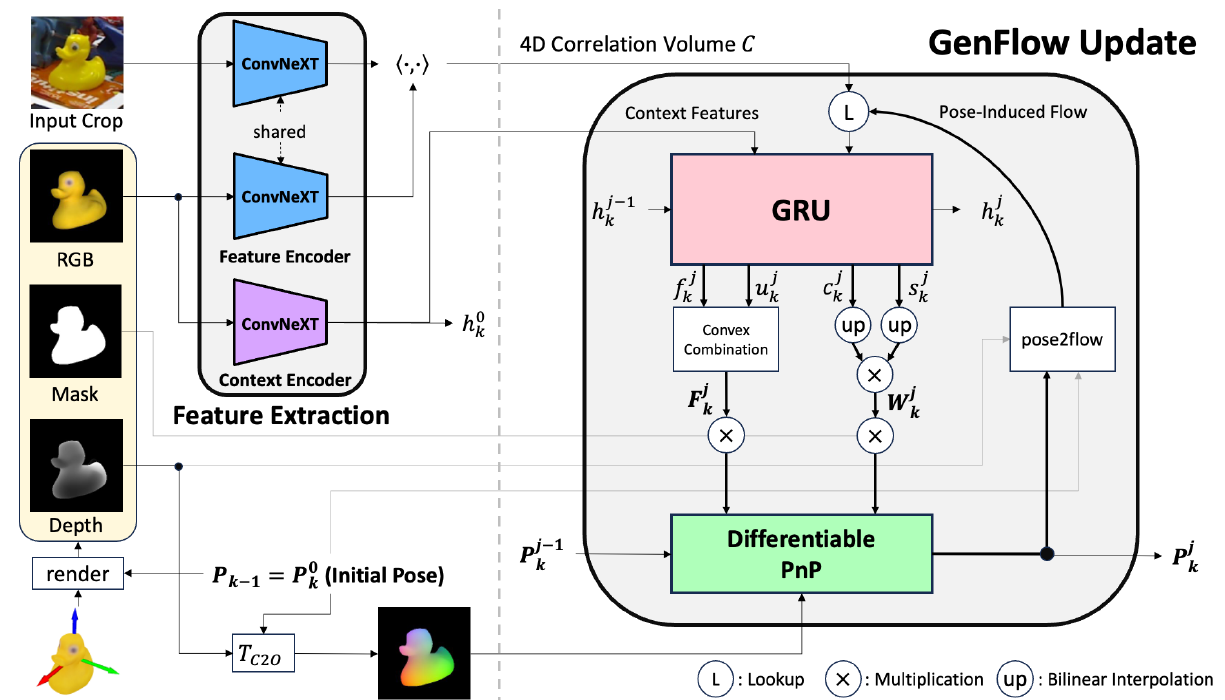
它把两者合并为一个 recurrent loop:
当前 pose 下渲染 CAD;
在 render 与 observation 之间预测 dense flow;
用 render depth 将 flow 转成 2D–3D correspondence;
differentiable PnP 更新 pose;
新 pose 产生 pose-induced flow,重新查询 correlation volume。
再通过 shape constraint、certainty / pose-sensitivity factorization 和 multi-scale cascade 提升泛化。完整设计在统一 coarse initialization 下从 66.3 提升到 70.7 mean AR;在 CNOS 未见对象协议中,RGB / RGB-D mean AR 为 57.8 / 67.2。
2. 任务边界与系统组成
核心 refiner 输入:
observed RGB crop I t I_t I t
target CAD M \mathcal M M
camera intrinsics K K K
initial pose P init P_{\text{init}} P init
当前 pose 下 render 的 RGB、mask、depth。
输出是 camera-space absolute 6D pose。新增对象无需 fine-tune,但仍需要 metric CAD、renderer、object localization 和初始 hypotheses。
论文还训练 coarse model:
输入 observed RGB 与某个 candidate pose render;
判断该 candidate 是否落入 refiner convergence basin;
GMM-based sampling 用更少 renders 产生高质量 hypotheses;
multi-hypothesis pipeline 细化多个候选后再由 coarse scorer 重排。
训练数据来自 MegaPose:
约 2M synthetic RGB-D images;
形状来自 ShapeNet 与 Google Scanned Objects;
coarse 与 refiner 均在大量训练对象上学习 category-agnostic comparison。
3. Recurrent flow 如何更新 pose
原论文 Figure 3。观测图与 CAD render 共享 feature encoder;4D correlation volume、context feature 和 pose-induced flow 进入 GRU,输出稠密 flow 与权重,differentiable PnP 给出下一轮 pose。来源:CVPR 2024 正式论文 ;图片版权归论文作者及 IEEE/CVF 所有,本站仅作论文解读展示。
3.1 4D correlation volume
预训练 ConvNeXt 同时编码 observed crop 与 render,两个尺度的 feature maps 构成 all-pairs correlation:
C i ∈ R H i × W i × H i × W i . C_i\in\mathbb R^{H_i\times W_i\times H_i\times W_i}. C i ∈ R H i × W i × H i × W i . 这与 RAFT 类似,但 lookup 坐标不是只由上一步 flow 决定,而是由当前 6D pose 在 CAD shape 上诱导的 flow 决定。换言之,correlation search 被 object geometry 约束。
3.2 从 render pixel 到 object-space 3D
当前 pose P k 0 = [ R k 0 ∣ t k 0 ] P_k^0=[R_k^0|t_k^0] P k 0 = [ R k 0 ∣ t k 0 ] ( u , v ) (u,v) ( u , v ) D r ( u , v ) D_r(u,v) D r ( u , v )
[ x y z ] = ( R k 0 ) ⊤ ( K − 1 D r ( u , v ) [ u v 1 ] − t k 0 ) . \begin{bmatrix}x\\y\\z\end{bmatrix}
=(R_k^0)^\top\left(K^{-1}D_r(u,v)
\begin{bmatrix}u\\v\\1\end{bmatrix}-t_k^0\right). x y z = ( R k 0 ) ⊤ K − 1 D r ( u , v ) u v 1 − t k 0 . GRU 预测的 flow 将 render pixel 映射到 observed image,形成 2D–3D correspondence。加权 reprojection residual 由 LM-based differentiable PnP 最小化,输出新 pose P k j P_k^j P k j
3.3 为什么是 recurrent
每次 pose 更新后,根据 P k j P_k^j P k j
一个 outer refinement step 内有 8 个 GenFlow inner updates;论文常用 5 个 outer steps。
4. confidence factorization 与 cascade
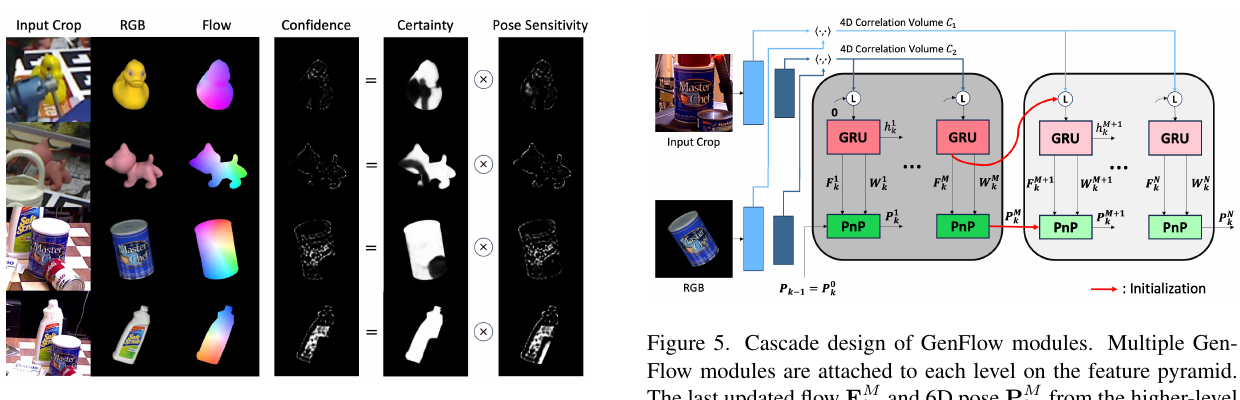
原论文 Figure 4–5。最终 correspondence confidence 被分解为 certainty 与 pose sensitivity;两级 GenFlow modules 串联,粗层最终 flow / pose 初始化细层。来源:CVPR 2024 正式论文 ;图片版权归论文作者及 IEEE/CVF 所有,本站仅作论文解读展示。
最终权重不是单一 confidence head:
W j = c j ⊙ s j . W^j = c^j\odot s^j. W j = c j ⊙ s j .
certainty c c c
pose sensitivity s s s R , t R,t R , t
二者分开可以避免“看起来匹配得准”与“对 pose 有信息量”被混为一谈。certainty 在训练中使用 depth,但 RGB inference 并不要求 observed depth。
cascade 为每个 correlation scale 配一个 GenFlow module。高层语义 / 大感受野先做粗更新,最后的 flow 与 pose 初始化低层细节 module。它不是简单把 feature pyramid concat,而是让 pose state 在层级之间传递。
5. 损失与稳定训练
pose loss 将 rotation、2D center 与 depth translation 解耦,避免单一 SE(3) distance 被某个分量支配。flow 使用 L1 endpoint error,certainty 使用 depth consistency BCE。
总损失对各 recurrent step 采用指数增权:
L = ∑ j = 1 N γ j − N ( L flow j + α L cert j + β L pose j ) , \mathcal L=\sum_{j=1}^{N}\gamma^{j-N}
(\mathcal L_{\text{flow}}^j+\alpha\mathcal L_{\text{cert}}^j+\beta\mathcal L_{\text{pose}}^j), L = j = 1 ∑ N γ j − N ( L flow j + α L cert j + β L pose j ) , 其中 γ = 0.8 \gamma=0.8 γ = 0.8 N = 8 N=8 N = 8
6. BOP 结果:先分清 locator 协议
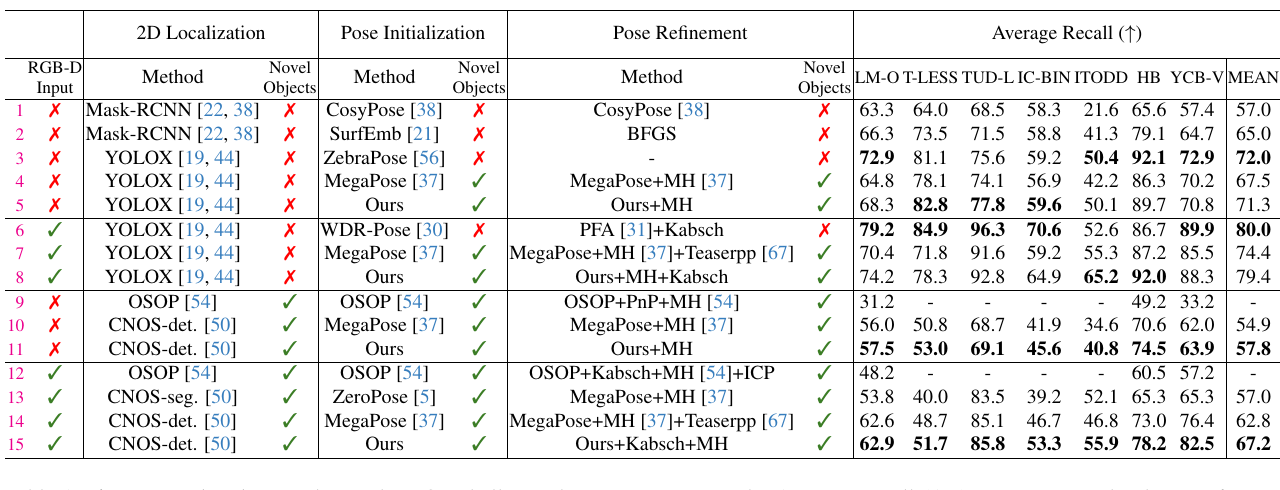
原论文 Table 1。红色 / 绿色标记分别说明 RGB-D、定位、初始化和 refinement 是否使用 novel-object-capable 组件;同一行的最终 AR 是整条 pipeline 的结果。来源:CVPR 2024 正式论文 ;表格版权归论文作者及 IEEE/CVF 所有,本站仅作论文解读展示。
真正的 unseen end-to-end locator 协议是 CNOS rows:
输入 Pipeline LM-O T-LESS TUD-L IC-BIN ITODD HB YCB-V Mean RGB CNOS-det + MegaPose + MH 56.0 50.8 68.7 41.9 34.6 70.6 62.0 54.9 RGB CNOS-det + GenFlow + MH 57.5 53.0 69.1 45.6 40.8 74.5 63.9 57.8 RGB-D CNOS-det + MegaPose + Teaser++ 62.6 48.7 85.1 46.7 46.8 73.0 76.4 62.8 RGB-D CNOS-det + GenFlow + Kabsch + MH 62.9 51.7 85.8 53.3 55.9 78.2 82.5 67.2
GenFlow 相对同 locator 的 MegaPose:
RGB +2.9 mean AR;
RGB-D +4.4;
RGB-D 在 ITODD +9.1、YCB-V +6.1,说明 certainty-filtered depth correspondences 对部分数据尤其有效。
使用 target-trained YOLOX 时,RGB / RGB-D mean 可到 71.3 / 79.4,但这只能说明 refiner 本身强,不能作为开放场景完整 pipeline 的数字。
7. coarse sampling、设计消融与时间
GMM-based coarse sampling:
方法 renders Mean AR naive uniform 576 22.5 GMM 144 31.3 GMM 208 35.8
更少 renders 反而更准,说明 coarse proposal distribution 比模板数量更重要。
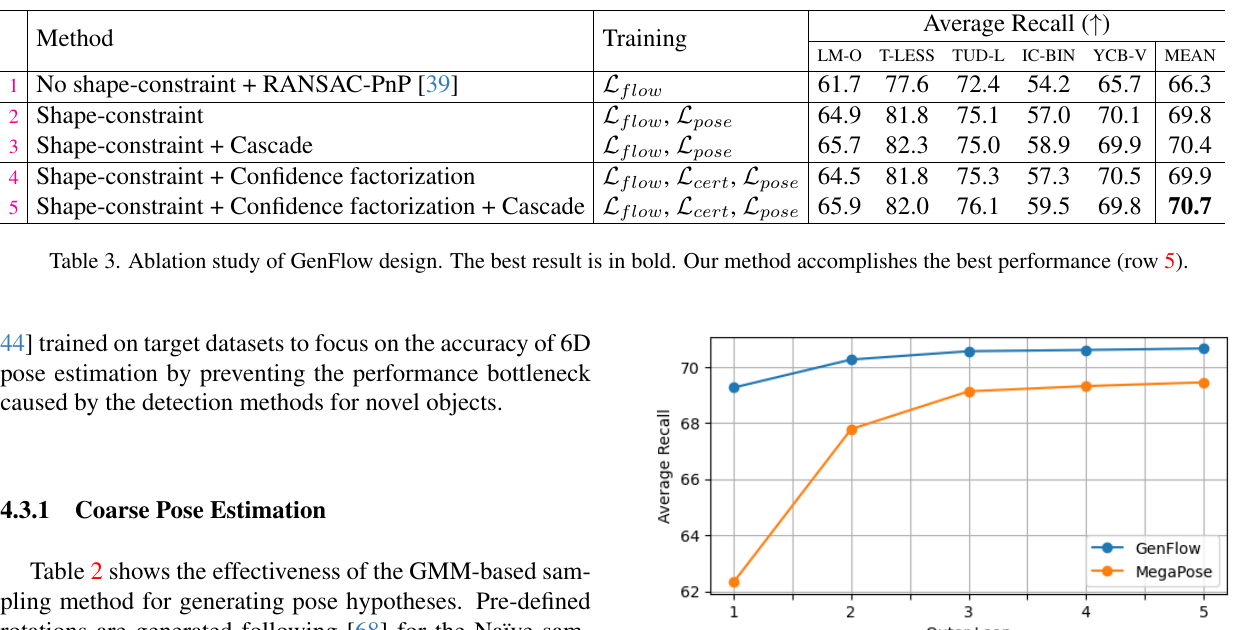
原论文 Table 3 与 Figure 6。shape constraint 提供最大基础提升,cascade 与 confidence factorization 继续累积收益;GenFlow 单 outer step 较慢,但两步已超过 MegaPose 多步。来源:CVPR 2024 正式论文 ;图表版权归论文作者及 IEEE/CVF 所有,本站仅作论文解读展示。
统一 coarse pose 下:
设计 Mean AR 无 shape constraint + RANSAC-PnP 66.3 + shape constraint 69.8 + cascade 70.4 + confidence factorization 69.9 + factorization + cascade 70.7
shape constraint 贡献 +3.5,是最大单项;cascade / factorization 各自增益不大,但组合达到最佳。
RTX 3090 + i9-10920X:
GenFlow outer update:98.2 ms;
MegaPose refiner:66.5 ms。
因此 GenFlow 并非“每步更快”;其优势是同样步数更准、约两步后已超过 MegaPose 五步附近的水平。实际时延仍需乘 outer steps、hypothesis count,再加 rendering、coarse scoring 与 detection。
8. RGB-D extension 的真实作用
RGB 主干已用 render depth 形成 2D–3D correspondence,但 observed side 没有 depth。若 observed RGB-D 可用,最后一轮 flow 把 observed depth 与 render point 建成 3D–3D pairs:
以 certainty threshold 去掉 outliers;
RANSAC-Kabsch 求 depth correction;
每个 outer step 后执行。
这条支路解释了 RGB-D 在 IC-BIN / ITODD / YCB-V 的明显提升,也意味着 RGB-D 版本已不再只由 differentiable PnP 更新。
9. 局限与复现检查
不是 CAD-free;必须有 metric mesh 与可靠 renderer;
不是从整图直接 pose;外部 detection / segmentation 是系统瓶颈;
refiner 有 convergence basin,初始 pose 太差仍会失败;
98.2 ms 不是整条 pipeline,也不是五步、多假设的总时延;
observed depth 噪声会损伤 Kabsch,但论文只以 certainty filtering 缓解;
training 使用 MegaPose 级 2M synthetic data,通用性有显著数据成本;
复现必须固定 outer=5、inner=8、hypotheses=10、GMM render count 与 locator;
BOP 七数据集 mean 和消融五数据集 mean 不应混用;
需分别报告 RGB 与 RGB-D,以及 seen YOLOX 与 unseen CNOS。
10. 最终评价
GenFlow 的强项是把“看起来像光流网络”的模块真正闭合到 6D geometry:flow 产生 correspondence,PnP 更新 pose,pose 又决定下一轮 correlation lookup。shape constraint +3.5 AR、CNOS 协议下对 MegaPose 的稳定提升,以及 RGB-D 的进一步增益,都支持这种设计。
它没有消除 render-and-compare 的依赖,也不是实时端到端系统;CAD、初始 pose、多假设和大规模 synthetic training 仍在。最准确的定位是:GenFlow 是一套面向训练未见 CAD 的、几何约束更强的通用 pose refiner,适合作为 MegaPose / GigaPose 等 coarse estimator 后端,而不是单独完成开放世界检测与 pose 的模型。