论文精读笔记:GigaPose
1. 核心判断
GigaPose 的设计可以概括为:不要用模板同时离散全部旋转自由度。
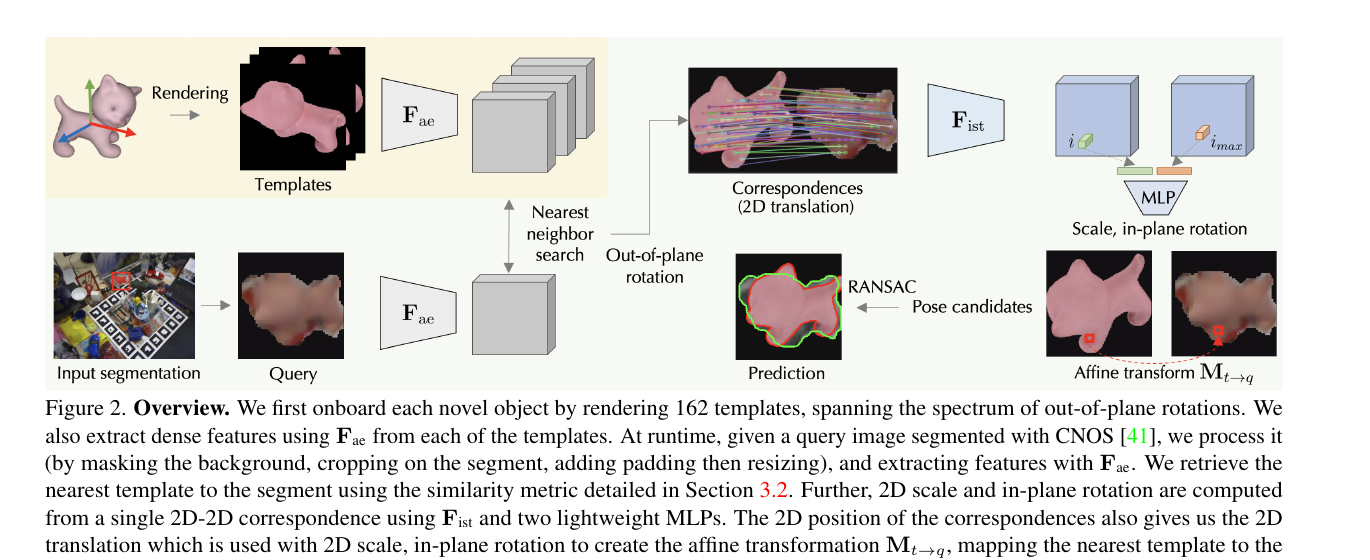
传统 render-and-compare 通常需要对 azimuth、elevation、in-plane rotation 都采样,模板数迅速膨胀。GigaPose 只渲染 162 个 out-of-plane viewpoints:
template retrieval 负责 azimuth / elevation;
一个局部 2D–2D correspondence 负责 scale、in-plane rotation 与 2D translation;
scale + intrinsics 再恢复 depth / 3D translation;
RANSAC 从多个单对应候选中选 pose。
它把 MegaPose 每个 query-template 都跑网络的 1.68 s,变成预计算 dense features 后的 48 ms / detection。七个 BOP 数据集上 coarse mean AR 从 MegaPose 20.8 提到 26.8;接相同 refinement 后仍保持更好的初始化质量。
这不是完全“one correspondence 就稳定求 pose”:每个 correspondence 生成一个候选,最终仍由多候选 RANSAC 选择。标题强调的是单个 2D–2D match 已包含生成完整 pose candidate 所需的信息。
2. 输入、输出与系统边界
输入:
RGB image;
CNOS 给出的 object mask / detection;
camera intrinsics K K K
测试时新对象 CAD;
onboarding 阶段离线渲染的 templates 与 features。
输出:
coarse R , t R,t R , t
可选 top-1 / top-5 hypotheses;
可接 MegaPose 或 GenFlow refinement。
训练与测试对象分离。网络在 Google Scanned Objects、ShapeNet 的约 2M BlenderProc renderings 上训练,不为 BOP test objects 更新权重。
“novel object”指训练未见实例;系统仍知道每个 test object 的 CAD identity,且 CNOS 已完成目标发现 / 分割。它不是 open-vocabulary、model-free 或 category-level pose。
3. 自由度分解
原论文 Figure 2。左侧模板 / query 由 \(F_{\mathrm{ae}}\) 检索 out-of-plane rotation;右侧对应 patch 经 \(F_{\mathrm{ist}}\) 与 MLP 预测 scale、in-plane rotation,patch 坐标提供 translation,最后 RANSAC 选候选。来源:CVPR 2024 正式论文 ;图片版权归论文作者及 IEEE/CVF 所有,本站仅作论文解读展示。
完整 pose 的 6DoF 被重新参数化为:
out-of-plane rotation:azimuth、elevation;
in-plane rotation α \alpha α
image-plane translation t x , t y t_x,t_y t x , t y
metric scale s s s
检索最近 template 后,out-of-plane rotation 已知。对 template patch i i i i ′ i' i ′
位置差直接给出 image translation;
两侧 F i s t F_{\mathrm{ist}} F ist
形成 affine transform M t → q M_{t\rightarrow q} M t → q
将 template pose 组合成完整 6D candidate。
相比 3D–2D PnP 至少需要多个对应,GigaPose 利用已知 template viewpoint 和 learned scale / angle prior,让一个 2D–2D correspondence 就能定义 candidate。
4. 两套 feature 为什么分开
F a e F_{\mathrm{ae}} F ae
对 scale、in-plane rotation、2D translation 不敏感;
对 out-of-plane rotation 敏感;
跨 synthetic template / real query 保持对应。
F i s t F_{\mathrm{ist}} F ist
in-plane rotation;
scale。
如果用同一完全 invariant feature,后两项信息会被主动丢弃。论文因此将“检索 invariance”与“剩余自由度 regression”拆为两套表示。
5. F a e F_{\mathrm{ae}} F ae
训练 pair 是同一 CAD 的两个 renderings:
out-of-plane rotation 相同;
scale、in-plane angle、translation 不同。
由渲染已知几何建立 2D–2D ground-truth correspondences。正样本:
相同物体;
同一 surface patch;
允许 scale / in-plane / translation 改变。
负样本:
同对象错误位置;
不同 out-of-plane rotation;
不同对象;
batch 内其他 template。
局部 contrastive objective 使对应 patch feature 靠近,其余远离。训练时还加入:
color augmentation;
random crop;
random in-plane rotation。
目的是缩小 synthetic-to-real gap,并让 F a e F_{\mathrm{ae}} F ae
6. 模板数量与 onboarding
162 viewpoints 来自规则 icosphere,将 Blender icosphere triangle 再细分四份,只覆盖 camera direction / out-of-plane rotation。
对每个新对象:
渲染 162 templates;
提取并存储 F a e F_{\mathrm{ae}} F ae
建 nearest-neighbor search index。
onboarding 时间:
GigaPose:11.5 s / object;
MegaPose:0.82 s / object。
GigaPose 把更多计算前移到 onboarding,以换取重复 inference 的巨大提速。只有当同一对象被多次使用时,11.5 s 才容易摊薄。
ablation 使用 576 templates:
162 templates mean AR:27.9;
576 templates:28.5;
只提升 0.6。
说明单对应对剩余自由度的估计确实降低了密集模板采样需求。
7. BOP 主结果
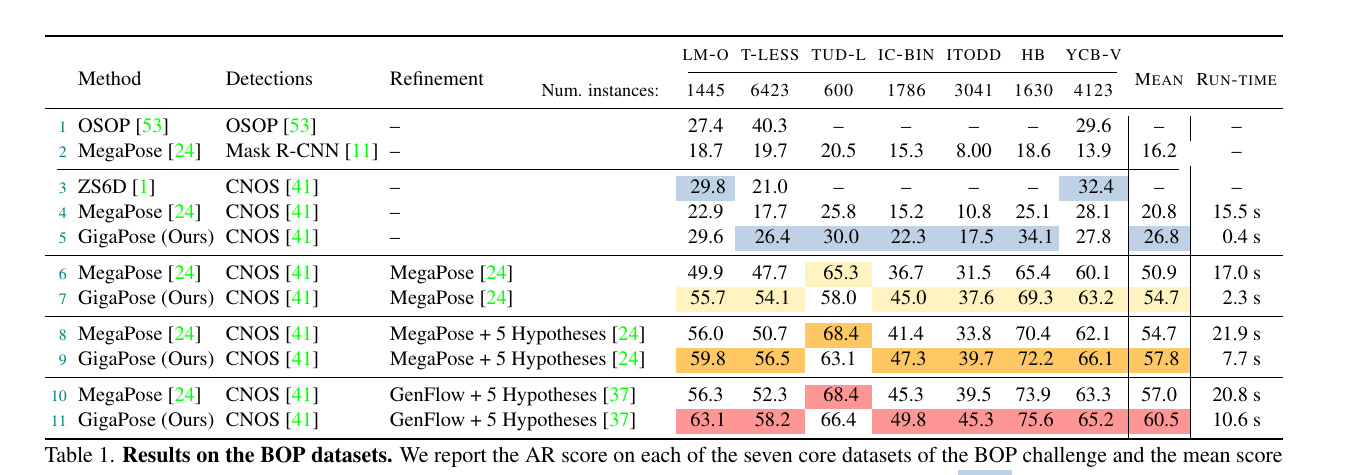
原论文 Table 1。七列分别为 LM-O、T-LESS、TUD-L、IC-BIN、ITODD、HB、YCB-V;每组在相同 CNOS detections / refiner 下比较 GigaPose 与 MegaPose 初始化。来源:CVPR 2024 正式论文 ;表格版权归论文作者及 IEEE/CVF 所有,本站仅作论文解读展示。
七个数据集共:
132 objects;
19,048 test instances;
clutter、occlusion、textureless 与工业对象混合;
标准 BOP AR:VSD、MSSD、MSPD 的 threshold-averaged recall。
无 refinement:
方法 LM-O T-LESS TUD-L IC-BIN ITODD HB YCB-V Mean time MegaPose + CNOS 22.9 17.7 25.8 15.2 10.8 25.1 28.1 20.8 15.5 s GigaPose + CNOS 29.6 26.4 30.0 22.3 17.5 34.1 27.8 26.8 0.4 s
GigaPose 只在 YCB-V 略低 0.3,其余数据集都更高。T-LESS、IC-BIN、ITODD 的增益超过 5 points,支持对 textureless / industrial object 的 robustness。
不同 refinement:
初始化 + refiner Mean AR time MegaPose init + MegaPose 1 hyp 50.9 17.0 s GigaPose init + MegaPose 1 hyp 54.7 2.3 s MegaPose init + MegaPose 5 hyp 54.7 21.9 s GigaPose init + MegaPose 5 hyp 57.8 7.7 s MegaPose init + GenFlow 5 hyp 57.0 20.8 s GigaPose init + GenFlow 5 hyp 60.5 10.6 s
更好的 coarse pose 不只提高自身 AR,也让同一个 refiner 避免局部极小值。
8. 定性、预测 3D 模型与速度
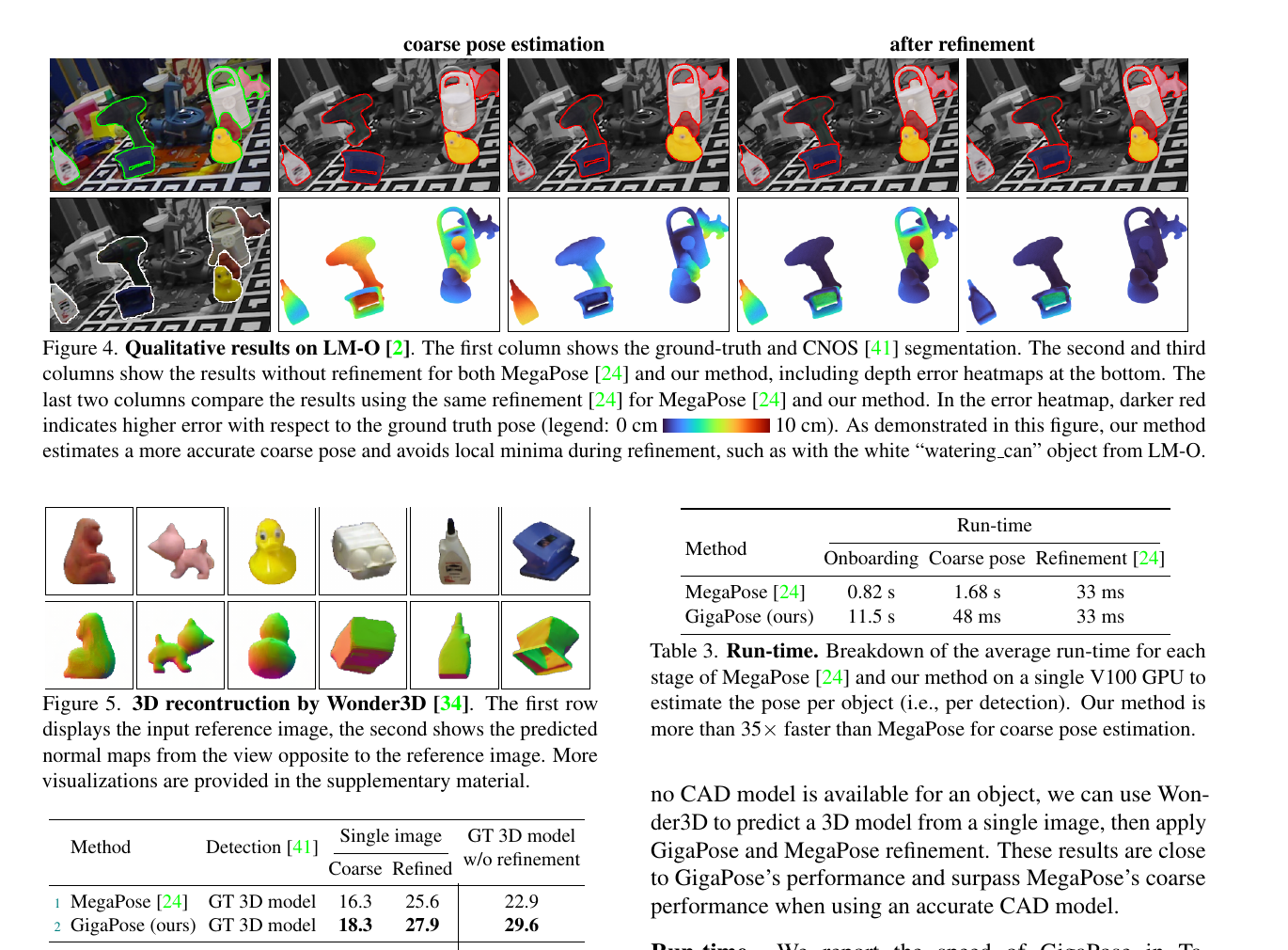
原论文 Figure 4–5 与 Table 2–3。上方比较 coarse / refined pose;左下用 Wonder3D 从单图预测 3D model,右下把 onboarding、coarse 和 refinement 时间拆开。来源:CVPR 2024 正式论文 ;图表版权归论文作者及 IEEE/CVF 所有,本站仅作论文解读展示。
单 detection、V100:
阶段 MegaPose GigaPose Onboarding / object 0.82 s 11.5 s Coarse pose / detection 1.68 s 48 ms MegaPose refinement 33 ms 33 ms
论文称约 35× speedup;正文按 1.68 / 0.048 可得到 35×,另有“more than 38×”表述,可能来自未四舍五入时间。网站统一使用“约 35×”。
BOP Table 1 的 0.4 s 是 每张图像平均、包含 CNOS 分割与所有 detections ,不能与 48 ms / detection 混为同一计时。
Wonder3D predicted model,LM-O:
3D source 方法 Coarse Refined GT CAD MegaPose 16.3 25.6 GT CAD GigaPose 18.3 27.9 single-image model MegaPose 15.4 25.2 single-image model GigaPose 17.6 27.2
结果只在作者谨慎挑选的 reference images 上验证,因为 Wonder3D 对输入质量敏感。它展示潜力,但不能据此声称 CAD dependency 已普遍消除。
9. Segmentation robustness 与消融
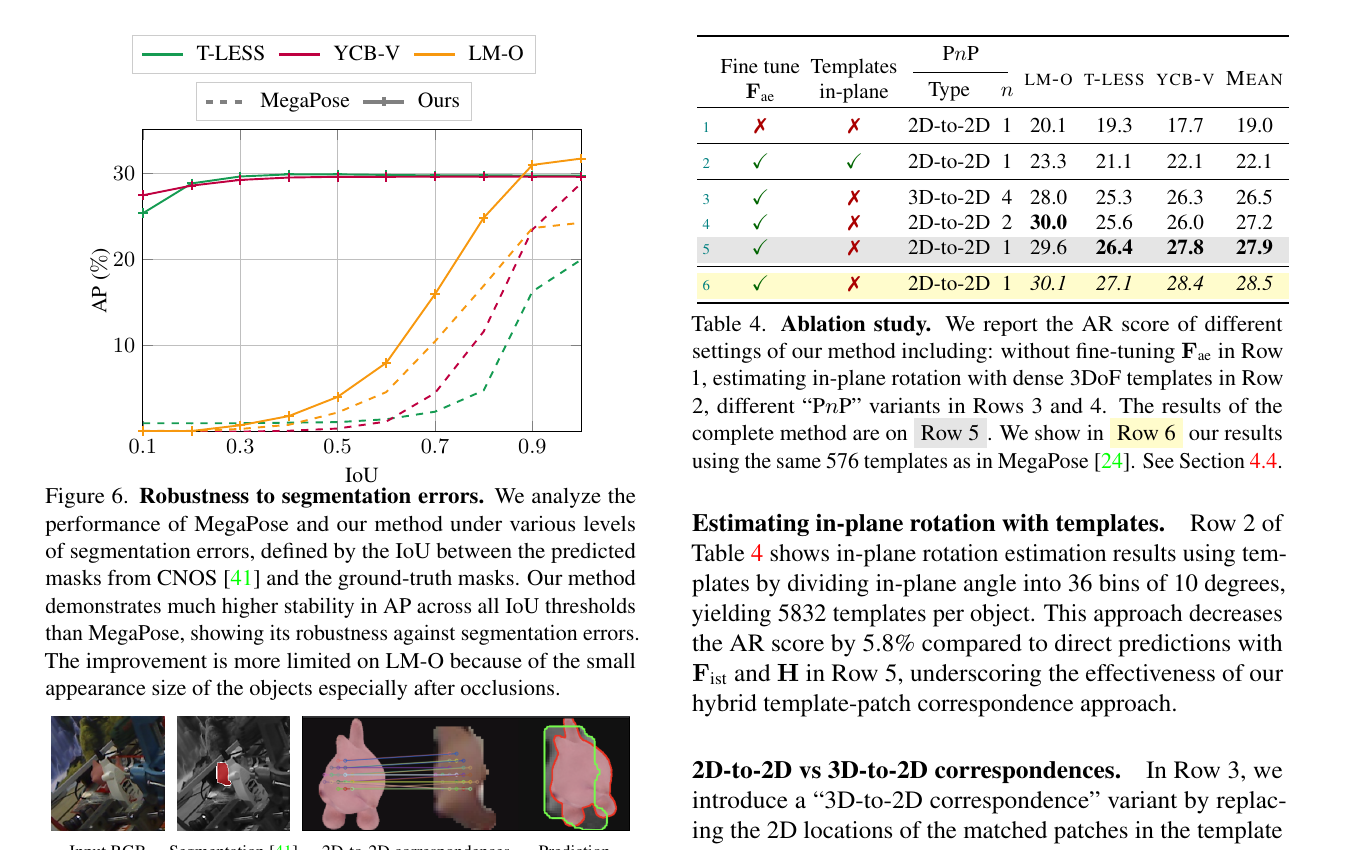
原论文 Figure 6–7 与 Table 4。左侧按 CNOS mask IoU 分组比较 AP,并给出 LM-O 小目标失败案例;右侧消融 fine-tuning、密集面内模板、3D–2D / 双对应和模板数。来源:CVPR 2024 正式论文 ;图表版权归论文作者及 IEEE/CVF 所有,本站仅作论文解读展示。
在 T-LESS / YCB-V 上,GigaPose 随 mask IoU 变化的 AP 比 MegaPose 平坦;MegaPose 主要在高 IoU mask 才取得高分。这来自:
dense patch retrieval 不把整幅 crop 压成单一 score;
RANSAC 可忽略一部分 boundary / background matches;
template feature 已离线计算,不需要每个 noisy crop 与每模板联合前向。
LM-O 改善有限,因为:
object 在图中很小;
heavy occlusion;
mask resize 后有效 patch 极少;
某些 CAD fidelity 低。
Table 4:
设置 LM-O T-LESS YCB-V Mean 不 fine-tune F a e F_{\mathrm{ae}} F ae 20.1 19.3 17.7 19.0 36-bin in-plane templates,5832 total 23.3 21.1 22.1 22.1 3D–2D ePnP,4 correspondences 28.0 25.3 26.3 26.5 2D–2D Kabsch,2 correspondences 30.0 25.6 26.0 27.2 one-correspondence full 29.6 26.4 27.8 27.9 full + 576 templates 30.1 27.1 28.4 28.5
关键结论:
fine-tuning local features 是最大增益之一;
把 in-plane rotation 放回模板会产生 5832 templates,反而比 learned one-correspondence 低 5.8 mean;
标准 3D–2D ePnP 并不优于任务定制的 2D–2D parameterization;
one correspondence mean 最好,但 LM-O 上 two-correspondence 略高。
10. “One correspondence”中的几何与学习
系统不是纯解析:
out-of-plane rotation 来自离散 template;
scale / in-plane rotation 由 MLP 学习;
2D translation 来自 patch coordinates;
depth / 3D translation 依赖 CAD render geometry 与 intrinsics;
RANSAC 依赖多个 candidate 的 consensus。
因此它的成功建立在 correspondence feature、template camera model 与 learned MLP 三者共同标定良好。换相机内参、render convention 或 CAD scale 时,必须检查 affine-to-3D conversion。
11. 与相邻方法的关系
MegaPose:
对每个 query-template pair 跑 coarse scoring network;
模板更多,运行慢;
refiner 强,但初始化成本高。
GigaPose:
template features 预计算;
nearest-neighbor sublinear retrieval;
162 templates;
coarse 更快且可接同一个 MegaPose refiner。
ZS6D:
也用 DINOv2 与 correspondence;
倾向 3D–2D correspondences + PnP;
GigaPose 的实验表明在该协议下,学习 2D scale / angle 的 hybrid representation 更有效。
FoundationPose:
统一 CAD / model-free pose 和 tracking;
render-and-compare refinement 更重;
GigaPose 主要优化 CAD-based novel-object coarse initialization,可作为其他系统前端。
12. 局限
test-time CAD 仍是主设定;
predicted 3D model 实验依赖挑选 reference image;
CNOS mask / detection 是硬前端;
小目标、重遮挡、低质量 CAD 会导致 retrieval 与 correspondence 同时失败;
162-template quantization 仍限制 out-of-plane initial accuracy;
onboarding 11.5 s 比 MegaPose 慢;
coarse mean AR 26.8,不适合直接替代 refinement;
reported V100 timings 与当前硬件不可直接横比;
训练依赖 2M synthetic images 与 BOP/MegaPose data;
one-correspondence MLP 可能受 camera / render distribution shift;
symmetry 主要由 BOP metrics 处理,网络本身不输出 pose distribution;
RANSAC 多候选意味着最坏运行时间仍受 correspondence count 影响。
13. 复现检查表
使用论文相同 BOP synthetic / MegaPose training sets;
CAD 单位、origin、camera convention 与 BOP 一致;
精确渲染 162 icosphere viewpoints;
template feature 只在 onboarding 计算一次;
F a e F_{\mathrm{ae}} F ae F i s t F_{\mathrm{ist}} F ist 正 / 负 patch correspondence 按真实 render geometry 生成;
加入 color、crop、in-plane rotation augmentation;
实现 nearest-neighbor template retrieval;
MLP 分别预测 scale 与 in-plane angle;
检查 2D translation、scale 到 3D translation 的公式和 intrinsics;
多 correspondence 生成候选后再 RANSAC;
与 MegaPose 比较时固定 CNOS detections;
coarse、single-hypothesis、five-hypothesis 分开报;
分开报告 onboarding / object、coarse / detection、whole image;
对 mask IoU、小目标、CAD fidelity 单列 failure curves。
14. 最终评价
GigaPose 是一篇非常工程化、同时又有明确几何结构的 unseen-object pose 工作。它没有简单换更大的 backbone,而是重新设计 pose parameterization,使 162 个模板足以覆盖 out-of-plane rotation,再把剩余自由度交给局部对应。Table 4 对密集面内模板、ePnP、双对应和模板数的消融有力支撑了这一选择。
它并未摆脱 CAD、mask 与 refinement;coarse 26.8 AR 也说明速度不是最终精度。但在同一 CNOS / refiner 条件下,GigaPose 始终提供更快、更好的初始化。最准确的结论是:对需要反复估计训练未见 CAD 对象的系统,将模板检索与局部对应按自由度解耦,可以把 coarse stage 从秒级降到几十毫秒,并提高后续 refinement 的可达精度。