论文精读笔记:IFFNeRF: Initialisation Free and Fast 6DoF Pose Estimation from a Single Image and a NeRF Model
1. 基本信息
- 作者 / 机构:Matteo Bortolon、Theodore Tsesmelis、Stuart James、Fabio Poiesi、Alessio Del Bue;IIT PAVIS、FBK TeV、University of Trento、Durham University
- 年份 / 会议:2024 / ICRA
- 论文:arXiv / PDF
- 项目页:IFFNeRF
- 阅读模式:精读
2. 一句话定位
IFFNeRF 将 inverse-NeRF 的 test-time pose optimization 改写成 ray retrieval:先从 density field 采样表面并生成覆盖潜在 camera viewpoints 的 parameterized rays,学习 query image patches 与 rays 的 attention score,再把 top rays 看成指向相机中心的 3D lines,以加权 least-squares line intersection 直接恢复 pose。
2.1 论文图表导读
| 图表 | 内容 | 关键点 |
|---|
| Figure 2 | IFFNeRF 完整 pipeline | attention 负责检索,least squares 负责几何求解 |
| Table I / Figure 5 | 定量结果和 top-ray selection | 29 ms;对 random-init iNeRF 优势大 |
| Figure 6 | synthetic / real qualitative camera poses | 绿为 GT、红为预测;不同对象误差差异明显 |
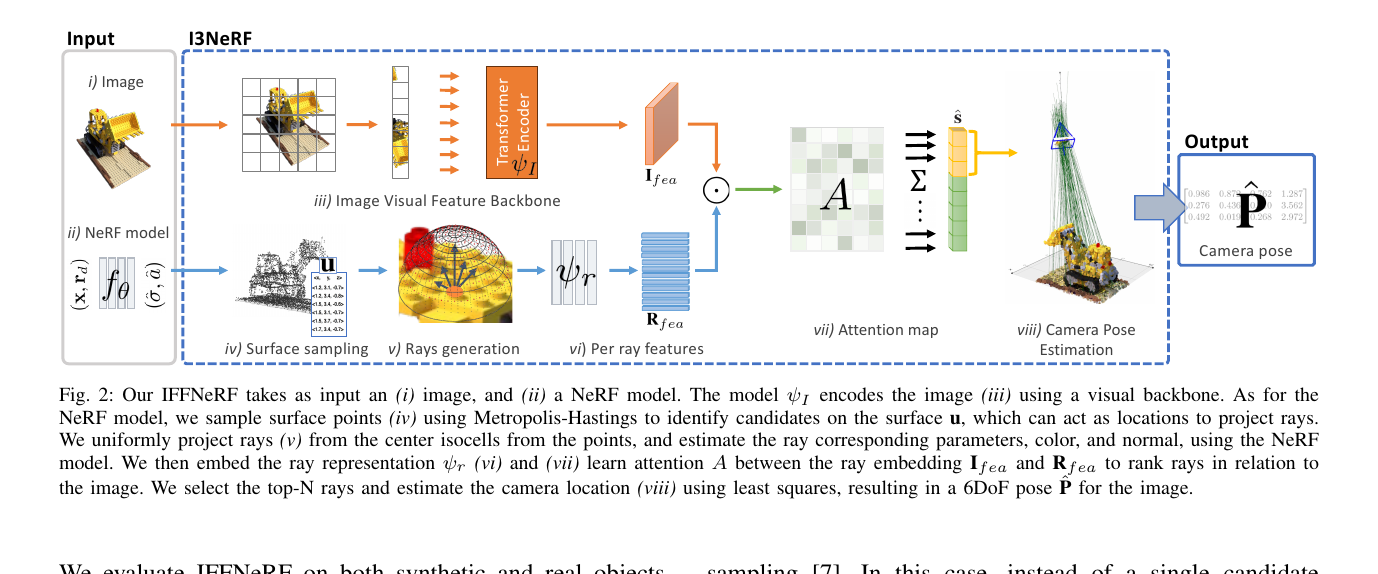 原论文 Figure 2:NeRF 端产生 surface-conditioned rays,query 端由 visual backbone 编码;attention matrix 将图像证据汇总为 per-ray scores,最后由几何求解器输出 camera pose。来源:论文 PDF。图片版权归论文作者及出版方所有,本站仅作论文解读展示。
3. 问题设定与任务边界
| 输入 / 假设 | 是否需要 |
|---|
| 单张 query RGB | 是 |
| query camera intrinsics | 是 |
| 目标 object / scene NeRF | 是 |
| 初始 camera pose | 否 |
| CAD / mesh | 否 |
| query depth | 否 |
| 每 scene IFFNeRF 训练 | 是 |
| test-time NeRF optimization | 否;可选 iNeRF refinement |
论文将所有对象缩放到 unit box,MTE 是 normalized units,不应直接写成厘米。Synthetic NeRF 与 Tanks & Temples 原本是 scene / view-synthesis 数据,不是标准 object-pose benchmark。
4. 研究脉络
- iNeRF:固定 NeRF weights,反向传播 photometric residual 到 camera pose;局部精确但依赖近初值、在线迭代慢。
- Parallel-iNeRF / Loc-NeRF:用多初值或 sampling 扩大 basin,但仍围绕 optimization。
- feature-NeRF localization:用 learned features 替代 RGB residual,提高 illumination robustness。
- IFFNeRF:完全取消 test-time pose gradient descent,把在线问题改为 attention + closed-form。
5. 方法详解
5.1 Density-guided surface sampling
从 NeRF 抽取 G=5000 个 3D surface points。作者使用 Metropolis–Hastings,使采样概率跟 density 相关,避免在大体积空空间均匀浪费 samples。
该步骤隐含假设是 NeRF density peaks 与真实表面基本一致。floaters、透明 / 反光造成的假 density 会产生错误 ray origins。
5.2 Rays generation
每个 surface point ro 周围按 isocell distribution 产生方向 rd,并用 NeRF 查询:
- ray origin;
- unit direction;
- rendered color;
- local surface normal。
作者使用 hemisphere 以减少无关方向。ray feature 再经 positional encoding + MLP,放大相近空间参数之间的差异。
5.3 Image–ray attention
query image 使用 DINOv2 提取 W×H patch features。image features 作为 query,ray features 作为 key / value,attention map 沿 image dimensions 汇总成 per-ray score s^j。
训练 target 不是离散 pose class,而是 ray 到 GT camera center 的距离函数:越接近真实相机位置的 ray,分数越高。L2 loss 拟合这份 soft score。
5.4 Top-ray least-squares
测试时取 Ntop=100 条 rays。理想情况下它们交于 camera center;有离散方向与 matching noise 时,求点 p 到所有 3D lines 的加权平方距离最小值:
pminj∑s^j(I−rd,jrd,j⊤)(p−ro,j)22.
这可转成线性 least-squares。论文将 ray geometry 与 camera pose 连接起来;但网页解读应避免把它简化成普通 PnP,因为对应对象是“3D rays 与 camera center”,不是 2D pixels 与 CAD points。
6. 训练与工程复杂度
- 每个 scene / object 在其 NeRF training split 上训练约 1.5k iterations,RTX 3090 约 45 min。
- attention 模型不是跨 scene 通用模型,这是“initialisation-free”背后的主要离线成本。
- 推理约 29 ms、显存约 3294 MB;iNeRF 约 6.1 s、4870 MB。
- IFFNeRF pose 可作为 iNeRF initialization;这会提高部分真实场景精度,但时间回到约 6.2 s。
7. 实验分析
7.1 数据与协议
- Synthetic NeRF:8 objects / scenes,100 train、200 test images。
- Tanks & Temples:Barn、Caterpillar、Family、Ignatius、Truck,平均约 247 train、35 test。
- iNeRF 对比两种 initialization:论文规定的近 GT 范围,以及随机训练 pose。
- 指标:MAE(degree)、MTE(unit-box normalized translation)、time。
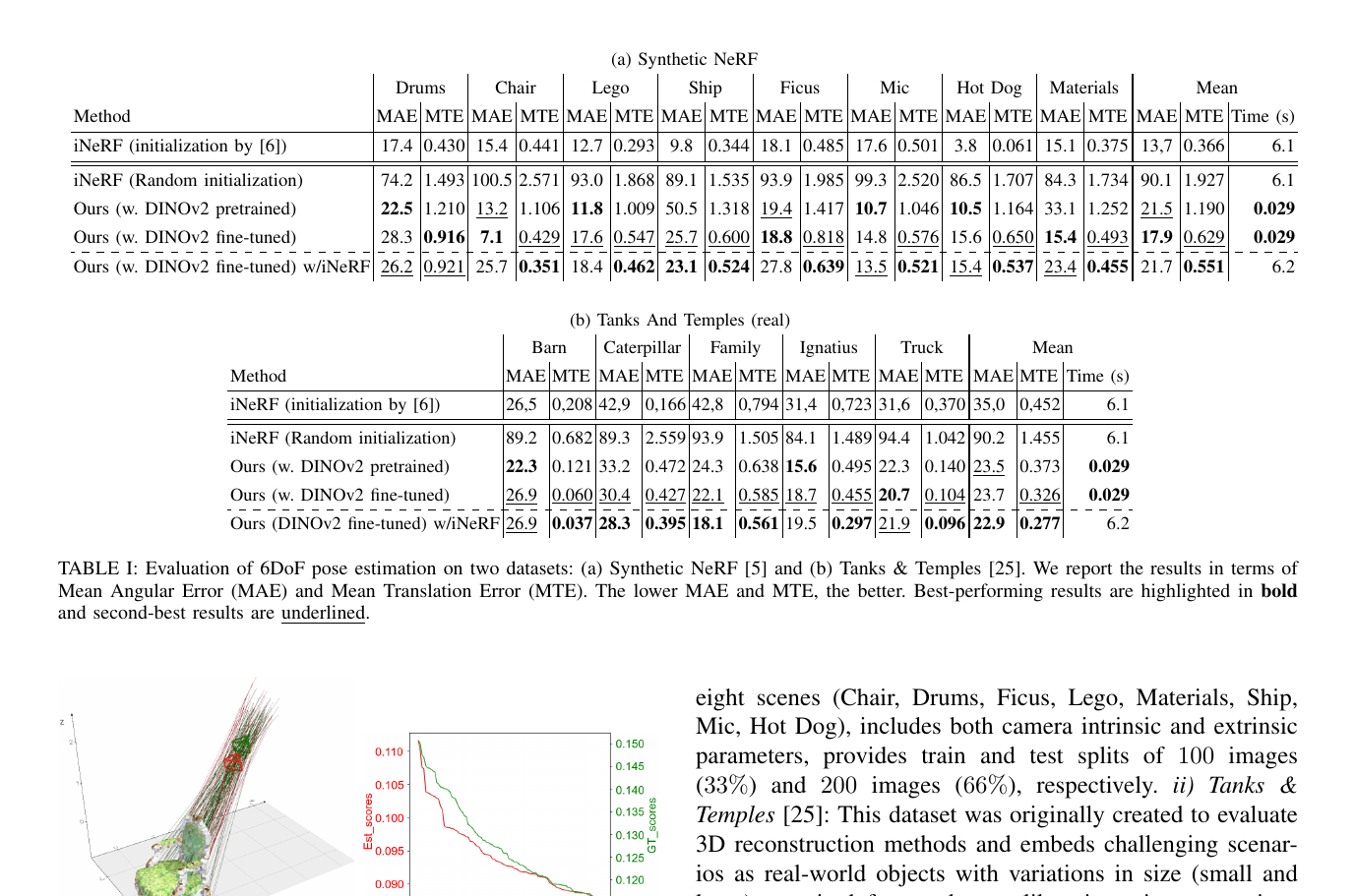 原论文 Table I / Figure 5:Table I 同时列出 synthetic、real、近邻 / 随机初始化和 runtime;下方示例显示预测 top rays 与 GT rays 的分布。来源:论文 PDF。图片版权归论文作者及出版方所有,本站仅作论文解读展示。
7.2 主结果的正确读法
| 协议 | 方法 | Synthetic mean MAE / MTE | Real mean MAE / MTE | 时间 |
|---|
| 近 GT init | iNeRF | 13.7 / 0.366 | 35.0 / 0.452 | 6.1 s |
| random init | iNeRF | 90.1 / 1.927 | 90.2 / 1.455 | 6.1 s |
| 无 init | IFFNeRF fine-tuned | 17.9 / 0.629 | 23.7 / 0.326 | 0.029 s |
作者声称:相对 random-init iNeRF,synthetic angular / translation error 分别改善约 72.2° / 1.29 units,real 改善约 66.5° / 1.129 units。
我的分析:
- 这有力证明 IFFNeRF 扩大了 capture range。
- 它没有证明在已有高质量 initialization 时精度全面高于 iNeRF;synthetic 上近初始化 iNeRF rotation 更低。
- real scenes 上 IFFNeRF 明显更稳,可能因为 DINOv2 features 比 photometric loss 更耐 shadows。
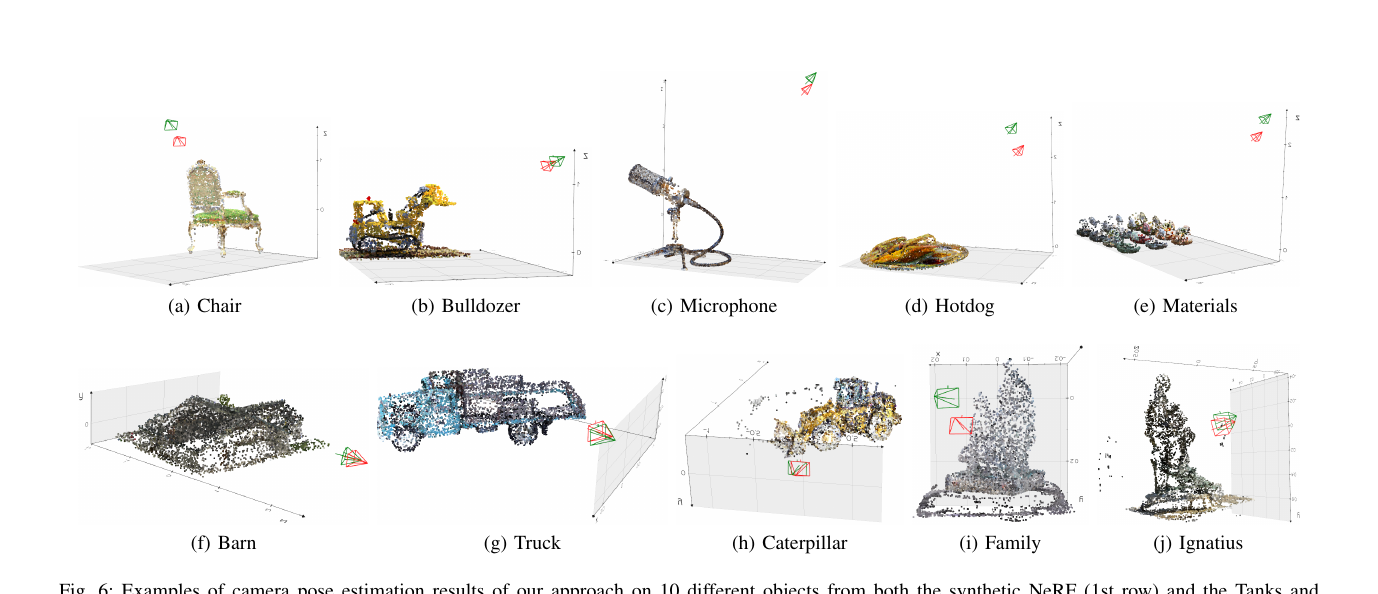 原论文 Figure 6:绿色相机为 GT,红色为预测。图中可见不同 scene 的 translation 与 viewing-direction error 并不一致,不能只用平均值描述。来源:论文 PDF。图片版权归论文作者及出版方所有,本站仅作论文解读展示。
7.3 鲁棒性
- query 加 50% Gaussian noise 后,误差上升 14.01° / 0.201 units;有一定 robustness,但不是轻微退化。
- pretrained 与 scene-fine-tuned DINOv2 的相对优劣依数据变化:real rotation 未必因 fine-tuning 改善。
- IFFNeRF + iNeRF 在 real 上进一步改善,synthetic 上 rotation 反而可能下降,说明 refinement basin 与初值误差形态有关。
8. 批判性分析
优点
- 将慢速 nonlinear optimization 变成一次 attention 与线性几何求解。
- capture range 和 runtime 都有明确实验证据。
- 以 feature matching 对抗真实 illumination change,设计动机合理。
缺点与隐含假设
- 每场景训练使它并非 generalizable novel-object pose。
- NeRF training 与 IFFNeRF training 时间没有纳入在线速度数字。
- unit-box MTE 不能直接映射到机器人抓取精度。
- 评测数据规模小,且没有 BOP symmetry / occlusion protocol。
- NeRF geometry failure、scene clutter 和多对象分离没有系统实验。
9. 可改进方向
- 训练跨 NeRF / object 通用的 ray matcher,做到新 NeRF 只需索引、不再 fine-tune。
- 将 rotation / translation uncertainty 从 ray score geometry 中解析出来。
- 引入 multi-scale rays 或 coarse-to-fine top-ray refinement。
- 在 metric object NeRF 和 BOP-like clutter 上评测 ADD(-S) / VSD。
- 将 NeRF quality / density uncertainty 纳入 ray confidence。
10. 对研究的启发
IFFNeRF 展示了 neural field 的另一种用法:不在 inference 时把它当 differentiable renderer,而把它预编译成带 appearance 的几何 rays。对需要实时的机器人系统,这类“representation → searchable primitives → closed-form solver”往往比端到端迭代更实用。
11. 待解决问题
- 论文中完整 6DoF orientation 如何从 selected rays 稳定恢复,哪些量由 ray direction / image relation决定?
- 每 scene 训练能否由 synthetic NeRF pretraining 替代?
- 对 NeRF floaters、透明对象和稀疏 views 的敏感性多大?
- 与 one-step NeRF + feature matching 在同一数据 / initialization protocol 下谁更稳?
