论文精读笔记:DigitalTwinArt
1. 核心判断
DigitalTwinArt 的关键建模选择是把“几何重建”和“关节推理”拆成两阶段。若像 PARIS 一样同时从图像优化多个 part-specific radiance fields,part boundary、shape、motion 与 rendering 会彼此补偿,容易陷入不同随机初始化对应的坏局部最优。
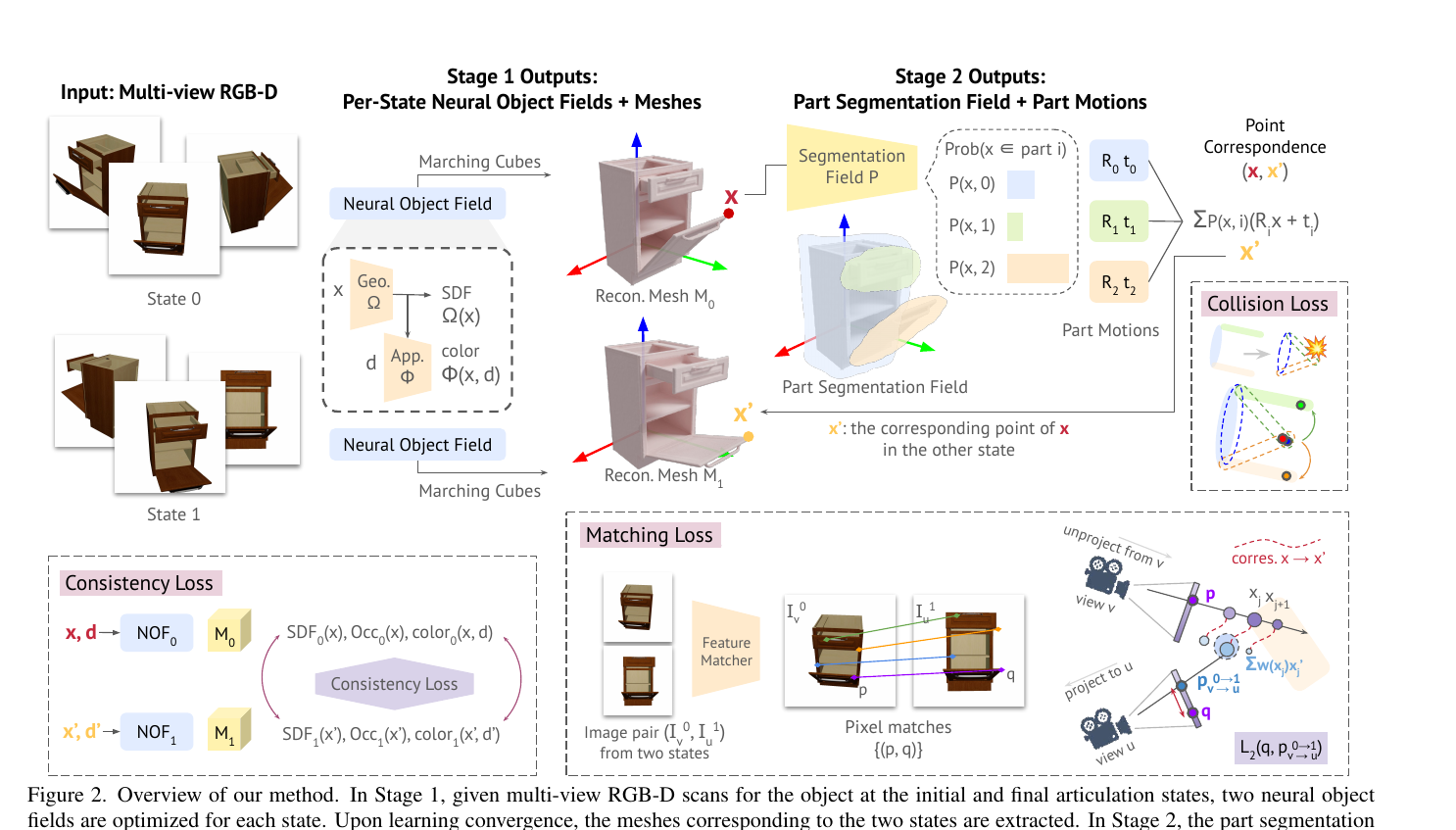
本文先不关心 articulation,把每个 state 当一个完整刚体对象,获得高质量 object-level SDF;第二阶段只需解释“两个已重建几何之间怎样由若干刚体 part motions 对应”。由 segmentation + motion 生成的 point correspondence field 成为统一接口,几何、颜色、2D matching 和碰撞约束都作用于这个 field。
这使它在 multi-part 与未知类别上比 prior-based Ditto 和 joint-optimization PARIS 更稳,但代价是每个对象、每个状态都要进行高成本多视图采集与两阶段优化。
2. Stage 1:每状态对象级 neural field
对 state t ∈ { 0 , 1 } t\in\{0,1\} t ∈ { 0 , 1 }
{ ( I v t , D v t , M v t ) } v = 1 V , \{(I_v^t,D_v^t,M_v^t)\}_{v=1}^{V}, {( I v t , D v t , M v t ) } v = 1 V , 其中 V ≈ 100 V\approx100 V ≈ 100
geometry network Ω t : x ↦ d \Omega^t:x\mapsto d Ω t : x ↦ d
appearance network Ψ t : ( x , d ) ↦ c \Psi^t:(x,\mathbf d)\mapsto c Ψ t : ( x , d ) ↦ c
两者用 multi-resolution hash encoding,实现沿用 BundleSDF 风格的 RGB rendering 与 SDF supervision。优化后:
Marching Cubes 提取 mesh M t M^t M t
从 mesh 得 Euclidean SDF Ω ~ t ( x ) \tilde\Omega^t(x) Ω ~ t ( x )
构造 occupancy:
Occ t ( x ) = clip ( 0.5 − Ω ~ t ( x ) s , 0 , 1 ) . \operatorname{Occ}^t(x)
=\operatorname{clip}
\left(
0.5-\frac{\tilde\Omega^t(x)}{s},0,1
\right). Occ t ( x ) = clip ( 0.5 − s Ω ~ t ( x ) , 0 , 1 ) . Stage 1 不尝试识别 parts,所以遮挡边界和接缝不会过早限制 shape reconstruction。
3. Stage 2:由 articulation “渲染” correspondence
原论文 Figure 2。两个 state 先各得完整 mesh;part segmentation field 与 rigid motions 通过 soft correspondence 把 state 0 的任意点映射到 state 1,所有监督都围绕这个映射定义。来源:CVPR 2024 正式论文 ;图片版权归论文作者及 IEEE/CVF 所有,本站仅作论文解读展示。
对象有 M M M
P t ( x , i ) = Pr ( x belongs to part i ) , P^t(x,i)=\Pr(x\text{ belongs to part }i), P t ( x , i ) = Pr ( x belongs to part i ) , 由 dense voxel 3D feature volume + MLP heads 实现。每个 part 有:
T i t = ( R i t , t i t ) ∈ S E ( 3 ) , T_i^t=(R_i^t,t_i^t)\in SE(3), T i t = ( R i t , t i t ) ∈ S E ( 3 ) , rotation 用连续 6D representation。两个方向共享 motion:
T i 1 = ( T i 0 ) − 1 . T_i^1=(T_i^0)^{-1}. T i 1 = ( T i 0 ) − 1 . point correspondence field 类似 linear blend skinning:
x t → t ′ = ∑ i P t ( x , i ) ( R i t x + t i t ) . x^{t\to t'}
=
\sum_iP^t(x,i)(R_i^tx+t_i^t). x t → t ′ = i ∑ P t ( x , i ) ( R i t x + t i t ) . 它不是先 hard-segment 再 registration;soft part assignment 与 rigid motion 可互相修正。
4. 四类约束
Surface consistency
若 x x x t t t t ′ t' t ′
ℓ s ( x ) = ( Ω ~ t ( x ) − Ω ~ t ′ ( x t → t ′ ) ) 2 , \ell_s(x)
=
\left(
\tilde\Omega^t(x)
-\tilde\Omega^{t'}(x^{t\to t'})
\right)^2, ℓ s ( x ) = ( Ω ~ t ( x ) − Ω ~ t ′ ( x t → t ′ ) ) 2 , ℓ c ( x ) = ∥ Ψ t ( x , d ) − Ψ t ′ ( x t → t ′ , d ′ ) ∥ 2 2 . \ell_c(x)
=
\left\|
\Psi^t(x,d)-\Psi^{t'}(x^{t\to t'},d')
\right\|_2^2. ℓ c ( x ) = Ψ t ( x , d ) − Ψ t ′ ( x t → t ′ , d ′ ) 2 2 . 对远离 surface、SDF / color 不可靠的点,改用 occupancy consistency,约束整个空间的 inside / outside 结构。
Image matching
从 LoFTR 得跨状态 pixel pairs,经相机射线与渲染权重求两端 3D surface points,要求 articulation correspondence 把前者映射到后者。这提供纯 3D SDF 难以确定的 appearance anchors。
Collision loss
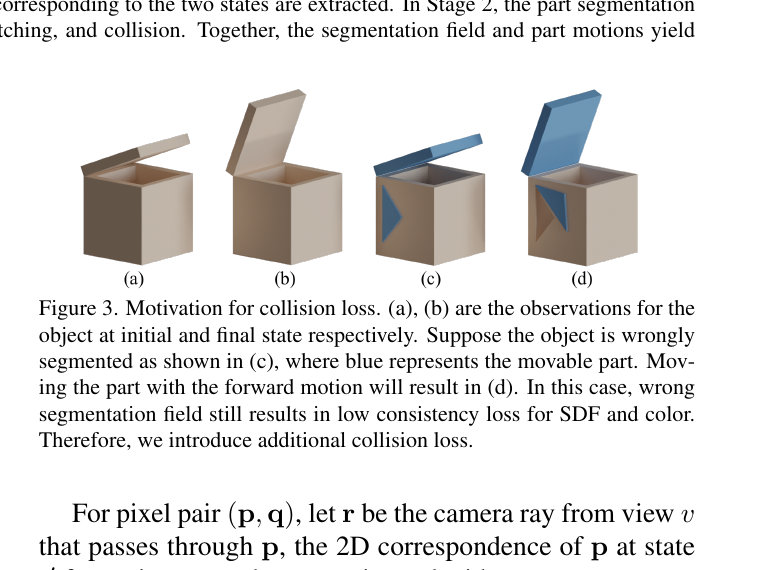
原论文 Figure 3:错误 segmentation 可能让抽屉面板随 drawer 一起运动并穿过 base;仅 SDF / color consistency 未必惩罚,collision loss 对 motion sweep 中的部件互穿给出额外约束。来源:CVPR 2024 正式论文 ;图片版权归论文作者及 IEEE/CVF 所有,本站仅作论文解读展示。
作者在两状态间插值各 part rigid motion,检测移动点是否进入其他 part 的 occupancy。collision loss 不直接监督 joint axis,但排除“几何能对齐、运动过程却不物理”的退化解。
Partial observation handling
只在另一个 state 的 observed space 内计算跨状态 consistency;若映射点落在被遮挡 / 未观察区域,不把 hallucinated surface 当作可靠监督。这对真实 RGB-D scan 很重要。
总损失可概括为:
L = λ c o n L c o n + λ m a t c h L m a t c h + λ c o l l L c o l l , \mathcal L
=\lambda_{\mathrm{con}}\mathcal L_{\mathrm{con}}
+\lambda_{\mathrm{match}}\mathcal L_{\mathrm{match}}
+\lambda_{\mathrm{coll}}\mathcal L_{\mathrm{coll}}, L = λ con L con + λ match L match + λ coll L coll , 其中 consistency 又包含 SDF、RGB 与 occupancy。
5. 从 rigid motion 提取 joint
优化结束后:
对 part probabilities 取 hard label;
对每个 T i T_i T i
angle 接近 0 时视为 prismatic,并从 translation 得 axis 与 amount;
否则视为 revolute,从 rotation matrix / axis-angle 得 axis,再求 joint position;
part mesh 与 joint parameters 共同导出可交互 digital twin。
论文已知 part / joint 数量,并固定 part 0 静止。它不学习未知拓扑,也不处理闭环机构。
实验中的 Part Motion Err 对 revolute joint 是 rotation geodesic error,对 prismatic joint 是 translation Euclidean error;混合关节的平均值是 mixed-unit 汇总,阅读表格时不能统一解释为毫米。
6. 两部件与多部件结果
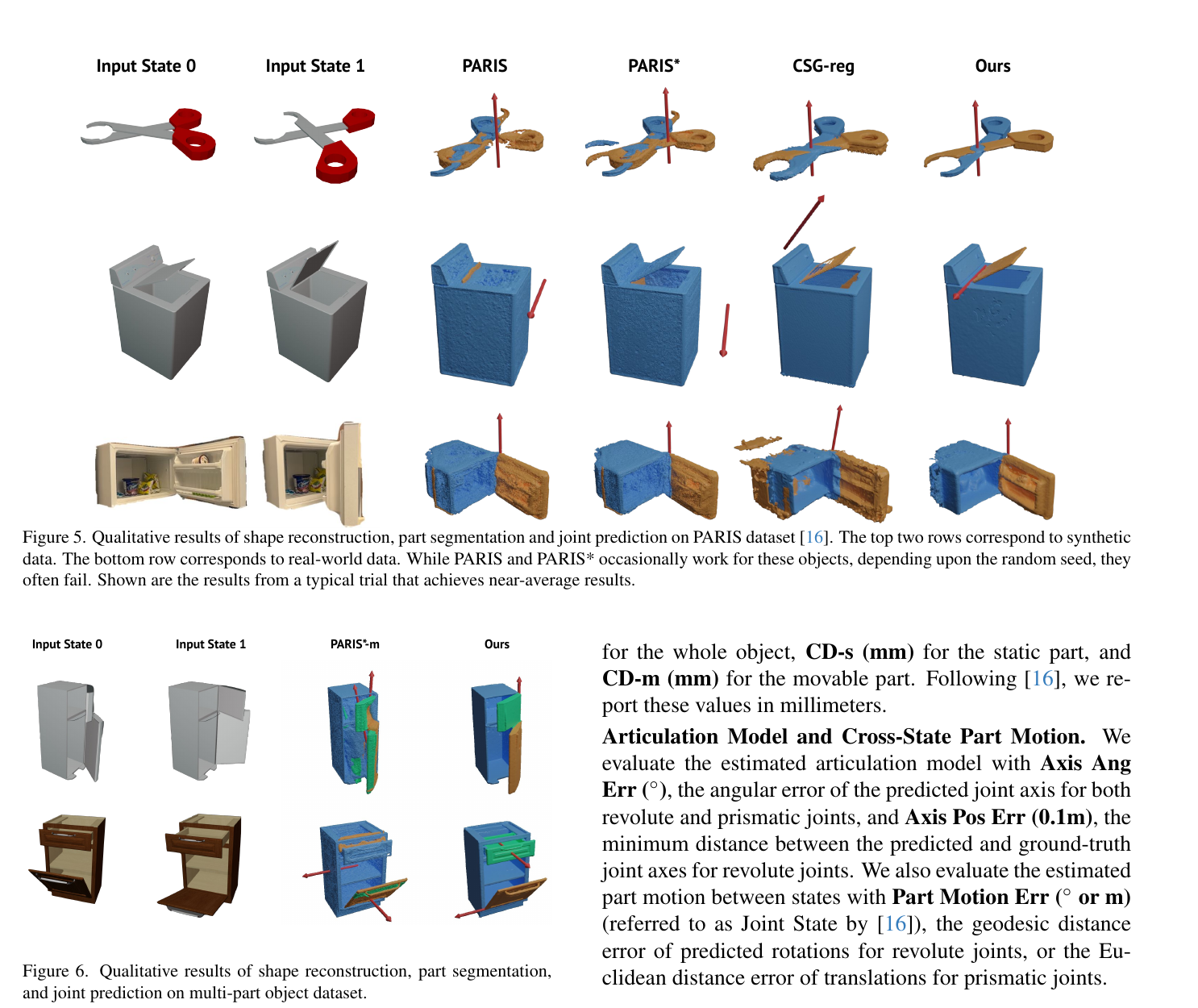
原论文 Figure 5–6。PARIS / PARIS* 常出现 part fragmentation 或 joint axis 偏移,CSG-reg 受两状态几何差分噪声影响;本文在 synthetic 与 real examples 上保持更完整 mesh 和更稳定分割。来源:CVPR 2024 正式论文 ;图片版权归论文作者及 IEEE/CVF 所有,本站仅作论文解读展示。
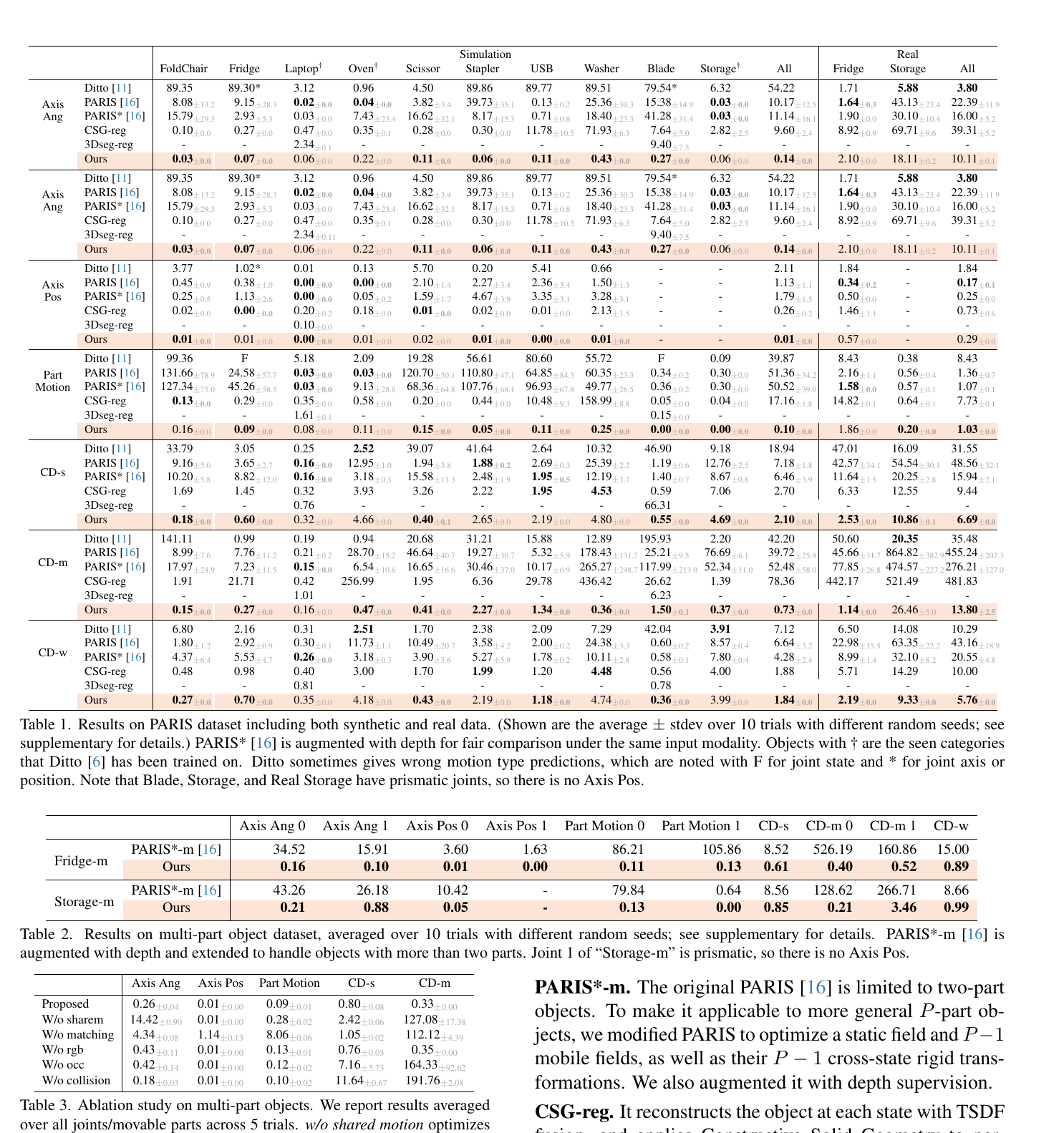
PARIS dataset 含 8 个对象类别、10 个 synthetic 与 2 个 real objects;既有 revolute 也有 prismatic joints。每个 optimization-based method 用 10 个随机 seeds 重复,报告 mean ± stdev。这一协议很重要,因为 PARIS 有时结果很好、有时彻底失败,单次最好结果会掩盖不稳定性。
作者另构造 2 个 multi-part objects:
对象 指标 PARIS*-m DigitalTwinArt Fridge-m Axis Ang 0 / 1 34.52 / 15.91 0.16 / 0.10 Fridge-m Part Motion 0 / 1 86.21 / 105.86 0.11 / 0.13 Fridge-m moving CD 0 / 1 526.19 / 160.86 0.40 / 0.52 Storage-m Axis Ang 0 / 1 43.26 / 26.18 0.21 / 0.88 Storage-m Part Motion 0 / 1 79.84 / 0.64 0.13 / 0.00 Storage-m moving CD 0 / 1 128.62 / 266.71 0.21 / 3.46
这些 synthetic numbers 很强,但样本只有两个多部件对象,不能据此推断任意复杂机构都已解决。
7. 消融:哪些约束真正必要
原论文 Table 1–3。Table 1 是 10 个随机 seeds 的两部件全量结果;Table 2 是 multi-part;Table 3 将 shared motion、matching、RGB、occupancy 与 collision 逐一移除。来源:CVPR 2024 正式论文 ;表格版权归论文作者及 IEEE/CVF 所有,本站仅作论文解读展示。
多部件平均:
配置 Axis angle Axis pos. Part motion Static CD Moving CD 完整 0.26 0.01 0.09 0.80 0.33 无 shared motion 14.42 0.01 0.28 2.42 127.08 无 matching 4.34 1.14 8.06 1.05 112.12 无 RGB consistency 0.43 0.01 0.13 0.76 0.35 无 occupancy 0.42 0.01 0.12 7.16 164.33 无 collision 0.18 0.01 0.10 11.64 191.76
joint angle 不一定随 shape 一起恶化:无 collision 时 angle 甚至略好,但 moving-part CD 从 0.33 变 191.76。说明 collision / occupancy 主要消除错误分割和几何退化,不是直接优化 joint axis。
shared motion 最关键地稳定双向优化;matching 最直接影响 motion;RGB 的边际贡献较小,geometry 与 whole-space constraints 才是 mesh quality 的主要来源。
8. 与 pose estimation 的联系
DigitalTwinArt 不应和 LM-O / BOP 的单帧 6D pose 方法直接比准确率。它处理:
同一对象两个状态之间的 part-level rigid transforms;
part segmentation 与 joint axis;
未知形状的 mesh reconstruction;
可交互资产生成。
但它对 pose 研究有三个启发:
correspondence field 可统一 segmentation 与 motion ;跨状态共享 inverse transform 是强几何约束;物理可行性损失 能排除纯 photometric / geometric matching 的退化 pose。
这些思想可迁移到 articulated tracking、object manipulation 与 dynamic NeRF pose。
9. 局限与复现检查
每状态约 100 个 calibrated RGB-D views,采集成本远高于单帧 / 少视图。
camera poses、object masks、joint count 已知。
base part 假设静止且两状态基座对齐。
两阶段 per-object optimization 不适合实时在线推理。
real data 规模很小;multi-part 验证只有两个 synthetic objects。
遮挡模式差异大时,跨状态可见区域不足,作者也列为开放问题。
只考虑 revolute / prismatic,未覆盖柔性、螺旋、闭环或接触可变结构。
Stage 1 reconstruction error 会传递到 Stage 2;论文没有系统扫描 depth / calibration noise。
10. 最终评价
DigitalTwinArt 是一篇高质量的扩展 pose 工作:它把未知关节对象的 part pose、shape、segmentation 和 kinematics 放进一个由 correspondence field 驱动的优化框架,并以多随机种子、multi-part 与细致消融证明稳定性。
它更接近离线数字孪生资产构建,而不是实时 object pose。下一步若要进入机器人实际使用,需要显著减少视图和优化时间,自动推断 joint count / base alignment,并在真实多关节对象、未知相机位姿和变化遮挡下验证。