论文精读笔记:RGB-Based Category-Level Object Pose Estimation Via Decoupled Metric Scale Recovery
1. 基本信息
简称 :DMSR作者 / 机构 :Jiaxin Wei(ShanghaiTech)、Xibin Song、Weizhe Liu、Pan Ji(Tencent)、Laurent Kneip(ShanghaiTech)、Hongdong Li(Tencent / ANU)年份 / 会议 :2024 / ICRA论文 :arXiv / PDF 代码 :goldoak/DMSR 阅读模式 :精读
2. 一句话定位
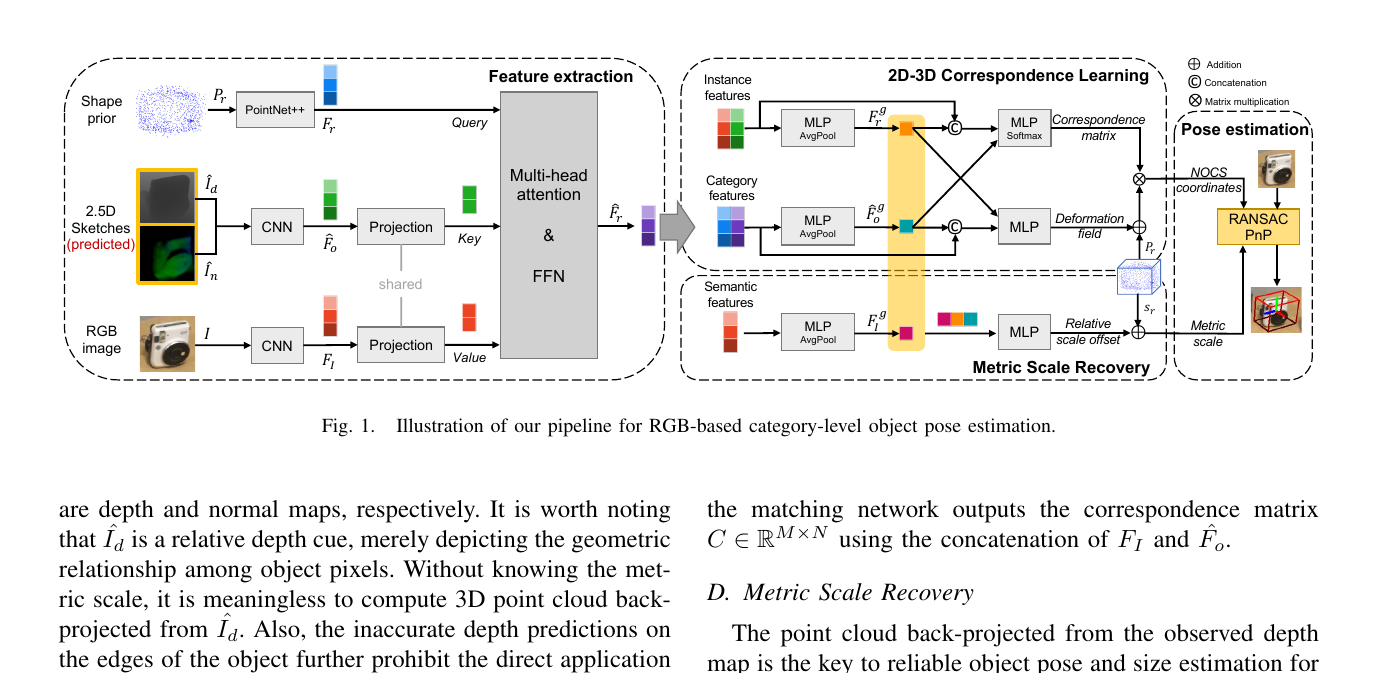
DMSR 不要求单目网络恢复可信的绝对深度,而把预训练 relative depth / normal 当作 correspondence features;网络在 normalized category space 学习 2D–3D 对应,同时用独立分支从 category prior 恢复 metric scale,最后以 perspective PnP 求 R , t R,t R , t
2.1 论文图表导读
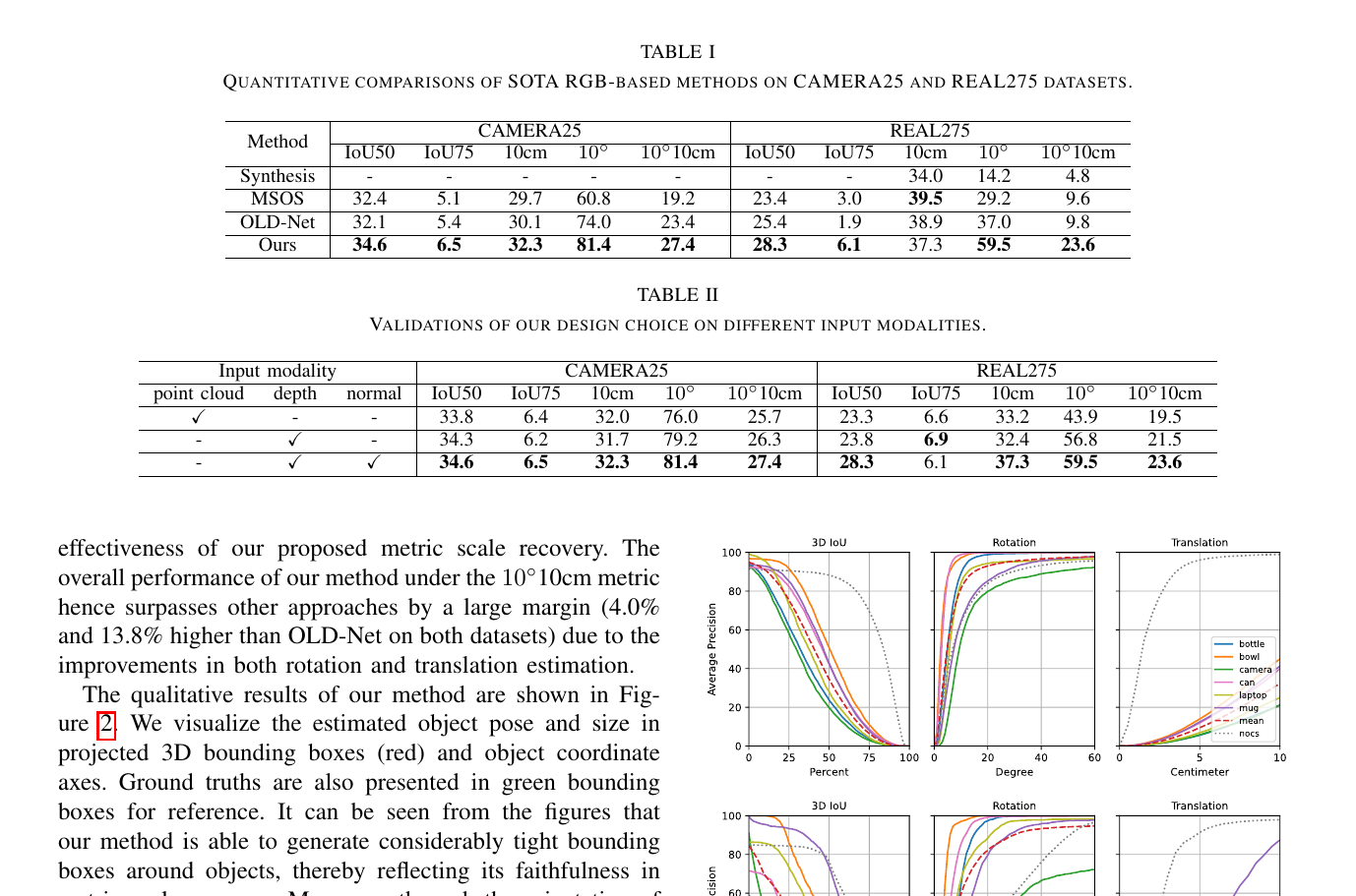
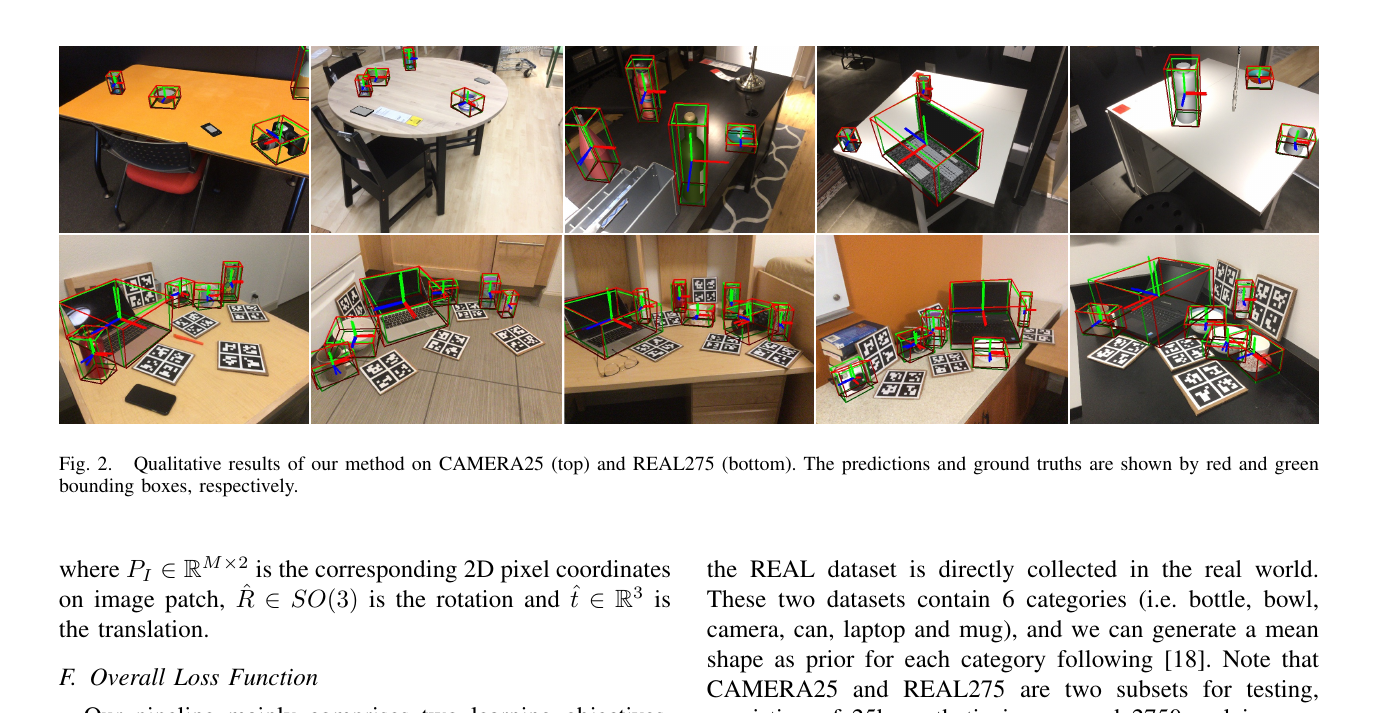
图表 内容 关键结论 Figure 1 RGB / 2.5D features、prior deformation、correspondence、scale branch、PnP pose 与 scale 只在 solver 前汇合 Figure 2 CAMERA25 / REAL275 定性结果 真实 clutter 下 bbox / axes 大体贴合,仍有尺度偏差 Tables I–III 主结果、输入模态和 scale strategy 消融 2.5D 几何与 decoupled scale 均有独立贡献
原论文 Figure 1:RGB 与 Omnidata 2.5D sketches 提供实例特征;category prior 经 deformation 后成为 NOCS 3D points。correspondence matrix 决定每个 image point 对应的 NOCS point,metric scale recovery 另行预测尺度。来源:论文 PDF 。图片版权归论文作者及出版方所有,本站仅作论文解读展示。
3. 问题设定与任务边界
属性 设定 任务 category-level 6D pose + metric size 测试对象 已知类别中的未见实例 观测 单张 RGB crop;测试时无真实 depth 几何辅助 预训练 Omnidata 输出 relative depth 与 surface normal 对象先验 每类 normalized mean shape / point set 训练监督 mask、category、NOCS correspondence、pose / size solver perspective-n-point + RANSAC
DMSR 与真正 prior-free 方法不同:它不需要 instance CAD,但需要 category mean shape。与 RGB-D 类别级方法不同:它不能直接得到可靠 metric point cloud。
4. 研究脉络
NOCS / SPD / SGPA 路线通常把 observed depth cloud 与 normalized category prior 对齐,用 Umeyama / Procrustes 同时求 pose 与 scale。
OLD-Net 等 RGB-only 方法先恢复 object-level absolute depth,再回到 RGB-D pipeline;绝对 depth 的 metric error 会传入刚体变换。
DMSR 的核心判断是:relative depth / normals 对“哪里对应哪里”有帮助,却不应被当成 metric coordinate。
5. 方法详解
5.1 2.5D 几何特征
对 crop I I I
D ^ = f d ( I ) , N ^ = f n ( I ) , \hat D=f_d(I),\qquad \hat N=f_n(I), D ^ = f d ( I ) , N ^ = f n ( I ) , 其中 D ^ \hat D D ^ N ^ \hat N N ^
RGB、depth、normal 分别经 CNN / projection,形成 image semantic features 与 geometric features。relative depth 的数值不用于直接 back-projection,因此即便全局尺度错误,只要局部排序和表面方向仍有信息,就能帮助 correspondence。
类别 prior P r P_r P r Δ P r \Delta P_r Δ P r
P ~ r = P r + Δ P r . \tilde P_r=P_r+\Delta P_r. P ~ r = P r + Δ P r . 网络输出 image points 与 P ~ r \tilde P_r P ~ r C C C
5.3 Decoupled Metric Scale Recovery
独立 MLP 从 instance / category features 回归相对 mean size 的 scale offset Δ s \Delta s Δ s s r s_r s r
s ^ = s r + Δ s . \hat s=s_r+\Delta s. s ^ = s r + Δ s . 关键在于:correspondence learning 不依赖 s ^ \hat s s ^ s ^ \hat s s ^
5.4 Perspective PnP
给定 image points P i P_i P i s ^ P ~ i \hat s\,\tilde P_i s ^ P ~ i K K K
R ^ , t ^ = PnP ( P i , s ^ P ~ i , K ) . \hat R,\hat t
=\operatorname{PnP}\!\left(P_i,\hat s\,\tilde P_i,K\right). R ^ , t ^ = PnP ( P i , s ^ P ~ i , K ) . RANSAC 用于抑制 correspondence outliers。与 3D–3D Procrustes 相比,PnP 更贴合 RGB 的 perspective observation,也避免把 pseudo-depth 直接当真实 scene coordinate。
6. 训练与工程
image / prior correspondence 与 scale offset 使用监督损失联合训练,但网络结构显式分支。
2.5D estimator 是外部 pretrained dependency;其 domain robustness 会影响 DMSR。
query 仍需 mask / crop,论文不评测 open-world detection。
主要计算包含 Omnidata、PSPNet / ResNet18 特征、prior interaction 与 RANSAC-PnP。
代码公开,使其适合复现 RGB-only category-level baseline。
7. 实验分析
7.1 数据与指标
CAMERA25 :合成 NOCS 测试集,25k images。REAL275 :真实 NOCS 测试集,2,750 images,六类日常对象。指标 :3D IoU25 / 50 / 75,以及 5 ∘ 2 5^\circ2 5 ∘ 2 5 ∘ 5 5^\circ5 5 ∘ 5 10 ∘ 2 10^\circ2 1 0 ∘ 2 10 ∘ 5 10^\circ5 1 0 ∘ 5
这些指标同时受 rotation、translation、size 影响;论文额外画不同 error thresholds 的 AP 曲线,能更连续地观察 rotation / translation。
原论文 Tables I–III:Table I 对比 RGB-based category pose;Table II 验证 RGB / predicted depth / normal 的组合;Table III 比较 mean scale、scale offset 等尺度恢复策略。来源:论文 PDF 。图片版权归论文作者及出版方所有,本站仅作论文解读展示。
7.2 主要结论
相比 Synthesis、MSOS、OLD-Net,DMSR 在 CAMERA25 与 REAL275 的 rotation-sensitive criteria 上更强。
论文总结其在 REAL275 相比 MSOS 的 rotation error 约降低 50%,同时模型仅约 5.1% 参数量。
quantitative gain 在 synthetic CAMERA25 更稳定;REAL275 的 metric size 受类别实例分布差异影响。
7.3 消融解释
消融 支撑的主张 我的判断 RGB only → + depth / + normal 2.5D geometry 提升 correspondence 支持;但应同时报告外部 estimator 成本 depth only vs depth+normal normal 补充局部 surface orientation 对 rotation 尤其合理 mean scale → learned scale offset 类别统计不足以覆盖实例 size 支持 joint scale vs decoupled branch scale error 不应污染 pose feature 是本文最关键的结构证据
原论文 Figure 2:上行为 CAMERA25、下行为 REAL275;红色为预测框、绿色为 GT。真实场景中仍可见局部 translation / scale 偏差。来源:论文 PDF 。图片版权归论文作者及出版方所有,本站仅作论文解读展示。
8. 批判性分析
优点
对单目类别级 pose 的 scale ambiguity 给出结构化解法,而非只换 backbone。
relative geometry 的使用方式克制:帮助 matching,不伪装成 metric depth。
PnP 将 camera model 显式放回 pipeline。
缺点与隐含假设
“RGB-only”不代表只依赖一个网络;实际要运行两个 pretrained 2.5D estimators。
category prior、mask 和 NOCS supervision 都是强先验。
mean-scale residual 假设训练 / 测试类别尺寸分布相近;REAL275 已显示偏移。
论文主要在六类 NOCS benchmark 上验证,尚不能证明扩展到长尾类别。
对对称对象的训练与评价处理没有形成独立的多解建模。
9. 可改进方向
用 metric-depth uncertainty 而非单个 scale offset,输出 pose / size distribution。
用 foundation monocular geometry 替代 Omnidata,并评测跨域 calibration。
将 mask uncertainty 传播到 correspondence weights 与 PnP covariance。
扩展到开放类别 shape prior retrieval,减少固定 mean shape 依赖。
在真实机器人上直接评价抓取 / 放置成功率,而不只看 NOCS thresholds。
10. 对研究的启发
这篇论文最可复用的思想是“让不可靠的几何只做它擅长的事”。relative depth 适合排序和局部形状,metric scale 则需要独立统计或测量;把两者硬拼成 pseudo point cloud 反而会增加 rotation error。
11. 待解决问题
scale offset 的误差如何定量传到 PnP translation?
去掉 category mean shape 后,DMSR 是否仍能保持 correspondence?
Omnidata 在透明、反光、无纹理对象上的 failure 会怎样表现?
与同设定的 FAP-Net 在 detector、mask 和训练数据完全一致时谁更强?