论文精读笔记:PLANTPose
1. 核心判断
PLANTPose 针对农业对象的关键观察是:类别内变化不仅是纹理变化,也不是一个尺度参数就能解释,而是显著的非刚体几何变化。若仍用平均香蕉 mesh 做 render-and-compare,位姿优化会尝试用错误旋转和平移去补偿形状不匹配。论文因此用一个 24D lattice deformation 显式吸收实例形状,再单独估计 6D pose。
方法最值得关注的是“形变与刚体运动的标注解耦”。随机移动 lattice corners 会同时造成弯曲、整体平移和整体旋转;若直接把这些 offset 当 deformation ground truth,网络会把姿态和形变混为一谈。作者用 Umeyama 对齐原始 / 变形网格,移除形变里的刚体分量。后续消融也显示这不是数据预处理小技巧,而是 pose–shape 分解能否成立的关键。
2. 任务边界
给定一个农业对象类别的 base mesh 和单幅 RGB crop,网络预测:
- rotation R∈SO(3);
- translation t∈R3;
- lattice corner offsets δ∈R24。
推理阶段不使用 depth,但需要:
- 已知类别及其 base mesh;
- YOLOv11 detection / crop;
- camera intrinsics;
- 针对该类别训练的 PLANTPose network。
它不是任意 CAD 输入的 novel-object pose 方法,也不是通用 deformable registration。论文当前只训练香蕉一个类别,base mesh 作为固定训练先验而非动态网络输入。
3. 数据与方法全流程
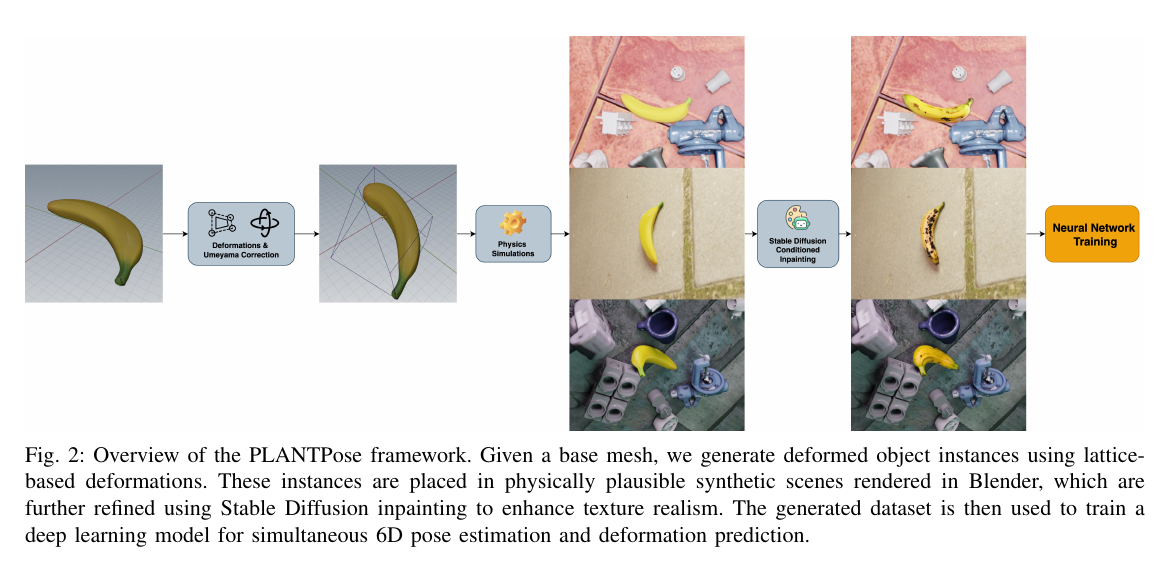 原论文 Figure 2。图中“Deformations & Umeyama Correction”先构造低维形变并去除其刚体分量;物理仿真决定 pose 与遮挡,Stable Diffusion 负责纹理域变化。来源:作者公开稿;图片版权归论文作者及 IEEE 所有,本站仅作论文解读展示。
3.1 2×2×2 lattice 与 cubic B-spline
基础 mesh 的 bounding box 形成 lattice。8 个角点各有三维 offset Ci,j,k,因此只需 24 个参数。任意顶点 p 先归一化到 (u,v,w)∈[0,1]3,再由 cubic B-spline basis 加权:
δx(u,v,w)=i,j,k=0∑3Wi(u)Wj(v)Wk(w)Ci,j,kx,
y,z 分量同理,最终 p′=p+δ(u,v,w)。角点 offset 会扩展 / clamp 到 4×4×4 控制网格,以满足 cubic basis 的边界行为。B-spline 的 C2 连续性使形变比逐顶点噪声更平滑,也让网络输出固定长度参数。
这种表示适合香蕉式低频弯曲、粗细与整体轮廓变化;它不适合拓扑变化、局部断裂、枝叶结构或需要高频细节的对象。
3.2 用 Umeyama 移除伪姿态
随机 lattice deformation 后,作者用
(s,R,t)=Umeyama(Poriginal,Pdeformed)
估计两点集的最优 similarity transform,固定 s=1,再校正 lattice points,使形变标注不携带全局 rotation / translation。否则同一变形既可由 δ 表达,也可由 R,t 表达,监督不唯一。
这一步同时引出一个隐含条件:base mesh 与变形 mesh 顶点一一对应。真实扫描只在评测时使用 Chamfer / ICP,不直接作为训练 deformation label。
3.3 物理合成与 diffusion texture refinement
BlenderProc 创建带墙面、地板、材质、光照和 distractors 的场景,将变形对象按物理属性掉落并稳定,再围绕 point of interest 采样相机。每个随机形变场景渲染 3 个视角。
传统 PBR 仍难覆盖农业对象的成熟度、斑点和腐烂纹理,因此作者在渲染完成后用 Stable Diffusion inpainting 修改目标对象区域。ControlNet 接收 depth map,目的是保持几何轮廓和 pose;prompt 覆盖 unripe、ripe、rotten 与自然颜色变化。
该设计比直接 text-to-image 更可控,但作者承认,即使有 depth conditioning,少数图像仍会轻微改变对象 6D pose。若 altered image 继续沿用原合成标注,就会产生 label noise。
3.4 网络与损失
输入是对象 crop。small ViT(30.9M parameters,ImageNet-21k pretraining,32×32 patches)后接三个 head:
- rotation head:输出 6D continuous rotation representation,再正交化为 R;
- translation head:输出 crop frame 下 3D vector;
- deformation head:输出 24D lattice offsets。
总损失为:
L=λr∥r6dpred−r6dgt∥2+λd∥δpred−δgt∥2+λp∥Proj(P∣R,t,δ)−v2dgt∥2.
projection loss 把 shape、rotation 和 translation 的组合结果投影到 2D,与真值 mesh vertices 的 2D 位置比较。推理时将 crop offset / scale 反变换到整图,再用 lattice-deformed 3D points、2D projections 和 camera intrinsics 运行 PnP,得到相机坐标系 translation。
论文描述中 translation head、projection loss 与最终 PnP translation 的关系略显混杂;复现时必须核对网络平移是用于 crop projection 的中间变量,还是直接初始化 PnP。
4. 真实香蕉基准
作者采集:
- 6 根不同形状与成熟阶段的真实香蕉;
- 100 张 RealSense D435 RGB 图;
- 用 iPhone 14 Pro LiDAR 分别扫描每根香蕉;
- 人工标注图像 pose。
由于扫描 mesh 与 base mesh 没有逐顶点对应,shape 采用 Chamfer distance;rotation / translation 误差先通过 ICP 对齐真实扫描与 base mesh 后计算;deformation error 则在移除预测 pose 后单独比较形状。
这一协议能同时衡量 pose 与 shape,但 ICP alignment 会参与真值坐标建立,扫描质量和 ICP 局部最优都会影响误差。数据只有 100 张,论文也没有拆分每根香蕉、遮挡程度与成熟度的统计。
5. 主结果
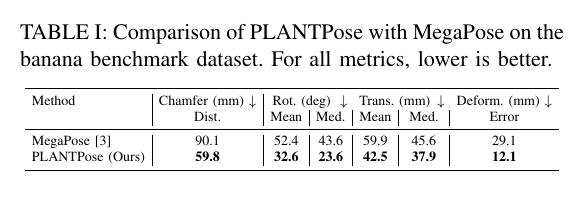 原论文 Table I。所有指标越低越好;MegaPose 使用相同平均香蕉 mesh,但不预测实例形变。来源:作者公开稿;表格版权归论文作者及 IEEE 所有,本站仅作论文解读展示。
| 方法 | Chamfer (mm) | Rotation mean / median (°) | Translation mean / median (mm) | Deformation (mm) |
|---|
| MegaPose | 90.1 | 52.4 / 43.6 | 59.9 / 45.6 | 29.1 |
| PLANTPose | 59.8 | 32.6 / 23.6 | 42.5 / 37.9 | 12.1 |
相对 MegaPose,PLANTPose 的 Chamfer 降 30.3 mm,平均旋转误差降 19.8°,平均平移误差降 17.4 mm,deformation error 降 17.0 mm。由于对照只有一个且任务设定并不完全等价,这些数字主要证明“对当前香蕉基准,显式形变优于把所有实例塞进平均 mesh”,不能扩展为对通用类别级方法的 SOTA 结论。
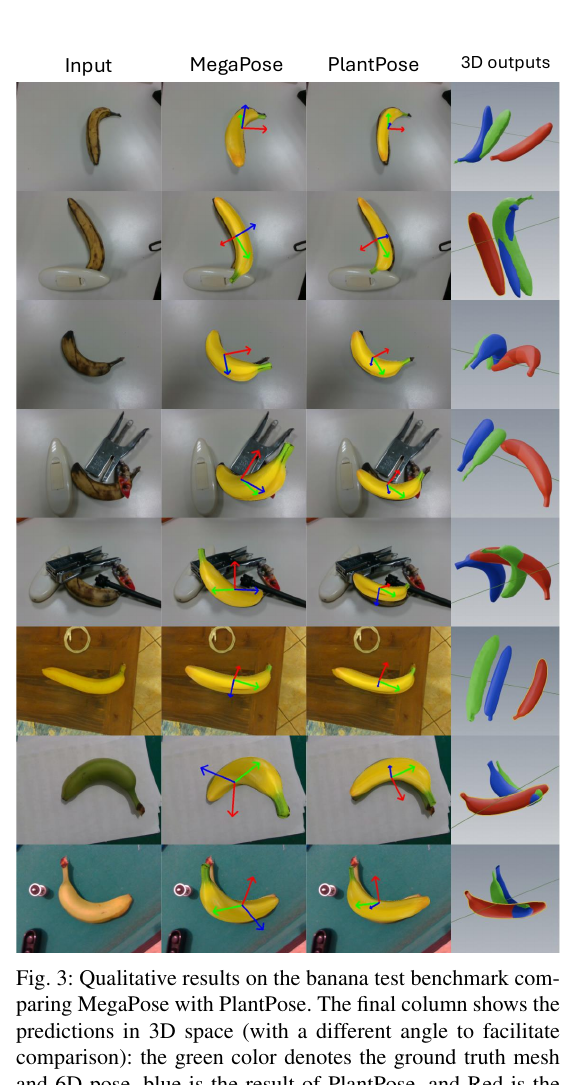 原论文 Figure 3:绿色为真值 mesh / pose,蓝色为 PLANTPose,红色为 MegaPose;最后一列从另一视角展示三者几何与姿态差异。来源:作者公开稿;图片版权归论文作者及 IEEE 所有,本站仅作论文解读展示。
图中 PLANTPose 更能跟随弯曲方向和长度变化;MegaPose 的平均 mesh 偏差会连带影响 pose。但部分样本仍存在明显 3D rotation / shape mismatch,平均旋转误差 32.6° 也说明尚未达到精细农业操作所需的高精度。
6. 消融
| 设置 | Chamfer | Rot. mean / med. | Trans. mean / med. | Deform. |
|---|
| Full | 59.8 | 32.6 / 23.6 | 42.5 / 37.9 | 12.1 |
| w/o Stable Diffusion | 71.5 | 37.7 / 23.0 | 48.9 / 48.7 | 13.9 |
| w/o Umeyama | 73.1 | 36.5 / 26.2 | 50.3 / 45.8 | 12.7 |
| w/o Umeyama and SD | 89.7 | 36.1 / 26.7 | 61.1 / 61.9 | 26.5 |
Stable Diffusion 主要改善跨真实纹理泛化;Umeyama 主要阻止 deformation label 吞掉 translation / rotation。单项消融并非所有列都严格变差,例如 w/o SD 的 median rotation 23.0° 略优于 full 的 23.6°,因此“所有指标都由每个模块改善”的说法需要收敛为整体趋势。
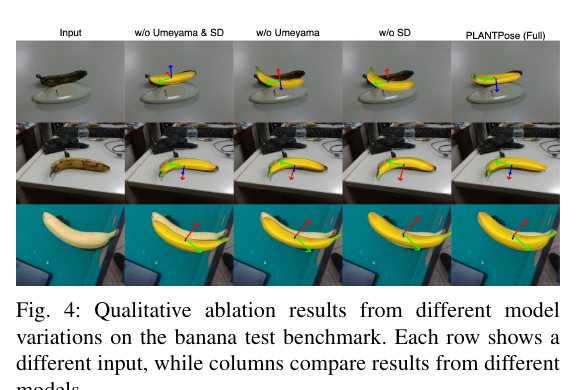 原论文 Figure 4:去 Umeyama 后,形变与 translation / rotation 混叠;去 Stable Diffusion 后,对未见纹理更容易丢失整体 pose。来源:作者公开稿;图片版权归论文作者及 IEEE 所有,本站仅作论文解读展示。
7. 局限与复现风险
作者明确指出:
- 当前每个 category 需要独立训练;
- 希望未来把 base CAD 作为动态输入,跨类别适配;
- Stable Diffusion 偶尔会在 depth conditioning 下仍改变 pose。
本站补充:
- 只有香蕉类别、6 个真实实例与 100 张图,无法证明对苹果、番茄、草莓或叶片等结构泛化;
- 训练形变来自低维 B-spline,真实香蕉扫描若含局部凹痕和非均匀细节,表示上限受限;
- 真实 RGB 由 D435 获取,但没有深度输入不等于不需要标定;PnP 仍要求 intrinsics;
- 没有与 NOCS / shape-prior category-level methods 在统一 RGB-only 输入上比较;
- 没有运行时间、检测失败、严重遮挡、树叶背景与机器人抓取测试;
- 真实标注和扫描 protocol 未给出足够细节,尤其是 ICP 坐标对齐与对称 / 朝向定义。
8. 复现检查表
- 固定 base banana mesh、单位、坐标轴和 lattice bounding box;
- 记录 8 corner offsets 的采样范围与 4×4×4 clamp 规则;
- 保存 Umeyama correction 前后 R,t,δ,验证刚体分量被移除;
- 对 diffusion 结果做 image–depth / mask 一致性过滤,丢弃几何改变样本;
- 复现 4,000 scenes × 3 views、物理参数、distractors、光照和 prompts;
- 核对 ViT input size、patch 32、loss weights 与 rotation orthonormalization;
- 明确 crop-frame translation 与最终 PnP translation 的坐标变换;
- 对每个真实实例报告误差,并公开扫描 mesh、intrinsics 与标注协议。
9. 最终评价
PLANTPose 的贡献不只是给农业对象套一个 pose network,而是用低维可解释形变、Umeyama 解耦和 diffusion 纹理增强构成完整数据—模型闭环。其香蕉基准和消融足以证明这条路线在当前单类别上有效;但 32.6° 平均旋转误差、100 张测试图和每类别独立训练也表明它仍是“有说服力的任务原型”,而不是已经可直接部署的通用农业 pose 系统。
