论文精读笔记:Shape From Shading for Robotic Manipulation
1. 基本信息
论文简称 :Active Shape from Shading / Controlled-Illumination Workspace作者 :Arkadeep Narayan Chaudhury, Leonid Keselman, Christopher G. Atkeson机构 :The Robotics Institute, Carnegie Mellon University会议 / 页码 :WACV 2024,pp. 8389–8398官方论文页 :CVF Open Access 论文 PDF :CVF PDF 公开版本 :arXiv:2304.11824 阅读模式 :精读专题口径 :扩展收录。论文主任务是机器人工作区的 active shape sensing,object pose / tracking 是四类下游应用之一。
2. 一句话定位
论文把机器人桌面工作区改造成一个大尺度 photometric-stereo sensor:六个低入射角方向光和一个顶光依次照明,两个 calibrated cameras 记录同一静态对象,系统反演表面法向、提取阴影形成的 depth discontinuities,并可积分出局部 3D surface;这些观测随后支持吸盘抓取、薄物体检测、已知柔性物体形变估计、已知 CAD 的 render-and-compare pose alignment,以及无 CAD 对象两次观测间的相对平面 tracking。
Pose 读者应先记住的三条边界
已知对象 :方法可能优化完整 3D model pose,但定量表只报告 rendered / observed object edges 的 image-space pixel misalignment,没有 GT rotation / translation error。未知对象 :不是绝对 pose estimation,而是同一物体两次观测之间的 relative registration;主表只扰动 / 测量 Δ X , Δ Y , Δ θ \Delta X,\Delta Y,\Delta\theta Δ X , Δ Y , Δ θ 核心传感假设 :主实验物体为 monochromatic matte-white Lambertian surfaces;必要时作者直接喷漆。它不是通用自然 RGB 物体的无约束方案。
2.1 论文图表导读
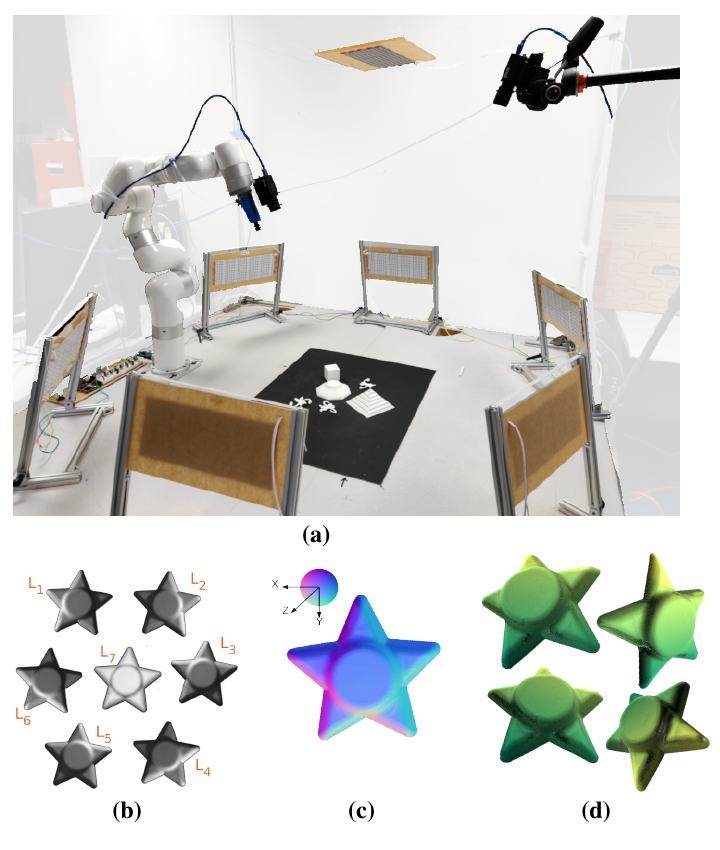
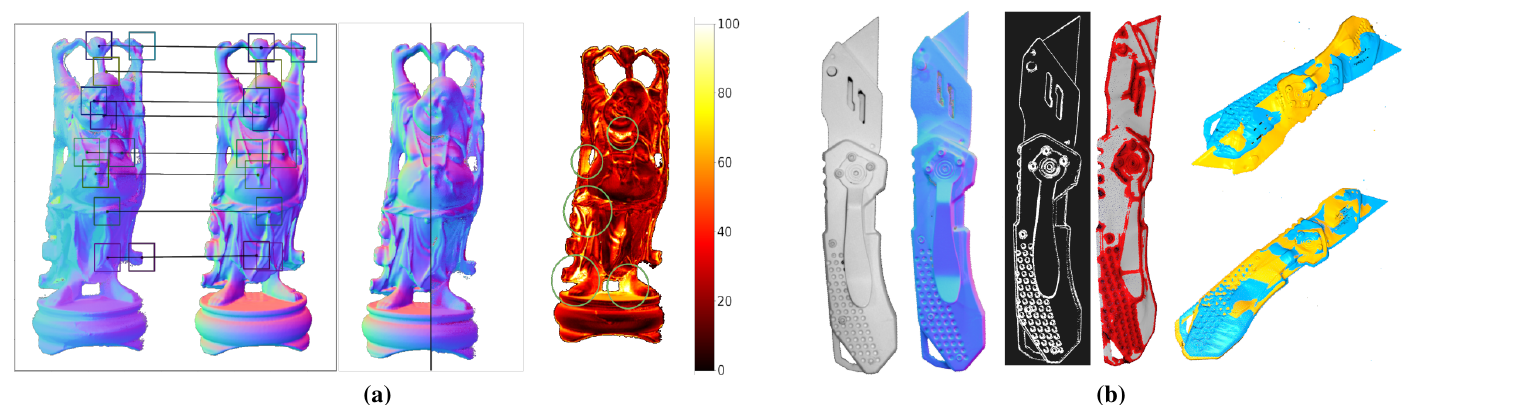
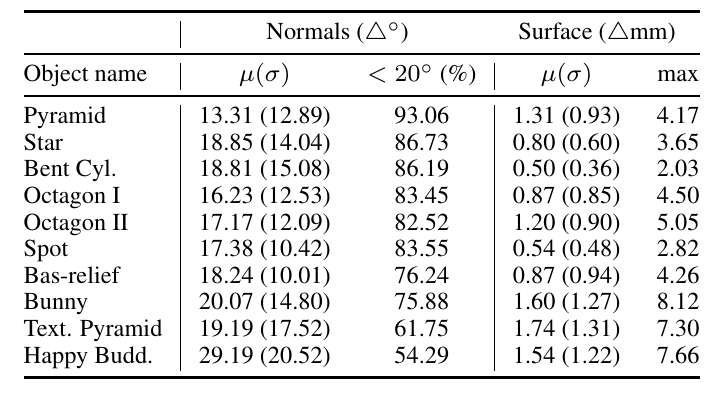
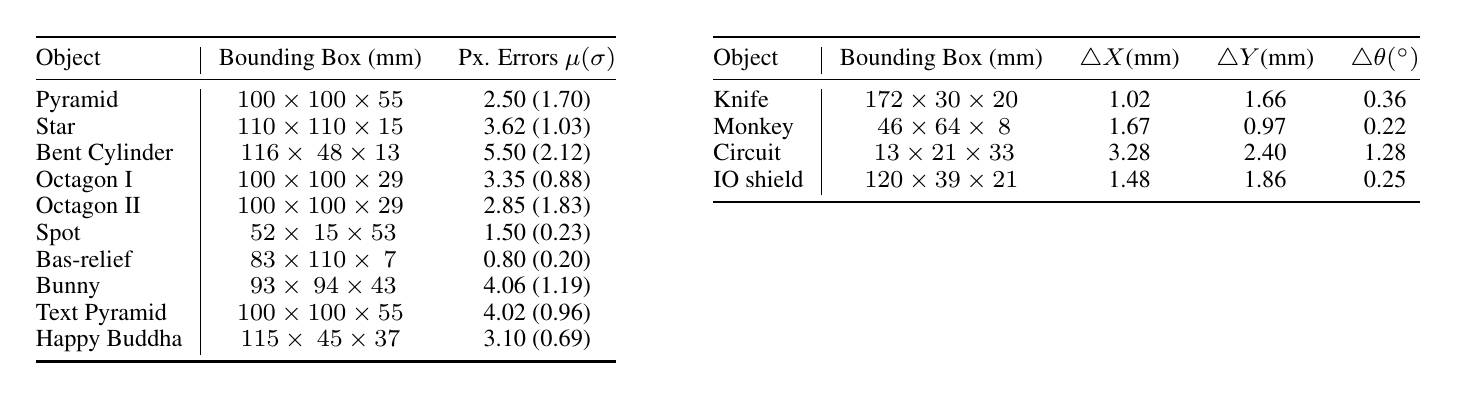
图表 对应模块 正确读法 Figure 1 硬件与表示 展示 2 cameras + 7 lights,以及 seven images→normals→surface;不是算法首页装饰,而是系统输入条件。 Table 2 sensing accuracy 法向误差 13.31°–29.19°,表面 mean error 0.50–1.74 mm;平均表面准不等于所有局部 normal 准。 Figure 5 pose / tracking pipeline 有 CAD 时比较 measured / rendered modalities;无 CAD 时积分两次 point clouds 做 registration。 Tables 4–5 pose evidence known-object 是 px error,unknown-object 是 planar mm / degree;两种指标不可合并成“统一 6D accuracy”。
原论文 Figure 1:C1 安装在机器人上、C2 固定观察工作区;桌边六个低入射角灯 L1:6 与顶部灯 L7 依次照明。子图 b 为七次观测,c 为 photometric-stereo normal map,d 为从 normals 导出的 surface representation。来源:CVF Open Access 。图片版权归论文作者及出版方所有,本站仅作论文解读展示。
3. 问题设定与任务边界
3.1 主问题不是单一 pose benchmark
论文研究:受控照明能否以低计算成本,为桌面机器人提供足够精细的 surface normals 与 depth discontinuities,并服务多个 manipulation tasks?
实验层次为:
sensing quality:与 commercial depth sensors 比较 surface normals;
metric accuracy:对 3D printed known meshes 测 normal / integrated surface error;
grasping:3D arbitrary surfaces 与薄 flat objects;
deformation:PVC card buckling;
pose:known-object CAD alignment;
tracking:unknown-object relative point-cloud registration;
generic-material extension:PIE-Net intrinsic decomposition + DiLiGenT。
所以将它单独写成“6D pose estimator”会遗漏论文主体,也会夸大其评价协议。
3.2 硬件与采集输入
组件 作用 关键条件 Camera C1 机器人携带的 machine-vision camera camera pose / intrinsics 受控 Camera C2 固定第二视角 与 C1 标定,用于 triangulation / frontal views Lights L1:6 六个桌边低入射角方向光 近似平行、方向已标定;突出 shading / occlusion edges Light L7 overhead light 提供常规外观 / 辅助定位 Matte-white surface 统一 albedo、接近 Lambertian 必要时喷 Rust-Oleum flat white paint Static scene 依次采多张不同照明图 采集期间不能有明显物体 / 相机运动
3.3 输出
每像素 surface normal n k n_k n k
shadow / occlusion / depth edge pixels;
可选 integrated depth map / point cloud;
grasp location 与 approach normal;
deforming known mesh parameters;
known-object model alignment;
unknown-object relative planar translation / rotation。
3.4 模型与可见性依赖
known-object pose / deformation 需要 3D model / initial mesh;
unknown-object tracking 不需 CAD,但要求同一对象在两次观测中有足够重叠表面;
论文明确说 integrated representation 对不可见部分不 metrically correct;
deformation comparison 假设对象近乎完全可见;
skewed views 降低跨相机有效共同 pixels,作者因此通常使用 frontal C1 / C2 views。
4. 研究脉络
4.1 从 passive perception 到 active illumination
传统 RGB-D 系统把照明当环境条件,本文把它当可控 action。主动感知可控制:
environment:illumination;
extrinsics:camera position / pose;
intrinsics:gain / focal length 等。
本文主要控制第一项,也结合固定 / robot-mounted cameras。其思想不是“用神经网络补偿传感器”,而是先改变成像物理,让需要的几何信号在 pixels 中更强。
4.2 与 photometric stereo 的关系
经典 photometric stereo 在相机固定、illumination direction 改变时,从强度变化恢复 surface normal。论文没有宣称新的通用 shape-from-shading theory,而是:
将 classical linear / quadratic illumination model 标定到 robot-workspace scale;
用六个低角度光突出局部 surface 与 depth discontinuity;
显式处理 shadows;
把 normals / edges 接到 manipulation 与 pose pipelines;
对商用 depth sensors 做近场 normal quality 对比。
4.3 与学习式 6D pose 的区别
维度 本文 常见 RGB / RGB-D pose network 数据 同一场景七次主动照明 单帧或视频自然观测 核心特征 calibrated photometric normals + edges learned RGB / depth features 对象外观 主实验喷白、Lambertian 尝试适应自然纹理 / 材质 known pose analysis-by-synthesis optimization direct / keypoint / correspondence + solver unknown pose 两时刻局部 surface registration novel-object reference matching / reconstruction 评价 pixels,或 planar x / y / θ x/y/\theta x / y / θ ADD(-S)、BOP AR、R/t error
这意味着它更接近“主动几何传感 + 经典对齐”而非可替换 FoundationPose / MegaPose 的通用 baseline。
5. 研究动机
5.1 小、薄、弱纹理物体的 RGB-D 困境
对 tabletop-scale objects:
stereo 需要纹理 / 投影 pattern;
ToF / structured-light 的空间分辨率和边缘噪声可能掩盖毫米级结构;
depth 经过 temporal / spatial smoothing 后,局部 curvature 与 sharp edge 被削弱;
3.15 mm 厚的 disc 可能无法被商用 depth sensors 稳定检测。
5.2 低入射角照明为什么有用
高频 surface discontinuity 产生明显小阴影;
depth boundary 产生方向相关 occlusion shadow;
低频曲率改变 shading gradient;
多方向照明可把一个方向不可见的边缘在另一个方向突出。
与提高 RGB spatial resolution 相比,主动 illumination 增强的是几何 signal-to-noise ratio。
5.3 为什么限制到 matte white
观测 intensity 同时由 geometry、reflectance、illumination 决定。若颜色 / specularity 都未知,从七幅图中稳定解 normal 更难。作者通过喷白、matte coating 把 reflectance 近似固定,让问题退化为 calibrated illumination 下的几何反演。
这是实验成功的关键,也是泛化限制的来源。
6. 方法详解(一):表面法向与深度边缘
6.1 Linear Lambertian model
对第 k k k i i i
I i k = ρ π ⟨ n k , l i ⟩ , i ∈ { 1 , … , 6 } . I_i^k=\frac{\rho}{\pi}\langle \mathbf n_k,\mathbf l_i\rangle,
\qquad i\in\{1,\ldots,6\}. I i k = π ρ ⟨ n k , l i ⟩ , i ∈ { 1 , … , 6 } . 其中:
I i k I_i^k I i k ρ \rho ρ n k \mathbf n_k n k l i \mathbf l_i l i
6.2 Quadratic illumination model
为描述 ambient / nonideal illumination,论文还使用二阶 spherical harmonics:
I i k = n k T M i n k . I_i^k=\mathbf n_k^T\mathbf M_i\mathbf n_k. I i k = n k T M i n k . M i \mathbf M_i M i
6.3 Shadow 与 depth discontinuity
低入射角灯在突起 / 物体边缘形成明显 dark–bright transitions。系统利用多个方向下的 brightness changes 区分:
color texture edge:在不同 lights 下位置 / 响应不同;
geometric occlusion edge:沿对应 light direction 出现稳定 shadow cue。
薄 disc 实验中,普通 overhead appearance 的视觉纹理无法把 object 与 table 分开,但沿 low-angle direction 的 shadow 足以找到 edge,再跨 C1 / C2 拟合 minimum enclosing circle 并 triangulate center。
6.4 Normal integration
需要 3D representation 时,把 normal field 空间积分成 depth map / point cloud,并结合 camera intrinsics 恢复尺度。问题是 normal integration 会累计误差,且单视角不可见部分没有真实 metric geometry;论文后面发现把该 point cloud 再 meshing、然后当 CAD 做 known-object pipeline,反而比直接注册两次 point clouds 更差。
7. 方法详解(二):已知对象 pose
7.1 Pipeline
对真实 object capture 估计 normal map N R N_R N R M R M_R M R
从 3D model 渲染候选 pose 下的 normals N S N_S N S M S M_S M S
在 measured / simulated normal maps 中发现 local patch correspondences,产生 initial pose proposals;
多尺度优化 pose;
联合 normal mismatch、edge mismatch、silhouette mismatch 形成 multimodal cost;
保留 / 收敛到与 observed data 最一致的 pose。
原论文 Figure 5:Figure 5a 的方框连线为 measured / rendered normal patches 的 correspondences,中间叠加 $N_R/N_S$,右侧显示 pixel-wise pose cost;Figure 5b 依次展示无模型 knife 的原图、normal、depth edges、integrated surface features 以及初始 / 最终 registration。来源:CVF Open Access 。图片版权归论文作者及出版方所有,本站仅作论文解读展示。
7.2 为什么多模态 cost 能容错
Happy Buddha 示例中约 50% pixels 的 measured normal error 超过 20°,under-cut regions 局部 cost 很高;但 object boundary 与其他 visible patches 仍提供正确约束。normal、depth edge、silhouette 互补:
normals 约束局部 orientation;
silhouette 约束整体 scale / image alignment;
depth edges 约束 discontinuities;
patch correspondences 帮助避开纯局部 optimization 的坏初始化。
作者称十个对象均在 5.5 px 以内收敛,但该结论基于其受控工作区和 image-space overlay metric。
7.3 Evaluation protocol
C1 视野:227 mm × 129 mm;
resolution:约 7 pixels/mm;
每个对象随机 position / orientation;
alignment 后叠加 simulated / measured data;
人工测量 object edges 周围的 pixel misalignment;
每对象重复 5 次;
报告 mean / standard deviation。
它不是用 mocap / calibrated turntable 得到 GT R , t R,t R , t
8. 方法详解(三):无模型相对 tracking
8.1 问题重新定义
没有 CAD 时,单次观测的经典 absolute pose 没有 canonical object frame,因此问题本身 ill-posed。论文改为:给同一对象的两次观测,估计 pose change。
8.2 Pipeline
两个时刻分别获取多光照 images;
估计 normals 与 depth edges;
结合 intrinsics 积分为 viewpoint-dependent point cloud;
提取 salient point features;
对两次 point clouds 做 rigid registration;
恢复相对 Δ X , Δ Y , Δ θ \Delta X,\Delta Y,\Delta\theta Δ X , Δ Y , Δ θ
8.3 为什么不是任意 6DoF tracking
Table 5 只有三个误差列:
Δ X \Delta X Δ X Δ Y \Delta Y Δ Y Δ θ \Delta\theta Δ θ
没有 Δ Z \Delta Z Δ Z relative planar tracking 。Figure 5b 的点云注册形式理论上可扩展到 6DoF,但论文证据没有证明六个自由度都达到这些数值。
8.4 View-dependent geometry
作者明确说 integrated surface 对相机看不到的部分不 metrically correct,例如 knife belt clip 的完整侧面。两次观测有足够 overlap 时,relative surface depth 与 overall scale 尚可支持 registration;novel views / 大转角则会破坏这一条件。
9. 表面感知实验
9.1 与 commercial depth sensors 的比较
比较对象 / 条件:
flat 与 textured surface;
正对 optical axis 与 45° inclination;
D455、D405、D435 stereo;
L515、Kinect II ToF;
Ours photometric stereo。
对 depth sensors:
stereo sensors:每 pixel 50 frames,删去最小 / 最大各 10% 后 trimmed mean;采集 1.5–2 s;
textureless surface 按厂商建议投 visible / infrared patterns;
ToF:3×3 median filter + temporal trimmed mean;
从 depth spatial derivatives 计算 normals。
Table 1 normal-distribution dissimilarity(lower better):
Sensor Flat 0° Flat 45° Texture 0° Texture 45° D455 0.12 0.12 0.27 0.12 D405 0.09 0.04 0.21 0.15 D435 0.09 0.23 0.22 0.22 L515 0.06 0.05 0.20 0.15 Kinect II 0.24 0.14 0.19 0.16 Ours 0.02 0.01 0.18 0.10
公平性边界 :论文主动方法有专用近场工作区、对象材质先验和多次采集;大部分 commercial sensors 面向 room-scale。结果证明“在该近场任务条件下主动光照 normal 更好”,不应写成所有场景全面优于这些深度相机。
9.2 Printed-object metric accuracy
原论文 Table 2:normal 列给 per-pixel angular deviation 的 mean(std) 及误差小于 20° 的比例;surface 列给 integrated surface 到 GT mesh 的 mm error。复杂 Happy Buddha 的 mean normal error 29.19°,只有 54.29% pixels 小于 20°,但 mean surface error 仍为 1.54 mm,体现全局积分 / 对齐与局部法向误差并不等价。来源:CVF Open Access 。图片版权归论文作者及出版方所有,本站仅作论文解读展示。
Object Normal mean(std) Pixels <20° Surface mean(std) Surface max Pyramid 13.31° (12.89°) 93.06% 1.31 (0.93) mm 4.17 mm Star 18.85° (14.04°) 86.73% 0.80 (0.60) mm 3.65 mm Bent Cylinder 18.81° (15.08°) 86.19% 0.50 (0.36) mm 2.03 mm Octagon I 16.23° (12.53°) 83.45% 0.87 (0.85) mm 4.50 mm Octagon II 17.17° (12.09°) 82.52% 1.20 (0.90) mm 5.05 mm Spot 17.38° (10.42°) 83.55% 0.54 (0.48) mm 2.82 mm Bas-relief 18.24° (10.01°) 76.24% 0.87 (0.94) mm 4.26 mm Bunny 20.07° (14.80°) 75.88% 1.60 (1.27) mm 8.12 mm Textured Pyramid 19.19° (17.52°) 61.75% 1.74 (1.31) mm 7.30 mm Happy Buddha 29.19° (20.52°) 54.29% 1.54 (1.22) mm 7.66 mm
结果表明复杂 under-cuts、self-shadow 和 texture 会显著恶化 local normals。pose pipeline 需要依赖 robust multi-patch / multimodal fitting,而不能把每个 normal pixel 都当高精度观测。
10.1 吸盘抓取
对普通 3D objects:
寻找可容纳 suction cup 的 locally flat surface;
排除 occlusion edges;
C1 / C2 triangulate world point;
local average normal 决定 gripper orientation;
minimum-jerk trajectory 接近并抓取。
对薄 flat objects:
用 low-angle shadow 找 object edge;
跨两个视角拟合 minimum enclosing circle;
triangulate center;
沿 tabletop normal 接近。
实验:
35 次 3D object grasps;
10 次 flat textured objects(disc 5 次、irregular octagon 5 次);
总计四次失败,均为 textured pyramid;
原因:gripper attachment failure 或 triangulation error 引起碰撞;
3.15 mm 厚 disc 未被所比较 commercial depth sensors 可靠检测。
由总数推得 41/45 成功,但论文正文没有把它包装成标准 grasp success rate,也没有与其他 grasp pipelines 做统计对比。
card:0.76 mm thick,86×54 mm;
任务:通过 surface-normal change 估计 vertical-load buckling;
analysis-by-synthesis:变形 mesh 解释 observed normal changes;
theoretical curve:slope 1.78、offset 0.114、R 2 = 0.975 R^2=0.975 R 2 = 0.975
repeatability:5 cards、不同 C1 / C2 positions、23 points;slope 1.9、offset 0.055、R 2 = 0.966 R^2=0.966 R 2 = 0.966
论文强调:只有 vision,没有 force/torque input;与相关 work 比较时,本方法要求两视角近乎完整 visibility。由于 direct normal integration 强 view dependence,作者发现用 initial mesh 做 analysis-by-synthesis 比直接重建变形表面更可靠。
11. Pose / tracking 定量结果
原论文 Table 4(左)与 Table 5(右)。Table 4 是五次实验的边缘 pixel misalignment mean(std),不是 GT $R/t$ error;Table 5 是六次已知 perturbations 下的 planar translation / rotation errors。本站将两张原表裁切并排,未重绘或修改数据。来源:CVF Open Access 。图片版权归论文作者及出版方所有,本站仅作论文解读展示。
11.1 Known-object edge alignment
Object Bounding box Pixel error mean(std) Pyramid 100×100×55 mm 2.50 (1.70) px Star 110×110×15 mm 3.62 (1.03) px Bent Cylinder 116×48×13 mm 5.50 (2.12) px Octagon I 100×100×29 mm 3.35 (0.88) px Octagon II 100×100×29 mm 2.85 (1.83) px Spot 52×15×53 mm 1.50 (0.23) px Bas-relief 83×110×7 mm 0.80 (0.20) px Bunny 93×94×43 mm 4.06 (1.19) px Textured Pyramid 100×100×55 mm 4.02 (0.96) px Happy Buddha 115×45×37 mm 3.10 (0.69) px
虽然 resolution 约 7 px/mm,可把 0.8–5.5 px 粗略理解为边缘层面约 0.11–0.79 mm 的 image projection mismatch,但这不是 object-frame translation error:projection error 同时受 depth、rotation、translation、intrinsics 和 edge selection 影响,不能直接除以 7 后声称 6D translation accuracy。
11.2 Unknown-object planar tracking
Object Bounding box Δ X \Delta X Δ X Δ Y \Delta Y Δ Y Δ θ \Delta\theta Δ θ Knife 172×30×20 mm 1.02 mm 1.66 mm 0.36° Monkey 46×64×8 mm 1.67 mm 0.97 mm 0.22° Circuit 13×21×33 mm 3.28 mm 2.40 mm 1.28° IO shield 120×39×21 mm 1.48 mm 1.86 mm 0.25°
正文把总体 uncertainty 近似概括为约 4 mm translation 与 2° planar rotation,比表内 maxima 更保守。四个对象每个重复六次,但表格没有 std / confidence interval,也没有大旋转、低 overlap、depth change 与遮挡分组。
12. Generic-object 扩展
主系统依赖 matte-white Lambertian objects。论文尝试:
用 pretrained PIE-Net 做 intrinsic image decomposition;
把自然 RGB 分成 reflectance 与 shading;
在 shading images 上用 global linear photometric stereo;
在 DiLiGenT 的 95 lighting conditions 中选 30–40 directions;
输入分辨率 256²。
定性结果:
bear、buddha 较好;glossy、dark、self-occluding harvest 明显失败;
没有显式处理 shadows / specularities;
作者明确承认离主机器人 setup 的 metric quality 很远。
这部分证明“路线可能扩展”,不是已经解除材质先验。
13. 鲁棒性与失败案例
13.1 Shadow ambiguity
低角度光既产生有用 depth-edge shadows,也会让 local normal inversion 失败。论文在 complex edges / under-cuts 附近看到 >20° local errors,并推测 lights 未与 camera co-located 是原因之一。
13.2 Specularity / color texture
主实验通过喷白消除;
textured surface 的 normal sensor comparison 优势缩小;
generic extension 中 glossy dark harvest 失败。
因此不能声称方法天然适合反光、透明或彩色物体。
13.3 Occlusion / visibility
deformation 需要两视角近乎完整 visibility;
integrated 3D 对不可见 parts metric 不正确;
unknown registration 依赖跨时刻 surface overlap;
skewed camera views 减少共同 pixels,显著降低 deformation performance。
13.4 Motion
七张不同 lights 的图是顺序采集。如果对象 / 机械臂在 sequence 内移动,intensity variation 会同时包含 motion 与 illumination,经典 photometric stereo 假设破坏。论文未给动态采集 FPS 或运动补偿。
13.5 Grasp failures
四次 textured-pyramid failures 来自:
suction cup 未稳定附着;
triangulation error 导致 gripper collision。
这说明高质量 normal / edge 不自动保证 end-effector mechanics 与 calibration 全链条成功。
13.6 Representation failure
作者尝试把 unknown-object integrated point cloud meshing 后送入 known-object pipeline,结果更差:normal estimation→integration→meshing 的误差层层累积,且 view-dependent mesh 在 novel views 下 metric 不正确。这是论文中很有价值的 negative result。
14. 贡献是否被实验支撑
作者声称 证据 充分程度 我的判断 受控照明获得高质量 normals / edges Table 1、2,Figure 2 较充分 近场受控对象上有效;复杂对象 local normal errors 仍高 比 commercial depth sensors 更好 Table 1 部分充分 特定 near-field normal metric 上最好;传感器设计距离 / 条件不同 支持通用吸盘抓取 45 trials、4 failures 部分充分 有真实 robot evidence;对象集小、无 baseline / confidence interval 能测已知对象形变 Figure 4、Table 3、R 2 R^2 R 2 较充分 能复现 buckling trend;需要 mesh 与 full visibility 能估计 known-object pose Figure 5a、Table 4 部分充分 overlay errors 小,但缺 GT R / t R/t R / t 能 track unknown objects Figure 5b、Table 5 部分充分 四对象 planar perturbation 有效;未验证 full 6DoF / large viewpoint change 可扩展到 generic materials Figure 6 不充分 仅定性 proof-of-concept,glossy dark object 失败且需 30–40 lights
15. 批判性分析
15.1 优点
物理层解决问题 :通过 illumination design 改善 observability,而非全靠学习 prior。完整系统证据 :从 calibration / sensing 到 robot grasp / pose / deformation,体现工程可落地链条。保留负面结果 :复杂 normals、skewed views、meshing degradation、glossy harvest failures 都被明确讨论。多种几何信号融合 :normals、silhouette、depth edges 对 pose 互补,能容忍局部异常。对小薄物体有独特价值 :这是一般 room-scale RGB-D 设备不一定优化的工作区。
15.2 缺点
材质先验过强 :喷白对象限制真实生产 / 家庭场景。动态能力弱 :多光照顺序采集要求静态场景。硬件复杂度高 :七灯、两相机、工作区级标定与遮光条件。Pose protocol 不标准 :known-object 没有 R / t R/t R / t 比较不对齐 :commercial sensors 的适用距离与 active system 不同。算法细节分散在 supplement :正文重结果、轻实现,复现依赖额外材料。对象与 trials 数有限 :没有统计显著性、跨天标定漂移或长期稳定性。
15.3 隐含假设
albedo uniform 且 Lambertian;
lighting direction / intensity stable;
ambient illumination 可被模型吸收;
object 与 camera 在 illumination sequence 内不动;
camera / light calibration 精确;
物体有足够 visible surface overlap;
integration error 不会破坏 local registration;
image edge misalignment 能代表 downstream pose usefulness。
15.4 真实应用可行性
最适合:
固定工作站;
小型 opaque objects;
可喷涂 / 可控制材质的制造、检测或实验环境;
允许对象暂时静止;
需要 fine surface normal、薄件 detection 或 suction orientation。
不适合直接部署:
高速 conveyor / moving objects;
透明、镜面、深色自然物体;
户外变化 illumination;
狭窄空间无法布置灯阵列;
需要一次曝光即时 full-6D pose;
不能改变对象外观 / 工作区的应用。
16. 复现指南
16.1 硬件复现
搭建 rigid tabletop frame,固定六个近似均匀方位的 low-angle lights 与一个 overhead light。
标定 C1 / C2 intrinsics、extrinsics 和机器人 hand–eye transform。
为每个 light / color channel 标定线性向量 l i l_i l i M i M_i M i
测量 ambient light,并固定 exposure / gain / white balance。
使用 matte-white calibration objects 验证 normal inversion。
同步 light switching 与 cameras,确认 sequence 内无 motion。
16.2 Sensing 最小复现
依次点亮 L1:6,采集六张图;另采 overhead / ambient image。
检测 shadow / saturated pixels。
先用 linear model 初始化 normal,再用 quadratic model refinement。
对 normal field 做 integrability-aware integration,恢复 depth。
与 known plane / 3D printed mesh 对齐,报告 normal angular error 与 surface distance。
16.3 Known-object pose 最小复现
从 CAD 渲染 normal、silhouette、depth-edge pyramids。
计算 observed / rendered normal-patch descriptor。
建立候选 correspondences 和 pose initializations。
多尺度联合优化 normal / edge / silhouette cost。
除 pixel overlay 外,必须用 calibrated turntable 或 mocap 报告 rotation / translation error、ADD(-S) 或 BOP metrics。
16.4 Unknown tracking 最小复现
同一对象在两个已知 perturbations 下采集;
对两次 normal maps 使用同一 integration / scale;
feature matching + robust rigid registration;
分别扫描 overlap、rotation magnitude、out-of-plane motion、occlusion;
报 full S E ( 3 ) SE(3) S E ( 3 )
16.5 必须补报的工程指标
七张图总 acquisition time;
normal / edge / integration / pose optimization latency;
light switching rate;
calibration time 与跨日 drift;
ambient-light sensitivity;
texture / albedo / specularity sweep;
object motion tolerance;
power、工作区尺寸与遮挡风险。
17. 可改进方向
17.1 Multiplexed / coded illumination
与其七次逐灯采集,可设计 Hadamard-coded or frequency-coded lights:
减少曝光次数;
提高 SNR;
允许一定 object motion;
与 event camera / high-speed global shutter 结合;
同时估计 shadow confidence。
17.2 RGB-D fusion
作者也提出将 active illumination 与 commercial depth sensor 结合:
depth 提供 metric low-frequency shape;
photometric normals 提供 high-frequency local geometry;
edges 修复 depth discontinuities;
uncertainty-weighted fusion 避免 normal integration drift。
这可能比完全替代 depth sensor 更实用。
17.3 学习式反射 / 阴影建模
以 calibrated lights 合成大量 supervision;
网络预测 normal、albedo、specular component 与 shadow mask;
物理 loss 保持 integrability / photometric consistency;
在 colored / non-Lambertian objects 上做 uncertainty estimation;
对失败区域回退到 depth / tactile observation。
17.4 Pose-aware sensor planning
根据当前 pose hypotheses 主动选择下一盏灯 / camera viewpoint,使信息增益最大:
对称 ambiguity 下选能暴露非对称 patch 的方向;
遮挡时选择提高 visible surface overlap 的视角;
以 PnP / alignment covariance 作为 illumination policy reward;
减少固定七照明的冗余。
17.5 标准化 pose 评价
必须增加:
known-object GT R / t R/t R / t
ADD(-S)、MSSD / MSPD / VSD;
full-6D unknown relative pose;
large-rotation / low-overlap curves;
baseline:ICP、RGB-D registration、FoundationPose / classical model alignment;
end-to-end robot success 与 perception-only error 分离。
18. 对研究工作的启发
可直接借鉴的思想
先改 observability,再改 network :光照、视角、传感器参数都可作为 pose pipeline 的设计变量。局部 normal + global silhouette :细粒度与全局约束互补,适合 refinement。不要无条件 mesh 化 noisy observations :多次表示变换会累积误差,任务适配的 intermediate representation 更重要。评价指标必须匹配 claim :pixel overlay 支持 alignment quality,不足以证明 metric 6D pose accuracy。
active perception / active illumination;
photometric stereo for manipulation;
suction grasp surface-normal estimation;
analysis-by-synthesis known-object pose;
model-free relative object tracking;
small / thin object sensing。
可能形成自己的切入点
构建一个 uncertainty-aware RGB-D + coded-light pose refinement system:基础模型提供 object mask / coarse pose,主动光照只选择 2–3 个最大信息增益方向,网络联合预测 normal、shadow confidence 与 depth-edge correction,再用 symmetry-aware render-and-compare 输出 pose covariance,并在标准 BOP + robot grasp 协议上评价。
19. 待解决问题
概念问题
对相同 image-space edge error,不同 depth / object size 下的 3D pose uncertainty 如何变化?
low-angle shadow 何时是有用 depth edge,何时是破坏 normal inversion 的 outlier?
对 known object,normal-patch descriptor 是否对对称几何产生多模态 matches?
公式 / 实现问题
linear 与 quadratic inversion 的具体组合 / sequential solver;
shadow handling threshold 与 per-channel calibration;
normal integration 的 boundary conditions 和 scale recovery;
multimodal pose cost 的权重、pyramid levels 与 optimizer;
unknown point-cloud features 和 robust registration 细节。
实验问题
七次曝光总时间与动态物体容忍速度;
known-object full R / t R/t R / t
unknown-object out-of-plane translation / rotation;
ambient illumination 变化与长期 calibration drift;
不喷漆时不同 albedo / roughness / metallicity 的误差曲线;
C1 / C2 overlap 降低时的 tracking failure threshold。
复现问题
project code / hardware bill 是否完整公开;
lights 的型号、距离、角度与光强;
two-camera synchronization;
sprayed object CAD 与 ground-truth mesh alignment;
commercial sensor comparison 的 exact distance / FOV / resolution matching。
20. 最终判断
作者声称
机器人工作区尺度的 controlled illumination 能以低计算成本提供高质量 surface normals 与 depth discontinuities,比若干 commercial depth sensors 更适合小型桌面物体,并可支持吸盘抓取、形变测量、known-object pose 和 unknown-object tracking。
我的分析
论文对 受控 matte-Lambertian 小物体的 sensing 与 manipulation utility 给出了可信、多层次证据:表面 mean error 0.50–1.74 mm,十个 known objects 的 edge alignment 0.80–5.50 px,四个 unknown objects 的 planar tracking 表内误差不超过 3.28 mm / 2.40 mm / 1.28°,还有 45 次真实抓取和 PVC deformation 实验。
但 pose claim 必须收紧:known-object 表没有 GT R / t R/t R / t x / y / θ x/y/\theta x / y / θ 当被动视觉对细小几何不可观测时,主动设计照明与观测,再用物理可解释的 normals / edges 支撑 pose 和操作。