Reading Notes
粗读 / 精读
已生成 src/paper-notes/unified-detection-pose-iccv2025/coarse.md
论文粗读笔记
用于快速判断论文定位、问题设定、核心方法、实验结论和是否值得精读。
论文粗读笔记:Unified Category-Level Object Detection and Pose Estimation from RGB Images using 3D Prototypes
1. 基本信息
- 年份 / 会议:2025 / ICCV;阅读模式:粗读。
- 任务:RGB-only 类别级 multi-object detection、6D pose 与 9D pose refinement。
- 原文:ICCV Open Access。
2. 一句话定位
这项工作把 detector 与单物体 pose estimator 合成一个以 neural-mesh 3D prototypes 为中心的框架,用同一 2D–3D feature matching 同时找对象、估 pose、再估尺度形变。
2.1 论文图表导读
| 图表 | 看点 |
|---|---|
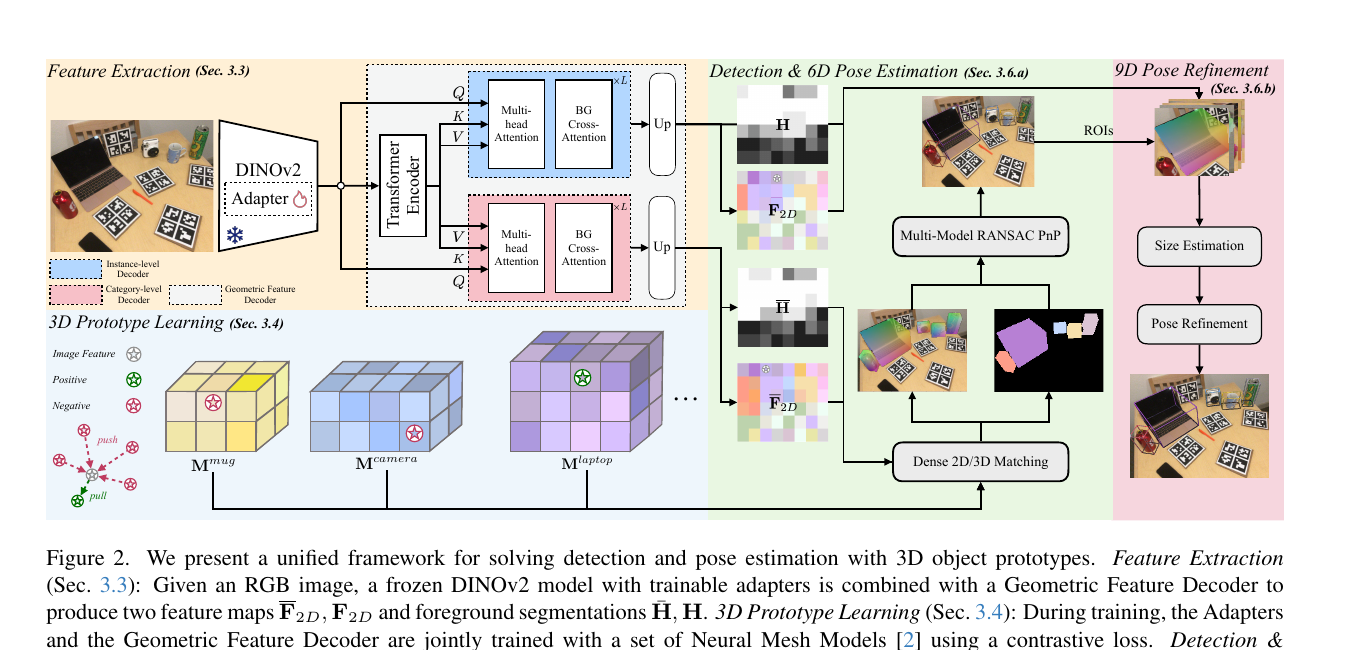
| Figure 2 | DINOv2 features、3D prototype learning、multi-model RANSAC 与 9D refinement 的统一结构。 |
3. 方法概览
- frozen DINOv2 配合可训练 adapter 与 geometric decoder,输出 instance-level / category-level feature maps 和前景信息。
- 每个类别以 neural mesh prototype 存储几何顶点与学习特征;dense 2D–3D matching 送入 multi-model RANSAC-PnP,同时发现多个对象及其 6D pose。
- 对每个实例再优化 deformation / scale,形成 9D pose。关键优势是 RGB-only,不必把 detector 的错误作为不可恢复前置条件。
4. 实验概览
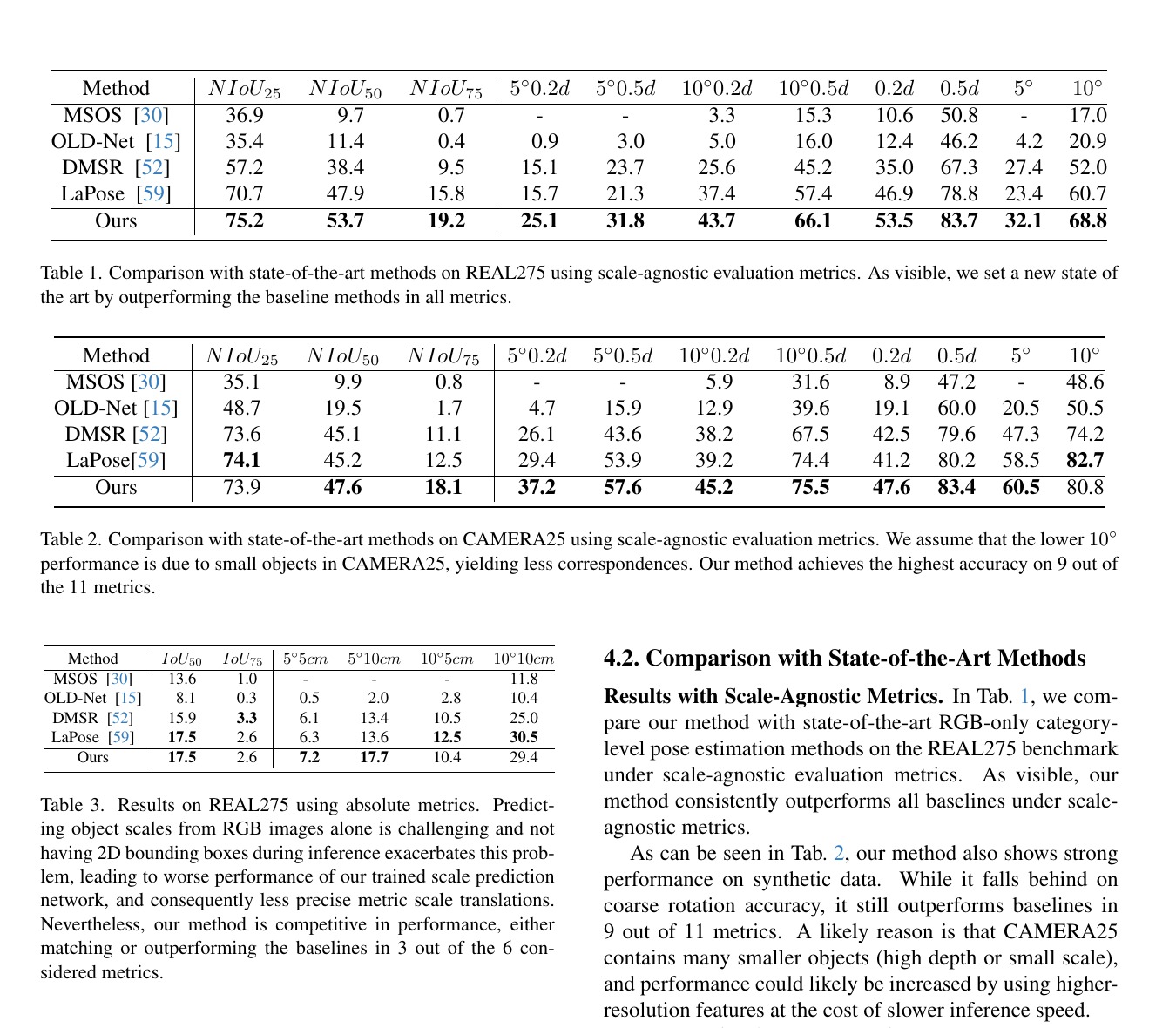
- 数据集:REAL275、CAMERA25;使用类别级 scale-agnostic 指标。
- 作者声称:REAL275 上平均 scale-agnostic 结果比此前 SOTA 高 22.9%,并比单阶段 baseline 更鲁棒。
- 我的分析:将 detection 和 pose 放进共享 3D representation 是强设计;不过 prototype 构建、内参需求、RANSAC 多实例复杂度和 9D refinement 成本都需结合代码评估。
5. 优缺点与启发
- 优点:从 RGB 直接做多物体类别级 pose,减少两模型串联的误差传播。
- 风险:不是 category-agnostic;仍要求预先定义类别 3D prototypes。
- 启发:类别级 pose 可以用“可匹配的 3D 原型”统一表达 detection、orientation 与 size,而非分别做多个 head。